


Asset Based Lending for Day Traders: 2026 Verdict

Asset based lending for day traders qualifies you on brokerage account balances and liquid assets instead of monthly trading profit, so a losing month or a lumpy 1099 does not sink your mortgage application the way it would at a conventional bank.
TL;DR
- Asset based lending for day traders qualifies you on liquid brokerage balances instead of monthly P&L, and LoanGuys.com structures these deals for real estate purchases.
- DSCR loans let a rental property's own cash flow carry the underwriting, skipping personal trading income entirely.
- Bank statement loans still average 12-24 months of deposits, which punishes a trader whose account swings month to month.
- FINRA's pattern day trader rule sets a $25,000 minimum equity floor — most asset-based lenders in 2026 want reserves well past that.
- Best for traders with six-figure-plus liquid accounts and thin tax returns; a small account won't move the needle on loan size.
Why asset based lending matters for day traders in 2026
Day trading income does not look like a paycheck. A trader can close out a strong year and still show a loss on Schedule D during the exact months an underwriter pulls, because gains and losses get marked trade by trade, not smoothed into a salary. Conventional mortgage underwriting averages two years of tax returns and calculates debt-to-income off that average — a structure built for W2 earners, not for someone whose P&L can flip from a strong quarter to a drawdown in a matter of weeks.
That mismatch is why day traders end up in bank statement loans for day traders and forex traders or true asset-based programs instead of a conventional 30-year fixed. Bank statement programs still average deposits over 12-24 months, so a volatile stretch drags the qualifying number down. Asset-based lending skips income averaging altogether: the lender looks at what sits in your account today, not what you earned last quarter.
How to qualify for asset based lending as a day trader
Pull every brokerage and bank statement you have
Start with documentation, not a lender application. Underwriters want to see the full account, not a curated snapshot.
- 12 consecutive months of consolidated brokerage statements, not just a year-end summary
- Margin account statements that separate cash balance from buying power
- Bank statements for the account your trading proceeds settle into
- Documentation of any outstanding margin loans or securities-backed lines of credit
- A letter from your broker confirming account ownership if the account sits inside an LLC
Calculate your usable asset base
Your account balance and your qualifying asset base are not the same number.
- Subtract any margin debt or leveraged open positions from total account value
- Count cash and marketable securities at full value; retirement accounts typically get discounted for early-withdrawal penalties
- Exclude funds you plan to use for the down payment — lenders want to see reserves survive closing separately
- Add joint accounts only if every account holder is on the loan
- Flag any recent large deposits now, because underwriting will ask you to source them later
Choose the loan structure that fits your income pattern
The manual path is applying with whatever conventional lender you already bank with and hoping two years of tax returns tell a flattering story. For most day traders it doesn't — Schedule D losses in a down year read as negative income even when the account balance grew. A faster path is asset-based lending built to qualify on a stock portfolio rather than tax-return income, which is the structure LoanGuys.com underwrites for traders and other volatile-income borrowers.
- Asset-based / asset-utilization: qualifies on account balance, ignores trading P&L
- DSCR: qualifies on the subject property's rent, ignores your personal income entirely
- Bank statement: qualifies on averaged deposits, still sensitive to a bad month
- Conventional: qualifies on tax-return income, the toughest fit for a trader
Document account ownership if you trade through an entity
- LLC operating agreement listing every member and ownership percentage
- Two years of K-1s if the trading entity files as a partnership
- EIN documentation and an entity resolution authorizing the borrower to close the loan
- A personal guarantee if the lender requires one against entity-held assets
- Bank and brokerage statements titled to match the entity name exactly
Pick a property type that fits the loan structure
- Single-family and small multifamily rentals qualify cleanly for DSCR pairing
- Short-term rentals need a lender comfortable underwriting projected nightly-rate income
- Condos and condotels sometimes trigger extra project review — confirm before going under contract
- Primary residences generally fall outside asset-based investment programs; confirm intended use upfront
Seeing the three structures side by side makes the trade-offs easier to hold in your head before you start calling lenders.
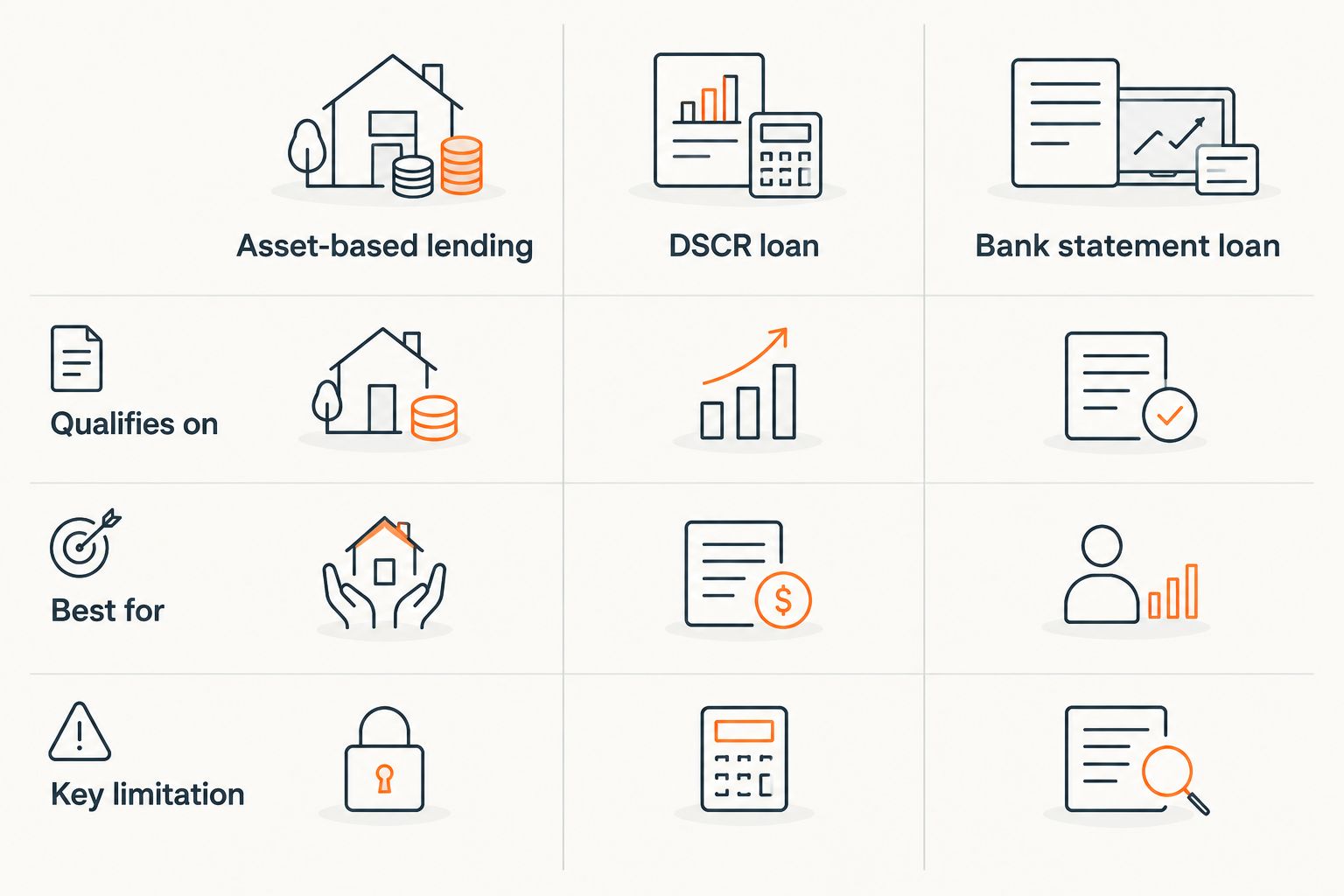
Asset-based lending is the only one of the three that ignores trading income entirely.
Compare lenders on reserve requirements and loan-to-value in 2026
Once you know which structure fits, the differences between lenders come down to how much they discount your assets and how many months of reserves they want left over after closing.
Loan options for day traders compared in 2026
Asset-based / asset-utilization loan
- Best for: Traders with six-figure-plus liquid brokerage balances and thin tax returns
- Key limitation: Ignores trading income entirely, so a small account limits loan size
DSCR loan
- Best for: Traders buying rental property who want the property's rent to carry underwriting
- Key limitation: Doesn't touch your trading assets at all — the rent has to work on its own
Bank statement loan
- Best for: Traders with steadier monthly deposits running through a registered business account
- Key limitation: Averages 12-24 months of deposits, so one bad month still drags the number down
Conventional mortgage
- Best for: W2 employees with stable, predictable pay
- Key limitation: Requires two years of tax returns and DTI math that penalizes trading losses
HELOC / home equity loan
- Best for: Traders who already own property and need to unlock equity for a down payment
- Key limitation: Often still underwritten on income, and adds a new lien to a home you already hold
Verdict: a day trader with a large, seasoned brokerage account and thin tax returns qualifies for more through asset-based lending than through any income-averaging program. Buy it if your account clears the reserve bar; wait if it doesn't yet.
Talk to an asset-based lending specialist
Get a read on what your brokerage balance qualifies for in 2026.
Build your reserve cushion before you apply
- Hold 6-12 months of PITIA in reserves beyond the funds used to qualify
- Avoid large withdrawals from the brokerage account in the 60 days before applying
- Keep margin utilization low going into underwriting — a heavily leveraged account reads as risk, not reserves
- Don't shuffle assets between accounts right before closing; let statements show a stable balance instead
Common mistakes day traders make with asset based lending
- Treating margin buying power as cash. Lenders subtract open margin balances before counting usable assets — buying power isn't reserves.
- Pulling a large lump sum right before applying. An unsourced deposit in the 60 days before underwriting triggers a paper trail request that can stall closing.
- Assuming a strong trading year erases seasoning requirements. Most programs still want the balance to sit in the account for a period before counting it in full.
- Closing in a personal name when the trading entity holds the funds. A mismatch between the account name and the borrower name creates a documentation gap underwriters flag immediately.
- Shopping only "bank statement loan" lenders. The term is more familiar, but a true asset-based or asset-utilization program fits volatile trading income better than deposit averaging does.
FAQ
What is asset based lending for day traders?
Asset based lending for day traders is a mortgage structure that qualifies the borrower on liquid brokerage or bank balances instead of monthly trading income. A lender verifies an account balance today rather than trying to average income that swings from month to month.
Is asset based lending better than a bank statement loan for a day trader?
For a trader with a large, stable account balance and thin tax returns, asset-based lending usually qualifies for more than a bank statement loan does. Bank statement programs still average 12-24 months of deposits, so a volatile trading month drags the qualifying number down.
How much do I need in my brokerage account to qualify?
There's no single published minimum, since it depends on the loan amount and the lender's reserve requirements, but asset-based programs are built for six-figure-plus liquid balances. A small account limits how much loan size the assets can support.
Can I use a margin account to qualify for asset based lending?
Yes, but lenders subtract any outstanding margin debt from the account's total value before counting it as usable assets. Buying power created by leverage isn't treated the same as cash.
Does asset based lending check two years of trading history?
Asset-based programs typically focus on current account balances and recent statements rather than a multi-year trading track record. That's the core difference from tax-return-based underwriting, which does require two years of returns.
Can day traders get a DSCR loan instead?
Yes. A DSCR loan qualifies on the rental property's own cash flow rather than the borrower's personal income, which sidesteps trading P&L entirely. It's a common pairing for traders who want to buy rental property without touching their brokerage assets.
What is the FINRA pattern day trader rule and does it affect financing?
FINRA's pattern day trader rule requires traders using margin to maintain at least $25,000 in equity in their brokerage account to keep trading actively. It's a trading regulation, not a mortgage rule, but most asset-based lenders in 2026 expect reserves well beyond that $25,000 floor.
Can crypto gains qualify the same way as a stock portfolio?
Some asset-based and asset-utilization lenders will count verified crypto holdings, though documentation requirements and how much of the balance counts vary by lender. Traders cashing out crypto gains for a purchase should ask about programs built for that specific situation.
One last thing
The FINRA pattern day trader rule sets a $25,000 equity floor just to keep trading — most asset-based mortgage programs in 2026 want reserves several multiples past that before they'll count your account toward a loan. If your trading balance sits right at that $25,000 line, you're a trader by regulation but not yet a qualifying asset base by underwriting. Build the account past that threshold before you start shopping lenders, not after.


