


Asset based lending for private equity investors: complete 2026 guide

Private equity investors’ asset-based lending is financing secured by identifiable assets with the aim of funding acquisitions, working capital, or property investments. This 2026 guide explains asset based lending for private equity investors, where collateral ownership, existing liens, and fund-level obligations make structuring more complex than simply borrowing against an asset’s value.
TL;DR
- Asset based lending for private equity investors starts with eligible collateral, not the fund’s headline valuation.
- Match receivables and inventory to corporate ABL; evaluate property-backed financing separately for real estate investments.
- Loanguys offers real estate investment loan programs, not an established corporate receivables-financing offering.
- Compare borrowing-base controls, collateral releases, guarantees, and repayment plans before choosing a financing structure.
Why asset-based lending matters for private equity investors
An acquisition can contain valuable assets without generating enough unrestricted cash to fund the next operating cycle. Asset-based lending, often shortened to ABL, connects financing to eligible collateral rather than relying exclusively on earnings or sponsor equity.
The distinction is control. A portfolio company owns its receivables, a property-holding entity owns its building, and a fund owns investment interests; those assets do not automatically support the same borrowing request. Existing debt agreements and organizational documents also determine what each entity can pledge.
Choose the borrowing entity and collateral pool before choosing the loan. For property-backed transactions, the asset-based lending guide for real estate investors addresses a different financing question from a revolving facility secured by operating-company receivables.
For your 2026 investment review, separate three objectives: financing the acquisition, funding operations after closing, and repaying the facility. A structure that solves only the first objective leaves the investment exposed later.
How to structure asset-based financing
Define the financing purpose
Start with a spreadsheet showing the transaction’s sources and uses. Separate the purchase consideration from working capital, property improvements, transaction expenses, and liquidity retained after closing. Do not assume one facility should fund everything.
For a buyout, ask whether the target needs recurring working capital or a fixed amount at closing. For a property investment, identify whether you are buying, renovating, holding, or refinancing. Those purposes require different repayment mechanics.
Document the decision in plain language before approaching providers. The financing request should explain what you need, who needs it, and what activity produces repayment.
- Name the legal entity requesting the financing.
- Separate acquisition funding from recurring operating needs.
- Identify which uses require cash at closing.
- Match the expected holding period to the proposed debt structure.
Map collateral ownership and existing claims
Build a collateral register manually from the balance sheet, asset schedules, title records, and existing loan documents. Record the owner, location, valuation basis, existing security interests, and restrictions for each material asset.
Corporate ABL commonly involves accounts receivable and inventory; equipment and real estate also support secured financing. However, an asset’s accounting value is not necessarily its eligible lending value. Receivable aging, customer disputes, inventory condition, and prior liens affect the analysis.
Fund interests require separate treatment. A limited partner’s fund interest is not direct ownership of the portfolio company’s machinery or rental property, and transfer restrictions matter.
- List each asset beside its actual legal owner.
- Obtain receivable aging and inventory reports where relevant.
- Identify prior liens and required payoff arrangements.
- Ask counsel to review pledge and transfer restrictions.
- Separate property collateral from operating-company collateral.
Match the provider to the collateral
Prepare a short transaction summary and send the same facts to prospective financing providers. Comparing responses becomes easier when each provider receives identical information about the borrower, collateral, intended use, and repayment source.
Corporate ABL providers evaluate operating assets and borrowing-base reporting. Mortgage brokers address property-backed financing. Subscription facilities and net asset value facilities address different fund-level collateral and repayment arrangements; they are not interchangeable with operating-company ABL.
Loanguys is best suited to real estate investors seeking property loan programs, rather than corporate receivables ABL. Its stated offerings include DSCR, fix-and-flip, bridge, bank-statement, and short-term rental loans. Discuss the property component through its loan services, without treating those programs as a substitute for corporate working-capital financing.
- Route receivables and inventory requests to corporate ABL providers.
- Route property acquisition and renovation requests to property-financing specialists.
- Explain sponsor ownership and entity relationships upfront.
- Confirm collateral and borrower eligibility before ordering reports.
Model borrowing capacity and downside liquidity
Build your own borrowing-capacity model before relying on a proposed facility amount. For a borrowing-base facility, the relevant calculation generally applies contractual advance rates to eligible collateral, then deducts applicable reserves and outstanding borrowings. The agreement defines the details.
Property financing uses different measures. Loan-to-value, or LTV, compares the loan balance with the applicable property value. Debt service coverage ratio, or DSCR, compares qualifying income with debt payments; confirm the lender’s calculation rather than importing assumptions from another program.
Use 3 repayment scenarios in your 2026 model: the operating plan, slower collections or leasing, and a delayed exit. These are planning cases, not lender-required thresholds.
- Obtain written definitions of eligible collateral and reserves.
- Model cash needs when receivables age or inventory becomes ineligible.
- Keep property valuation assumptions separate from business valuations.
- Include operating expenses and required debt payments.
- Identify the equity contribution needed in each downside case.
Negotiate controls before accepting terms
Read the reporting and collateral-control provisions alongside the funding terms. An ABL facility can impose borrowing-base certificates, financial reporting, examinations, collection controls, and limits on distributions or additional debt. The agreement determines which obligations apply.
The sponsor’s practical question is whether those controls fit the investment plan. A lender’s consent right over asset sales can affect a portfolio-company disposal, while a property release provision can affect a planned sale from a real estate portfolio.
Assign 1 reporting owner internally, supported by finance and legal teams. Accountability reduces the risk that a required certificate or consent falls between the sponsor and the portfolio company.
- Request a calendar of reporting and certification obligations.
- Review guarantees, recourse, and default provisions with counsel.
- Check restrictions on distributions and additional borrowing.
- Negotiate asset-sale and collateral-release procedures.
- Confirm how collections move through controlled accounts.
Test the repayment plan before closing
Build a repayment schedule from operating cash flow, asset sales, or refinancing assumptions. Identify which proceeds legally belong to the borrower and which require distributions, approvals, or releases before reaching the debt.
For your 2026 closing memo, document 2 exit routes: the intended repayment source and a fallback. A fallback is not merely the same refinancing assumption with a different lender’s name. It needs its own financial logic and execution requirements.
An ABL structure can support recurring working capital, but borrowing capacity can contract when eligible assets decline. Property-backed bridge financing creates a different question: whether the property can qualify for its planned refinance or sale before repayment falls due.
- Identify the primary repayment source and its dependencies.
- Document a fallback that does not repeat the same assumptions.
- Check collateral-release requirements before scheduling disposals.
- Stress-test refinancing against lower income or valuation.
- Assign responsibility for each condition needed to exit.
Reconcile valuation with lender eligibility
Use a valuation bridge to explain why purchase value, book value, and lending value differ. Start with the acquisition model, then show the assets the proposed lender accepts and the deductions the financing agreement applies. Keep enterprise value outside that calculation unless the facility expressly uses it.
A business valuation supports investment and transaction decisions; a borrowing base establishes contractual borrowing capacity. Applying business valuation principles helps distinguish the value of the operating business from the assets and cash flows supporting a particular financing request.
For a mixed operating-business and property acquisition, reconcile the property appraisal, business valuation, and purchase allocation. Otherwise, you risk counting the same economic value twice in your financing model.
- Label enterprise value, book value, and eligible collateral separately.
- Reconcile valuation dates and supporting financial periods.
- Identify exclusions instead of treating them as unexplained deductions.
- Ask advisers to resolve overlapping business and property values.
The sequence matters: establish the purpose, identify the assets, select the financing route, then test capacity, controls, repayment, and valuation together.
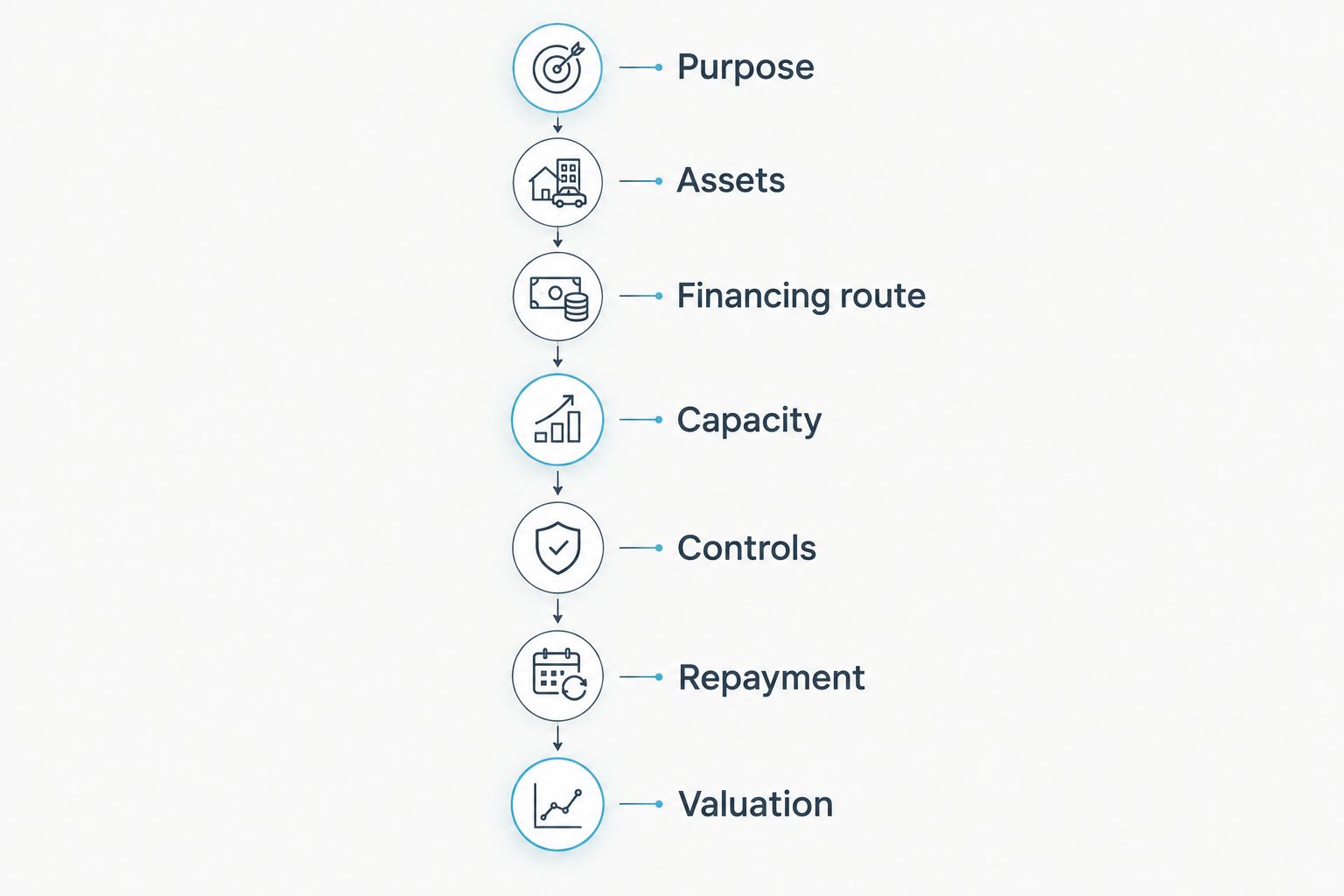
Choose the financing route only after identifying the borrowing purpose and assets.
Compare financing options for the transaction
The best option follows the collateral and repayment source, not the sponsor’s label. Use this comparison to route your 2026 request; actual eligibility and contractual requirements require a transaction-specific review.
Corporate ABL revolver
- Best for: Portfolio companies with eligible receivables or inventory
- Main advantage: Links borrowing capacity to an operating asset pool
- Key limitation: Eligibility deductions, reserves, and reporting affect usable capacity
Equipment-backed financing
- Best for: Businesses financing identifiable machinery or equipment
- Main advantage: Connects financing to specific productive assets
- Key limitation: Asset condition, valuation, and existing liens constrain the structure
Property-backed bridge loan
- Best for: Real estate acquisitions or transitional properties with a defined exit
- Main advantage: Addresses a property’s temporary financing need
- Key limitation: Repayment depends on executing the sale or refinancing plan
DSCR rental loan
- Best for: Rental investors evaluating financing around property income
- Main advantage: Focuses the financing analysis on rental debt coverage
- Key limitation: Income calculations and property eligibility differ by program
Subscription facility
- Best for: Funds borrowing against eligible investor commitments
- Main advantage: Addresses a fund-level timing need
- Key limitation: Depends on fund documents, investor eligibility, and commitment-related rights
NAV facility
- Best for: Funds seeking financing supported by portfolio investment value
- Main advantage: Addresses financing at the portfolio or fund level
- Key limitation: Valuation, concentration, and distribution controls require separate analysis
Loanguys’ property loan programs belong in the real estate portion of this comparison. The advantage is access to several stated property-financing categories through a mortgage broker; the limitation is that those offerings do not establish a corporate ABL or fund-finance capability.
Do not confuse bank-statement qualification with collateral-based corporate lending. Bank statements document income or cash flow for underwriting; their use does not turn a mortgage into a receivables-backed revolving facility.
Common mistakes private equity investors make
Treating enterprise value as pledgeable collateral
A purchase multiple does not establish eligible assets. Goodwill, projected synergies, and expected earnings improvements do not automatically enter a borrowing base. Reconcile the acquisition model with the lender’s collateral definitions before committing sponsor equity.
Assuming sponsor ownership solves entity restrictions
Owning a company does not erase its existing loan covenants or authorize every asset pledge. Confirm borrower authority, required consents, and lien priority before relying on financing proceeds in the closing funds flow.
Counting the headline facility amount as usable cash
A commitment and current borrowing capacity are different figures. Reserves, eligibility exclusions, and existing draws affect how much the borrower can actually draw. Build the closing and operating models from the contractual calculation.
Using short-term property debt without a tested exit
A renovation budget alone is not a repayment plan. The refinance must work with the expected completed property, income, ownership structure, and documentation. Loanguys offers bridge and DSCR programs, but that does not guarantee a bridge-to-DSCR refinance for a specific transaction.
Letting reporting obligations follow the wrong team
The sponsor negotiates the facility, but the portfolio company often produces the underlying reports. Assign ownership before closing and confirm that accounting systems can produce the required information. Reporting requirements are operating responsibilities, not just legal clauses.
FAQ
What is asset based lending for private equity investors?
Asset based lending for private equity investors is financing secured by eligible assets to support acquisitions, operations, or property investments. The borrower, collateral owner, existing liens, and repayment source determine the appropriate structure.
Is asset-based lending the same as a NAV loan?
No. Corporate ABL generally relies on eligible operating assets such as receivables and inventory, while a NAV facility relies on portfolio investment value and related rights. The borrower and collateral arrangements differ.
Can a private equity investor borrow against a portfolio company’s assets?
A portfolio company can seek financing secured by its assets, subject to lender underwriting and legal authority. Sponsor ownership alone does not override existing liens, debt covenants, or required approvals.
Does asset-based lending mean there is no cash-flow review?
No. Collateral supports the financing, but lenders also evaluate repayment and the borrower’s ability to meet contractual obligations. Asset-based lending is not a synonym for no underwriting or no documentation.
What documents should a sponsor prepare for an ABL request?
Prepare borrower organizational documents, financial statements, existing debt documents, and schedules supporting the proposed collateral. Receivable aging, inventory reports, appraisals, or property records depend on the assets involved.
When is a DSCR loan more relevant than corporate ABL?
A DSCR loan is more relevant when the financing concerns a rental property and qualifying rental income supports debt repayment. Corporate ABL addresses a different need when operating-company receivables or inventory form the collateral pool.
Does Loanguys offer corporate receivables financing?
Loanguys’ stated offerings establish property loan programs, not corporate receivables financing. Its listed programs include DSCR, fix-and-flip, bridge, bank-statement, and short-term rental loans.
One last thing
An asset sale can generate cash while also triggering a required loan repayment. Before your 2026 investment committee approves a disposal assumption, trace the proceeds through the financing agreement, collateral-release provisions, and entity structure. Only then decide how much cash remains for operations or distributions.


