


Asset Based Lending for Real Estate Agents in 2026

Asset based lending for real estate agents is a mortgage qualification path that uses your liquid assets — savings, brokerage accounts, retirement funds — instead of the net income shown on your tax returns, and it exists because commission checks and aggressive write-offs make agents look far less qualified on paper than they actually are. Real estate agents with strong balance sheets but lumpy 1099 income are the exact borrower this loan type was built for.
TL;DR
- Asset based lending for real estate agents converts liquid assets into qualifying income instead of using tax return net income.
- Asset depletion programs typically divide total qualifying assets by a 60- or 84-month term to produce a monthly income figure.
- Bank statement loans fit agents with steady deposits; asset-based lending fits agents heavy on savings but light on cash flow documentation.
- DSCR loans skip personal income entirely and qualify off the subject property's rent, which often beats both options for a rental purchase in 2026.
Why asset based lending matters for real estate agents
Commission income doesn't arrive on a schedule. An agent can close three deals in Q4 and nothing in Q1, and a two-year average on a loan application flattens that volatility into a number that undersells the agent's actual financial position. On top of that, most agents write off mileage, marketing, MLS fees, and a home office, which lowers net taxable income and, with it, the income a conventional lender will use to qualify a loan.
Asset based lending sidesteps both problems. Instead of asking what you reported to the IRS in 2026, the lender asks what you currently hold in checking, brokerage, and retirement accounts, then converts that balance into a monthly income figure using a set formula. LoanGuys.com underwrites this path for agents buying an investment property or refinancing one, alongside DSCR and bank statement alternatives, at LoanGuys.com.
Add up every liquid asset you actually control
Before contacting any lender, total the assets that non-QM programs typically count. This is a five-minute exercise most agents can do from their phone.
- Checking and savings balances, usually averaged over the most recent 60-90 days
- Brokerage and taxable investment accounts, generally counted at or near 100% of value
- Retirement accounts like a 401(k) or IRA, typically counted at 60-70% to account for early-withdrawal penalties and taxes
- Cash value of whole life insurance policies, where applicable
- Vested, already-exercised stock or RSU positions
Decide between asset depletion, bank statement, and DSCR before you apply
These are three distinct qualification methods, and picking the wrong one wastes weeks. Run this comparison before you talk to anyone.
- Asset depletion: total qualifying assets divided by a term, commonly 60 or 84 months in non-QM lending, becomes your monthly qualifying income
- Bank statement loans: 12 to 24 months of business or personal deposits, averaged, work better when deposits are steady and well-documented — read how this applies specifically to bank statement loans for real estate agents
- DSCR loans: qualification runs off the subject property's rent versus its debt payment, and your commission history barely enters the conversation — the strongest fit when the purchase is a rental, not a primary residence
- Blended files: some non-QM lenders combine asset and bank statement documentation on a single application when neither method alone clears the bar
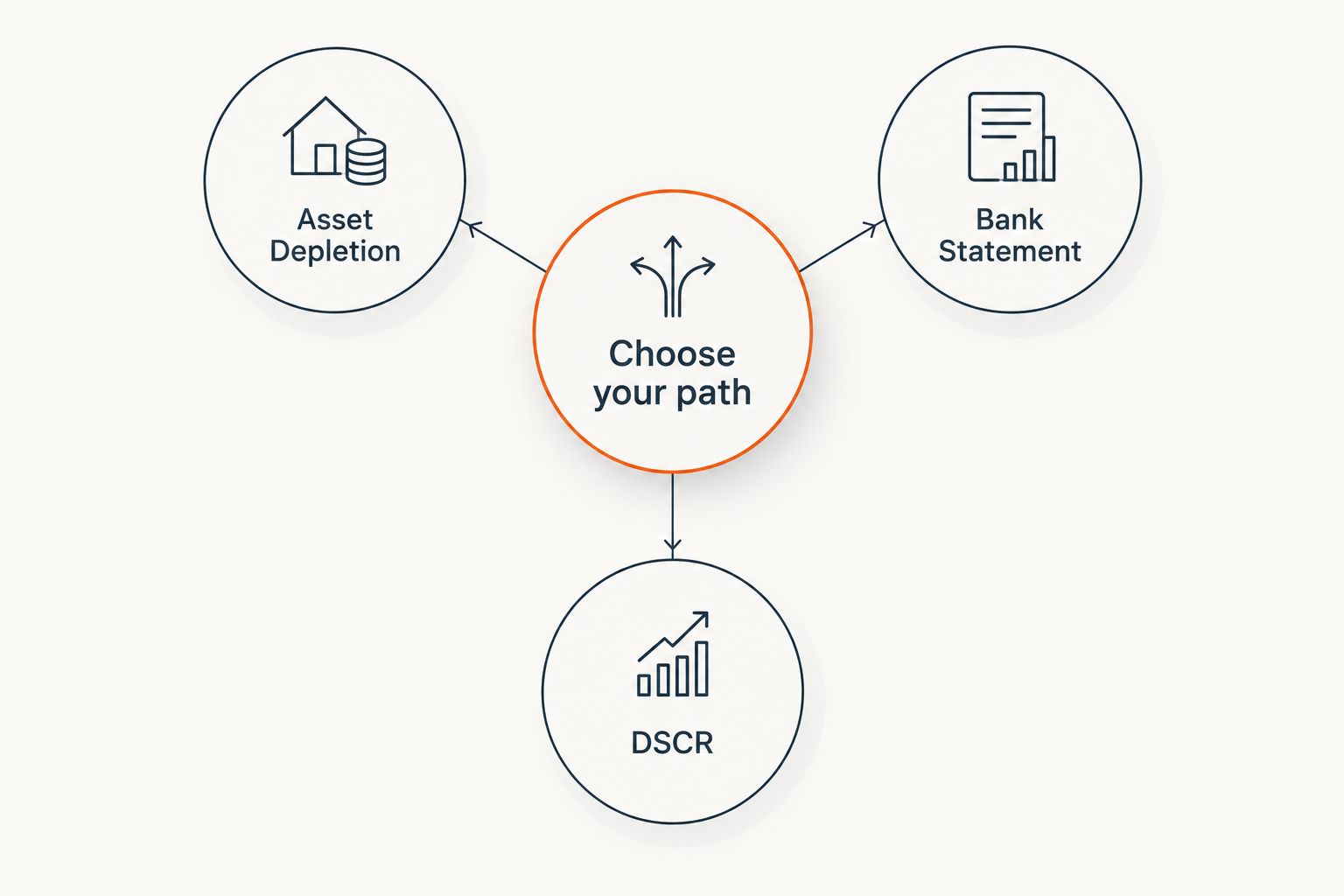
Which path wins depends on whether you're buying a home to live in or a property to rent out.
Pull the exact documents underwriters ask for
Asset-based files stall when documentation is incomplete, not when the assets themselves are insufficient. Gather these before you submit.
- Two to three months of statements for every account you're claiming
- A letter of explanation for any large deposit that isn't a transfer between your own accounts
- Retirement account custodian statements showing current vested balance
- Proof of active real estate license and recent transaction history, if the lender wants evidence of ongoing commission activity
- Two forms of government ID and a completed loan application
Run the math on your qualifying income before you commit
Asset depletion math is mechanical, not negotiable, once a lender sets the divisor. A file with $500,000 in countable assets divided across an 84-month term produces a very different monthly income figure than the same assets divided across 60 months — get the exact divisor from your loan officer in writing before you go under contract, not after.
Compare that figure against what a bank statement loan would produce using your actual deposit history. Agents who assume asset-based automatically wins are often surprised that a strong deposit pattern qualifies for more.
Match the property type and loan purpose to the right program
The same agent buying a primary residence versus a rental should not default to the same loan type.
- Buying a primary residence: asset depletion or personal bank statement programs, since DSCR products generally exclude owner-occupied purchases
- Buying a rental or investment property: DSCR usually outperforms asset-based lending because the property's rent carries the file, not your commission checks — see options built for asset-based lenders serving real estate investors
- Cash-out refinance to fund a new deal: cash-out DSCR or an asset-based cash-out structure, depending on whether the target property is owner-occupied or a rental
- Second home or vacation rental purchase: non-QM asset-based programs generally allow this where standard agency guidelines restrict it
Work with a broker who underwrites commission-heavy files daily
Not every loan officer handles 1099 borrowers well, and the gap shows up at underwriting, not at application.
- Ask how many commission-only or 1099 files the loan officer closed in the past year
- Confirm the lender accepts every asset type you're claiming — some non-QM investors exclude retirement accounts outright
- Get the asset depletion divisor and any haircuts on retirement funds in writing before locking a rate
- Run the asset-based number against a bank statement estimate side by side before choosing a program
Compare your loan options in 2026
See which qualifying path fits your commission income and asset mix.
Comparison: which qualifying path fits your file
Asset depletion
- Best for: Agents with heavy savings/investments but thin tax return income
- Key limitation: Divisor terms and retirement account discounts vary by lender
Bank statement loan
- Best for: Agents with steady, well-documented monthly deposits
- Key limitation: Requires 12-24 months of clean statements with no unexplained gaps
DSCR loan
- Best for: Agents buying a rental where the property carries its own debt
- Key limitation: Not usable for a primary residence purchase
Conventional mortgage
- Best for: Agents with two full years of strong, consistent net income
- Key limitation: Write-offs that lower net income directly hurt qualifying income
Verdict: asset based lending for real estate agents is the right call when your balance sheet is strong and your tax return net income isn't — pair it with a broker who underwrites 1099 files regularly, or compare it against a bank statement loan before signing anything.
Common mistakes real estate agents make
- Maximizing tax write-offs right before applying, assuming it won't matter — it doesn't hurt asset-based math, but it kills a conventional application filed at the same time
- Assuming every lender counts retirement accounts at full value; most apply a 60-70% discount
- Depositing a large one-time commission check without documenting where it came from, which stalls underwriting for weeks
- Trying to blend asset depletion and DSCR qualification on one file when the two methods don't combine
- Defaulting to "asset-based" because it's the trending term in 2026, without running the bank statement math first
FAQ
What is asset based lending for real estate agents?
It's a mortgage qualification method that uses your liquid assets — savings, brokerage accounts, retirement funds — instead of tax return net income to calculate a monthly qualifying income figure. It's built for agents whose commission income and write-offs make them look under-qualified on paper.
How does asset depletion calculate qualifying income?
Total qualifying assets get divided by a term, commonly 60 or 84 months in non-QM lending, producing a monthly income number underwriters use in place of your reported income. Retirement accounts are typically discounted to 60-70% of their value first.
Is asset based lending better than a bank statement loan for real estate agents?
It depends on which number is stronger: agents with heavy assets but thin deposit history usually do better with asset depletion, while agents with steady, well-documented commission deposits often qualify for more through a bank statement loan.
Can I use asset based lending to buy a rental property?
Yes, but a DSCR loan usually qualifies faster and for more since it's based on the property's rent rather than your personal assets or income. Asset-based lending tends to fit primary residence purchases better.
Do retirement accounts count fully toward asset based lending?
No. Most non-QM programs discount 401(k) and IRA balances to roughly 60-70% of their stated value to account for early withdrawal penalties and taxes before including them in the qualifying calculation.
How many months of bank statements does a real estate agent need?
Bank statement loan programs typically require 12 to 24 months of personal or business account statements, averaged to determine qualifying income. Asset depletion programs instead require 2-3 months of statements per account being claimed.
Does a real estate agent need two years of tax returns for asset based lending?
No — that's the point of the program. Asset based lending is built specifically to avoid relying on tax return net income, which is why it works for agents whose write-offs shrink their reported income.
What documents does a real estate agent need for an asset based loan?
Account statements for every asset being claimed, a letter of explanation for any large unexplained deposit, retirement custodian statements, proof of active real estate license, and two forms of ID.
One last thing
The detail most agents miss: the asset depletion divisor isn't fixed across the industry — a 60-month term versus an 84-month term on the same asset balance changes your qualifying income by roughly 40%, and lenders don't always volunteer which one they're using until you ask directly in 2026.


