


Bank Statement Loans for Tattoo Artists (2026 Guide)
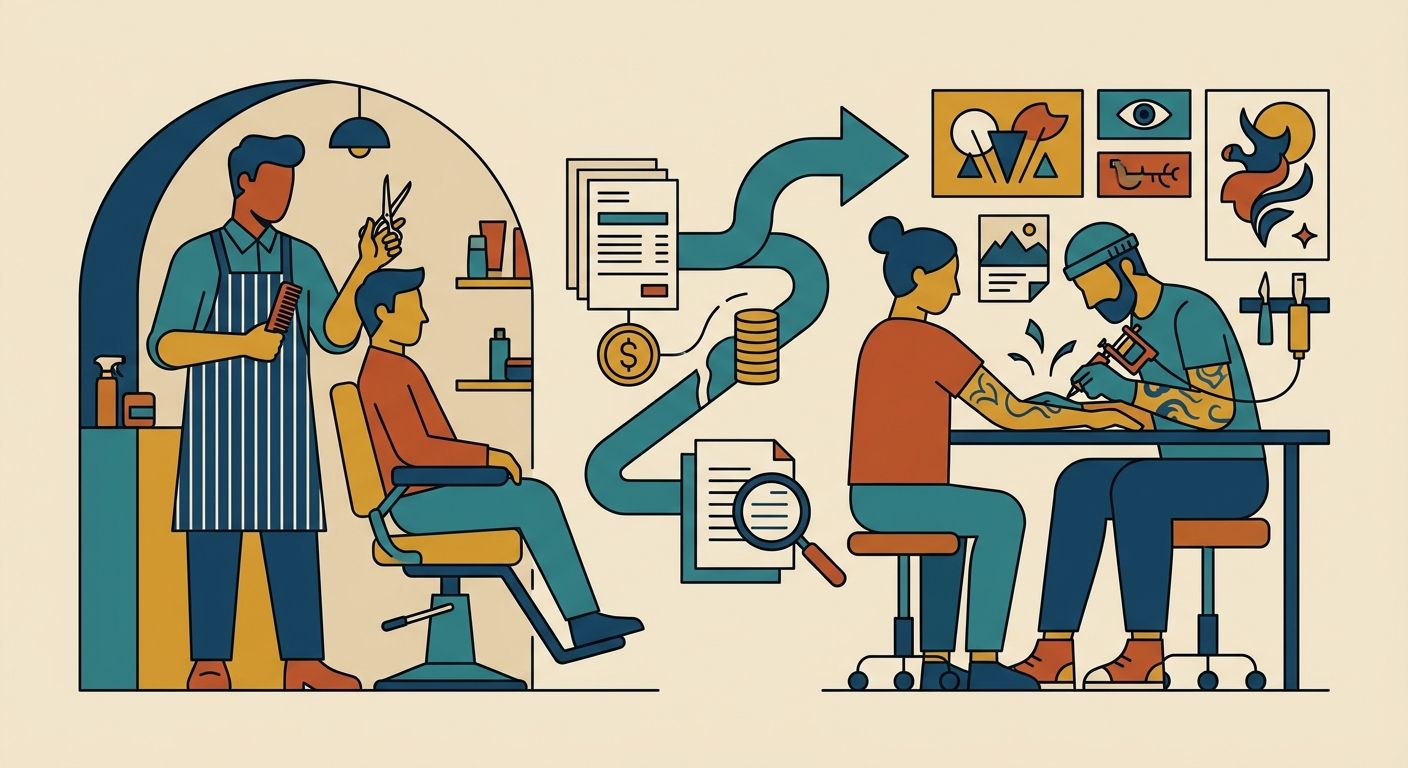
Barbers and tattoo artists run cash-heavy businesses that traditional mortgage underwriters don't know how to read. A bank statement loan replaces tax returns with 12 to 24 months of deposits, which means the write-offs that shrink your Schedule C income never touch your approval.
TL;DR
- Bank statement loans for tattoo artists and barbers qualify income from deposits, not tax returns filed with heavy write-offs.
- A 24-month business statement program is the safe pick for shop owners with steady deposits; buy it.
- 1099 booth renters do better with a dedicated 1099 bank statement program than a standard W-2 mortgage.
- Expect a 50% expense factor applied to gross deposits and a 600-680 credit score floor in 2026.
Why this matters
A barber grossing $9,000 a month in chair-rental deposits can show a net profit of $28,000 on a Schedule C after deducting rent, product, and equipment. A conventional lender reads that $28,000 as your annual income and shuts the loan down before it starts.
Bank statement loans for tattoo artists and barbers flip the math. The lender averages your deposits over 12 or 24 months, applies a flat expense factor (commonly 50%), and qualifies you off what's actually landing in the account. Bank statement loans for small business owners work the same way whether the shop sells fades or full sleeves — the underwriting logic doesn't care what's on the sign out front.
This matters more in 2026 because tip income, Cash App transfers, and Square deposits make up a growing share of gross revenue in both trades, and none of that shows cleanly on a 1040.
Who this is for
This guide is built for self-employed barbers, tattoo artists, booth renters, and shop owners who file a Schedule C or run an S-corp, take a meaningful share of income in cash or tips, and can't show enough net income on two years of tax returns to hit a conventional debt-to-income ratio. It also applies to artists who moved shops mid-year, work under a 1099 as an independent contractor inside someone else's studio, or want to buy a rental property with the same cash-flow logic through a DSCR loan instead of a bank statement program.
If your tax preparer is good at their job, your tax returns are working against you here — not for you.
What to look for in a bank statement loan for barbers and tattoo artists
How many months of statements the lender averages
A 12-month lookback rewards artists who had a strong recent year — new shop, new clientele, more walk-ins. A 24-month lookback smooths out a slow stretch but also drags down income if last year was rougher than this one. Ask which window the lender defaults to before you apply, because it changes your qualifying income by thousands of dollars a month.
How cash deposits and tips get treated
Some lenders only count deposits that hit a business or personal checking account; cash you pocket at the chair and never deposit doesn't exist to underwriting. If tips are a real chunk of your income, start depositing them consistently for at least a few months before you apply — paper trail beats memory every time.
The expense factor applied to gross deposits
Most bank statement programs apply a flat expense ratio, commonly 50%, against your gross deposits to estimate net income — unless you supply a CPA-prepared profit and loss statement that documents a lower expense ratio. A tattoo artist buying ink, needles, and sterilization supplies in bulk might genuinely run closer to 35% expenses, and proving that can raise your qualifying income significantly.
Personal versus business bank statement options
Sole proprietors and single-member LLCs often qualify off personal account deposits. Shop owners running payroll or multiple chairs usually need the business statement version, which looks at gross business deposits before the expense factor gets applied. Bank statement loans for salon and spa owners follow the same business-account structure most tattoo shops with employees will use.
Credit score and reserve requirements
Expect a credit score floor somewhere in the 600-680 range for 2026 bank statement programs, with better pricing above 680. Reserve requirements — cash left over after closing — typically run two to six months of the new payment, higher for self-employed borrowers with irregular deposit patterns.
Whether the property is a primary home or a rental
Buying a primary residence keeps you in bank statement territory. Buying a rental property — including a second unit you plan to lease to another artist — often makes more sense as a DSCR loan, which qualifies off the property's rental income instead of your personal deposits.
Get your bank statement loan options
Talk through your deposit history and see what you qualify for in 2026.
Top picks by scenario
The safe pick — 24-month business bank statement program. Built for shop owners with two years of consistent business deposits and at least one employee or booth renter on the books. Expect the standard 50% expense factor and a credit score floor around 620. Buy it if your deposits have been steady for 24 months straight.
The booth renter's pick — dedicated 1099 program. Tattoo artists and barbers who rent a chair and get paid as independent contractors often don't fit a standard W-2 mortgage or a business bank statement loan cleanly. Best bank statement loan programs for 1099 contractors qualify off 1099 deposits directly, skipping the business-account requirement entirely. Buy it if your last 12 months of 1099 income is your strongest financial year to date.
The fast-track pick — 12-month personal statement program. Good for an artist who had a breakout year in 2025 and doesn't want a slower 2024 dragging the average down. It qualifies faster but usually carries a slightly higher rate than the 24-month version. Consider it if your most recent 12 months materially outperform the prior year.
The paperwork pick — CPA profit and loss letter add-on. Instead of accepting the flat 50% expense factor, a signed P&L from a licensed CPA can document your actual expense ratio. How to get approved for a bank statement loan as a business owner walks through exactly what that letter needs to include. Consider it if your real expenses run well under 50% of gross deposits.
The wildcard — DSCR loan for a rental purchase. If you're using shop profits to buy a rental property rather than a home to live in, a DSCR loan qualifies off the property's projected rent, not your personal deposits at all. It sidesteps the bank statement conversation completely. Consider it if the property cash-flows on its own regardless of what your shop earned last year.
What to avoid
- A lender that only offers 24-month averaging with no 12-month option. If last year was your best year yet, you're leaving qualifying income on the table.
- Skipping the CPA letter to save time. A flat 50% expense factor can undercut your real income by tens of thousands of dollars a year if your actual costs run lower.
- Mixing personal and business deposits in one account. Underwriters flag commingled accounts, which slows the file and sometimes forces a switch to the stricter business-statement program mid-process.
Verdict comparison
24-month business statement
- Statement window: 24 months
- Best for: Shop owners with employees
- Verdict: Buy
1099 contractor program
- Statement window: 12-24 months
- Best for: Booth renters, independent artists
- Verdict: Buy
12-month personal statement
- Statement window: 12 months
- Best for: Recent breakout year
- Verdict: Consider
CPA P&L add-on
- Statement window: Varies
- Best for: Low actual expense ratio
- Verdict: Consider
DSCR loan (rental purchase)
- Statement window: N/A — rent-based
- Best for: Buying investment property
- Verdict: Consider
FAQ
What is a bank statement loan for tattoo artists?
A bank statement loan for tattoo artists qualifies income using 12 to 24 months of bank deposits instead of tax returns. It's built for self-employed artists whose write-offs make their taxable income look lower than their real cash flow.
Can barbers who rent a chair qualify for a bank statement loan?
Yes — booth-renting barbers typically qualify through a 1099 bank statement program that averages 1099 deposits directly. It skips the need for a business bank account or payroll history.
How many months of bank statements do lenders need in 2026?
Most 2026 bank statement programs require either 12 or 24 months of statements. The shorter window helps if your most recent year outperforms the prior one; the longer window smooths out a slow stretch.
Do tips and cash deposits count toward income?
Tips count only if they're actually deposited into the account being reviewed. Cash kept out of the bank never shows up in the averaging, so consistent deposits matter more than actual earnings.
What credit score do you need for a bank statement loan in 2026?
Most 2026 programs set a floor between 600 and 680, with stronger pricing above 680. Reserve requirements typically run two to six months of the new payment on top of the score.
Is a bank statement loan better than a DSCR loan for a barber buying a rental property?
A DSCR loan is usually the better fit for a rental purchase because it qualifies off the property's rental income instead of your personal deposits. A bank statement loan makes more sense for a primary residence.
How much down payment do self-employed barbers need in 2026?
Down payment requirements vary by lender and credit profile, so check current terms directly rather than assuming a flat number. Stronger credit and larger reserves typically unlock lower down payment options.
Can tattoo artists use business bank statements instead of personal?
Yes — tattoo shop owners with employees or multiple chairs usually qualify through the business bank statement version, which reviews gross business deposits before applying the expense factor.
One last thing
The single biggest lever most artists ignore is the CPA profit and loss letter. Accepting the default 50% expense factor is the easy path, but a documented lower expense ratio can raise qualifying income by thousands of dollars a month for an artist who genuinely runs lean on supply costs.


