


Bank Statement Loans for Firearms Instructors: 2026 Guide

Firearms instructors and shooting range owners qualify for a mortgage in 2026 using 12 to 24 months of bank statements instead of tax returns, because write-offs for ammunition, range maintenance, and liability insurance shrink the net income a conventional underwriter wants to see. A bank statement loan replaces that net-income test with actual cash moving through your business account, which matters when certification fees, private lesson bookings, and retail counter sales never land on a predictable schedule. LoanGuys underwrites this segment against deposits, not Schedule C write-offs, which is the difference between a denial and an approval for most range operators.
TL;DR
- Bank statement loans for firearms instructors qualify on 12 or 24 months of deposits, not tax returns, in 2026.
- LoanGuys underwrites private lessons, range fees, and retail sales together instead of isolating one revenue stream.
- Range owners buying the building itself should compare a bank statement loan against a commercial real estate loan.
- Most 2026 bank statement programs start around a 620 credit score, with better pricing above 700.
Why bank statement loans matter for firearms instructors and range owners
Most firearms instructors work as sole proprietors or 1099 contractors, stacking income from private lessons, concealed-carry certification classes, and range-day supervision. Range owners run the same problem at a bigger scale: lane rentals, ammo and gear sales, FFL transfer fees, and membership dues all hit the bank account on different days at different amounts.
A conventional underwriter averages two years of Schedule C net income after every legitimate deduction, and range businesses deduct heavily on insurance, ammunition inventory, and facility upkeep. That leaves qualifying income far below what the business actually generates. A bank statement loans for personal trainers and fitness pros program works the same way for that adjacent self-employed segment — deposits count, write-offs don't cancel the math.
How to get a bank statement loan as a firearms instructor or range owner
The process runs through documentation, income calculation, and lender selection, in that order. Skip a step and you'll re-do the application with a second lender.
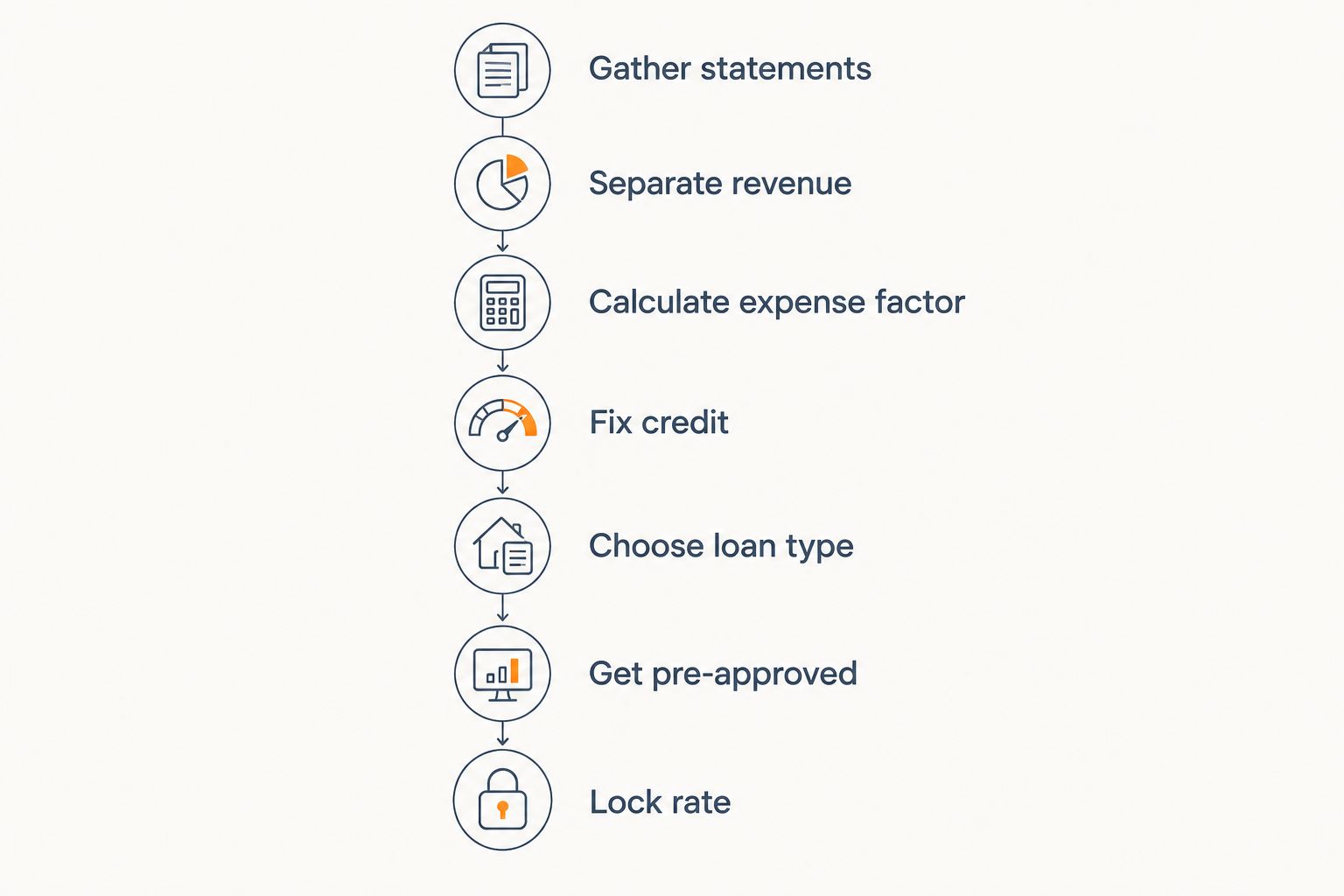
Gather 12 or 24 months of bank statements
Most programs let you pick 12-month or 24-month documentation, and 24 months generally produces a smoother average if one season ran slow.
- Pull personal statements if you teach under your own name as a sole proprietor
- Pull business statements if the range operates as an LLC or S-corp
- Keep NSF fees and overdrafts to a minimum in the months before you apply
- Flag one-time deposits — an equipment sale, an insurance payout — so they don't get counted as recurring income
- Match every deposit to actual range or instruction activity; stray personal transfers into a business account get questioned
Separate range revenue streams before you apply
Underwriters read bank statements line by line, and a range with five income types reads cleaner when you can explain each one.
- Lane rental and open-range fees
- Private lesson and CCW class income
- Retail counter sales — ammo, targets, safety gear
- Firearms transfer and FFL fees
- Membership dues if the range runs a membership model
Documentation comes first — lenders can't calculate income they can't source.
Calculate your expense factor honestly
Lenders on business bank statement programs apply a flat expense ratio to your deposits unless you prove your actual overhead runs lower.
- Ask your CPA for a signed letter if real overhead sits below the lender's default ratio
- Expect a default expense factor around 50% on business account statements
- Personal bank statement programs often skip the expense factor entirely
- Bring two years of licensing and certification records to support a lower ratio
Fix credit issues before you shop lenders
Credit drives both approval and pricing on a bank statement loan more than it does on a conventional mortgage.
- Pull your three-bureau report at least 60 days before applying
- Pay revolving balances under 30% utilization
- Dispute any equipment financing reported incorrectly against the range
- Know that most 2026 bank statement programs start around a 620 score, with sharper pricing above 700
Decide between a bank statement loan and a commercial loan for the range property
A bank statement loan qualifies you to buy or refinance a home. It's the wrong tool for buying the range building itself.
- Use a bank statement loan for a personal primary residence or an investment home
- Use a commercial real estate loans for shooting ranges and gun stores program when you're buying or refinancing the range facility
- Consider a DSCR loan if the property itself throws off rental-style cash flow you want to qualify against
- Keep personal and business financing goals in separate applications — mixing them slows underwriting on both
Get pre-approved with a lender that understands firearms businesses
- Ask upfront how the lender treats FFL and retail sales-tax deposits
- Confirm the lender offers both personal and business bank statement programs
- Compare rate, LTV, and documentation requirements across at least two lenders before committing
- Bring a year-to-date profit and loss statement even when it isn't required — it speeds review
Lock your rate and gather property documentation
- Confirm the rate lock window matches your closing timeline
- Provide two years of business license or range operating permits
- Line up your insurance agent for updated liability coverage documents
- Order the appraisal early — specialty-use properties like ranges can take longer to schedule
Get pre-qualified for your bank statement loan
Talk through your deposit history and expense factor before you apply.
Loan options compared for firearms instructors and range owners
Bank statement loan
- Best for: Instructors buying or refinancing a home on 1099 or sole-proprietor income
- Key limitation: Rates run higher than a conventional W-2 loan
DSCR loan
- Best for: Range owners buying a separate rental property, qualified on that property's income
- Key limitation: Won't help qualify for a primary residence purchase
Commercial real estate loan
- Best for: Range owners purchasing or refinancing the range building itself
- Key limitation: Requires business financials and typically a larger down payment
Conventional mortgage
- Best for: Instructors with two full years of W-2 income alongside teaching
- Key limitation: 1099 write-offs on the side income can still drag qualifying income down
Verdict: a bank statement loan is the right call for a firearms instructor buying a personal home on 1099 income, and the wrong call for a range owner trying to buy the range building — that's a commercial loan.
Common mistakes firearms instructors and range owners make
- Depositing student payments from Venmo or Cash App into a personal account with no documentation trail — lenders can't source what they can't trace
- Maximizing Schedule C deductions on ammunition and travel to lower a tax bill, then being surprised a bank statement program exists that ignores those write-offs entirely
- Applying with a lender who has never underwritten an FFL-holding business and doesn't know how to treat transfer fees
- Mixing state sales tax collected on retail purchases into gross deposits, which inflates income and gets flagged on review
- Waiting until under contract to start pulling bank statements together and missing the closing window
FAQ
What's the best loan for a firearms instructor with irregular income?
A bank statement loan is the best fit for a firearms instructor with irregular income because it qualifies you on 12 to 24 months of deposits instead of net income after tax write-offs. It works whether you're a sole proprietor or run the business through an LLC.
Is a bank statement loan better than a conventional mortgage for range owners?
For a personal home purchase, yes, if your Schedule C deductions keep your reported net income low. For buying the range building itself, a commercial real estate loan or DSCR loan is the better fit, not a bank statement mortgage.
How many months of bank statements do lenders require in 2026?
Most 2026 bank statement programs require either 12 or 24 months of statements. Twenty-four months usually smooths out a slow season better than 12.
Can shooting range owners use a DSCR loan to buy the range building?
A DSCR loan qualifies you based on a property's rental income, which doesn't fit a range you operate yourself. A commercial real estate loan built for gun stores and ranges is the standard route for buying or refinancing the facility.
What credit score do I need for a bank statement loan?
Most 2026 bank statement programs start approvals around a 620 credit score, with meaningfully better pricing above 700. Scores below that range narrow your lender options fast.
Do FFL retail sales count as income on a bank statement loan?
Retail sales deposits count as gross income, but sales tax collected on behalf of the state should be separated out before the lender calculates your average monthly deposits. Mixing the two inflates your numbers and gets flagged during underwriting.
How much down payment do firearms instructors need for a bank statement loan?
Down payment requirements vary by lender, credit profile, and property type, so get a specific figure from a loan officer rather than assuming a flat percentage. Investment properties generally require more down than a primary residence.
Can I combine personal and business bank statements on one application?
Some lenders blend personal and business account deposits into one calculation, others require picking one account type. Ask this question before you submit statements so you're not re-documenting mid-application.
One last thing
Get the CPA letter on your expense ratio before you submit the application, not after you've locked a rate — a default 50% expense factor on a range with genuinely lower overhead can shave your qualifying income enough to change the loan amount you're offered, and re-underwriting after a rate lock costs time you don't get back. Firearms instructors and range owners who walk into a bank statement loan application in 2026 with that letter in hand close faster than those who scramble for it mid-review.


