


Bank Statement Loans for Tutors 2026: Best Options
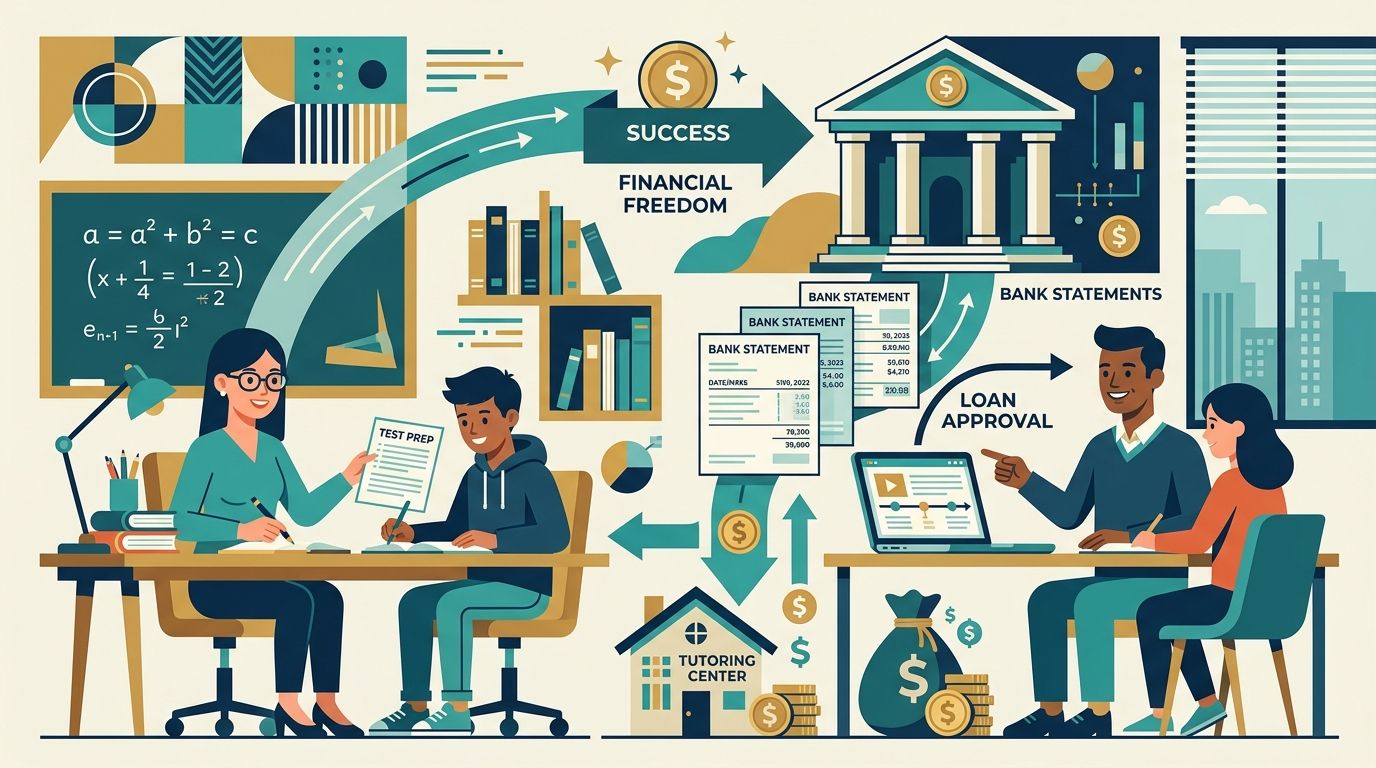
Bank statement loans for private tutors and test prep coaches let self-employed education professionals qualify for a mortgage using 12 to 24 months of bank deposits instead of tax returns, solving the problem that write-offs and irregular pay create with traditional lenders. Tutors who bill through Venmo, Zelle, checks, and tutoring platforms rarely show income the way a W-2 does, and a bank statement loan is built around that reality rather than around a pay stub.
TL;DR
- Bank statement loans for tutors qualify income from 12-24 months of deposits, not tax returns showing write-offs.
- Test prep coaches with seasonal SAT/ACT income need lenders who average deposits across the full statement period, not just peak months.
- Loan Guys reviews personal and business statements together for tutors who mix in-person and online tutoring income.
- Separating tutoring deposits from personal transfers before applying speeds underwriting and avoids stipulation delays.
Why bank statement loans matter for private tutors and test prep coaches
Traditional mortgage underwriting looks at net income after deductions. A tutor who nets $38,000 on paper after mileage, curriculum, software subscriptions, and home-office write-offs can still be depositing $6,000 a month during SAT and ACT prep season. Full-doc lenders see the lower number. A bank statement loan looks at what actually hit the account.
Test prep coaching is also seasonal by nature. Deposits spike ahead of spring and fall test dates and dip in the summer. A lender unfamiliar with that rhythm may flag the swings as inconsistent income. A lender who reviews the full 12 to 24 month window averages it out instead of penalizing the slow months.
Many tutors also run a hybrid model: in-person sessions paid by check, online sessions paid through a platform that batches payouts, and occasional group workshops billed separately. That mix of deposit sources is normal for this profession, but it needs a lender who reads bank statements for a living, not one applying a generic self-employed checklist.
Update your bank statement documentation before you apply
Lenders qualify you off actual deposits, so the statements need to tell a clean story before underwriting ever sees them.
- Pull 12 to 24 months of personal or business bank statements, matching what the specific loan program requires
- Flag any large one-time deposits (a security deposit refund, a gift, a loan payoff) so they aren't mistaken for income
- Confirm the account name matches your business name if you invoice as an LLC or DBA
- Note any months with unusually low deposits and be ready to explain the seasonal pattern
- Gather 1099s or platform payout summaries as backup documentation, even though they aren't the primary qualifier
Separate tutoring income from personal transfers
Mixed accounts are the single biggest slowdown in bank statement underwriting for this segment, because a $500 Venmo payment from a parent looks identical to a $500 transfer from a spouse.
- Route tutoring payments into a dedicated checking account, even if you're not formally incorporated
- Label recurring family or roommate transfers clearly in your own records so you can explain them fast
- Avoid depositing cash from in-person sessions into the same account as reimbursements or refunds
- Keep a simple spreadsheet mapping deposits to specific clients or platforms for months with irregular activity
- Ask your loan officer which 12 or 24 month window shows the strongest, most consistent pattern before locking in the statements you submit
Calculate your qualifying income the way underwriters will
Bank statement programs typically apply an expense factor to gross deposits rather than accepting the full deposit total as income, so your real qualifying number is lower than your total revenue.
- Add up total qualifying deposits across the full statement period, excluding transfers and one-time windfalls
- Divide by the number of months to get an average monthly deposit figure
- Expect the lender to apply a deduction for assumed business expenses before landing on usable income
- Compare that adjusted number against your target loan amount before you start touring homes
- Ask for a written pre-qualification showing exactly how the lender calculated your income, not just an approved amount
Getting a clear answer on how to get approved for a bank statement loan as a business owner before you apply saves a round of stipulations later, since the documentation standards are consistent across self-employed professions.
Choose the right loan type for your situation
A private tutor buying a primary residence needs a different program than a test prep coach buying a rental or an investment property to house their practice.
- Bank statement loan — best for tutors buying a primary or second home who need income qualification without tax returns
- DSCR loan — best for coaches buying a rental property, since qualification runs off the property's rental income, not personal income at all
- P&L only loan — best for tutors with a clean profit-and-loss statement from a CPA but thin bank statement history
- Traditional full-doc mortgage — best for tutors who also hold a W-2 job and can qualify on that income alone
A tutoring business that's outgrown a home office and needs a physical location is a different financing question entirely — commercial financing for tutoring center real estate loans runs on business cash flow and lease terms, not personal bank statements.
Compare lenders and programs before committing
Rates, minimum credit scores, and statement requirements vary enough between non-QM lenders that shopping matters as much as the loan type itself.
Bank statement loan (12-month)
- Best for: Tutors with strong recent income
- Key limitation: Shorter history can mean stricter rate pricing
Bank statement loan (24-month)
- Best for: Coaches with seasonal swings
- Key limitation: Requires two full years in the same account setup
DSCR loan
- Best for: Tutors buying a rental property
- Key limitation: Doesn't use personal income at all, qualifies on rent
P&L only loan
- Best for: Tutors with a CPA-prepared P&L
- Key limitation: Needs a licensed CPA, not self-prepared statements
Traditional conventional loan
- Best for: Tutors with W-2 income too
- Key limitation: Tax-return write-offs still lower qualifying income
Verdict: bank statement loans are the strongest fit for full-time private tutors and test prep coaches with no W-2 backup, and DSCR loans take over the moment the purchase is a rental rather than a home.
The programs built for 1099 contractor bank statement programs overlap closely with what tutors need, since both groups get paid per session or per project rather than on a salary schedule.
Get pre-qualified as a tutor
Talk through your deposit history and loan options before you shop for a home.
Common mistakes tutors and test prep coaches make
- Mixing platforms without a clear paper trail — Venmo, Zelle, checks, and tutoring-app payouts all landing in one account with no labels forces underwriters to ask for more documentation, not less.
- Over-deducting on tax returns while still planning to use a full-doc loan — if you're going to lean on write-offs for taxes, plan for a bank statement program from the start instead of discovering the mismatch mid-application.
- Ignoring the seasonal dip in summer months — a coach who books heavily in spring and fall but goes quiet in July should apply during or after a strong season, not right after the slow one.
- Switching bank accounts right before applying — a new account with three months of history undercuts the 12 or 24 month pattern lenders want to see.
- Assuming DSCR and bank statement loans are interchangeable — a DSCR loan qualifies off a property's rent, not your tutoring income, and using the wrong program wastes weeks in underwriting.
FAQ
What are bank statement loans for tutors?
Bank statement loans for tutors are mortgages that qualify income from 12 to 24 months of bank deposits instead of tax returns, built for self-employed tutors and test prep coaches whose net income on paper is lower than actual cash flow.
How much income do I need to qualify as a private tutor?
Qualifying income is calculated by averaging your monthly deposits over the statement period and applying an expense factor, not by using your gross revenue directly. A written pre-qualification from a non-QM lender shows the exact number before you shop.
Can test prep coaches with seasonal income qualify?
Yes, a 24-month bank statement program smooths out seasonal spikes and dips better than a 12-month program, since it averages a full two-year cycle including slow summer months.
Is a DSCR loan better than a bank statement loan for tutors?
A DSCR loan is better only if you're buying a rental property, since it qualifies off the property's rent rather than your personal tutoring income. For a primary or second home, a bank statement loan is the right fit.
Do I need a business bank account to qualify?
A dedicated account isn't always required, but a clean, separate account for tutoring income makes underwriting faster because deposits don't need to be untangled from personal transfers.
What credit score do bank statement loans require?
Requirements vary by lender and program, but bank statement loans generally carry higher minimum credit score thresholds than conventional full-doc mortgages since they carry more income-verification risk.
Can I use 1099 income from a tutoring platform?
Yes, 1099 payout summaries from tutoring platforms support your bank statement documentation, though the deposits themselves remain the primary qualifier, not the 1099 forms.
How far back do lenders look at bank statements?
Most bank statement programs review either 12 or 24 consecutive months, and the choice between the two often depends on how consistent your deposits are across that window.
One last thing
The tutors who move through underwriting fastest in 2026 aren't the ones with the highest income — they're the ones whose bank statements already look organized before a loan officer sees them. A test prep coach with a dedicated account, labeled deposits, and two full years of consistent activity clears conditions faster than one earning more but depositing through five different apps into a shared household account.


