


Bank Statement Loans for Real Estate Appraisers (2026)
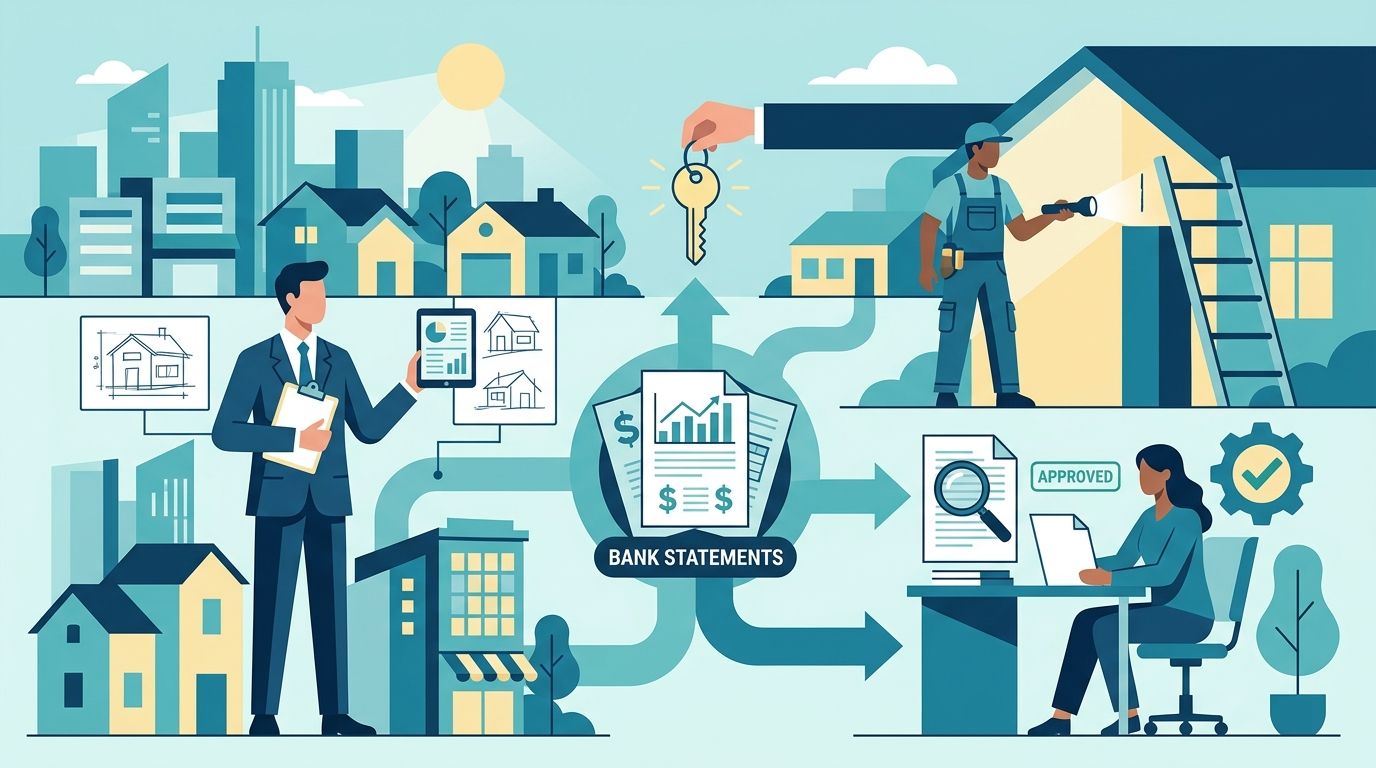
Bank statement loans for real estate appraisers qualify income from 12 to 24 months of business bank deposits instead of tax returns, built for professionals whose write-offs make net income look smaller than actual cash flow. Appraisers and home inspectors run lean 1099 businesses with mileage, equipment, E&O insurance, and software subscriptions stacked as deductions, and those same deductions tank a debt-to-income ratio on a conventional loan application.
TL;DR
- Bank statement loans for real estate appraisers use 12-24 months of deposits, not tax returns, to calculate qualifying income.
- An appraiser billing $9,000/month in gross deposits can often qualify for more than a tax-return-based loan would allow.
- Expense ratios on these programs typically run 15%-50% depending on lender and stated business type.
- LoanGuys.com structures bank statement programs for self-employed field professionals including appraisers and inspectors in 2026.
- Mixing business and personal deposits in the same account is the single biggest reason files get delayed or declined.
Why bank statement loans matter for appraisers and inspectors
Most appraisers and home inspectors operate as sole proprietors or single-member LLCs, invoicing per file rather than drawing a W-2 salary. Volume swings with the local housing market: a slow refinance season can cut monthly deposits by 30% to 40% even when the business itself is healthy. Underwriters looking only at a Schedule C see a shrunken net figure after depreciation, home office deductions, vehicle expenses, and continuing education costs.
A bank statement loan program for real estate agents works on the same principle appraisers need: deposits, not adjusted gross income, drive the qualifying number. For a field inspector who nets $60,000 on paper after write-offs but deposits $140,000 a year, that difference decides whether a rental purchase or a primary residence refinance closes at all.
Pull your last 12-24 months of bank statements
Start with the raw records before you touch a lender application. Every bank statement program leans on consistency and traceability of deposits.
- Download 12 consecutive months for a 12-month program, or 24 months if your deposits are uneven
- Confirm every statement shows the account holder's name matching the loan applicant
- Flag any NSF fees or overdrafts — lenders count these against you
- Note large one-time deposits (equipment sale, tax refund) that need a written explanation
- Keep statements in PDF form directly from the bank portal, not scanned copies
Separate business and personal deposits
Appraisers who run everything through one personal checking account create the messiest files in this loan category. Lenders need a clean read on what's actually business revenue.
- Open a dedicated business checking account if you haven't already
- Route all client payments and appraisal management company (AMC) deposits into that account
- Move personal expenses (rent, groceries, car payment) out of the same account entirely
- Keep a simple ledger noting which deposits are appraisal fees versus reimbursements
- Avoid transferring funds between personal and business accounts in the months before applying
Document your 1099 or business structure correctly
Most appraisers work through AMCs on a 1099 basis, while some inspectors run LLCs with multiple contractors under them. The paperwork differs.
- Gather 1099-NEC forms from every AMC or client that paid you $600 or more
- Pull your business license or state appraisal certification number
- If you operate as an LLC, have your operating agreement and EIN letter ready
- Confirm your business has been active for at least 12 months — most bank statement lenders require it
- List any partners or co-owners and their ownership percentage
Calculate your expense ratio the right way
Expense ratio is the percentage of your gross deposits a lender assumes goes to overhead before counting the rest as qualifying income. This single number swings your approved loan amount more than almost anything else.
- Ask each lender what expense ratio they'll apply to your industry — appraisers often land between 15% and 30%
- Request a fixed expense ratio in writing before you sign a rate lock
- Compare a stated expense ratio against your actual costs; a lower ratio means more qualifying income
- If you keep detailed books, ask whether a CPA-prepared P&L can override a flat industry ratio
- Don't assume every lender uses the same default percentage — this is negotiable at some non-QM shops
This is where a broker who underwrites appraiser and inspector files regularly earns their fee. LoanGuys.com works bank statement loan files across self-employed trades daily and can tell you upfront which expense ratio a specific lender will apply before you submit anything.
Line up your down payment and reserves
Bank statement programs almost always require larger down payments and post-closing reserves than a conventional W-2 loan, because the income documentation carries more assumption.
- Budget for a larger down payment than you'd expect on a standard conventional purchase
- Set aside 3-6 months of reserves in a separate, seasoned account
- Avoid moving large sums into your account in the 60 days before closing without a paper trail
- Gift funds are allowed on many programs but require a signed gift letter and sourced transfer
- Keep retirement or investment account statements handy — some lenders count a percentage toward reserves
Compare bank statement lenders before you apply
Not every non-QM lender treats appraisers and inspectors the same way. Some flag seasonal-income trades as higher risk and price accordingly; others have specific programs built for licensed trade professionals.
- Ask whether the lender has closed loans for appraisers or inspectors specifically, not just "self-employed borrowers" broadly
- Compare 12-month versus 24-month statement requirements — 12-month programs suit a strong recent year better
- Check whether the lender allows a co-borrower's W-2 income to blend with your bank statement income
- Confirm loan-to-value maximums for investment properties versus primary residences
- Ask about prepayment terms if you plan to refinance once your file has two full years of tax returns
Get pre-approved with a broker who reads appraiser income correctly
A generic pre-approval letter based on a quick guess at your income wastes everyone's time once you're under contract. Appraisers and inspectors need a lender who has actually underwritten a 1099 field-services file before.
- Request a full income calculation, not a verbal estimate, before house hunting
- Ask for the expense ratio and qualifying income figure in writing
- Confirm which 12 or 24 months of statements the lender will use if your income has grown recently
- Get the pre-approval letter structured for the property type you're targeting — primary, second home, or investment
- Re-verify the pre-approval if more than 60 days pass before you make an offer
Comparing loan options for appraisers and inspectors
12-month bank statement loan
- Best for: Appraisers with a strong, recent 12-month income trend
- Key limitation: Requires more recent volume; won't smooth out a slow prior year
24-month bank statement loan
- Best for: Inspectors with variable or seasonal deposit patterns
- Key limitation: Averages in slower months, which can lower qualifying income
P&L only loan
- Best for: Business owners with clean, CPA-prepared books
- Key limitation: Requires a CPA letter and generally carries tighter LTV limits
Conventional loan with tax returns
- Best for: Appraisers who minimize deductions and show strong net income
- Key limitation: Write-offs that lower AGI directly shrink the qualifying number
Verdict: a 24-month bank statement loan is the safer default for most appraisers and inspectors with seasonal swings, while a 12-month program fits anyone coming off a genuinely strong recent stretch — compare both before locking a rate.
Common mistakes appraisers and inspectors make
- Mixing personal and business deposits in one account. This forces underwriters to manually separate every transaction, which slows the file and often lowers the counted income.
- Applying with a lender unfamiliar with AMC payment patterns. Appraisal management companies often batch payments, and a lender who doesn't recognize that pattern may flag deposits as inconsistent.
- Assuming a strong tax-return year disqualifies them from a bank statement loan. These programs work even when tax returns look fine — some appraisers use them simply because deposits document income more favorably.
- Skipping the reserves conversation until underwriting. Waiting to figure out reserves after submitting a file causes last-minute scrambling and can blow a closing date.
- Not shopping expense ratios across lenders. A five-point difference in assumed expense ratio can change qualifying income by tens of thousands of dollars a year.
A fair number of appraisers and inspectors pick up extra file volume on distressed or auction properties for investor clients, and that work brings its own diligence checklist — radon testing on auction properties matters just as much as income documentation when the property itself carries unknown history. Treat both sides of the transaction, the borrower's income file and the property's condition file, with the same level of paper trail.
Talk through your bank statement file
Get a straight answer on qualifying income before you house hunt.
FAQ
What is a bank statement loan for real estate appraisers?
A bank statement loan for real estate appraisers is a non-QM mortgage that qualifies income from 12-24 months of business bank deposits instead of tax returns. It's built for 1099 and LLC appraisers whose write-offs shrink net income on paper.
Can home inspectors qualify for a bank statement loan too?
Yes, home inspectors qualify under the same bank statement loan structure as appraisers since both typically operate as self-employed or 1099 field professionals. Lenders look at deposit consistency rather than job title.
How many months of bank statements do lenders require?
Most programs require either 12 or 24 consecutive months of business bank statements in 2026. A 12-month program works better for appraisers with a strong recent stretch; 24 months smooths out seasonal swings.
What expense ratio applies to appraiser income?
Expense ratios for appraisers commonly run between 15% and 30% depending on the lender, meaning that percentage of gross deposits is assumed to cover overhead before the rest counts as qualifying income. Ask for this figure in writing before locking a rate.
Is a bank statement loan more expensive than a conventional loan?
Bank statement loans generally carry higher down payment and reserve requirements than conventional loans because of the alternative documentation. Rate and cost specifics vary by lender and should be confirmed directly.
Can I use a bank statement loan for an investment property as an appraiser?
Yes, bank statement programs cover primary residences, second homes, and investment properties, though loan-to-value maximums are typically tighter on investment purchases. Confirm the LTV cap with your lender before making an offer.
Do I need two years in business to qualify?
Most bank statement lenders require at least 12 months of active business history, though some programs prefer 24 months of established deposits. A newer appraisal business may need to wait or find a lender with a shorter history requirement.
Can a spouse's W-2 income be combined with my bank statement income?
Many lenders allow a co-borrower's W-2 income to blend with bank statement income on the same loan file. This combination often improves the qualifying debt-to-income ratio significantly.
One last thing
The expense ratio a lender applies is negotiable more often than borrowers assume — appraisers with a CPA-prepared profit and loss statement can sometimes swap a flat 30% industry-default ratio for one closer to their actual 15%-20% overhead, and that swing alone can add tens of thousands of dollars to qualifying income. Ask for the P&L option before accepting the first number a lender quotes in 2026.


