


Bank Statement Loans for Seasonal Business Owners 2026
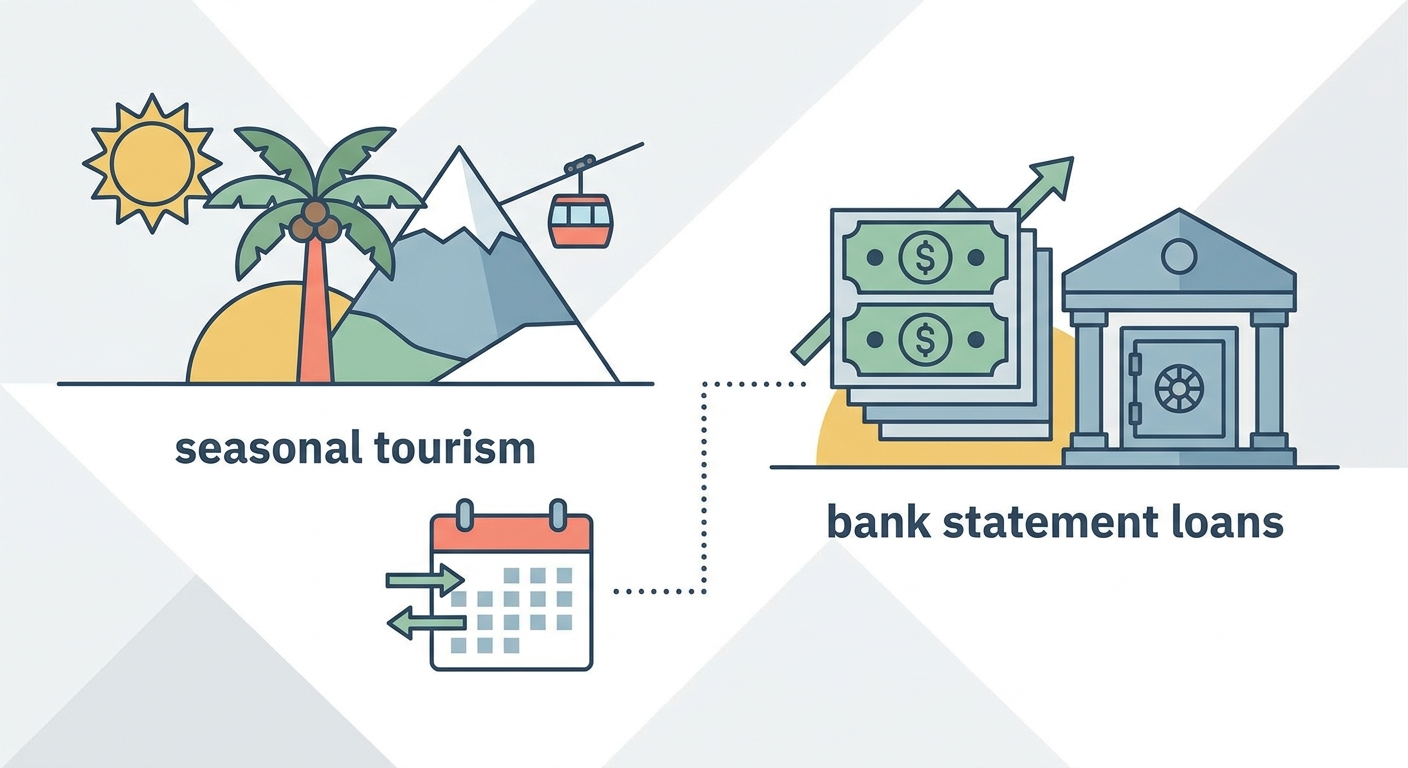
Seasonal tourism businesses — ski lodges, beach rental agencies, dive shops, festival vendors, glamping outfits — earn most of their annual revenue in a four-to-six month window, and traditional mortgage underwriters read that as instability instead of a business model. Bank statement loans for seasonal business owners solve that mismatch by qualifying you off actual deposits instead of a tax return that's been shaped by write-offs and depreciation.
TL;DR
- LoanGuys.com structures bank statement loans for seasonal business owners around actual deposits, not tax returns. Buy.
- A 24-month lookback smooths a single slow season better than a 12-month window for ski, beach, or festival operators.
- Restaurant and bar owner programs and Airbnb/STR host programs default to different expense-factor assumptions — confirm yours before applying.
- Pairing a DSCR loan on the property with a bank statement loan on the business is the standard 2026 structure for seasonal operators buying real estate.
Why This Matters
A W-2 underwriter sees a flat paycheck every two weeks. A seasonal operator's bank statement loan for small business owners has to account for months where deposits are near zero and months where they're triple the average.
That swing is exactly what trips up conventional approval in 2026. Tax returns compress a full year of feast-and-famine into one number, and depreciation, meals, and equipment write-offs often make a profitable operator look unprofitable on paper.
If your December deposits are three times your June deposits, a lender needs an explanation, not a reason to decline.
Bank statement programs read your actual cash flow — 12 or 24 months of it — and average it the way your business actually runs, not the way a W-2 does.
Who This Is For
This guide is for owners of ski lodges, beach rental agencies, dive shops, campground stores, tour operators, festival vendors, and short-term rental portfolios where the bulk of annual revenue lands in a defined season. If your last two tax returns show a loss or a thin margin because of legitimate business write-offs, and your bank deposits tell a healthier story, a bank statement loan is built for exactly your situation in 2026.
What to Look for in Bank Statement Loans for Seasonal Business Owners
1. Look-back period: 12 months vs. 24 months
A 12-month window captures only one full season, so if your off-season runs November through March, that single dip can drag your entire qualifying average down. A 24-month statement package spreads that same dip across two winters instead of concentrating it in the trailing year, which matters most for ski and beach operators with one consistent slow stretch.
2. Expense factor method — flat 50% vs. a CPA-prepared P&L
Most bank statement programs apply a flat 50% expense ratio to gross deposits unless you submit a CPA-prepared profit-and-loss statement. High-margin operators — dive instructors, tour guides, coaching-style businesses — often qualify for more income under the flat 50% than under an actual P&L. Restaurants and equipment-rental businesses with real supply costs usually do better submitting the P&L.
3. Gross deposits vs. net deposit averaging
Ask whether the lender averages gross deposits or nets out large one-time transfers, like an owner contribution or a seasonal loan payoff. A single $40,000 August payroll transfer routed through the wrong account can distort a 12-month average and either inflate or crater your qualifying income.
4. Reserve requirements matched to your actual off-season
Seasonal operators need reserve requirements tied to when revenue really stops, not a generic 2-month bank standard. Look for programs asking for 6 to 12 months of reserves, since a beach rental agency can post near-zero deposits from January through March every single year.
5. DSCR overlay when the loan finances the property itself
If the loan is for the lodge, cabin, or short-term rental property rather than working capital, a DSCR loan replaces personal or business income entirely and qualifies off the property's own rental income. Most 2026 investor guidelines want a coverage ratio between 1.0x and 1.25x, and pairing that with a bank statement program on the operating business is the structure most seasonal owners end up using.
Top Picks: Bank Statement Programs for Seasonal Tourism Operators
Restaurant & Bar Owner Program — the classic seasonal case. Built around a 24-month lookback and zero tax return requirement, this program handles the tip-heavy, cash-adjacent deposit patterns that show up in coastal and resort-town restaurants. A property posting $150,000 or more in gross annual deposits typically qualifies without touching a Schedule C. Buy — see the bank statement program for restaurant and bar owners.
Airbnb/STR Host Program — the shoulder-season smoother. This program layers a DSCR loan on the property with a bank statement loan on the host's operating income, and it's commonly capped around 80% LTV. It's built for owners scaling past one unit into a small portfolio where personal cash flow and rental income need to be evaluated together. Buy — see the bank statement program for Airbnb hosts and STR operators.
Cabin & Glamping Site Program — the off-grid outlier. Land-heavy, structure-light properties confuse conventional appraisers, so this program pairs a 24-month lookback with 6 to 12 months of reserves to cover the long winter gap most glamping and cabin sites see. It's slower to close than the two programs above because appraisals on unconventional structures take longer. Consider — see loans for short-term rental cabin and glamping site investors.
1099 Contractor / Solo Guide Program — the fallback for one-person operations. Ski instructors, dive guides, and festival vendors who never incorporated often qualify off a shorter 12-month lookback since there's less deposit history to average in the first place. It works, but the shorter window means one bad month carries more weight than it would under a 24-month program. Consider.
Get your seasonal deposits reviewed
Find out which bank statement program fits your season before you apply.
What to Avoid
- Full-doc loans that only look at tax returns. Two years of returns showing a loss from depreciation and write-offs will sink an approval even in a genuinely profitable season.
- Bank statement programs that average only the trailing 12 months right after your slow season. Timing the application matters as much as the program itself — apply while your peak season is still inside the average window.
- HELOCs and home equity products marketed as flexible but underwritten purely on W-2 income. They won't recognize a seasonal deposit pattern at all, and they're built for a different borrower entirely.
Verdict Comparison
Restaurant & Bar Owner
- Look-back Period: 24 months
- Ideal For: Seasonal eateries, $150k+ annual deposits
- Verdict: Buy
Airbnb/STR Host
- Look-back Period: 12-24 months + DSCR overlay
- Ideal For: Owners scaling a rental portfolio
- Verdict: Buy
Cabin & Glamping Site
- Look-back Period: 24 months, 6-12 month reserves
- Ideal For: Land-heavy or off-grid properties
- Verdict: Consider
1099 Contractor/Guide
- Look-back Period: 12 months
- Ideal For: Solo instructors, guides, vendors
- Verdict: Consider
FAQ
What is a bank statement loan for seasonal business owners?
It's a mortgage or business loan qualified off 12-24 months of actual bank deposits instead of tax returns, built for owners whose income spikes in one season and drops in another. In 2026 this is the standard workaround for tax returns that show write-offs rather than true cash flow.
How many months of bank statements do lenders want in 2026?
Most programs ask for either 12 or 24 months, with 24 months preferred for businesses with one full seasonal cycle of highs and lows. A 24-month window prevents a single bad off-season from dominating the average.
Can a seasonal restaurant or bar qualify for a bank statement loan?
Yes, restaurants and bars with $150,000 or more in gross annual deposits commonly qualify under a 24-month bank statement program with no tax returns required. Tip-heavy deposit patterns are handled the same way as any other gross-deposit average.
Is a bank statement loan better than a DSCR loan for a seasonal short-term rental?
They solve different problems: a bank statement loan qualifies you off your personal or business income, while a DSCR loan qualifies off the property's own rental income. Seasonal STR owners often use both together, a DSCR loan on the property and a bank statement loan on the operating business.
What credit score do you need for a bank statement loan in 2026?
Program minimums vary by lender, but stronger pricing and higher LTV typically require a credit profile well above the program floor. Ask about the specific score tier tied to the LTV you want before applying.
Do bank statement loans require tax returns?
No, that's the entire point of the program: qualification runs off deposit history instead of the Schedule C or 1120 that shows depreciation and expense write-offs. Some lenders will still ask for a CPA letter confirming the business is active.
What LTV can seasonal business owners expect?
STR-backed bank statement structures commonly cap around 80% LTV, while pure business bank statement loans vary by lender and reserve strength. Stronger reserves and a longer deposit history both push LTV higher.
How does the off-season affect bank statement loan approval?
A well-timed application, submitted right after peak season closes, keeps the full season's deposits inside the 12 or 24-month average. Applying during the slow months themselves can pull the average down even though annual revenue hasn't changed.
One Last Thing
Most seasonal operators apply during their slowest month out of habit, right when cash is tightest and the urge to fix it is strongest. Apply instead the month your peak season closes, while your 12 or 24-month average still carries that season's deposits at full weight — it's the single easiest way to raise a qualifying income number without changing anything about the business itself.


