


Bank Statement Loans for Influencers: Qualify in 2026
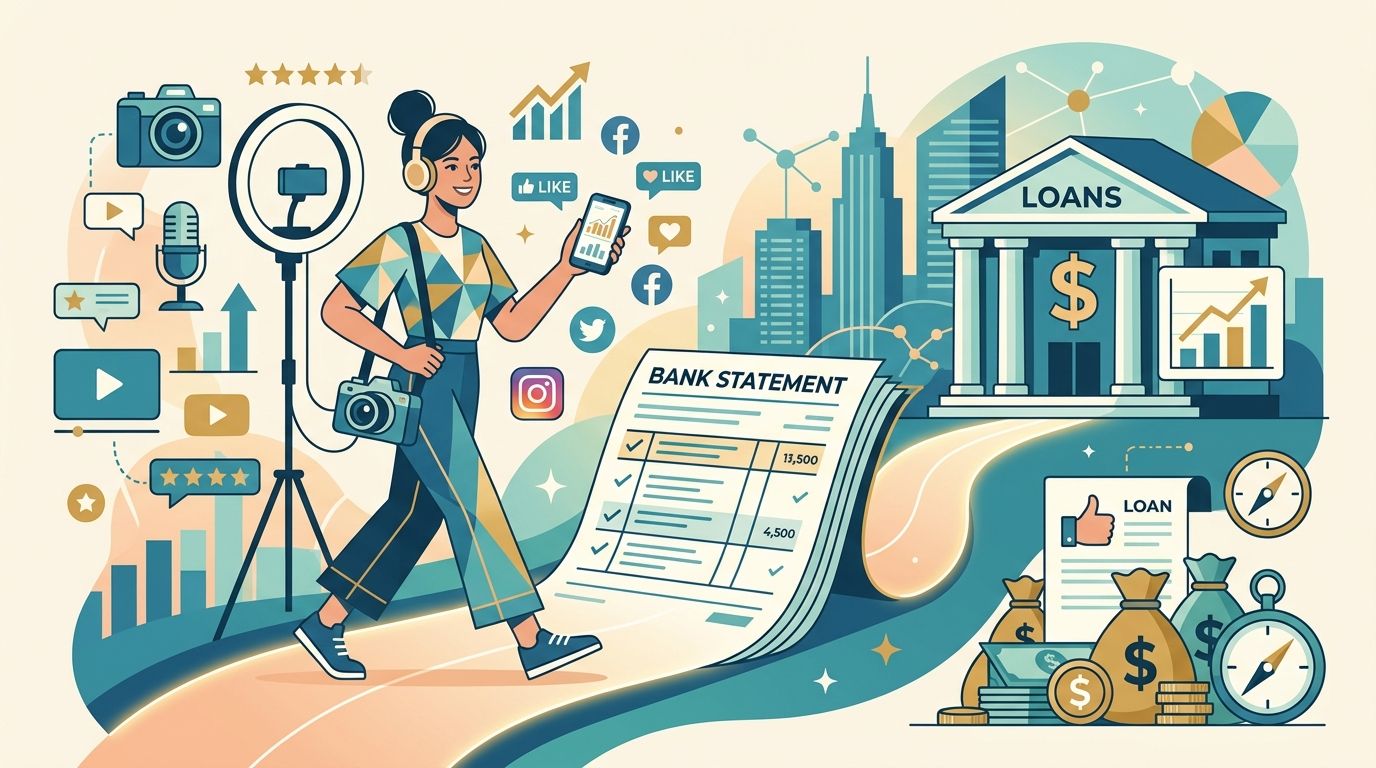
Bank statement loans for influencers let YouTubers, TikTok creators, and social media personalities qualify for a mortgage using 12 to 24 months of deposits instead of two years of tax returns — the fix for income that looks thin on paper after write-offs but lands very differently in the bank account. Sponsorship checks, ad revenue splits, and affiliate payouts rarely show up as a clean W-2, so this guide walks through how creators actually get approved in 2026.
TL;DR
- Bank statement loans for influencers qualify creators on 12-24 months of deposits instead of tax returns.
- LoanGuys combines brand-deal, ad-revenue, and multi-platform payouts into one qualifying income figure.
- Non-QM programs often allow DTI up to 50%, well above the roughly 43% ceiling most conventional lenders enforce.
- Keep sponsorship and platform payouts flowing into one account for 12+ months before you apply.
Why bank statement loans matter for influencers and content creators
A content creator's income doesn't look like a paycheck. It's YouTube AdSense one week, a TikTok Creator Fund payout the next, a brand deal wired through PayPal, and a merch drop settling through Stripe. None of that shows up as salary on a W-2.
Worse, a good accountant minimizes taxable income with equipment write-offs, home studio deductions, and travel expenses tied to shoots. That's smart tax planning and terrible mortgage math — a conventional lender averages two years of tax returns and sees a fraction of what actually hit the bank. Bank statement loans for content creators and influencers exist specifically to close that gap by qualifying on deposits, not deductions.
The step-by-step path to qualifying
Consolidate your income streams into one account
Underwriters want a clean, readable deposit history. Scattered income across five apps makes that impossible.
- Open one dedicated business checking account for creator income
- Route Stripe, PayPal, and brand-direct payments into that same account
- Send YouTube AdSense and TikTok Creator Fund payouts to it as well
- Stop routing personal Venmo transfers through the business account
- Build at least 12 months of history there before you apply
Separate personal and business spending
Commingled accounts are the single biggest reason a bank statement file gets kicked back for more documentation.
- Move equipment and travel purchases off personal cards and onto the business account
- Run merch fulfillment and affiliate payouts through the business side only
- Avoid large, unexplained transfers between personal and business accounts
- Keep a paper trail — invoices, contracts — for one-off brand collaborations
Document irregular and lump-sum deposits
Creator income spikes around launches, campaigns, and seasonal sponsorship cycles. Underwriters need context for those spikes, not just the number.
- Label sponsorship payments clearly in your bookkeeping software
- Keep signed brand contracts on file for any deposit over a few thousand dollars
- Note which months carry launch or campaign-driven spikes
- Save invoices for affiliate deals and UGC contracts
- Flag any resale income from gifted products separately
Calculate your qualifying income the way lenders do
Most personal bank statement programs apply a standard expense ratio — often around 50% — to your gross deposits unless a CPA states otherwise. That assumption can badly undercount a creator whose actual overhead is closer to 20%.
- Ask a CPA to write an expense-ratio letter if your real costs run below the standard assumption
- Run both a 12-month and a 24-month average and compare which qualifies you for more
- Separate one-time platform bonuses from recurring monthly income
- Exclude reimbursed expenses that pass through the account without being real income
Hold a steady deposit pattern before you apply
Lenders read consistency as reliability. A creator who platform-hops or goes quiet for two months right before applying makes underwriting harder than it needs to be.
- Avoid opening new business accounts in the 60 days before applying
- Keep at least one recurring income source — sponsorships or ad revenue — active every month
- Delay large equipment purchases until after closing
- Don't let a demonetization gap or slow content month sit inside your qualifying window if you can help it
Compare lenders built for self-employed and creator income
Not every lender treats multi-platform income the same way, and the difference shows up in your approved loan amount.
- Compare 12-month versus 24-month programs — 12-month options usually demand stronger cash reserves
- Ask how each lender treats staggered platform payout timing
- Confirm whether income from multiple platforms gets combined or averaged separately
- Check the LTV cap tied to your credit score
- Review how to get approved for a bank statement loan as a business owner before you shop rates
Financing options for creators compared
Personal bank statement loan
- Best for: Creators depositing sponsorship and ad revenue into a personal account
- Key limitation: Requires 12-24 months of statements and carries a higher rate than a conventional loan
Business bank statement loan
- Best for: Creators running income through an LLC or S-corp
- Key limitation: Qualifying income is tied to your ownership percentage of the business
P&L-only loan
- Best for: Creators with a CPA-prepared profit and loss statement
- Key limitation: Needs a licensed CPA and generally caps loan amounts lower than bank statement programs
DSCR loan for a rental purchase
- Best for: Creators buying an investment property rather than a primary residence
- Key limitation: Qualifies on the property's cash flow, not personal income, so it doesn't help finance a primary home
Conventional W-2 mortgage
- Best for: Creators with a full-time job plus content income on the side
- Key limitation: Averages two years of tax returns, which undercounts income after write-offs
Bank statement loans win for full-time creators with strong, documentable deposits; a DSCR loan wins the moment the purchase is a rental instead of a home to live in.
See what your deposits qualify for
Get a read on your bank statement loan options before you apply.
Common mistakes influencers make with bank statement loans
- Over-optimizing for taxes. Writing off every possible expense on Schedule C helps in April and hurts when a lender needs to see real earning power.
- Commingling payment apps with personal spending. PayPal, Venmo, and brand-direct deposits sitting in the same account as rent and groceries force underwriters to ask for more documentation, which slows the file down.
- Applying right after a slow month. A three-month demonetization gap or a quiet content stretch drags down a 12-month average right when the number matters most.
- Skipping the CPA expense-ratio letter. Without one, most programs default to a 50% expense assumption that can undercount a creator whose real costs are much lower.
- Ignoring how side income gets counted. Creators who supplement sponsorship income with freelance consulting gigs often underestimate what that work is worth — checking current freelance digital marketing rates before quoting a retainer keeps that secondary income line from being priced too low to matter on a bank statement file.
Creators juggling several income sources aren't alone in this — bank statement loans for gig economy workers run into nearly identical documentation issues, and bank statement loans for online course creators and coaches face the same platform-payout timing problem.
FAQ
What's the best loan for social media influencers with irregular income?
A bank statement loan is the best fit for most influencers because it qualifies you on 12-24 months of actual deposits instead of tax returns that have been reduced by write-offs. It's built for exactly this kind of lumpy, multi-source income.
Can I qualify for a mortgage using YouTube ad revenue and sponsorship deposits?
Yes, as long as those deposits land in a documented account with a consistent 12-24 month history. Lenders combine ad revenue, sponsorship payments, and affiliate income into one qualifying figure rather than requiring a single income source.
How many months of bank statements do lenders require for influencers?
Most programs require either 12 or 24 months of statements. The 12-month option usually needs stronger cash reserves, while the 24-month option smooths out a slow quarter or a demonetization dip.
Is a bank statement loan better than a conventional mortgage for content creators?
For most full-time creators, yes — a conventional loan averages two years of tax returns and undercounts income after deductions, while a bank statement loan reads what actually deposited. A creator with a stable full-time job and modest side income may still qualify conventionally.
Do I need an LLC to get a bank statement loan as an influencer?
No. Personal bank statement programs work off deposits into a personal account, though a dedicated business account makes the file cleaner. An LLC structure opens up business bank statement programs, which calculate income differently based on ownership percentage.
How does DTI work on a bank statement loan for creators?
Non-QM bank statement programs often allow debt-to-income ratios up to 50%, compared to roughly 43% on most conventional loans. That flexibility matters for creators whose qualifying income is already adjusted by an expense ratio.
Can I use a bank statement loan to buy a rental property as a content creator?
Yes, though a DSCR loan is usually the better fit for a rental purchase since it qualifies on the property's cash flow rather than your personal deposits. Bank statement loans are built for primary and second homes financed on personal income.
What credit score do I need for a bank statement loan in 2026?
Requirements vary by lender and loan-to-value ratio, and non-QM programs generally accept lower scores than conventional financing. Talk to a lender directly about where your score lands relative to their 2026 program tiers.
One last thing
Twelve-month bank statement programs almost always demand deeper cash reserves than 24-month programs. If your content income only ramped up in the last year, the 24-month option often qualifies you for more — even though it looks, on paper, like the slower path through underwriting in 2026.


