


Bank Statement Loans for Vending Machine Business (2026)
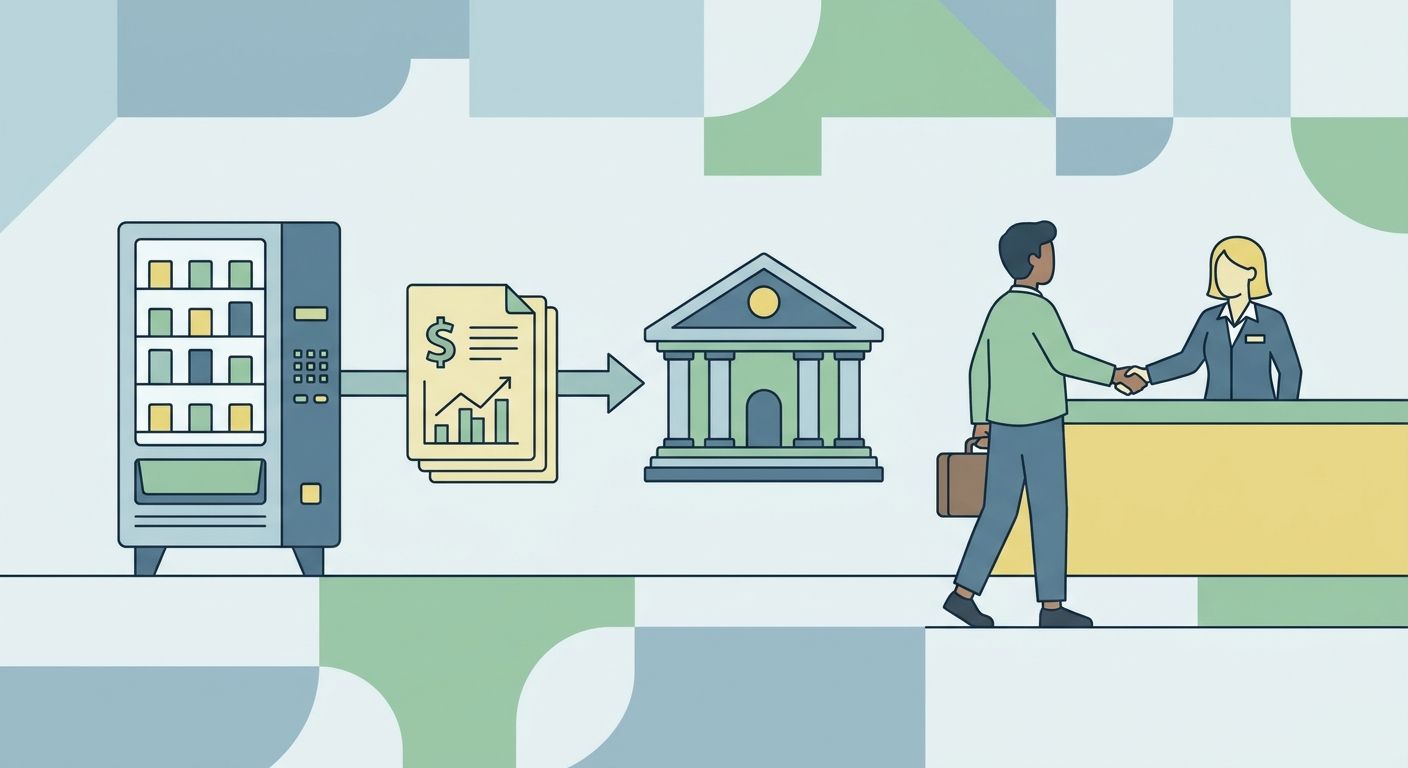
Vending machine business owners use bank statement loans to qualify for financing off deposit history instead of a tax return, because route cash and coin collections rarely match the thin net income that shows up after equipment depreciation and write-offs. An operator running machines across a dozen offices, gyms, or breakrooms needs a program built around irregular collection schedules and cashless processor payouts, not one designed for a salaried W-2 buyer.
TL;DR
- Bank statement loans for vending machine business owners use 12 or 24 months of deposits instead of tax returns to qualify in 2026.
- Loanguys underwrites vending route income off actual bank deposits, so equipment depreciation and write-offs don't sink an application.
- Separating route collections from personal spending before you apply speeds approval more than any other single step.
- No-doc business loans and asset-based lending against machines remain the backup path when statement history is too thin.
Why bank statement loans matter for vending machine business owners
Vending route income looks inconsistent on paper even when the business is stable. Cash pulled from coin boxes, checks from host-location commissions, and cashless processor settlements from vendors like Cantaloupe or Nayax all land in an account on different schedules, and a lender reading a standard debt-to-income snapshot sees noise instead of a pattern.
A tax return also understates what a vending operator actually brings in. Section 179 deductions on new machines, vehicle mileage for route servicing, and depreciation on a growing fleet routinely push net income on a Schedule C well below what the business deposits every month. That mismatch is the exact reason bank statement loans exist, and it's why more route operators get approved for a bank statement loan as a business owner than they do for a conventional mortgage or SBA product built around a 1040.
In 2026, most bank statement programs still land in the same range as five years ago: 12 or 24 months of statements, gross deposits counted before a lender applies an expense ratio. What changes for vending owners specifically is how much of that deposit total comes from cash versus a processor settlement, and that split is what an underwriter scrutinizes first.
Bank statement loans for vending machine business owners work best when route collections are consolidated into one account and cashless processor deposits are clearly labeled — a messy account with commingled personal spending is the single biggest reason applications stall.
Separate personal and business deposits
A lender reading twelve months of statements needs to see route revenue, not a blend of route revenue and personal spending. Clean this up before you apply, not after a loan officer asks for an explanation letter.
- Open a dedicated business checking account that receives every route collection
- Route host-location commission payments into that same account
- Stop depositing personal Venmo, Zelle, or paycheck transfers into the vending account
- Move owner draws out on a fixed schedule so deposits read consistently month to month
- Reconcile cash collected against machine telemetry or DEX vending reports monthly
Calculate your effective qualifying revenue
Most bank statement lenders total qualifying deposits across the statement window and back out anything that isn't operating revenue. Do this math yourself before you apply so you know what number a lender will land on.
- Total qualifying deposits across the full 12 or 24-month window, not just the strongest quarter
- Exclude transfers between your own accounts and any loan proceeds
- Average the total across the entire window instead of cherry-picking the best months
- Flag any month with a lost location, weather closure, or route change so you can explain the dip in writing
Choose a 12-month or 24-month statement program
The length of the program changes both the pricing and the paperwork burden, and the right choice depends on how the route business has trended.
- A 12-month program suits an operator who added machines or locations in 2026 and wants recent growth counted
- A 24-month program suits an operator with a longer, steadier deposit history who wants a lower rate
- Ask whether the lender uses gross deposits or applies a fixed expense ratio to net them down
- Confirm down payment and reserve requirements before comparing rate quotes across lenders
Address inconsistent deposits from vending routes
Route income swings for reasons that have nothing to do with the health of the business, and an underwriter needs context, not just a number.
- Provide a route list showing machine count and location type (office, gym, warehouse, break room)
- Write a short letter explaining any location loss or new contract signed mid-year
- Separate cashless processor settlements from cash deposits so the total reads consistently
- Include the most recent, strongest statements first if the program allows a rolling window
Track your monthly cash flow before you apply
A lender averages your deposits over the entire statement window, which means one slow month three statements back can drag down what you qualify for. Vending operators who reconcile route collections weekly rarely get surprised by that average; the discipline of tracking your business cash flow throughout the year is what keeps a strong quarter from being erased by a slow one that happened months earlier.
- Log collections by route weekly instead of waiting until tax season
- Watch for host-location contracts that pay net-30 instead of same-day
- Build a rolling 90-day view so a seasonal dip doesn't read like a shrinking business
- Note any one-time deposit or withdrawal so it doesn't get mistaken for recurring revenue
Compare bank statement loan lenders
Not every program treats vending revenue the same way, and the differences show up in what counts toward your qualifying total.
- Ask how many months of statements each lender requires: 12, 24, or a blended option
- Compare whether cashless processor deposits count the same as cash deposits
- Check whether the lender wants a business license or route contracts as backup documentation
- Loanguys reviews vending and other cash-heavy operators through bank statement loan programs built around deposit history rather than a standard debt-to-income model, alongside no-doc business loans for small business owners and asset-based lending for operators financing against machines or a route fleet
Prepare supporting documents beyond the statements
Statements alone rarely close a file. Have these ready before a loan officer asks.
- Business license or vending route/host-location contracts
- Voided business check or a bank letter confirming account ownership
- Photo ID and proof of business address
- A one-paragraph explanation for any large one-time deposit or withdrawal
Apply and lock in your terms
- Submit the full qualifying window of statements in one batch — partial submissions slow underwriting down
- Ask for a written breakdown of how your qualifying revenue was calculated
- Compare rate, term, and prepayment terms before signing anything
- Confirm whether the lender reports to business credit bureaus, which matters for future equipment financing
Comparing financing options for vending machine business owners
Bank statement loan (12-month)
- Best for: Operators who grew routes or added machines in the past year
- Key limitation: Recent months must be strong and consistent to carry the average
Bank statement loan (24-month)
- Best for: Operators with steady, longer deposit history
- Key limitation: More statements to gather and reconcile before applying
No-doc business loan
- Best for: Operators who can't produce a clean bank statement history
- Key limitation: Shorter terms and less predictable pricing than a statement program
Asset-based lending
- Best for: Operators with owned machines, vehicles, or route equipment
- Key limitation: Financing ties to equipment value, not to route revenue
SBA loan
- Best for: Operators who can document two full years of tax returns
- Key limitation: Slowest approval timeline and the heaviest paperwork of any option
Traditional bank loan
- Best for: Operators with strong net income after write-offs
- Key limitation: Most vending owners don't qualify since write-offs suppress net income
Verdict: a 24-month bank statement loan is the strongest fit for a vending operator with steady, well-documented route history; a 12-month program wins for an operator who expanded recently and wants growth counted immediately.
Talk to a bank statement loan specialist
Get your vending route deposits reviewed before you apply.
Common mistakes vending machine business owners make
- Comingling route cash with personal spending, then trying to untangle a year of deposits right before applying
- Waiting until tax season to reconcile collections, leaving months of deposits impossible to verify against machine data
- Applying with an unexplained location loss on the statements instead of attaching a short letter up front
- Assuming one strong current month offsets a thin year, when most bank statement programs average the full window
- Ignoring cashless processor deposits and only counting cash pulled from the machines, which understates real revenue
FAQ
What is a bank statement loan for a vending machine business?
It's a loan program that qualifies a borrower using 12 to 24 months of business bank deposits instead of tax returns. Vending owners use it because equipment depreciation and route expenses often make net income on a tax return look thinner than actual cash flow.
How many months of bank statements does a vending machine business owner need?
Most programs require either 12 or 24 consecutive months of statements. A 12-month program suits an operator with recent growth, while a 24-month program suits one with a longer, steadier deposit history.
Can vending income that's mostly cash still qualify for a bank statement loan?
Yes, as long as the cash is deposited into a dedicated business account on a consistent schedule. Lenders want to see the deposit pattern, not a mix of cash and undocumented personal transfers.
Is a bank statement loan better than an SBA loan for a vending machine business?
A bank statement loan is faster and doesn't require two years of tax returns, which favors an operator whose write-offs suppress net income. An SBA loan can offer better long-term pricing but takes longer and demands heavier documentation.
Do cashless vending payment processors count toward qualifying deposits?
Most bank statement lenders count settlements from processors like Cantaloupe or Nayax the same as cash deposits, as long as they land in the business account being reviewed. Confirm this with the lender before applying since treatment varies by program.
What if my vending business has seasonal dips, like fewer office locations open in summer?
Flag the seasonal months with a short explanation and let the lender average the full statement window instead of judging the business off one slow quarter. A rolling 90-day cash flow view during the year makes this easier to document.
Can I get a bank statement loan for a vending machine business under an LLC?
Yes, most bank statement programs work with LLC-owned businesses as long as the account statements clearly belong to the business entity applying for financing.
One last thing
Vending machines have shifted heavily toward cashless payments over the past several years, and those processor settlements post on a far more predictable schedule than loose coin-box cash. If your fleet has moved toward cashless in 2026, ask your lender whether that processor data can supplement thinner cash deposits on your statements — it often strengthens a file instead of complicating it, since a predictable settlement pattern is easier for an underwriter to verify than cash pulled at irregular intervals.


