


Best commercial loans for triple net lease properties

Best overall for stabilized properties: bank portfolio loans. Best for long-term holds with strong tenants: life insurance company loans. Best for properties needing a transition: commercial bridge loans. This 2026 guide compares five triple net lease financing options by lease strength, repayment structure, and exit flexibility—not by lender advertising.
TL;DR
- Bank portfolio loans are the default triple net lease financing option for stabilized properties needing negotiated terms.
- Life insurance company loans suit long-term NNN property holds with strong tenants and durable leases.
- CMBS loans suit stabilized commercial properties when borrowers accept structured servicing and restrictive exits.
- Credit tenant lease financing depends on enforceable lease obligations and the credit of the actual tenant guarantor.
- Loanguys is a mortgage broker for investors seeking guidance on investment-property loan programs; confirm commercial NNN eligibility first.
Why this matters
A triple net, or NNN, lease generally assigns property taxes, insurance, and maintenance expenses to the tenant. Those are 3 expense categories, not a guarantee that the owner has no remaining obligations. Roof, structure, capital replacements, and casualty provisions depend on the actual lease.
Financing follows those obligations. A lender evaluates both the real estate and the income contract supporting repayment, including who owes the rent and what happens if that party stops paying.
Loanguys offers investment-property loan programs, including bridge and DSCR loans. For commercial triple net lease financing, confirm property eligibility before treating any advertised program as a fit.
What makes the best triple net lease financing?
Use these criteria to compare proposals in 2026:
- Tenant credit: Identify the legal tenant and guarantor, not just the business name on the building.
- Lease durability: Review remaining enforceable lease term, termination rights, rent changes, and renewal provisions.
- Debt coverage: Measure net operating income against required debt payments after owner-paid expenses and lender adjustments.
- Maturity alignment: Compare the loan payoff date with lease expiration and your intended sale date.
- Exit flexibility: Read prepayment, assumption, release, and refinance provisions before choosing a structure.
- Property reuse: Evaluate whether another tenant can use the building if the current occupant leaves.
The best NNN loan fits the enforceable lease term, not the longest possible renewal scenario. An unexercised renewal option is not the same as committed rental income.
Triple net lease financing options at a glance
These are financing categories, not named lender offers. Each serves a different ownership plan.
Bank portfolio loan
- Best for: Stabilized properties needing negotiated terms
- Standout feature: Direct negotiation with the balance-sheet lender
- Key limitation: Recourse and maturity requirements need scrutiny
Life insurance company loan
- Best for: Long-term holds with strong tenants
- Standout feature: Long-term permanent financing structures
- Key limitation: Selective property and tenant underwriting
CMBS loan
- Best for: Stabilized properties suited to standardized execution
- Standout feature: Securitized commercial mortgage structure
- Key limitation: Restrictive prepayment and structured servicing
Credit tenant lease financing
- Best for: Transactions supported by qualifying tenant credit
- Standout feature: Underwriting centered on enforceable lease payments
- Key limitation: Narrow tenant-credit and lease requirements
Commercial bridge loan
- Best for: Lease-up, repairs, or near-term transitions
- Standout feature: Temporary financing before a defined exit
- Key limitation: Repayment depends on completing that transition
1. Bank portfolio loans: best for negotiated commercial terms
A bank portfolio loan stays on the lender's balance sheet rather than being originated for securitization. The bank evaluates property cash flow, collateral, borrower strength, and the banking relationship.
For a stabilized NNN property, this is the sensible starting point when you want to discuss structure directly with the lender. Negotiable does not mean unrestricted; the written proposal controls.
Bank portfolio loan pros:
- Direct discussion of recourse, reserves, and loan covenants.
- A relationship-based review of borrower and property strengths.
- Room to discuss lease-specific issues before committing to a structure.
Bank portfolio loan cons:
- Personal guarantees can expose assets beyond the property.
- A balloon maturity creates a refinance obligation before amortization ends.
- Financial reporting and covenant compliance continue after closing.
Ask whether the proposed loan term extends beyond the tenant's firm lease obligation. Also distinguish the amortization schedule from maturity: a slowly amortizing loan can still require a substantial balance payoff much earlier.
Best for: A stabilized property where the borrower values direct negotiation and understands the guarantee requirements.
Verdict: Buy when the written terms fit the lease and ownership plan; hold if repayment depends entirely on a tenant renewal.
2. Life insurance company loans: best for long-term NNN holds
Life insurance companies invest in commercial mortgages as part of their investment portfolios. Their permanent financing structures suit borrowers seeking to hold income-producing real estate over an extended period.
A durable lease, credible tenant, and marketable property support the case. This route is less suitable when your plan depends on near-term redevelopment or frequent ownership changes.
Life insurance company loan pros:
- Permanent financing suited to a long-term ownership strategy.
- Fixed-rate structures that make scheduled debt service predictable.
- Underwriting focused on durable property income and collateral quality.
Life insurance company loan cons:
- Property, location, and tenant selection can be restrictive.
- Prepayment provisions can conflict with an early sale.
- Lease rollover and specialized buildings require close review.
For a 2026 acquisition, map each contractual rent change against the proposed debt schedule. Predictable debt payments do not solve a lease that ends before the loan or allows the tenant to terminate early.
Best for: A long-term holder purchasing a stabilized property with a strong tenant and an enforceable lease.
Verdict: Buy when the expected hold and prepayment provisions align; skip when an early sale is central to the plan.
3. CMBS loans: best for structured permanent financing
Commercial mortgage-backed securities, or CMBS, loans are originated for securitization. Loan documents establish servicing, reporting, cash-management, and borrower obligations within that structure.
CMBS belongs on the shortlist for stabilized commercial properties when the borrower accepts a more rules-driven loan. It is not interchangeable with a relationship bank loan.
CMBS loan pros:
- Permanent financing for qualifying income-producing commercial properties.
- Nonrecourse structures, subject to specified exceptions and guarantees.
- Documented assumption procedures that support a sale when requirements are met.
CMBS loan cons:
- Defeasance, lockouts, or other prepayment restrictions can limit exits.
- Lease changes and property actions can require formal consent.
- Cash-management triggers can restrict distributions to the owner.
Nonrecourse does not mean no personal liability under every circumstance. Review the carve-out guaranty, which identifies conduct or events that trigger liability, with commercial real estate counsel.
Best for: A stabilized investment whose owner accepts formal servicing and has no planned early refinance.
Verdict: Buy only after reviewing exit provisions and cash-control triggers; skip if frequent changes are likely.
4. Credit tenant lease financing: best for qualifying tenant credit
Credit tenant lease, or CTL, financing places particular weight on the credit supporting contractual rent payments. The tenant's obligations, lease enforceability, and payment structure are central to the transaction.
A recognizable retail sign does not establish qualifying credit. A local franchise entity is not automatically backed by the national franchisor.
Credit tenant lease financing pros:
- Connects underwriting closely to the lease payment obligation.
- Suits transactions with strong, enforceable tenant-credit support.
- Encourages detailed alignment between rental receipts and debt repayment.
Credit tenant lease financing cons:
- Tenant credit and lease requirements narrow the eligible pool.
- Termination rights and landlord obligations can undermine the structure.
- Legal and document review is central, not incidental.
Read the signature block, guaranty, amendments, and assignment provisions together. A corporate name elsewhere in the transaction does not substitute for an enforceable payment obligation.
Best for: A property with qualifying tenant credit and lease documents that support a credit-focused financing structure.
Verdict: Hold until the lender confirms both tenant-credit eligibility and acceptable lease language.
5. Commercial bridge loans: best for a defined property transition
A commercial bridge loan provides temporary financing before a sale, refinance, or stabilization event. It fits an NNN acquisition when a specific issue prevents permanent financing today.
Examples include unfinished repairs, a lease amendment awaiting execution, or a tenant transition. The commercial property bridge loan guide explains the acquisition route in more detail.
Commercial bridge loan pros:
- Separates the acquisition from the later permanent-financing decision.
- Accommodates a defined transition rather than requiring completed stabilization.
- Supports a business plan with identifiable milestones.
Commercial bridge loan cons:
- Maturity creates a deadline for sale or refinancing.
- Extension rights depend on the loan documents and required conditions.
- An incomplete transition can leave the borrower without the planned exit.
Before selecting a bridge loan in 2026, identify the permanent lender's requirements. An unsigned lease amendment is not a completed refinance strategy.
Loanguys offers bridge loan programs; confirm that the specific commercial property, tenancy, and proposed exit meet program requirements.
Best for: An investor resolving a documented, temporary obstacle to permanent financing.
Verdict: Buy only with a credible exit and sufficient liquidity; skip when the plan is simply to refinance later.
How these financing options are ranked
The order prioritizes stabilized-property fit, lease durability, borrower control, and exit compatibility—not quoted interest rates. Bank portfolio loans lead as the starting point for negotiated terms; the remaining categories win for distinct transaction needs.
This is a structure-based comparison, not a claim that a particular lender has approved your property. Tenant credit, collateral, and final documents determine suitability.
Check these risks before requesting proposals
Tenant credit
Obtain the tenant's exact legal name, available financial statements, payment history, and guaranty documents. Separate the operating entity from any parent or franchise affiliation.
With 1 tenant supplying 100% of contractual base rent, tenant departure removes that rent stream. Building quality alone does not eliminate concentration risk.
Lease durability
Provide the signed lease and every amendment, not just a broker summary. Highlight termination rights, purchase options, landlord repair duties, and any rent abatement provisions.
Review an estoppel certificate—a tenant statement confirming specified lease facts—and any subordination, nondisturbance, and attornment agreement with counsel. These documents address different questions and do not replace the lease.
Debt coverage
Commercial debt service coverage ratio, or DSCR, compares net operating income with required debt service. A 1.0x DSCR means those amounts are equal; it is a mathematical break-even point, not a universal approval threshold.
Ask how the lender treats reserves, owner-paid expenses, and contractual rent increases. A residential DSCR program is not automatically eligible for a commercial NNN building.
Maturity alignment
Place loan maturity, firm lease expiration, and your intended sale on the same timeline. Then identify the earliest tenant termination right.
In 2026 underwriting, distinguish signed obligations from hoped-for renewals. The difference determines whether your exit rests on committed income or a future negotiation.
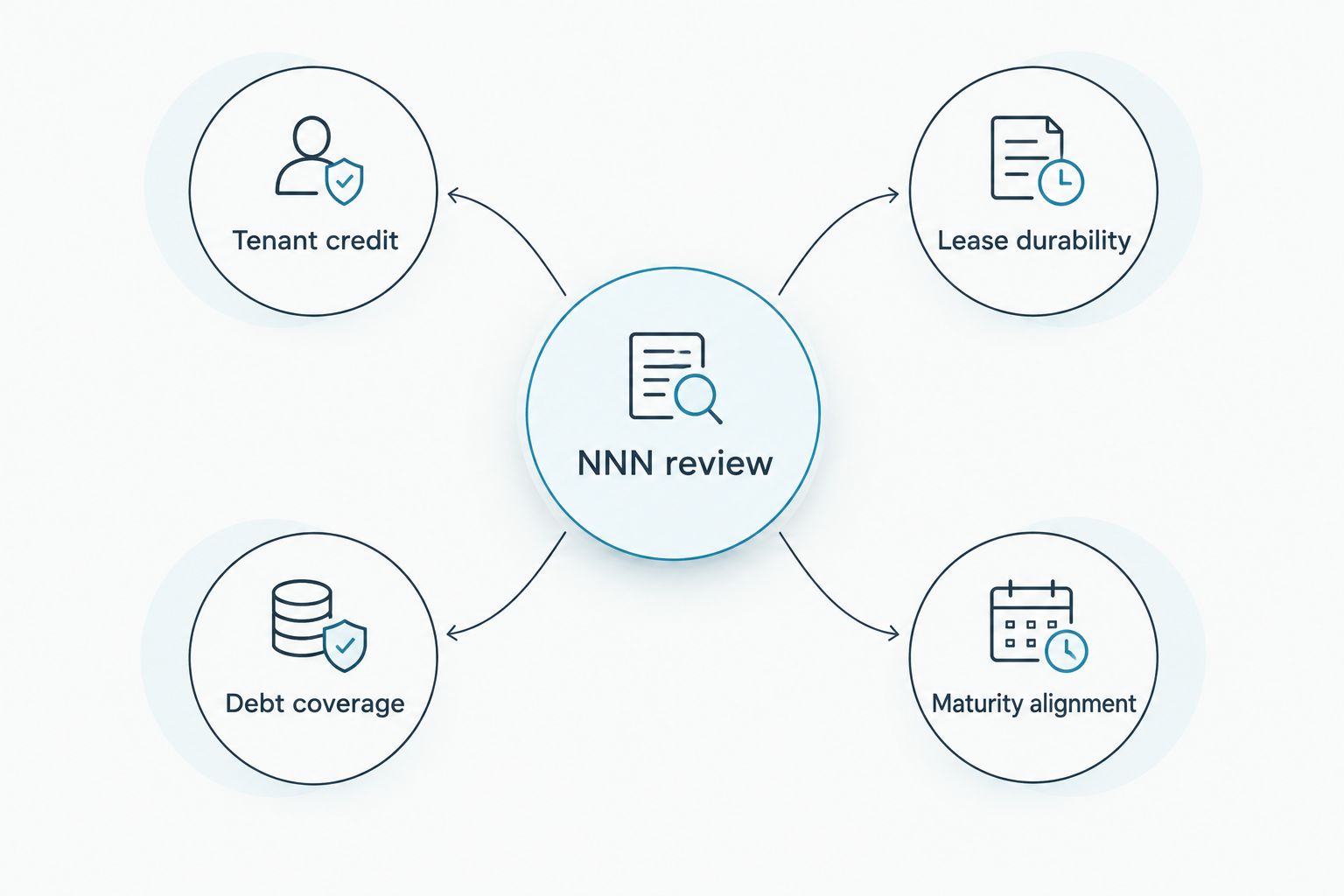
Review the tenant, lease, cash flow, and payoff timeline together before choosing a loan.
Property reuse
Assess the building without its current tenant. Layout, access, zoning, environmental conditions, and permitted uses affect replacement demand.
Request the lender's property-condition and environmental diligence requirements before committing to a closing date. A signed lease does not remove collateral risk.
Which commercial loan should you choose?
Start with a bank portfolio proposal for a stabilized NNN acquisition. Compare a life insurance company proposal when a long hold and strong tenancy support permanent financing. Consider CMBS when structured servicing is acceptable, CTL when tenant credit supports it, and bridge financing only for a defined transition.
Keep the comparison consistent. Give each lender the same lease package, operating information, borrower details, and ownership plan, then compare guarantees, reserves, maturity, prepayment, and consent requirements side by side.
Loanguys can discuss its investment-property programs with you. State clearly that the collateral is commercial NNN property and request confirmation of eligibility before proceeding.
Discuss your property financing
Share the property type, lease details, and intended exit to discuss loan-program eligibility.
FAQ
What's the best loan for a triple net lease property?
A bank portfolio loan is the starting point for a stabilized triple net lease property needing negotiated terms. Life insurance company, CMBS, CTL, and bridge loans suit different tenant profiles and ownership plans.
Does a triple net lease eliminate landlord expenses?
No. A triple net lease generally assigns taxes, insurance, and maintenance to the tenant, but the signed lease determines remaining landlord obligations. Review roof, structure, capital replacement, and casualty provisions.
Can I use a residential DSCR loan for a commercial NNN property?
Residential DSCR eligibility does not establish commercial NNN eligibility. Confirm that the program accepts the specific commercial property type and tenant arrangement before applying.
Is CMBS better than a bank loan for NNN financing?
CMBS is better suited to borrowers who accept structured servicing and restrictive exit provisions. A bank portfolio loan is the better starting point when direct negotiation and relationship-based underwriting matter.
Does a national tenant name guarantee approval?
No. The lender evaluates the legal tenant, any enforceable guarantor, lease obligations, and property. A franchise location does not automatically carry a national company's credit support.
Can an SBA loan finance a passive triple net lease investment?
A passive NNN investment leased to an unrelated tenant generally does not fit SBA owner-occupied real estate financing. Eligible passive company arrangements follow separate requirements and do not make ordinary passive rental investments eligible.
What documents should I prepare for triple net lease financing?
Prepare the signed lease, amendments, tenant and guarantor information, operating statements, property details, and borrower financial information. The lender will specify additional requirements, including third-party reports.
Can Loanguys help me compare financing for an NNN purchase?
Loanguys is a mortgage broker offering investment-property loan programs, including bridge and DSCR loans. Ask the team to confirm commercial NNN eligibility for your specific property and transaction.
One last thing
Read the guaranty before relying on the tenant's brand name. A familiar sign identifies a business; the executed documents identify who must pay. For a 2026 purchase, have your attorney reconcile the tenant, guarantor, and lease obligations before you accept a financing commitment.


