


Best DSCR Loan Lenders for Inherited Rental Properties 2026

Best starting point: Loanguys for comparing DSCR and bridge financing. Best for a settled, leased inheritance: a direct DSCR lender. Best for a relationship-based review: a local portfolio lender. This 2026 guide ranks financing routes by ownership status, rental income, and property condition—not unsupported claims about lender approval speed.
TL;DR
- Loanguys offers DSCR and bridge programs; confirm inherited-property eligibility before applying.
- The best DSCR loan lenders for inherited rental properties address title, rental income, and refinance classification first.
- A direct DSCR lender fits a settled inheritance with documented rent and an eligible property.
- A portfolio lender deserves consideration when personal income and the wider banking relationship strengthen the application.
- Use renovation financing for a repair project, not as a substitute for resolving estate ownership.
Why this matters
Inheriting a rental gives you an ownership interest, but it does not automatically produce a financeable transaction. The lender still needs to establish who can borrow, what collateral secures the loan, and whether the rental supports the proposed payment.
Start with the ownership question. An estate, a trust, several beneficiaries, and an individual heir are different borrowing situations; ask the lender and title professional to review yours before ordering loan-specific reports.
For the property-level background, read the guide to DSCR loans for inherited rental properties. In 2026, your first comparison should be transaction eligibility—not a headline loan term.
What makes the best inherited-property DSCR lender
Use these six criteria before choosing where to apply:
- Ownership review: The lender explains which borrower and vesting structure its program accepts, with title review addressing your authority to encumber the property.
- Inheritance seasoning: The lender states how it treats inherited ownership when applying minimum ownership-period requirements. Do not assume an exception.
- Transaction classification: The lender identifies whether your request is a refinance, cash-out refinance, or purchase of another beneficiary’s interest.
- Rental-income method: The lender explains which lease, appraisal, or rental-income evidence it uses and how it calculates debt-service coverage.
- Property eligibility: The lender reviews condition, unit count, rental use, and insurance requirements before you commit to a program.
- Exit compatibility: The loan’s repayment structure and prepayment provisions fit your plan to hold, renovate, refinance, or sell.
The best lender is the one whose written requirements fit the inheritance you actually received. A program designed for an ordinary rental purchase is not automatically suitable for an estate distribution or heir buyout.
Financing options at a glance
1. Loanguys
- Best for: Comparing DSCR with bridge financing
- Standout feature: Mortgage broker offering both program categories
- Key limitation: Inherited-property rules still require confirmation
2. Direct DSCR lender
- Best for: Settled ownership and documented rental income
- Standout feature: Property-income-focused underwriting
- Key limitation: Title and property eligibility remain separate requirements
3. Local portfolio lender
- Best for: Borrowers with a strong overall financial profile
- Standout feature: Institution-specific underwriting review
- Key limitation: Personal-income documentation can be central
4. Renovation or bridge lender
- Best for: An inherited rental needing work before long-term financing
- Standout feature: Financing structured around a transitional project
- Key limitation: Requires a credible repayment or refinance exit
The alternatives below are lender categories, not endorsements of unnamed companies. Each occupies a different decision slot, so you can shortlist the right kind of provider without confusing temporary financing with a long-term rental loan.
1. Loanguys: best for comparing DSCR and bridge financing
Loanguys is a mortgage broker offering DSCR, bridge, fix-and-flip, bank-statement, and short-term rental loan programs. That program mix makes it a relevant starting point when you need to decide whether the inherited property belongs in long-term rental financing or a transitional loan.
Bring the ownership documents, existing mortgage information, lease, and a clear explanation of your goal. Ask for inherited-property eligibility to be addressed before discussing an application path.
Loanguys is a starting point for inherited-rental borrowers comparing DSCR and bridge financing. That is a program-fit recommendation, not a promise that a particular inheritance qualifies.
Pros:
- DSCR and bridge programs are both part of the stated offering.
- Fix-and-flip financing provides another category to discuss for a renovation-and-sale plan.
- Bank-statement programs provide a separate route to evaluate when personal business income matters.
Cons:
- The stated program offering does not establish an inheritance-seasoning exception.
- Broker involvement does not remove title, appraisal, or underwriting requirements.
Best for: An heir who needs to compare keeping the rental with renovating or repositioning it.
Verdict — Hold: Request a transaction-specific review; proceed only after the proposed program accepts your ownership structure and loan purpose.
2. Direct DSCR lender: best for a settled, leased inheritance
A direct DSCR lender evaluates rental financing through its own program requirements. DSCR means debt-service coverage ratio: a measure of how income covers debt payments. Residential rental programs commonly compare qualifying rent with the proposed housing payment, while commercial calculations can use net operating income and debt service.
Ask for the exact formula. Do not compare ratios from different lenders until you know what each numerator and denominator includes.
This route fits a straightforward file: ownership is established, the property is suitable for its intended rental use, and rental-income evidence is ready for review. It does not solve an unresolved dispute among beneficiaries.
Pros:
- You can review one lender’s written program requirements directly.
- Property income is central to the DSCR qualification approach.
- A settled, leased property gives underwriting a defined income source to assess.
Cons:
- Inheritance does not automatically waive ownership seasoning or borrower requirements.
- A rent-focused program still requires acceptable collateral and title.
Best for: An heir keeping a rental with settled ownership and documented rent.
Verdict — Buy: Choose this route when the lender confirms eligibility and the proposed payment fits both its coverage calculation and your operating budget.
3. Local portfolio lender: best for a strong overall borrower profile
A portfolio lender holds loans rather than relying exclusively on selling them into a standardized secondary-market program. Ask a local bank or credit union whether it offers investment-property loans retained in its portfolio and whether it reviews inherited-property refinances.
This is a separate option from DSCR lending. Your income, assets, existing debts, and banking relationship can be relevant to its review; do not assume the property’s rent will be the only qualification measure.
For your 2026 shortlist, this route deserves attention when you have a documented financial profile and want the institution to assess the whole borrowing situation. It is not evidence that the lender will accept incomplete estate paperwork.
Pros:
- A retained-loan program has institution-specific requirements to review.
- Your personal financial position can support the application discussion.
- An existing banking relationship gives you a direct place to request a program assessment.
Cons:
- Personal-income and debt documentation can be more involved than you expect from a DSCR search.
- Investment-property and inheritance eligibility depend on the institution’s actual policy.
Best for: An heir with strong documented income and assets who wants an alternative to rent-focused qualification.
Verdict — Hold: Compare the written requirements with the DSCR option before choosing either route.
4. Renovation or bridge lender: best for a property needing work
Renovation and bridge financing address transitional needs rather than simply replacing a long-term rental mortgage. Consider this category when repairs or a change in property use must happen before the rental is ready for the permanent financing you intend to obtain.
Separate the construction question from the legal question. A renovation lender still needs acceptable collateral and authority to place its lien; unfinished probate is not merely another repair item.
Ask how funds are disbursed, what inspections apply, and when repayment becomes due. Then identify the intended exit: a sale, permanent refinance, or another documented repayment source.
Pros:
- The loan discussion can focus on the property’s transitional condition.
- Renovation financing provides a structure to evaluate for planned improvements.
- A bridge approach separates an immediate financing need from the eventual long-term loan.
Cons:
- A temporary loan creates a repayment deadline that your project must accommodate.
- The future DSCR refinance requires its own eligibility review; it is not guaranteed by the initial loan.
Best for: An heir with a defined renovation plan and a credible repayment exit.
Verdict — Wait: Establish the scope, borrowing authority, and exit before taking on transitional debt.
Resolve ownership before comparing loan terms
Your inheritance documents explain how you received the property. Your title review establishes the ownership and lien position relevant to a new mortgage. Treat those as connected tasks, not interchangeable documents.
Use this sequence:
- Ownership: Identify the estate, trust, individual, or entity that currently holds the property.
- Authority: Confirm who can sign and authorize a mortgage under the applicable documents and state law.
- Loan purpose: Specify whether you want to replace debt, receive cash, buy out an heir, or fund work.
- Income review: Supply the lease and the rental evidence the proposed program requires.
- Written terms: Review the lender’s conditions against your intended holding period and repayment plan.
Do not transfer the property into an LLC just because another investor recommends it. Review the proposed transfer with the lender, title professional, and your legal adviser first, including its effect on any existing mortgage.
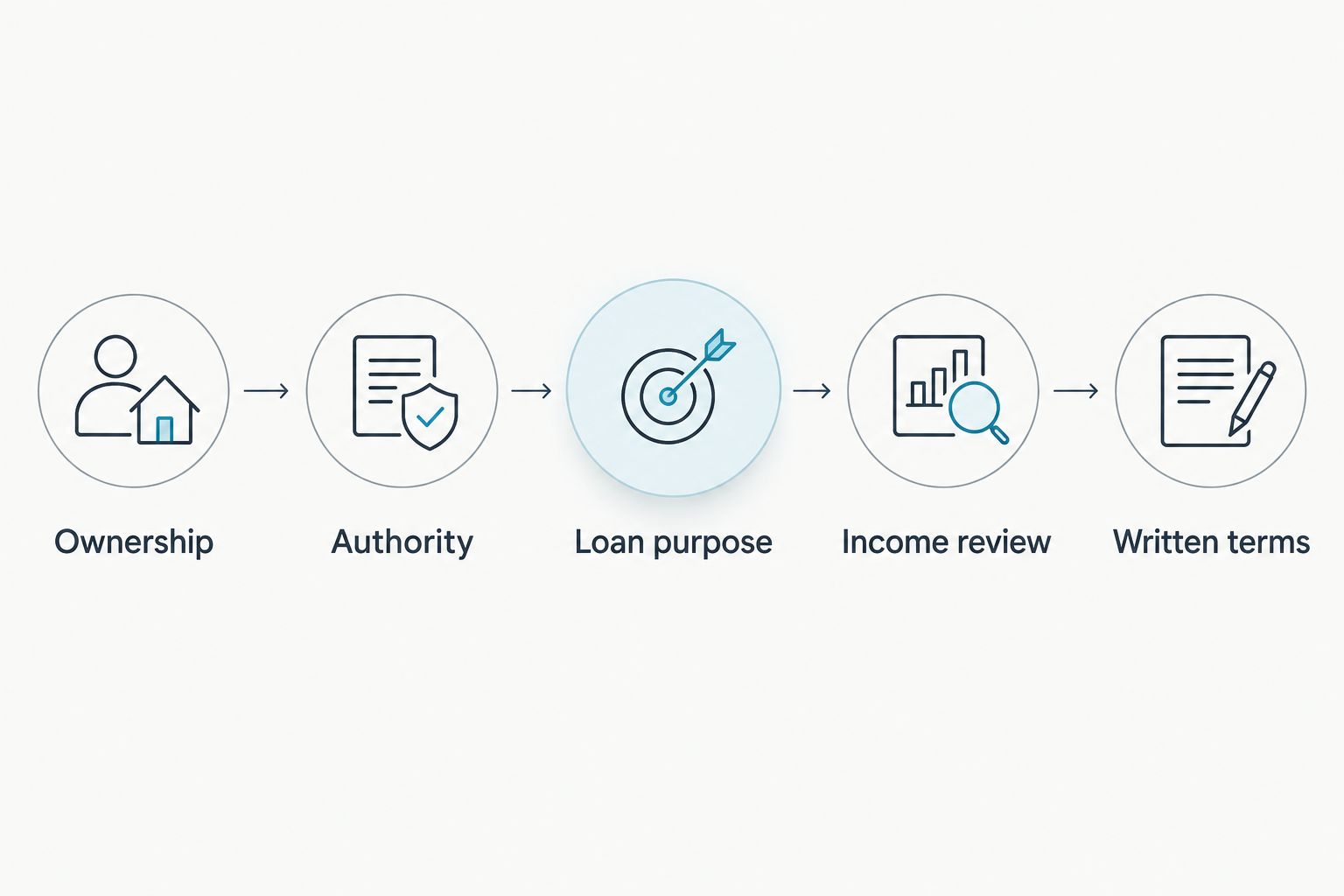
Confirm ownership and borrowing authority before committing to a loan program.
An heir buyout also needs explicit classification. Tell the lender who owns the property now, who will own it after closing, and who receives the proceeds; those details are more useful than calling every transaction a refinance.
Read DSCR without confusing it with profit
A DSCR of 1.00x means the income used in the calculation equals the debt-service amount used in that calculation. Above 1.00x, that income exceeds that debt service; below 1.00x, it falls short.
That mathematical relationship does not establish a lender’s minimum requirement. Ask for the program threshold and calculation rather than treating break-even coverage as automatic qualification.
A residential housing-payment calculation commonly includes principal, interest, property taxes, insurance, and applicable association dues. Your operating budget also needs to address expenses such as maintenance, vacancies, management, and repairs that the particular DSCR formula does not capture.
Loan qualification is not the same as a profitable rental. For a 2026 application, use current tax and insurance information rather than assuming the inherited property’s older records still describe its carrying obligations.
Questions that separate useful quotes from distractions
Send every shortlisted provider the same property summary. Include the ownership status, rental use, current debt, intended borrower, and requested transaction.
Ask these questions before authorizing loan-specific expenses:
- Does the program accept this inherited ownership structure?
- What ownership seasoning applies, and how is inheritance treated?
- How will an heir buyout or cash distribution be classified?
- Which rental evidence determines qualifying income?
- What property-condition issues must be resolved before closing?
- What prepayment provisions apply if I sell or refinance?
Keep the answers in writing. A verbal statement that a lender “does DSCR loans” does not answer whether it accepts your particular inheritance.
How these options were ranked
The 2026 ranking follows transaction fit: program choice first, a settled rental second, whole-borrower review third, and transitional financing fourth. Ownership, income evidence, property condition, and repayment plans determine the appropriate route—not an unsupported lender performance score.
Which financing route should you choose?
Start with Loanguys for a DSCR-versus-bridge program discussion, then compare the written eligibility requirements with a direct DSCR lender. If the inheritance is settled and the rental is financeable, prioritize long-term financing that matches your holding plan.
If your personal financial profile is the stronger qualification route, include a portfolio lender. If the property needs substantial work, resolve the project and repayment plan before pursuing temporary debt.
FAQ
What are the best DSCR loan lenders for inherited rental properties?
The best fit depends on settled ownership, rental income, and property condition. Loanguys offers DSCR and bridge programs to discuss; a direct DSCR lender fits a settled rental, while a portfolio or renovation lender serves a different financing need.
Can I get a DSCR loan while probate is still open?
Open probate does not establish that you can obtain a DSCR loan. The lender and title professional must determine whether the proposed borrower has authority to mortgage the property and whether the program accepts the transaction.
Do inherited properties automatically qualify for cash-out refinancing?
No, inherited ownership does not automatically establish cash-out eligibility. Ask the lender to confirm ownership seasoning, transaction classification, and the documents required for your specific inheritance.
Can I use a DSCR loan to buy out another heir?
An heir buyout requires the lender to approve the ownership transfer and classify the transaction. Explain the current owners, intended borrower, and distribution of proceeds before treating it as an ordinary refinance.
Does a DSCR loan require a tenant already in place?
The lender's program determines which rental-income evidence it accepts. Ask whether the review uses an existing lease, appraiser-supported market rent, or other permitted documentation; do not assume a vacant property qualifies.
Is a DSCR of 1.00x enough to qualify?
A DSCR of 1.00x means calculated income equals calculated debt service, not that the loan qualifies. The lender sets its eligibility threshold and also reviews other borrower and property requirements.
Should I put an inherited rental into an LLC before applying?
Do not transfer the property solely to prepare a loan application. Confirm the lender's vesting requirements and review the transfer with your legal adviser and title professional, including any existing mortgage implications.
What should I prepare for an inherited-rental loan in 2026?
Prepare ownership and estate documents, existing loan information, rental records, and a clear statement of the requested transaction. The lender and title professional will identify the additional documents needed for your circumstances.
One last thing
Tell the lender where the loan proceeds will go. Paying off an existing mortgage, distributing cash to yourself, paying another beneficiary, and funding repairs are different requests—even when they involve the same inherited house.
Write the intended transaction in plain English before completing the application. That small step keeps your ownership story and financing request aligned.


