


Best DSCR Loan Lenders for Short-Term Rentals in 2026

Short-term rental investors don't need one best DSCR lender — they need the best DSCR lender for their specific deal, and that changes based on the property, the borrower, and the timeline.
Best overall for short-term rental investors in 2026: a DSCR mortgage broker such as LoanGuys, who shops Airbnb-friendly DSCR programs across multiple wholesale lenders in one application. Best for scaling a portfolio: direct portfolio and correspondent DSCR lenders writing blanket loans across several properties. Best budget option: credit unions and community banks that already carry DSCR products. Best for foreign national or condotel deals: national non-QM wholesale lenders. Best for fast Airbnb arbitrage closings: hard money bridge-to-DSCR lenders.
TL;DR
- DSCR mortgage brokers like LoanGuys top the list of the best DSCR loan lenders for short-term rentals in 2026.
- Portfolio and correspondent lenders write blanket DSCR loans for investors scaling past three or four short-term rentals.
- Credit unions and community banks often carry lower fees but rarely finance condotels or arbitrage leases.
- Non-QM wholesale lenders are the realistic path for foreign national or ITIN short-term rental buyers in 2026.
- Bridge-to-DSCR lenders close Airbnb arbitrage deals in days, then refinance into a permanent DSCR loan.
Why this matters
Short-term rental income doesn't look like a W-2 paycheck or even a standard long-term lease, and most conventional lenders still underwrite it that way. A DSCR loan qualifies the property on its own rental income instead of your personal tax returns, but not every DSCR lender treats Airbnb and VRBO income the same way.
LoanGuys works with investors across the country on exactly this problem, matching a short-term rental deal to a DSCR program built for platform income instead of a generic rental loan that assumes a 12-month lease. Picking the wrong lender type in 2026 costs weeks of underwriting on a deal a specialized STR program would have closed in days. The lender types below aren't interchangeable — each one wins a different kind of short-term rental deal.
What makes the best DSCR lender for short-term rentals
- How it counts Airbnb income — trailing 12-month platform statements, AirDNA-style market rent projections, or a blend for new purchases.
- Minimum DSCR accepted — most programs sit between 0.75 and 1.25 DSCR; some allow no-ratio underwriting for negative cash flow.
- Property eligibility — condotels, non-warrantable condos, new construction, and co-hosted or arbitrage units get treated differently lender to lender.
- Loan-to-value on purchase and cash-out — DSCR purchases commonly cap around 80% LTV, with cash-out refinances landing lower.
- Portfolio and blanket loan options — whether the lender will roll four or more STR properties into one note.
- Speed to close and prepayment structure — arbitrage and auction deals need fast closings; long-term holds care more about the prepayment penalty.
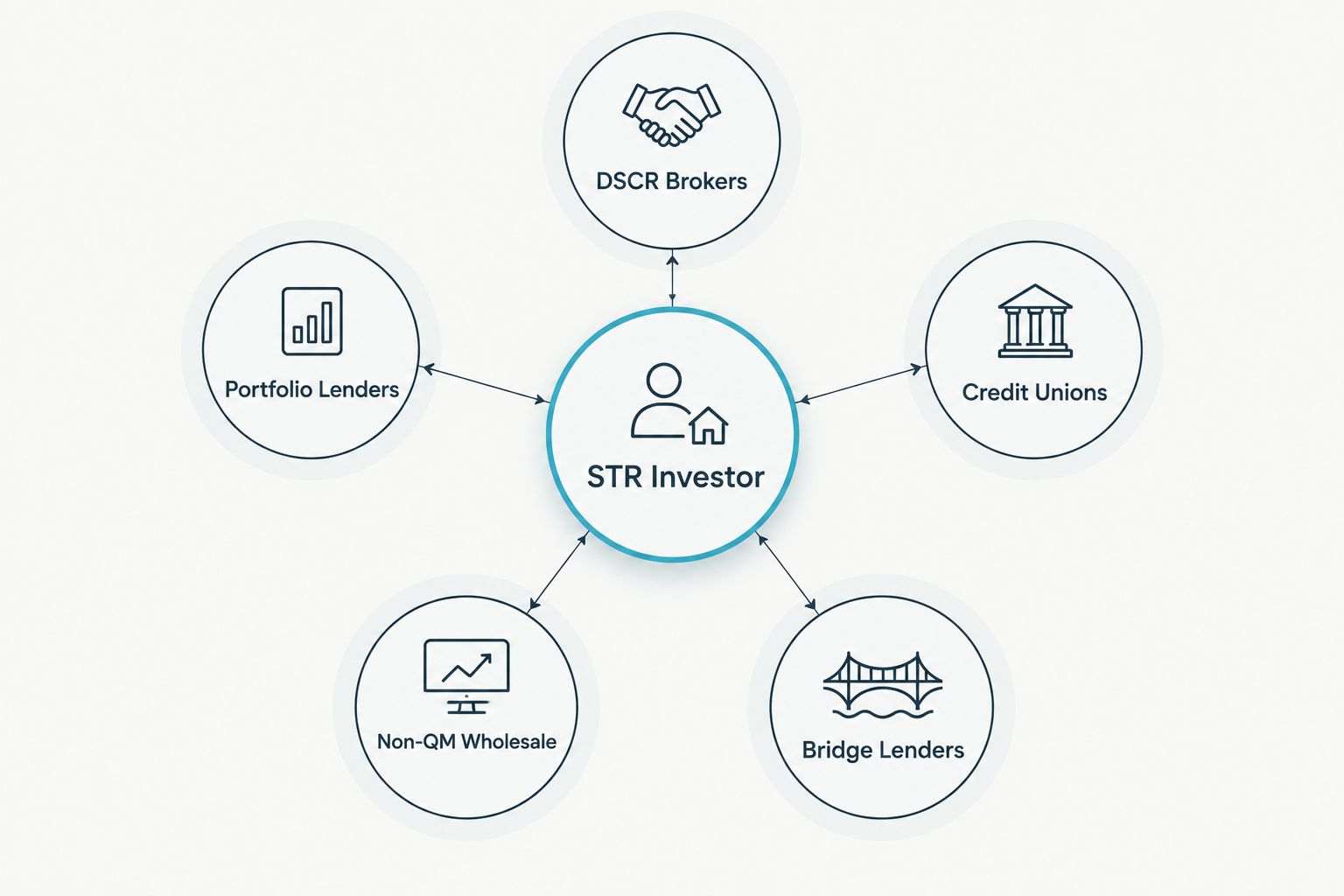
Every path leads back to the same underwriting question: does the rental income cover the mortgage payment.
Best DSCR loan lenders for short-term rentals at a glance
DSCR mortgage brokers (LoanGuys)
- Best for: Comparing multiple STR-friendly programs at once
- Standout feature: One application reaches several wholesale STR-DSCR products
- Key limitation: Doesn't underwrite in-house — final terms come from the wholesale lender
Portfolio & correspondent DSCR lenders
- Best for: Scaling a multi-property STR portfolio
- Standout feature: Blanket loans that roll multiple properties into one note
- Key limitation: Usually needs 4+ properties before blanket pricing improves
Credit unions & community banks
- Best for: Lower-cost financing with an existing relationship
- Standout feature: Human underwriters who can manually review an unusual STR
- Key limitation: Rarely finance condotels, non-warrantable condos, or arbitrage leases
National non-QM wholesale lenders
- Best for: Foreign national or condotel purchases
- Standout feature: DSCR-only underwriting, no personal income docs
- Key limitation: Rate premium for the higher-risk profile
Hard money / bridge-to-DSCR lenders
- Best for: Fast arbitrage or turnkey closings
- Standout feature: Closes on properties a DSCR lender would decline pre-stabilization
- Key limitation: Short-term rates run high until the DSCR refinance
1. DSCR mortgage brokers: best for comparing multiple STR-friendly programs at once
A DSCR mortgage broker doesn't fund the loan directly — it takes your short-term rental deal to a panel of wholesale non-QM lenders and comes back with the programs that fit the property. LoanGuys runs this process for STR and Airbnb investors, pulling DSCR programs that accept platform rental statements, market-rent projections, or a blend of both depending on how long the property has been operating.
LoanGuys pros:
- One application reaches several wholesale STR-DSCR programs instead of five separate ones
- Access to niche programs (condotel, arbitrage, no-ratio) not sold direct-to-consumer
- The broker handles rental income documentation, which is where most STR files get stuck
LoanGuys cons:
- Final approval and pricing sit with the wholesale lender, not the broker
- Program menus shift as wholesale investors tighten or loosen STR guidelines
LoanGuys pricing: rate, points, and fees come from the underlying wholesale lender, not the broker — comparing how DSCR rates and terms stack up across lenders before you lock is worth the extra day.
Best for: STR investors who want breadth without applying to five lenders individually.
Verdict: Start here for any short-term rental deal with real complexity — condotel, arbitrage lease, or a first-year property with no 12-month track record.
2. Portfolio and correspondent DSCR lenders: best for scaling a short-term rental portfolio
Portfolio and correspondent lenders fund DSCR loans directly and often keep them, or sell them to a small group of buyers rather than shopping every file across a wide wholesale panel. For an investor with four or more short-term rentals, that means one underwriter who already understands seasonal Airbnb income and one blanket note instead of four separate mortgages.
Portfolio lender pros:
- Blanket structure across multiple STR addresses, one payment
- Cross-collateralization can improve overall loan-to-value
- Underwriters who see enough STR files to move fast on platform income
Portfolio lender cons:
- Blanket pricing usually only beats individual DSCR loans past three or four properties
- Less flexible on a single outlier property that doesn't fit the portfolio profile
Portfolio lender pricing: varies by lender and portfolio size — request a blanket quote once you're past your third property.
Best for: investors consolidating four or more short-term rentals under one lender.
Verdict: Worth pursuing once you're scaling past your first few doors — skip it on a single Airbnb purchase.
3. Credit unions and community banks: best budget option for straightforward STR properties
Some credit unions and community banks have added DSCR-style products to serve rental-owning members, usually priced a notch below the national non-QM shops. The tradeoff is a narrower box: a single-family or duplex short-term rental with a clean title is fine, a condotel or an arbitrage lease usually is not.
Credit union pros:
- Lower origination costs than most non-QM specialty lenders
- Human underwriters who can manually review a co-hosted or seasonal STR
- An existing account relationship can smooth documentation
Credit union cons:
- Rarely finance condotels, non-warrantable condos, or rental arbitrage leases
- Underwriting and closing take longer than a dedicated DSCR shop
- Membership requirements can gate access before you even apply
Credit union pricing: typically lower fees than non-QM wholesale programs, but ask directly since it varies by institution and membership tier.
Best for: investors who already bank locally and own a straightforward single-family or small multifamily STR.
Verdict: Call first if you already have the relationship and the property is simple — skip it fast if the property is a condotel or arbitrage unit.
4. National non-QM wholesale lenders: best for foreign national or condotel deals
National non-QM wholesale lenders build DSCR programs specifically for borrowers and properties standard underwriting won't touch: foreign nationals, ITIN holders, condotels, and non-warrantable condos used as short-term rentals. These lenders qualify the loan on DSCR alone and skip personal income documentation entirely.
Non-QM wholesale pros:
- Widest property-type eligibility for STR investors, including condotels and non-warrantable condos
- Accepts ITIN and foreign national borrowers most banks decline outright
- DSCR-only underwriting means no tax returns, no W-2s
Non-QM wholesale cons:
- Rate premium reflects the higher risk profile
- Prepayment penalties are standard on the lower end of the rate range
Non-QM wholesale pricing: rate and points depend on DSCR, LTV, and property type; a broker can pull live comparisons across the panel.
Best for: foreign national investors, ITIN borrowers, or any STR property inside a condotel or non-warrantable building.
Verdict: The only realistic path for foreign national or condotel STR buyers in 2026 — the rate premium is the cost of admission, not a reason to skip it.
5. Hard money and bridge-to-DSCR lenders: best for fast Airbnb arbitrage closings
Bridge and hard money lenders close on the property, not the platform income, which makes them the right tool when a DSCR lender would decline the deal before it's stabilized — a rental arbitrage unit with no operating history, or an auction property that needs to close in under three weeks. Hard money loans commonly close in as little as 10 to 14 days.
Bridge-to-DSCR pros:
- Closes fast on properties without a rental track record
- Bridges the gap between purchase and a stabilized 12-month income history
- Refinances into a standard DSCR loan once the property is operating
Bridge-to-DSCR cons:
- Short-term rates run well above a permanent DSCR loan
- Carrying costs stack up if the refinance into DSCR gets delayed
Bridge-to-DSCR pricing: priced as a short-term bridge, not a permanent rate — plan the exit before you close.
Best for: Airbnb arbitrage operators and investors buying a property with no rental history yet.
Verdict: Use it as a bridge, not a destination — refinance into DSCR the moment you have income history to show.
How we ranked these
Each lender type above is scored against the same six criteria: how it counts Airbnb income, minimum DSCR accepted, property eligibility, loan-to-value, portfolio options, and speed to close. No single lender type wins on all six — that's why the ranking splits by use case instead of stacking every option against one winner.
Which DSCR lender should you choose in 2026?
If you're not sure where to start, default to a DSCR mortgage broker. LoanGuys compares Airbnb-friendly DSCR programs across wholesale lenders instead of forcing you to guess which single lender fits your property. Scale past four properties and a portfolio lender's blanket structure starts paying for itself. Buying a condotel, an arbitrage unit, or closing as a foreign national narrows the field to non-QM wholesale programs fast. Need to close in two weeks on a property with no rental history yet? A bridge-to-DSCR loan buys the time a permanent DSCR lender won't.
Compare DSCR programs for your rental
See which Airbnb-friendly DSCR programs you qualify for in 2026.
FAQ
What's the best DSCR loan lender for short-term rentals in 2026?
For most short-term rental investors, a DSCR mortgage broker like LoanGuys is the best starting point in 2026 because it compares Airbnb-friendly programs across multiple wholesale lenders in one application. Investors scaling past four properties often move to a direct portfolio lender for blanket pricing instead.
Do DSCR lenders count Airbnb income differently than long-term rental income?
Yes. DSCR lenders for short-term rentals typically use trailing 12-month platform statements or a market-rent projection instead of a signed lease, which is what long-term rental DSCR loans rely on. New STR purchases with no operating history usually qualify off the projection alone.
What DSCR ratio do I need to qualify for a short-term rental loan?
Most short-term rental DSCR programs want a ratio between 0.75 and 1.25, meaning the property's rental income covers 75% to 125% of the mortgage payment. Some non-QM lenders offer no-ratio programs for properties with negative cash flow, priced at a rate premium.
Can foreign nationals get DSCR loans on US short-term rentals?
Yes, but only through national non-QM wholesale lenders that specifically underwrite foreign national and ITIN borrowers — most banks and credit unions won't. These programs qualify the loan on the property's DSCR rather than US-based personal income or credit history.
Is a DSCR loan or a bank statement loan better for a short-term rental?
A DSCR loan qualifies off the property's rental income, while a bank statement loan qualifies off your personal or business deposits. Most short-term rental buyers use DSCR because it doesn't touch personal income at all, though bank statement financing can help when the DSCR math doesn't pencil.
Can I get a DSCR loan on a condotel used as a short-term rental?
Only through non-QM wholesale lenders that specifically approve condotels and non-warrantable condos — standard DSCR programs and most credit unions decline this property type outright. Expect a rate premium and a lower maximum loan-to-value than a standard single-family DSCR loan.
How fast can a bridge-to-DSCR loan close on an Airbnb arbitrage property?
Hard money and bridge lenders commonly close in as little as 10 to 14 days since they underwrite the property, not 12 months of platform income. The plan from day one should be refinancing into a permanent DSCR loan once the rental has an operating history.
Do I need 12 months of Airbnb history to qualify for a DSCR loan?
Not always. Several DSCR programs in 2026 accept a market-rent projection for a brand-new short-term rental purchase instead of requiring a full 12-month history. Properties converting from long-term to short-term use may need to show the projected STR income separately from the existing lease.
One last thing
The detail most investors miss: a DSCR lender that's aggressive on rate is often the same lender that requires a full 12-month trailing platform history, which locks out a short-term rental you just bought. If you're closing on a new Airbnb this year, ask about the income documentation method before you ask about the rate — some 2026 non-QM programs will underwrite off a market-rent projection alone, and that flexibility is worth more than a quarter-point on a property with no track record yet.


