


Best DSCR Loan Lenders for Student Housing: Fit First 2026

Best starting point: Loanguys for comparing DSCR and bridge financing paths. Best for a standard rental house: a residential DSCR lender that accepts the lease structure. Best for purpose-built student apartments: a commercial student-housing lender. This 2026 guide helps you choose the financing route before comparing individual offers.
TL;DR
- The best DSCR loan lenders for student housing accept your property type and actual lease structure.
- Loanguys offers DSCR and bridge programs; confirm student-housing eligibility before proceeding.
- Residential rentals and purpose-built student housing require different underwriting questions.
- Compare accepted rental income, repayment structure, reserves, and exit restrictions—not campus proximity alone.
Why this matters
A rental house occupied by students is not automatically the same financing proposition as a student apartment complex. Separate bedroom leases, shared utilities, academic-year occupancy, and property classification change the questions you need answered.
For your 2026 shortlist, establish eligibility before comparing terms. A financing offer does not solve your problem if the lender later rejects the way the property operates. Start with the building, leases, and documented income—not the lender's advertised headline.
The companion guide to DSCR loans for student housing near college campuses provides a focused next read. Here, the decision is which lender model belongs on your shortlist and what evidence to request before committing.
What makes the best DSCR lender for student housing
Use these criteria to screen each financing source. A strong match answers them against your actual property rather than a generic rental example.
- Property eligibility: Confirm whether the lender accepts a conventional rental, rooming-house arrangement, or purpose-built student property.
- Lease acceptance: Disclose whole-property leases, individual bedroom leases, guarantors, and any academic-year rental schedule.
- Income calculation: Ask which documented rents the lender uses and how vacancy or operating expenses affect qualification.
- Debt structure: Compare amortization, interest-only provisions, maturity, and any balloon repayment against your ownership plan.
- Cash requirements: Obtain the down-payment, reserve, and closing-funds requirements in writing before setting your acquisition budget.
- Exit restrictions: Check prepayment provisions and refinance conditions against your intended sale or refinance date.
Student-housing financing options at a glance
The ranking below is a decision tree by financing model, not a claim that every institution in a category accepts student housing. Match your property to a row, then verify the specific program.
Loanguys
- Best for: Comparing DSCR and bridge financing paths
- Standout characteristic: Mortgage broker offering both program types
- Key limitation: Student-housing and lease eligibility require confirmation
Residential DSCR lender
- Best for: Stabilized conventional rental houses and small residential buildings
- Standout characteristic: Rental-income-based qualification framework
- Key limitation: Room-by-room leases require explicit acceptance
Commercial student-housing lender
- Best for: Purpose-built student apartments
- Standout characteristic: Commercial property cash-flow analysis
- Key limitation: Detailed operating records and asset review
Portfolio bank
- Best for: Investors seeking a bank-held loan and ongoing lending relationship
- Standout characteristic: Loan retained in the bank's portfolio
- Key limitation: Property and borrower requirements are bank-specific
1. Loanguys: best starting point for comparing financing paths
Loanguys is a mortgage broker offering DSCR, fix-and-flip, bridge, bank-statement, and short-term rental loan programs to real estate investors and homeowners across the United States. For a campus-area acquisition, the relevant starting question is whether the property fits a DSCR program today or needs a different financing path before a long-term refinance.
Loanguys is best for investors comparing DSCR and bridge financing paths for a campus-area rental purchase. That recommendation concerns its stated program range; it is not a promise that a particular student-housing property qualifies.
Send the property address, legal unit count, rent roll, lease samples, and intended use together. Describe separate bedroom leases upfront. A whole-house lease and several independent room agreements should not enter the review as interchangeable arrangements.
Loanguys pros:
- Offers DSCR financing among its stated programs.
- Also offers bridge financing for a separate financing discussion.
- Serves real estate investors across the United States.
Loanguys cons:
- It is a broker, not the direct funding lender; identify the proposed lender and its conditions.
- The program list alone does not establish acceptance of student housing or bedroom leases.
Best for: Investors who want to discuss more than one stated financing path before choosing a program.
Verdict: Hold until the proposed lender confirms the property and lease structure in writing.
2. Residential DSCR lender: best for conventional campus-area rentals
A residential DSCR loan evaluates rental income against a defined debt-payment measure. The residential category generally covers 1–4 dwelling units, but unit count alone does not establish eligibility. Occupancy, legal use, condition, and lease structure still matter.
This is the first category to investigate for a stabilized house, duplex, triplex, or fourplex rented near a college. It is a closer conceptual match to an ordinary residential rental than financing designed around a purpose-built student complex.
Residential DSCR lender pros:
- Connects qualification to documented property rental income.
- Provides a relevant starting framework for conventional residential rentals.
- Lets you compare offers using a consistent property and lease package.
Residential DSCR lender cons:
- Individual bedroom leases need specific program acceptance.
- The lender's qualifying ratio does not replace your operating cash-flow analysis.
Best for: A conventional campus-area rental with documented leases and a residential property classification.
Ask the lender to explain its DSCR formula before interpreting a minimum ratio. Determine whether the denominator includes principal, interest, taxes, insurance, and association dues, and identify which rental-income figure goes in the numerator.
Verdict: Buy only after the lender accepts the actual leases and discloses its income calculation.
3. Commercial student-housing lender: best for purpose-built apartments
Commercial student-housing financing addresses an income-producing property as an operating asset. The analysis generally considers net operating income, debt service, occupancy, expenses, and the property's market position. A dedicated student complex belongs in this discussion rather than being presented as an ordinary rental house.
Properties with 5 or more dwelling units generally fall into commercial multifamily financing. Bedrooms are not automatically separate dwelling units: use the legal property records, not a count of rentable beds, to describe the asset.
Commercial student-housing lender pros:
- Provides a relevant framework for purpose-built student apartments.
- Examines operating expenses alongside rental revenue.
- Supports discussion of occupancy, leasing cycles, and property management as part of asset review.
Commercial student-housing lender cons:
- Requires a detailed property-level operating package.
- Projected occupancy does not substitute for documented performance.
Best for: Purpose-built student housing or a larger multifamily property operating as a student-focused asset.
For a 2026 acquisition, distinguish signed leases from applications, reservations, and marketing projections. Ask which of those categories the lender recognizes. Also clarify treatment of concessions, furnished units, owner-paid utilities, and any income that is not base rent.
Verdict: Buy only after underwriting reflects the property's real operating model.
4. Portfolio bank: best for a bank-held lending relationship
A portfolio bank retains a loan rather than originating it solely for sale into another lending channel. That makes the bank's own credit policy central to the transaction. Ask whether it evaluates your campus-area property through commercial cash flow, residential rental income, borrower finances, or a combination.
A portfolio loan is not automatically a residential DSCR loan. Compare the bank's actual underwriting method and repayment terms rather than treating the label as equivalent.
Portfolio bank pros:
- Provides a bank-held financing route to evaluate.
- Keeps the bank's credit requirements central to the discussion.
- Offers a relevant category for investors seeking an ongoing banking relationship.
Portfolio bank cons:
- Rental income alone does not establish borrower qualification.
- Bank-specific property requirements limit comparisons based on labels alone.
Best for: Investors who want a bank-held loan and can provide the financial documentation the bank requests.
Identify the maturity date separately from the amortization schedule. A payment calculated over a longer amortization period does not mean the loan remains outstanding for that entire period; a balloon balance creates a separate repayment obligation.
Verdict: Hold until borrower requirements, maturity, and any balloon payment fit your ownership plan.
Understand the DSCR calculation before choosing a lender
DSCR means debt service coverage ratio: the income figure accepted for underwriting divided by the debt-service figure used by the lender. Commercial property analysis commonly uses net operating income divided by debt service. Residential rental programs can use a rental-income calculation instead, so obtain the exact formula.
A DSCR of 1.00x means the qualifying income equals the debt-service amount in that calculation. It does not prove that you have covered every repair, vacancy period, management expense, or capital replacement. Keep your investment analysis separate from the lender's eligibility test.
LTV means loan-to-value ratio: the loan amount divided by the property value used for underwriting, expressed as a percentage. Ask which value the lender uses for your transaction and how that affects the cash you must contribute.
For your 2026 comparison, require each lender to show the inputs behind its result. Different income assumptions can produce different qualifying ratios for the same building, even before you compare repayment structures.
Build a student-housing loan package before requesting offers
Use this sequence to make each lender evaluate the same transaction. A consistent package exposes differences in eligibility and underwriting without confusing them with differences in your presentation.
Property classification
Provide the legal unit count, current use, relevant occupancy approvals, and any known zoning restrictions. Separate dwelling units from bedrooms. If the property operates through individual room leases, describe that arrangement explicitly rather than using only the phrase residential rental.
Lease evidence
Provide executed leases, renewal status, guarantor agreements, and a rent roll that reconciles to the documents. Identify lease start and end dates, concessions, furnished accommodation, and utility responsibilities. Keep projected rents separate from contractual rents.
Operating history
Provide available income and expense records, occupancy history, repair information, and management arrangements. Explain the summer leasing pattern using actual records. An academic calendar does not establish whether a tenant owes rent during the summer; the lease does.
Financing terms
Request written confirmation of eligibility, accepted income, required reserves, repayment structure, and prepayment conditions. Ask what remains subject to appraisal, title review, insurance, or final underwriting. Keep a conditional indication distinct from a final commitment.
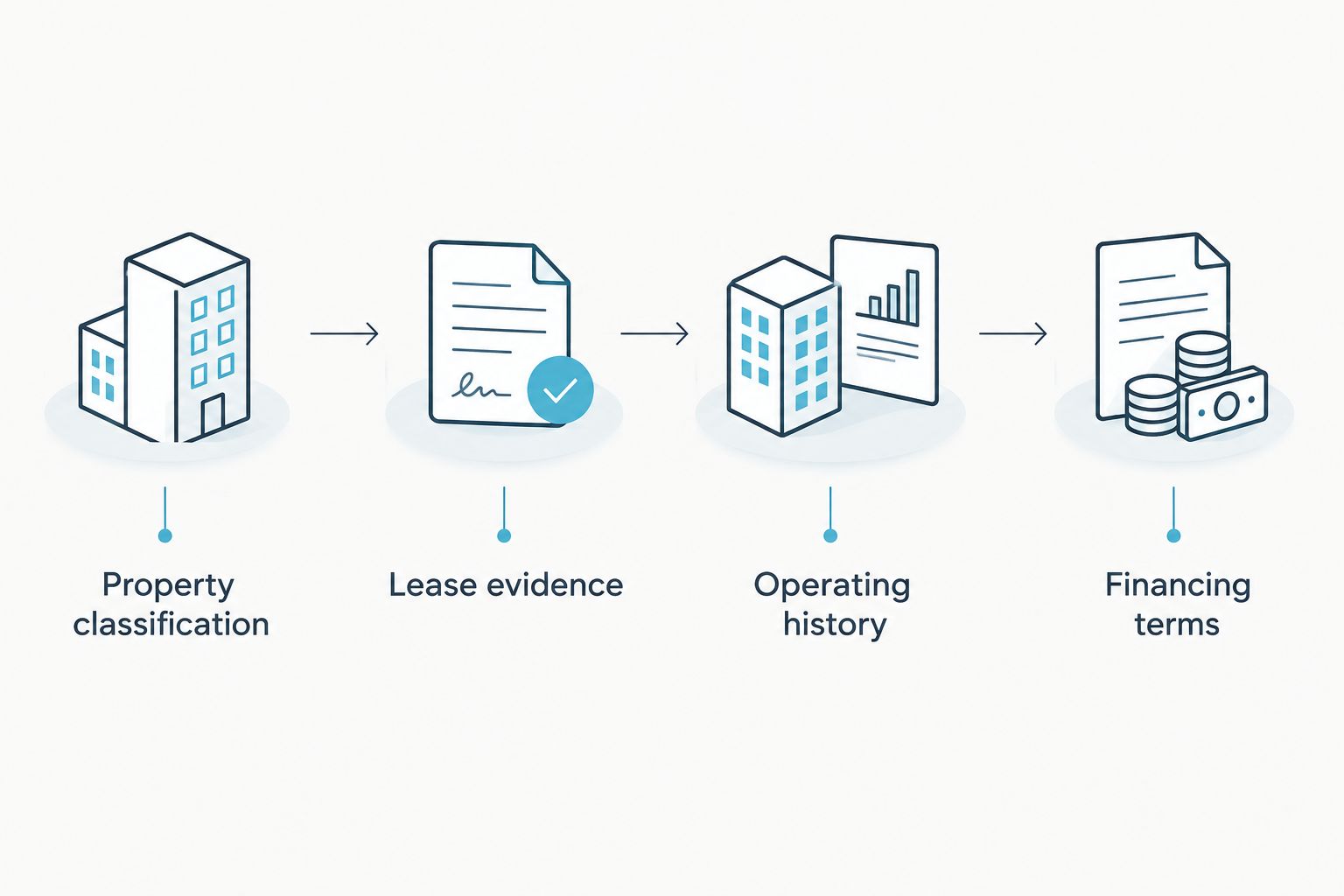
Give every lender the same property, lease, operating, and financing information.
A campus address is context, not proof of rental demand. Review the property's actual leasing record and independently verify campus access, competing rentals, and legal occupancy. Do not convert a seller's claim about walkability or student demand into an underwriting assumption.
Discuss your rental financing options
Bring your property details and lease structure to a DSCR or bridge financing discussion.
How the ranking works
The order prioritizes financing-path selection, conventional residential fit, specialized commercial fit, and a bank-held relationship. It follows the eligibility, lease, income, debt-structure, cash-requirement, and exit criteria above.
Use-case fit outranks a generic best-lender label. This guide does not rank lenders by approval speed, borrower satisfaction, or student-housing lending volume. Your written property-specific offer is the basis for the final choice.
Which student-housing financing route should you choose?
Start with the residential DSCR category when you are buying a conventional rental with an accepted lease structure. Start with commercial student-housing financing when the building operates as a purpose-built student asset. Evaluate a portfolio bank when a bank-held relationship is part of your plan.
If the property needs work or lease-up before it fits permanent financing, discuss the interim financing and refinance requirements together. A bridge loan is not a substitute for confirming the eventual exit.
For a 2026 purchase, the decisive next move is simple: send one complete property package and obtain written eligibility before selecting an offer. Choose the financing that matches the asset today and the ownership plan you can support—not an assumed future refinance.
FAQ
What's the best DSCR lender for a house rented to college students?
The best fit is a lender that explicitly accepts the house's legal use, lease structure, and documented rental income. Loanguys offers DSCR programs as a mortgage broker; ask for property-specific eligibility before proceeding.
Can I use a DSCR loan for individual student bedroom leases?
Individual bedroom leases require explicit acceptance from the proposed lender. Submit the actual lease agreements and legal occupancy information before relying on a whole-property rental estimate.
Is a student rental house the same as purpose-built student housing?
No. A conventional house rented to students and a purpose-built student apartment property have different physical and operating characteristics, so confirm the applicable financing category.
What does a 1.00x DSCR mean?
A 1.00x DSCR means qualifying income equals the debt-service amount used in the calculation. It does not establish that every operating expense or future repair is covered.
Does a DSCR loan ignore summer vacancy near a college?
Do not assume summer vacancy is ignored. Ask how the lender treats lease duration, occupancy history, and qualifying rental income, then assess vacancy separately in your investment budget.
Is a portfolio bank loan better than a residential DSCR loan?
A portfolio bank loan is better only when its property requirements, borrower review, and repayment structure fit your transaction. Compare written offers because a bank-held loan is not automatically underwritten like a residential DSCR program.
What should I send a lender for a student-housing purchase in 2026?
Send the legal unit count, property-use details, executed leases, rent roll, operating records, and purchase information. Disclose bedroom leasing, concessions, utilities, and seasonal occupancy so the lender evaluates the actual business model.
One last thing
A guarantor and an occupied bedroom answer different questions. A guarantor supports a tenant's contractual obligations; a lease documents the rent obligation and its duration. Neither should be presented as a substitute for documented collections or the lender's eligibility decision.
Before signing, ask the proposed lender to describe your property back to you in writing. The description should identify the legal units, lease arrangement, and qualifying income basis. If it describes a different rental model, resolve that mismatch before proceeding.


