


Best Fix and Flip Loan Lenders by Loan-to-Cost Ratio: 2026

Best for comparing fix-and-flip financing programs: Loanguys, a mortgage broker serving real estate investors. For the best fix and flip loan lenders by loan-to-cost ratio, rank written, property-specific offers—not advertised maximums—and choose the offer that funds your purchase and renovation without exhausting your cash reserves.
TL;DR
- Compare the best fix and flip loan lenders by loan-to-cost ratio using written terms, not advertised ceilings.
- Loanguys offers fix-and-flip loan programs; compare its proposed financing against direct-lender offers.
- Loan-to-cost measures financing against eligible project costs; after-repair value creates a separate borrowing limit.
- Choose financing that covers closing and renovation cash needs, not merely the highest stated LTC.
Why this matters
A high loan-to-cost ratio, or LTC, tells you how much eligible project spending a loan covers. It does not tell you how much money reaches the closing table or when renovation funds become accessible.
That distinction matters when you buy a property that needs work. A renovation holdback can count toward the total loan commitment while remaining unavailable until you satisfy draw conditions. Committed financing is not the same as cash available today.
For a 2026 financing decision, separate the purchase advance, renovation commitment, and borrower cash requirement. A lender ranking is useful only when those figures refer to the same property, budget, and borrower qualifications.
What makes the best fix-and-flip financing?
Use these criteria before deciding which offer belongs at the top of your shortlist:
- Comparable LTC: Require each provider to identify the costs included in its calculation.
- Closing funds: Separate the initial purchase advance from money reserved for construction draws.
- Value limits: Check whether current value or after-repair value restricts the loan below the LTC calculation.
- Draw conditions: Confirm inspection requirements, reimbursement procedures, and contractor-payment responsibilities.
- Borrower eligibility: Establish whether your experience, liquidity, credit, and ownership structure qualify for the proposed terms.
- Exit flexibility: Review maturity, extension conditions, and the requirements for selling or refinancing.
These criteria prevent a headline percentage from winning a comparison it does not deserve. They also identify the right financing channel before you spend time completing applications.
Fix-and-flip financing options at a glance
The order below is a decision sequence, not a claim that any provider has the highest verified LTC. Start with program comparison, then evaluate alternatives that match your project and investing pattern.
Loanguys mortgage broker
- Best for: Investors comparing financing programs
- Standout feature: Offers fix-and-flip and other investment-property loan programs
- Key limitation: Broker status does not establish the funding lender's approval terms
- LTC comparison requirement: Request property-specific terms and identify the funding lender
Direct rehabilitation lender
- Best for: Investors evaluating a defined renovation project
- Standout feature: Direct discussion with the proposed financing provider
- Key limitation: One provider's guidelines do not represent the entire market
- LTC comparison requirement: Separate purchase funding from renovation holdbacks
Local private lender
- Best for: Investors seeking a property-specific lending relationship
- Standout feature: Direct negotiation of the proposed transaction
- Key limitation: Terms depend on the individual lender and agreement
- LTC comparison requirement: Document eligible costs, collateral, and draw conditions
Fix-and-flip credit line
- Best for: Repeat investors comparing a recurring funding structure
- Standout feature: A framework for evaluating financing across projects
- Key limitation: A credit limit does not establish each property's borrowing amount
- LTC comparison requirement: Confirm project-level limits and concurrent-project rules
1. Loanguys: best for comparing fix-and-flip loan programs
Loanguys is a mortgage broker offering fix-and-flip, bridge, DSCR, bank-statement, and short-term rental loan programs. For a renovation-and-resale project, focus the discussion on purchase funding, the renovation budget, and your intended sale timeline.
Loanguys is a fix-and-flip financing option for investors seeking mortgage-broker guidance rather than a single direct-lender application. That positioning supports a program discussion; it does not establish an LTC advantage over another offer.
Mortgage-broker option pros:
- Gives you a starting point for discussing financing fit.
- Lets you distinguish short-term renovation financing from longer-term rental financing.
- Helps frame questions about purchase advances and renovation funding.
Mortgage-broker option cons:
- You still need to identify the funding lender and its approval conditions.
- A broker discussion does not replace a written, property-specific financing offer.
Best for: Investors who want to compare financing structures before choosing a funding provider.
Ask who makes the credit decision, who services the loan, and who administers renovation draws. Keep each answer with the proposed terms so you know which party handles a problem after closing.
Verdict: Hold until the funding lender, eligible costs, and cash requirements are documented.
2. Direct rehabilitation lender: best for a defined renovation project
A direct rehabilitation lender is the proposed financing provider rather than an intermediary arranging the loan. Compare its offer against your purchase contract, itemized scope of work, and planned exit.
Direct access is useful when you need clear answers about a specific project's underwriting. It does not prove that the lender offers higher LTC or better draw terms.
Direct rehabilitation lender pros:
- Gives you a direct route for questions about the proposed loan.
- Makes one provider's underwriting requirements easier to isolate.
- Supports a detailed comparison of purchase and renovation funding.
Direct rehabilitation lender cons:
- The provider's loan guidelines restrict the available structure.
- A total loan commitment can include renovation funds withheld from closing.
Best for: Investors with a defined property, renovation plan, and resale strategy.
For a 2026 comparison, request a written explanation of the initial advance and construction holdback. Require the lender to explain what happens if its approved renovation budget differs from your contractor's scope.
Verdict: Hold until the purchase advance and draw process fit your project cash flow.
3. Local private lender: best for a property-specific lending relationship
A private lender evaluates a proposed real estate loan under its own lending criteria. Locality alone does not establish speed, flexibility, or knowledge of your property type.
Use this channel when you want to discuss a transaction directly with a private funding source. Put the negotiated terms in writing; a relationship is not a substitute for an enforceable agreement.
Local private lender pros:
- Allows direct discussion of the proposed collateral and project.
- Gives you a defined counterparty for negotiating the loan agreement.
- Provides another financing structure to compare against institutional offers.
Local private lender cons:
- An individual lender's terms are not a market-wide benchmark.
- Informal discussions leave essential details unresolved until documented.
Best for: Investors evaluating a specific property with an identified private funding source.
Review lien priority, guarantees, funding conditions, and default provisions with qualified legal counsel. A high proposed LTC does not offset an agreement you do not understand.
Verdict: Hold until funding obligations and borrower responsibilities are explicit.
4. Fix-and-flip credit line: best for repeat-project funding comparisons
A fix-and-flip credit line is a recurring financing structure rather than a named lender. Evaluate it when your business requires financing across successive renovation projects.
The facility limit and each property's permitted borrowing amount are different questions. Confirm both before treating the line as dependable project funding.
Fix-and-flip credit line pros:
- Gives repeat investors a financing structure to evaluate across projects.
- Supports discussion of concurrent-project funding requirements.
- Makes project allocation and facility capacity separate comparison points.
Fix-and-flip credit line cons:
- Each project remains subject to the agreement's eligibility conditions.
- An unused facility limit does not establish a property's approved LTC.
Best for: Repeat investors comparing a recurring funding arrangement with individual project loans.
For 2026 planning, ask how existing balances affect the next property's financing. Also confirm what happens when one project's sale is delayed while another needs renovation draws.
Verdict: Hold until project-level approvals and facility restrictions match your pipeline.
How LTC actually determines your borrowing
Loan-to-cost equals the loan commitment divided by the lender's eligible project costs. The calculation is straightforward; defining eligible costs is the important part.
Ask whether the denominator includes acquisition, approved renovation work, and any other project expenses. Do not assume every expense in your business plan belongs in the lender's calculation.
A 100% LTC commitment mathematically equals all eligible costs in that denominator. It does not automatically cover excluded expenses or make every committed dollar accessible at closing.
Likewise, 100% renovation financing describes the approved renovation portion, not necessarily the acquisition advance. Treating it as full-project financing confuses two different measurements.
100% loan-to-value, or LTV, means the loan equals the property value used in that calculation. LTV measures value; LTC measures cost. Neither label identifies when funds become accessible.
Check the after-repair-value limit
After-repair value, or ARV, is the estimated property value after the planned improvements. A loan agreement can impose an ARV-based limit alongside an LTC limit.
Where both apply, the tighter constraint determines the permitted commitment. A high LTC ceiling does not override a lower value-based limit.
Compare the approved loan amount—not just the maximum ratio printed in a program summary. Ask for the valuation basis and the renovation scope supporting that amount.
Rank written offers using the same project
A defensible 2026 ranking begins with identical project information. Send each provider the same purchase contract, renovation scope, budget, ownership details, and exit plan.
Then follow this sequence:
- Define eligible costs: Record exactly which expenses each offer includes.
- Check value limits: Identify current-value and ARV constraints.
- Separate funding: Split the closing advance from the renovation commitment.
- Map draws: Identify work you must pay for before reimbursement.
- Check the exit: Review maturity and the conditions for sale or refinancing.
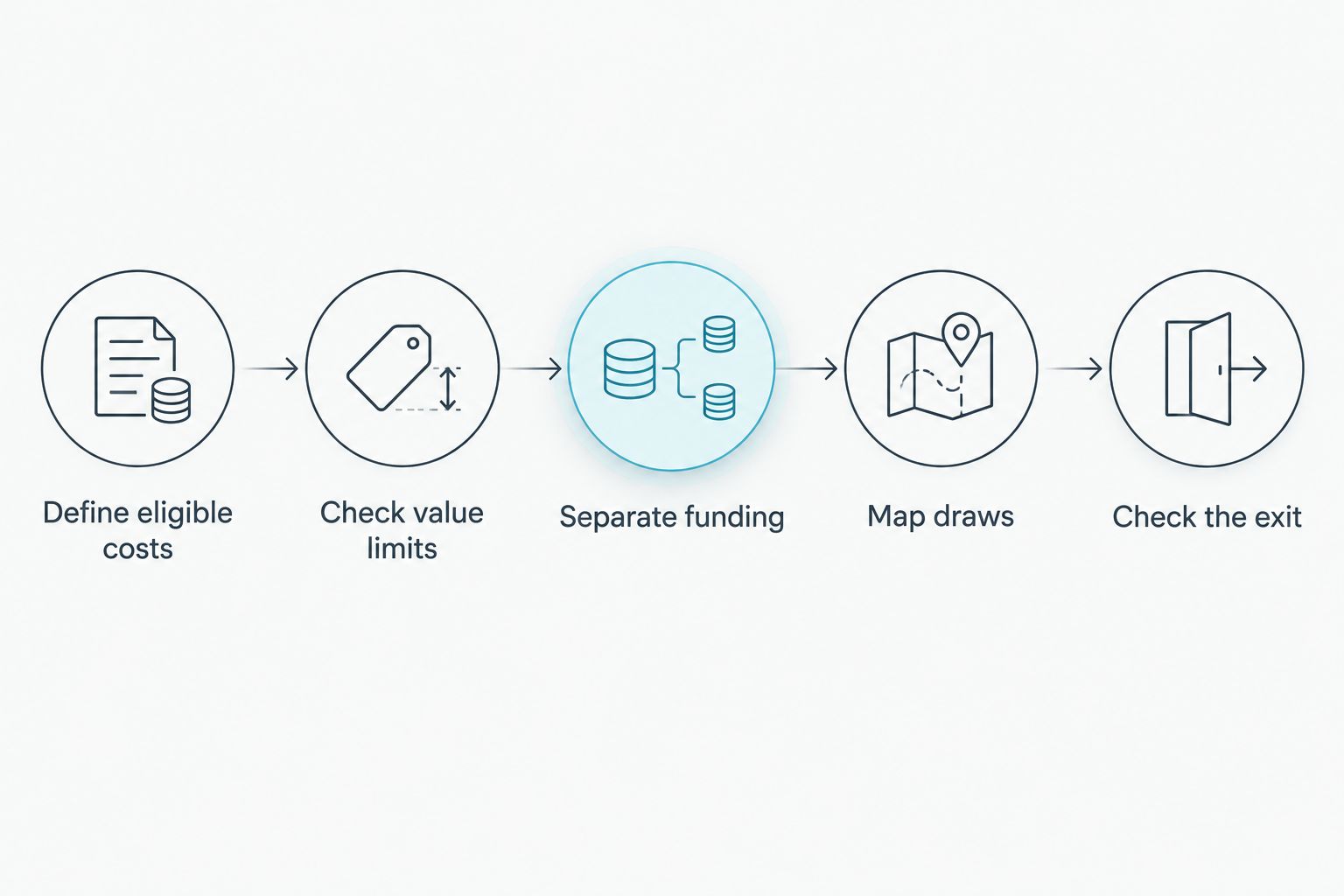
Compare the same project before ranking financing offers.
Once these details match, rank the offers by approved LTC and then test whether you can operate the project under their funding schedules. An offer that fails the cash-flow test should not remain your first choice solely because its ratio is higher.
Use the guide to compare hard money lenders before signing a term sheet when reviewing the written conditions.
How these options are ranked
The financing channels above are ordered by decision purpose: program comparison, defined-project underwriting, a private lending relationship, and recurring project funding. They are not a numerical lender leaderboard.
For an actual LTC ranking, use comparable written offers and the same eligible-cost definition. Break ties using closing cash requirements, renovation draw conditions, and exit provisions—not claims about speed or flexibility that are absent from the agreement.
Which fix-and-flip financing should you choose?
Start with the offer you can fund and execute, then use LTC to compare qualified alternatives. The highest ratio is useful only when its approved amount and funding schedule support your project.
Loanguys is a starting point for discussing fix-and-flip loan programs. Compare the proposed structure with direct financing alternatives and keep your renovation cash needs visible throughout the decision.
Before committing in 2026, obtain the written funding breakdown and understand the loan's repayment obligations. If you cannot explain how the first renovation expenses will be paid, the comparison is unfinished.
Discuss your fix-and-flip financing
Review purchase funding, renovation needs, and your planned exit before choosing a loan structure.
FAQ
What's the best way to compare fix and flip loan lenders by loan-to-cost ratio?
Compare written, property-specific offers using the same eligible-cost definition. Then check the approved loan amount, closing advance, renovation holdback, and value-based limits.
Does the highest LTC always make a fix-and-flip loan better?
No. A higher LTC does not resolve excluded expenses or renovation funds withheld until draw conditions are satisfied. Choose an offer whose cash requirements you can meet.
Is Loanguys a mortgage broker or a direct lender?
Loanguys is a mortgage broker offering fix-and-flip and other mortgage loan programs. Ask which lender funds the proposed loan and which party manages servicing and renovation draws.
What's the difference between LTC and LTV?
LTC compares the loan commitment with eligible project costs; LTV compares the loan with the property value used for underwriting. Ask which value basis applies and whether both limits restrict the loan.
Does full renovation financing cover the property purchase?
Full renovation financing describes the approved renovation budget, not the purchase advance. Request separate figures for acquisition funding, renovation funding, and borrower cash requirements.
Can a first-time flipper use the same LTC as an experienced investor?
The applicable LTC depends on the proposed lender's borrower and project requirements. Disclose your experience accurately and request written terms for your qualifications rather than relying on a program maximum.
What should I ask about renovation draws before closing?
Ask what triggers a draw, which documents are required, and whether funds are advanced or reimbursed. Also confirm inspection requirements and who pays contractors while a draw is being reviewed.
One last thing
Ask every financing provider to explain who pays for the first renovation work before the first draw is released. That question turns an abstract LTC comparison into a practical test of whether you can complete the project.
Keep the answer beside the closing funding breakdown. If either document leaves your cash obligations unclear, wait before signing.


