


Best foreign national lenders for European property investors

Best starting point for comparing loan programs: Loanguys. Best lender type for a stabilized rental: a foreign-national DSCR specialist. Best for a renovation purchase: a bridge or fix-and-flip lender. This 2026 guide compares foreign national lenders for European property investors buying U.S. real estate, with eligibility checks before you commit to a financing route.
TL;DR
- Compare foreign national lenders for European property investors by residency eligibility, property use, documentation, and repayment structure.
- Loanguys offers DSCR, bridge, fix-and-flip, bank-statement, and short-term rental programs; confirm foreign-national eligibility before applying.
- Choose a DSCR specialist for rental-income underwriting, subject to the lender’s foreign-national requirements.
- Use bridge financing only with a documented repayment or refinance plan.
Why this matters
A European passport does not identify the right mortgage program. Your residence, U.S. immigration status, income sources, ownership structure, and intended property use all belong in the initial eligibility discussion.
This guide concerns European investors purchasing property in the United States, not financing property located in Europe. It ranks financing routes by investment purpose rather than presenting an unsupported league table of individual lenders.
For a 2026 purchase, establish borrower and property eligibility before comparing proposed terms. A loan that does not accept your residency profile or rental strategy is not a useful alternative, regardless of its advertised features.
What makes the best foreign-national lender?
Use these criteria to screen lenders before submitting a full application:
- Borrower eligibility: Ask whether the program accepts your citizenship, country of residence, immigration status, and credit documentation.
- Property fit: Identify the state, property type, condition, ownership structure, and intended rental or personal use.
- Income method: Establish whether qualification uses property rent, personal income, business statements, or assets.
- Cross-border documentation: Request requirements for translations, overseas accounts, source of funds, and transfers.
- Repayment structure: Review amortization, maturity, prepayment provisions, and any balloon payment.
- Closing execution: Confirm signing arrangements, entity documents, outstanding conditions, and who coordinates closing.
Do not treat “foreign national,” “non-QM,” and “DSCR” as interchangeable labels. Foreign national describes a borrower category; non-QM describes a mortgage classification; DSCR describes a debt-service coverage measurement used in underwriting.
Foreign-national financing options at a glance
The order below matches the detailed recommendations. These are lender and broker categories, not verified offers to every European applicant.
Loanguys mortgage broker
- Best for: Comparing investment-loan programs
- Standout feature: Offers several financing approaches
- Key limitation: Foreign-national eligibility needs confirmation
Foreign-national DSCR specialist
- Best for: Stabilized rental purchases
- Standout feature: Focuses on qualifying rental income
- Key limitation: Rental coverage does not replace borrower screening
International or portfolio bank
- Best for: Relationship-based borrowing
- Standout feature: A route to discuss overseas finances
- Key limitation: Cross-border eligibility is institution-specific
Bridge or fix-and-flip lender
- Best for: Renovation and transitional property
- Standout feature: Matches financing to an interim project
- Key limitation: Requires a credible repayment exit
Short-term rental specialist
- Best for: Vacation-rental investments
- Standout feature: Evaluates the intended rental model
- Key limitation: Income evidence and permitted use require scrutiny
1. Loanguys: best starting point for comparing loan programs
Loanguys is a mortgage broker offering DSCR, fix-and-flip, bridge, bank-statement, and short-term rental loan programs. That makes the broker relevant when you need to distinguish between financing a completed rental, renovating a property, or documenting self-employment income.
Loanguys is best for investors comparing DSCR, bridge, and fix-and-flip financing routes. European applicants should first request confirmation that a program accepts their specific residence, citizenship, and transaction structure.
Loanguys pros:
- Offers several investment-property financing categories.
- Includes both rental and renovation financing programs.
- Offers bank-statement programs as another income-documentation route.
Loanguys cons:
- A broker is not the same as the institution funding your loan.
- Program names alone do not establish foreign-national eligibility.
Best for: Investors who need to identify the appropriate loan category before selecting a funding institution.
Verdict: Hold until the broker confirms a program matches your borrower profile and property.
2. Foreign-national DSCR specialists: best for stabilized rentals
A foreign-national DSCR specialist is the route to investigate when rental income is central to qualification. DSCR means debt-service coverage ratio: qualifying income divided by the debt-service amount defined by the program.
At 1.00x coverage, qualifying income equals the measured debt service. At 1.25x coverage, qualifying income is 125% of measured debt service; neither figure is a universal approval requirement.
Ask for the exact calculation. A residential rental program’s treatment of taxes, insurance, association dues, and qualifying rent matters more than the acronym.
DSCR specialist pros:
- Connects underwriting to the property’s rental-income case.
- Provides a clear framework for assessing rental coverage.
- Fits an investigation into financing for a completed investment rental.
DSCR specialist cons:
- Rental coverage does not eliminate identity, credit, or asset checks.
- Lender-calculated coverage is not your complete operating budget.
Best for: Investors buying a rental whose condition and income support long-term financing.
Verdict: Hold until the lender confirms foreign-national acceptance and its rental-income calculation.
3. International or portfolio banks: best for relationship-based review
An international bank or a bank retaining loans in its own portfolio is a route to investigate when you want an institution to review your broader financial position. Start with your existing banking relationships, then ask specifically about U.S. investment-property lending to nonresident borrowers.
Do not assume that a bank operating in Europe also provides U.S. mortgages to European residents. Separate the institution’s geographic presence from the lending entity and program handling your application.
International or portfolio bank pros:
- Offers a direct institution-level eligibility discussion.
- Gives you a route to ask about overseas income and assets.
- Allows you to explore an existing banking relationship.
International or portfolio bank cons:
- An existing account does not establish mortgage eligibility.
- International operations do not prove acceptance of your property or borrower profile.
Best for: Investors seeking a relationship-based review of their documented finances.
Verdict: Hold until the responsible lending entity confirms the transaction is eligible.
4. Bridge and fix-and-flip lenders: best for renovation purchases
Bridge financing addresses an interim funding need. Fix-and-flip financing focuses on a purchase-and-renovation project intended for resale; neither should be treated as a substitute for an unexplained long-term financing plan.
For a European investor, the critical comparison is the complete project structure: acquisition, renovation funding, draw conditions, maturity, and repayment. Ask how inspections and construction disbursements work when you manage the project from overseas.
Bridge and fix-and-flip lender pros:
- Matches the financing discussion to a transitional property.
- Makes renovation funding and disbursement conditions explicit.
- Supports comparison around a defined sale or refinance exit.
Bridge and fix-and-flip lender cons:
- Maturity creates a repayment deadline independent of project progress.
- A planned refinance remains subject to future approval.
Best for: Investors with a documented renovation scope and a credible repayment strategy.
Verdict: Skip if repayment depends entirely on an unconfirmed refinance.
5. Short-term rental specialists: best for vacation-rental investments
A short-term rental specialist is the route to investigate when your investment depends on vacation bookings rather than a conventional residential lease. Ask whether underwriting accepts the proposed use and which rental-income evidence supports qualification.
Keep personal use separate from investment use. A property you intend to occupy during holidays needs an accurate occupancy description, not a rental label chosen to fit an application.
Short-term rental specialist pros:
- Centers the discussion on your actual rental model.
- Prompts review of acceptable rental-income evidence.
- Brings occupancy and property restrictions into the screening process.
Short-term rental specialist cons:
- Projected bookings are not the same as established operating income.
- Financing approval does not establish permission for short-term rentals.
Best for: Investors whose intended use is a permitted vacation-rental business.
Verdict: Hold until both the financing assumptions and rental permissions are confirmed.
How the options are ranked
The ranking starts with program selection, then separates stabilized rentals, relationship-based borrowing, renovation projects, and vacation rentals. Each route has a different job; none replaces borrower eligibility, property review, or documented underwriting.
For your 2026 shortlist, apply the same criteria to every candidate. Compare written responses using the same borrower details, property information, ownership plan, and intended use.
Screen lenders before submitting a full application
Use this sequence to prevent a property-level discussion from running ahead of basic eligibility. Request written answers and distinguish preliminary screening from a credit decision.
- Borrower eligibility: Provide citizenship, residence, immigration status, and available credit records. Ask which documents establish eligibility.
- Property eligibility: Provide the address, condition, property type, intended use, and proposed owner.
- Income review: Identify the lender’s qualifying-income method and the evidence it accepts.
- Funds review: Explain where acquisition funds and reserves are held, including transfers between your accounts.
- Closing plan: Confirm entity requirements, signing arrangements, remaining conditions, and the repayment structure.
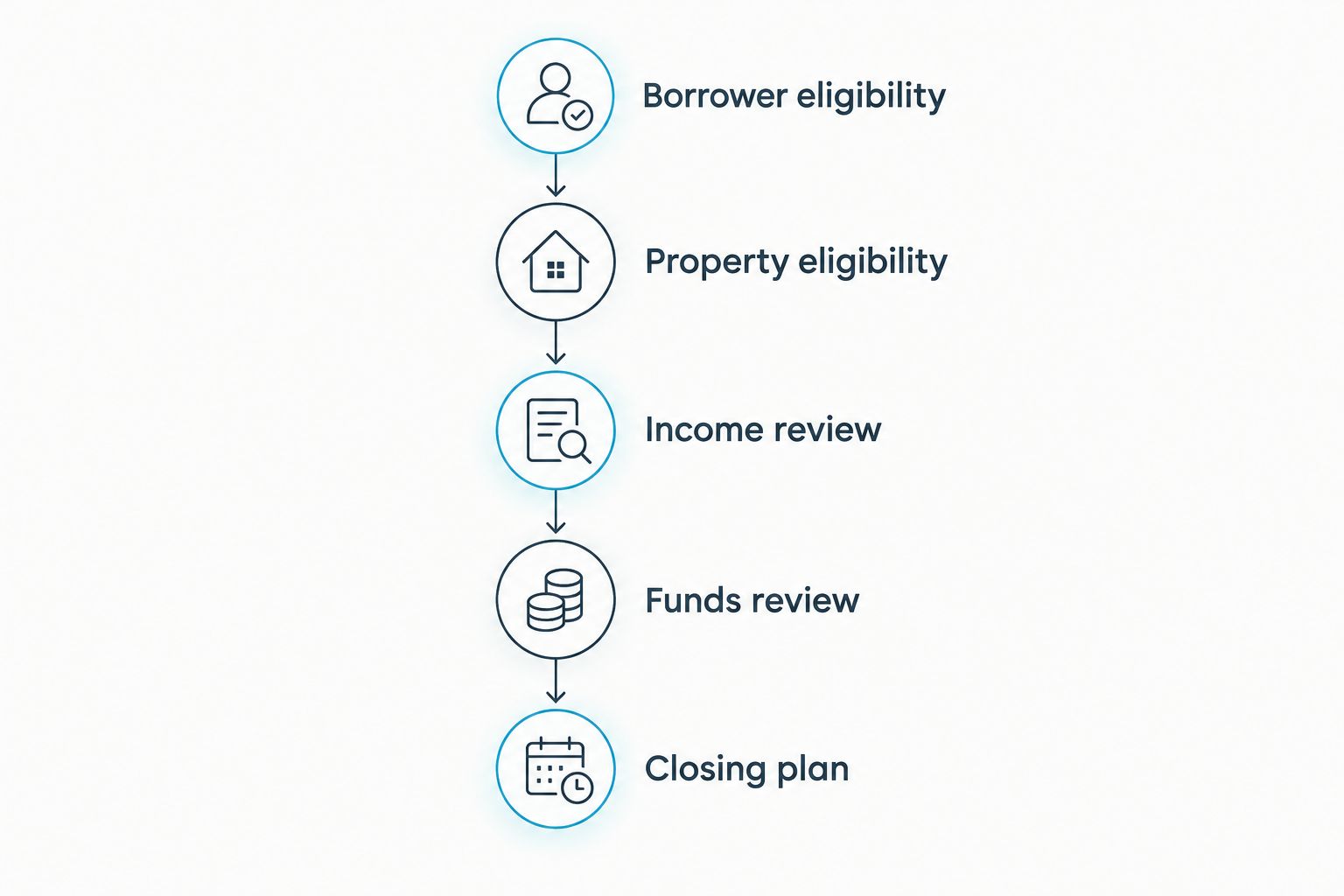
Confirm borrower eligibility before spending time on a full property-level application.
For a 2026 application, ask the lender to date its requirements and identify which terms remain subject to underwriting. Keep translations, account records, and entity documents consistent with the names appearing on your application.
Discuss your investment financing route
Explain your residence, property, rental strategy, and documentation before choosing a loan program.
Compare repayment risk, not just approval
Loan-to-value, or LTV, means the loan amount divided by the property value used for that calculation. An LTV of 100% means the loan equals that value; it does not describe whether such financing is offered or appropriate.
Request the lender’s valuation basis and distinguish LTV from loan-to-cost, which compares financing with defined project costs. For renovation loans, clarify whether a figure refers to current value, completed value, or eligible costs.
Currency exposure deserves a separate review. If your funding source is in euros, pounds, or another currency while the mortgage obligation is in U.S. dollars, exchange-rate movements change the home-currency amount needed for payments or transfers.
Before accepting terms, check:
- Maturity: When must the outstanding balance be repaid?
- Amortization: Do scheduled payments reduce principal?
- Prepayment: What happens if you sell or refinance early?
- Reserves: Which assets qualify, and where must they be held?
- Exit: What evidence supports the intended sale or refinance?
Use qualified legal and tax advisers for ownership and cross-border tax decisions. Mortgage eligibility is not a substitute for advice about the consequences of holding U.S. property.
Which financing route should you choose?
For a completed investment rental, investigate a foreign-national DSCR specialist first. If you need help distinguishing rental, renovation, and income-documentation programs, start with a broker-level eligibility discussion.
Choose a bank inquiry for relationship-based review, a bridge lender for a defined transitional project, and a short-term rental specialist for a vacation-rental strategy. In 2026, your default decision rule is simple: reject any option that cannot explain how your borrower profile, property use, and repayment plan fit together.
FAQ
What are the best foreign national lenders for European property investors?
The best route depends on the investment: investigate a foreign-national DSCR specialist for a stabilized rental, a bridge lender for renovation, or a short-term rental specialist for a vacation rental. Confirm acceptance of your residence, citizenship, and property before comparing terms.
Does a European passport qualify me for a U.S. investment mortgage?
A European passport alone does not establish mortgage eligibility. The lender must assess the borrower profile, required documentation, property, and applicable program rules.
Can I use rental income instead of European employment income?
A DSCR program evaluates qualifying property income against defined debt service. Ask whether the specific program accepts your foreign-national profile and which rental evidence it requires.
Can a European investor apply without U.S. credit history?
Ask the lender whether its foreign-national program accepts applicants without U.S. credit history. Request the exact alternative credit documentation before submitting a full application.
Is a U.S. LLC enough to qualify for financing?
A U.S. LLC does not by itself establish mortgage eligibility. Ask about entity acceptance, beneficial-owner documentation, guarantees, and borrower requirements before choosing the ownership structure.
Can I finance a property I will also use for holidays?
Disclose your intended personal use before selecting a loan program. The lender needs an accurate occupancy description, and local rental permissions require a separate review.
Should I take a bridge loan and refinance later?
Use that strategy only with a credible repayment plan. A future refinance requires its own approval, so review the bridge maturity and what happens if refinancing is unavailable.
One last thing
Passing a DSCR test does not prove that a rental will produce spendable cash. Build a separate operating budget covering vacancy, maintenance, management, repairs, and other ownership expenses, then compare it with the lender’s calculation. Underwriting eligibility and investment viability answer different questions.


