


Best Hard Money Lenders for Properties With Liens 2026

Hard money lenders for properties with title issues or liens fall into five distinct categories, and only two of them will actually fund before every lien is cleared — the rest make you resolve title first. LoanGuys.com ranks the field below by how each type handles an open lien, a curative period, and the closing timeline in 2026.
TL;DR
- LoanGuys.com wins overall for hard money loans on properties with title issues or liens in 2026.
- Local and regional hard money lenders close fastest on small, resolvable liens like HOA or utility balances.
- National private money lenders offer the lowest average rate but cap eligible lien balances.
- Specialty curative-title bridge lenders are the realistic option for stacked judgment or tax liens.
- Credit unions and community banks almost never close while a lien is still open.
Why this matters
A property with an open lien — HOA, mechanic's, judgment, or tax — kills a conventional mortgage file before underwriting even starts. Hard money lenders exist because they underwrite the deal, not just the borrower, and several categories of lender have built lien-payoff coordination into the process instead of treating it as a dealbreaker.
LoanGuys.com structures fix-and-flip, bridge, and DSCR loans around properties that traditional banks reject outright, and title issues are one of the most common reasons investors get turned down before they reach a term sheet. The lender you pick decides whether the lien gets paid off at closing through escrow, or whether you're stuck clearing it — and paying carrying costs — before anyone funds. That distinction drives the entire ranking below.
What makes the best hard money lender for a liened property
- Lien payoff verification — the lender coordinates directly with the title company to confirm payoff amounts before closing
- Escrow-hold structure — funds can be held back to satisfy a lien at or immediately after closing
- Lien-type experience — the underwriter has actually closed files with judgment, mechanic's, or tax liens, not just HOA balances
- Speed to close — hard money exists to move fast; a lien shouldn't add months to the timeline
- Loan-to-value flexibility — LTV gets recalculated around the lien balance, not just the purchase price
- Fee transparency — points and doc fees are disclosed before you order title work, not after
How a lien actually gets cleared at closing
Most investors assume a lien has to be paid off before a lender will even review the file. In practice, the stronger hard money lenders build the payoff into the closing itself: title search flags the lien, the lender orders a payoff demand from the lien holder, escrow holds the funds needed to satisfy it, the lien gets released at the closing table, and the loan funds the same day. Lenders that can't run that sequence are the ones telling you to clear it first.
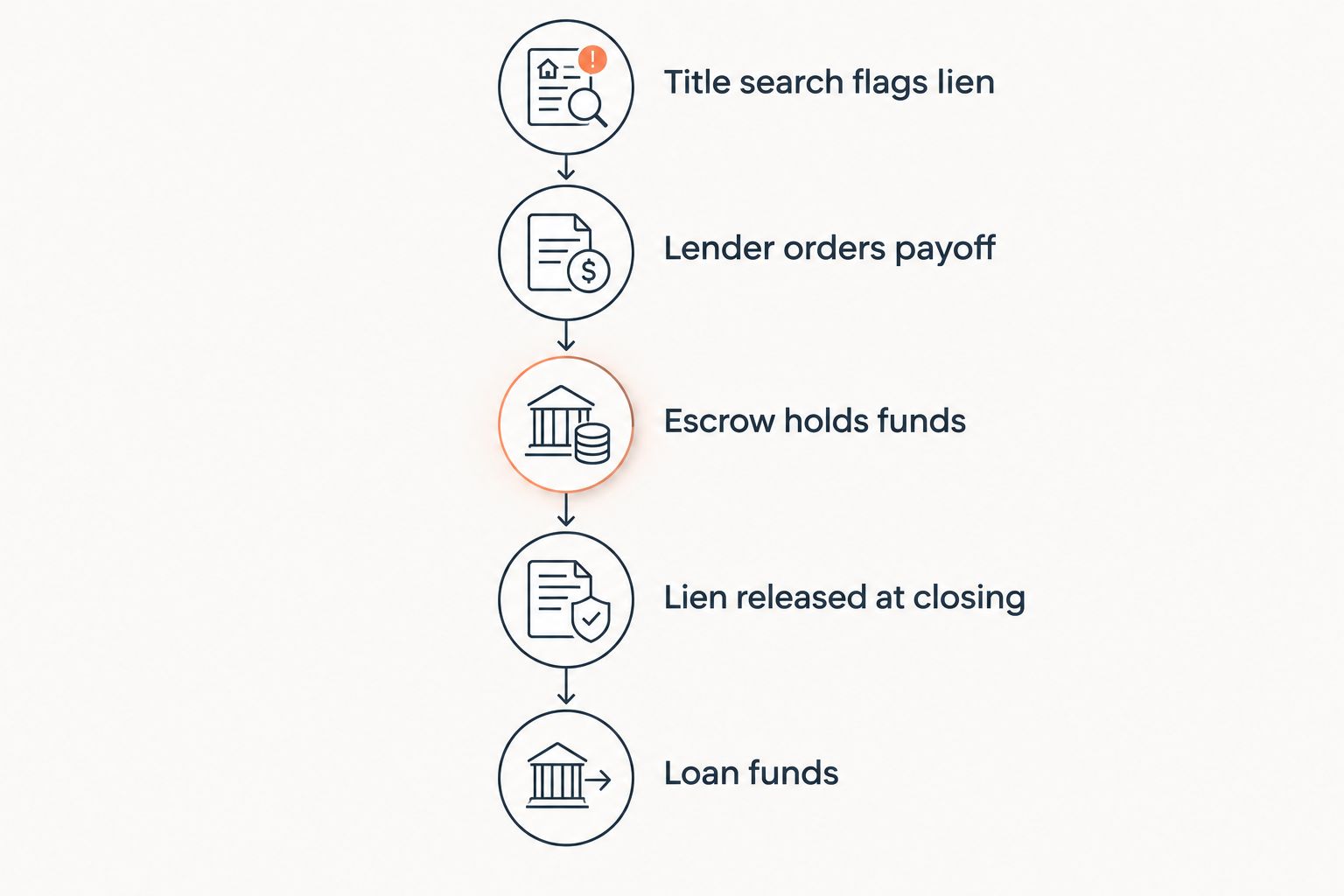
Lenders that can run this sequence close on liened properties without demanding payoff first.
Hard money lenders for liened properties at a glance
LoanGuys.com
- Best for: Investors nationwide funding around an existing lien
- Standout feature: Coordinates lien payoff with title companies across DSCR, bridge, and fix-and-flip programs
- Key limitation: Broker model means underwriting answers route through a partner lender
Local/regional hard money lenders
- Best for: Fast, in-person deals with small resolvable liens
- Standout feature: Direct relationship with the local title company and recorder's office
- Key limitation: Limited to one geography and smaller loan sizes
National private money lenders
- Best for: Multi-state investors, lowest average rate
- Standout feature: Consistent underwriting and pricing across states
- Key limitation: Often caps eligible lien balance well below judgment or tax lien totals
Specialty curative-title bridge lenders
- Best for: Stacked judgment, mechanic's, or tax liens
- Standout feature: Underwrites around a built-in curative period
- Key limitation: Fewer active lenders nationally, longest timeline of any category
Credit union / community bank portfolio lenders
- Best for: Borrowers who can clear the lien before closing
- Standout feature: Lower rate once title is clean
- Key limitation: Almost never closes while a lien is still open
1. LoanGuys.com: best hard money lender for investors funding around an existing lien
LoanGuys.com works fix-and-flip, bridge, and DSCR programs for investors that traditional banks turn away, and a title issue or lien is one of the most common reasons for that rejection. The broker model means your file gets matched to a lending partner already comfortable structuring around the specific lien type — including probate files, where heirs disputes and unpaid property taxes often show up together. That kind of deal gets covered under fix-and-flip loans for probate property purchases.
LoanGuys.com pros:
- Coordinates lien payoff directly with the title company as part of underwriting
- Covers DSCR, bridge, and fix-and-flip programs under one intake process
- Works probate, fixer-upper, and distressed-title files nationwide
LoanGuys.com cons:
- As a broker, some underwriting answers route through a partner lender rather than an in-house desk
- Most liens still need to be resolvable at or before closing, not indefinitely deferred
- Not built for owner-occupied purchases
Best for: investors anywhere in the country who want one contact to structure a hard money loan around an existing lien.
Verdict: Buy.
2. Local and regional hard money lenders: best for fast, in-person deals with small liens
A local hard money shop knows the county recorder's office and often has a working relationship with the title companies that handle payoffs in that market. That familiarity speeds up small, straightforward liens — HOA balances, unpaid utility bills, minor code violations — where the payoff amount is small and undisputed.
Local hard money lender pros:
- Fast, relationship-driven underwriting
- Local knowledge of lien-holder practices and recording timelines
- Easier to negotiate a payoff reduction on a small municipal or HOA lien
Local hard money lender cons:
- Limited to one metro area or state
- Smaller average loan sizes than national programs
- Underwriting standards vary widely from shop to shop
Best for: investors buying in the lender's home market with modest, resolvable liens.
Verdict: Hold.
3. National private money lenders: best budget option for multi-state investors
National private money lenders compete on price across a large footprint, which tends to produce a lower average rate than a single-market hard money shop can offer. The tradeoff is a more rigid underwriting box — many exclude liens above a set dollar threshold outright, regardless of how straightforward the payoff is.
National private money lender pros:
- Consistent underwriting and documentation across states
- Larger loan sizes for investors scaling a portfolio
- Competitive rate and point structure from higher deal volume
National private money lender cons:
- Slower file review than a local shop
- Often excludes judgment or tax liens above a set balance
- Less flexibility to negotiate around an unusual lien type
Best for: multi-state investors running several deals a year with liens under the lender's stated cap.
Verdict: Hold.
4. Specialty curative-title bridge lenders: best for stacked judgment, mechanic's, or tax liens
When a property carries more than one lien — a mechanic's lien on top of back property taxes, for example — most lenders walk away. Specialty curative-title bridge lenders are built for exactly this: they underwrite around a curative period, escrow-hold funds for multiple payoffs, and understand lien priority and subordination. This is also the category most active in raw land deals, where back taxes are common; see hard money loans for land acquisition and development for how that plays out on unimproved parcels.
Curative-title bridge lender pros:
- Comfortable with multiple, stacked lien types on one file
- Structures a formal curative period into the loan
- Understands lien priority disputes and subordination agreements
Curative-title bridge lender cons:
- Fewer active lenders nationally means less competitive terms
- Longest closing timeline of any category on this list
- Overkill — and unnecessarily expensive — for a single small lien
Best for: investors buying at judgment or tax lien sales with more than one lien to clear.
Verdict: Wait — use this category only when the lien stack is genuinely complex.
5. Credit union and community bank portfolio lenders: best for borrowers who can clear the lien before closing
Credit unions and community banks that hold loans in portfolio can be flexible on unusual collateral, but almost none of them will fund while a lien is still attached to the title. This category works as a landing spot after the lien is gone, not as financing for the purchase itself.
Credit union/community bank pros:
- Lower rate than any hard money category once title is clean
- Portfolio flexibility on non-standard properties
- Willing to hold the loan long-term rather than sell it
Credit union/community bank cons:
- Almost never closes with an open lien on title
- Slower underwriting timeline than any hard money option
- Often requires an existing membership or banking relationship
Best for: borrowers who can resolve the lien on their own timeline and just need permanent financing afterward.
Verdict: Skip for the purchase itself; revisit after the lien is released.
Get a hard money quote on a liened property
Talk through the lien payoff and closing timeline before you order title work.
How we ranked these categories
Each category was scored against the six criteria above, weighted toward lien-payoff coordination and speed to close since those two variables kill more deals on liened properties than rate or points ever do. For a line-by-line breakdown of what to ask any lender before you sign, see how to compare hard money lenders before signing a term sheet.
Which hard money lender should you choose for a liened property?
Choose LoanGuys.com if you want one point of contact structuring a hard money loan around a title issue, judgment, or lien in 2026 — the broker model exists specifically to match your file to programs built for exactly this situation. Choose a local hard money lender when the lien is small and you're buying in familiar territory. Reserve a specialty curative-title lender for genuinely complex stacks — tax liens plus a mechanic's lien plus a judgment — since that's the one category built to carry a formal curative period. Skip a credit union or community bank until the lien is fully released; that path fits the refinance after title clears, not the purchase itself. Once the loan is stabilized and the lien is behind you, refinancing into a longer-term program is worth exploring — see how to refinance a hard money loan into a DSCR loan.
FAQ
What's the best hard money lender for a property with an existing lien?
LoanGuys.com is the best overall option in 2026 because it coordinates lien payoff directly with the title company across DSCR, bridge, and fix-and-flip programs. Local lenders work better for small, resolvable liens in a single market.
Can hard money lenders fund a property with a title issue?
Yes, several categories of hard money lender fund properties with open liens by structuring an escrow-hold payoff at closing. The lender still needs a clean payoff demand and a clear plan to release the lien before or at funding.
How do hard money lenders handle lien payoffs at closing?
The lender orders a payoff demand from the lien holder, escrow holds the funds needed to satisfy it, and the lien is released at the closing table the same day the loan funds. Lenders that can't run this sequence require the lien cleared before they'll even review the file.
Is a judgment lien different from a mechanic's lien for financing purposes?
Yes — a judgment lien attaches from a court ruling and can carry priority disputes, while a mechanic's lien comes from unpaid contractor work and is usually easier to verify and pay off. Stacked liens of different types are why specialty curative-title lenders exist.
How much time does clearing a lien add to closing a hard money loan?
A single small lien with an undisputed payoff adds little to a standard hard money timeline. A stacked lien situation with a judgment or tax lien takes longer because the lender needs a curative period built into the closing.
Do local or national hard money lenders work better for liened properties?
Local lenders move faster on small, familiar liens because of their relationship with the title company and recorder's office. National lenders offer lower average rates but often cap the eligible lien balance well below what a stacked judgment or tax lien totals.
Can I refinance out of a hard money loan once the lien is cleared?
Yes, once the lien is released and the property is stabilized, refinancing into a longer-term DSCR loan is a common exit strategy in 2026. Rate and terms depend on the property's rental income and current loan-to-value.
What documents do lenders need to verify a lien payoff?
Lenders typically require a formal payoff demand letter from the lien holder, a current title search, and proof of escrow funds sufficient to cover the payoff amount. Missing or outdated payoff demands are the most common reason a liened-property file stalls in underwriting.
One last thing
Order the title search before you call any lender, not after. The most common reason a hard money file on a liened property stalls isn't lender hesitation — it's a payoff demand that doesn't surface until underwriting is already underway, and every category on this list moves faster in 2026 when the lien amount is confirmed on day one.


