


Best ITIN loan lenders for real estate investors

Best starting point for comparing investor loan programs: Loanguys. Best lender type for an income-producing rental: a DSCR specialist; best for self-employed income: a bank-statement specialist. When comparing ITIN loan lenders for real estate investors in 2026, confirm ITIN acceptance and investment-property eligibility before choosing a program; the broker’s listed programs alone do not establish either.
TL;DR
- Compare ITIN loan lenders for real estate investors by borrower eligibility, property use, and repayment documentation.
- Loanguys offers investor loan programs; confirm ITIN eligibility for your specific transaction before applying.
- DSCR specialists suit rental-income qualification; bank-statement specialists suit documented self-employment deposits.
- Choose rehabilitation financing for renovation projects, not as a substitute for permanent rental financing.
Why this matters
An ITIN mortgage and an investment-property mortgage are not interchangeable descriptions. A lender that accepts an Individual Taxpayer Identification Number for a primary residence does not automatically accept it for a rental purchase, refinance, or renovation project.
The IRS issues a 9-digit ITIN for federal tax purposes to qualifying individuals who need a taxpayer identification number but are not eligible for a Social Security number. An ITIN does not establish immigration status or authorize employment. Mortgage eligibility remains a separate underwriting decision.
For your 2026 lender search, borrower eligibility comes before loan structure. Confirm the identification requirements, then match financing to the property and your repayment evidence. This guide ranks lender types by use case rather than presenting unverified companies as confirmed ITIN lenders.
What makes the best ITIN investment-property lender?
Use these criteria before discussing a particular loan:
- Explicit ITIN acceptance: Get confirmation for the exact program, not a general statement about serving international borrowers.
- Investment occupancy: Specify that you will rent out the property rather than occupy it as your home.
- Property eligibility: Disclose the unit count, condition, location, and intended rental use.
- Income documentation: Establish whether qualification uses rental income, personal income, bank deposits, or another documented method.
- Ownership structure: Confirm whether you can borrow personally or through a limited liability company, and whether personal guarantees are required.
- Exit compatibility: Match the repayment schedule and refinancing conditions to your hold, renovation, or sale plan.
Ask about property size explicitly. Residential mortgage discussions commonly distinguish 1–4 housing units from buildings with 5 or more housing units; do not assume the same lender guidelines apply across that boundary.
ITIN investor financing options at a glance
These are starting points for different transactions, not verified ITIN approvals. Every option still requires program-specific confirmation.
1. Loanguys, mortgage broker
- Best for: Comparing investor loan structures
- Standout approach: Offers DSCR, bank-statement, bridge, fix-and-flip, and short-term rental programs
- Key limitation: ITIN acceptance is not established by the listed programs
2. DSCR specialist
- Best for: Qualifying an income-producing rental
- Standout approach: Evaluates rental income against debt obligations
- Key limitation: ITIN, property, and rental-income rules require confirmation
3. Bank-statement specialist
- Best for: Documenting self-employment income
- Standout approach: Reviews eligible deposits under program guidelines
- Key limitation: Deposits do not automatically equal qualifying income
4. Fix-and-flip or bridge specialist
- Best for: Financing a renovation or transitional project
- Standout approach: Matches financing to an interim property strategy
- Key limitation: Requires a credible repayment or refinancing exit
5. Portfolio lender
- Best for: Requesting review of a less-standard transaction
- Standout approach: Holds loans within its own portfolio
- Key limitation: Portfolio lending does not establish ITIN acceptance
1. Loanguys: best starting point for comparing investor programs
Loanguys is a mortgage broker serving real estate investors and homeowners across the United States. Its stated programs include DSCR, fix-and-flip, bridge, bank-statement, and short-term rental loans.
Loanguys is a starting point for investors comparing rental, self-employment, and renovation financing structures. That is a program-comparison recommendation, not a claim that the broker accepts ITIN borrowers under any particular program.
Loanguys pros:
- Lists financing structures for both rental ownership and renovation strategies.
- Offers bank-statement programs alongside property-income-focused DSCR programs.
- Serves investors across the United States.
Loanguys cons:
- The listed programs do not confirm ITIN eligibility.
- Program names do not establish property, credit, ownership, or documentation requirements for your transaction.
Best for: Investors who need to identify the right financing structure before selecting a lender.
Start the conversation with your identification type, state, property use, and purchase or refinance goal. Request an eligibility review for that combination before ordering third-party reports or relying on financing for a contract deadline.
Verdict: Hold until ITIN and investment-property eligibility are confirmed.
2. DSCR specialist: best for an income-producing rental
A debt service coverage ratio, or DSCR, compares income with debt obligations. In rental mortgage programs, lenders apply their own definitions of qualifying rental income and the payment used in that calculation.
A DSCR specialist is the appropriate starting point when rental performance is central to your qualification strategy. It is not an automatic solution for an ITIN borrower: identification, credit, reserves, and property rules still apply.
DSCR specialist pros:
- Centers the discussion on the property’s rental-income capacity.
- Provides a financing route to evaluate for a buy-and-hold strategy.
- Makes accepted rent evidence an explicit part of qualification.
DSCR specialist cons:
- Projected rent is not necessarily accepted at face value.
- Weak qualifying rental coverage can prevent the proposed structure from working.
Best for: Investors purchasing or refinancing a rental whose income can be documented under the lender’s rules.
For a 2026 application, ask whether the lender uses an existing lease, appraiser-supported market rent, or another permitted method. For short-term rentals, request the accepted income methodology separately; a vacation-rental projection is not the same document as a long-term lease.
Verdict: Hold until both ITIN acceptance and the rental-income calculation are confirmed.
3. Bank-statement specialist: best for self-employed income
Bank-statement mortgage programs assess eligible account deposits under the lender’s underwriting method. They provide a documentation route for self-employed borrowers, but they do not turn every deposit into income.
This lender type fits an investor whose qualification depends on business earnings rather than solely on the rental property. Confirm that the proposed program permits both ITIN borrowers and investment occupancy.
Bank-statement specialist pros:
- Provides an alternative way to document self-employment earnings.
- Connects qualification to identifiable account activity.
- Gives business owners a defined documentation route to investigate.
Bank-statement specialist cons:
- Transfers, borrowed funds, and other non-income deposits need explanation.
- Business expenses and ownership share affect how deposits are evaluated.
Best for: Self-employed investors with traceable business deposits who need personal-income qualification.
Ask which accounts qualify, what statement period is required, and how the lender accounts for operating expenses. Keep business and personal transfers identifiable so the same earnings are not presented twice. A large account balance alone does not establish recurring qualifying income.
Verdict: Hold until the lender confirms ITIN eligibility and explains its deposit calculation.
4. Fix-and-flip or bridge specialist: best for transitional property
Fix-and-flip financing supports a purchase-and-renovation strategy, while bridge financing addresses an interim financing need. Neither label establishes acceptance of ITIN borrowers.
Start here when the property requires work or the transaction depends on a defined transition before permanent financing. Describe the actual condition and intended exit rather than presenting the property as an ordinary stabilized rental.
Fix-and-flip or bridge specialist pros:
- Aligns the financing discussion with a renovation or transitional strategy.
- Brings the scope of work and repayment plan into the initial review.
- Helps separate acquisition financing from permanent rental financing.
Fix-and-flip or bridge specialist cons:
- A sale or refinance exit requires its own evidence and planning.
- Renovation funding procedures can create cash-management demands during construction.
Best for: Investors with a documented renovation plan and a credible sale or refinancing exit.
Request the rules for construction disbursements, inspections, extensions, and unfinished work. If your exit is a rental refinance, confirm that the future financing route accepts your borrower profile; completing repairs does not resolve identification eligibility.
Verdict: Hold until ITIN eligibility, renovation funding, and the exit strategy are documented.
5. Portfolio lender: best for a less-standard transaction review
A portfolio lender holds loans in its own portfolio rather than originating every loan for sale under a single external program. That structure makes its own lending policy the relevant starting point; it does not guarantee flexibility or approval.
Investigate this route when your transaction needs an individual policy review, such as unusual income documentation or a property that does not fit another lender’s guidelines. Ask directly whether the institution considers ITIN investment-property borrowers.
Portfolio lender pros:
- Offers a direct conversation about the institution’s own eligibility rules.
- Provides another route to investigate after a program-specific rejection.
- Lets you identify borrower and property restrictions before a full submission.
Portfolio lender cons:
- Geographic, relationship, or property restrictions can limit fit.
- Keeping loans in-house does not establish willingness to accept ITIN borrowers.
Best for: Investors seeking review of a transaction that falls outside another program’s criteria.
For your 2026 shortlist, request a precise explanation of what makes the file eligible. A general invitation to apply is weaker evidence than confirmation addressing your identification, investment use, and property type.
Verdict: Hold until the institution confirms that its portfolio policy covers your transaction.
How to screen lenders before submitting a full file
Use this sequence to avoid comparing programs that cannot finance your transaction:
- Borrower eligibility: Identify yourself as an ITIN borrower and disclose the relevant residency and documentation facts requested by the lender.
- Property fit: Provide the address, unit count, condition, occupancy, and intended rental use.
- Income review: Establish which documents and calculations will support repayment qualification.
- Written terms: Request the proposed structure, conditions, reserve requirements, and outstanding approval steps.
- Exit review: Check how repayment, sale, refinancing, or a prepayment provision interacts with your investment plan.
A written eligibility response is not a final loan approval. Keep that distinction clear when deciding whether to remove financing protections or commit additional funds.
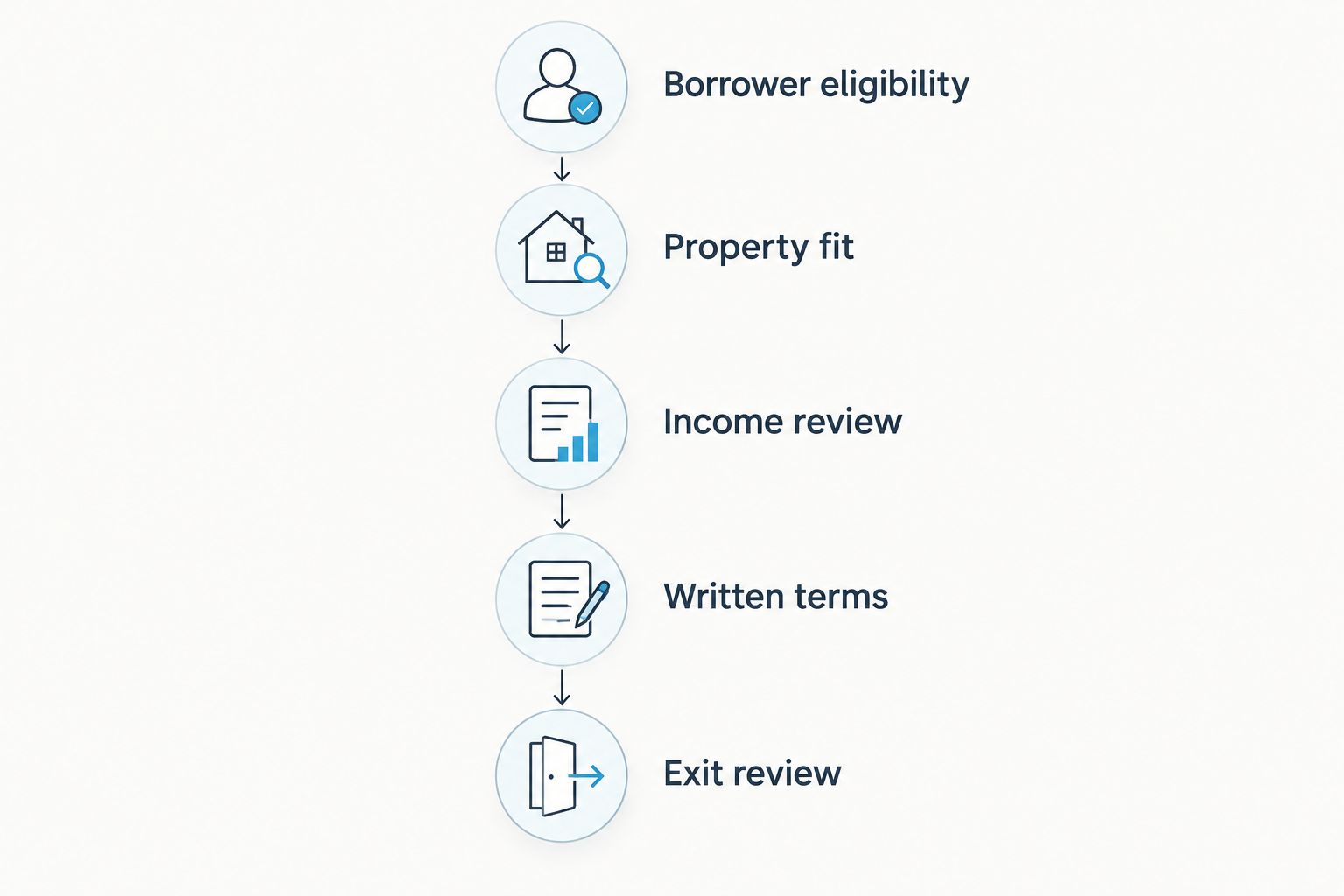
Confirm borrower and property eligibility before comparing proposed loan structures.
Send each lender the same transaction summary. Changing the occupancy description, ownership structure, or income assumptions between inquiries produces answers you cannot compare directly.
Discuss your investment financing
Ask which loan structure fits your property and whether your ITIN borrower profile qualifies.
How these options are ranked
The ranking prioritizes program comparison, then separates rental-income, self-employment, renovation, and individual-policy use cases. It does not rank approval speed, borrower outcomes, or ITIN acceptance rates.
For 2026, written transaction eligibility outranks a lender’s general product list. Apply the same criteria to every candidate: identification acceptance, investment occupancy, property fit, documentation, ownership, and exit compatibility.
Which ITIN investor financing route should you choose?
Start with a mortgage broker if you need help distinguishing financing structures. Choose a DSCR specialist for rental-income qualification, a bank-statement specialist for self-employment documentation, or a renovation specialist for a transitional property.
The default decision is simple: shortlist only providers that confirm your ITIN profile and investment transaction together. Then compare the proposed terms and remaining approval conditions. Do not choose based on a program name alone.
FAQ
What are the best ITIN loan lenders for real estate investors?
The best fit is a provider that explicitly accepts your ITIN borrower profile, investment occupancy, and property type. Compare DSCR, bank-statement, renovation, and portfolio routes according to how you will qualify and repay.
Does Loanguys offer ITIN investment-property loans?
ITIN acceptance is not established by the listed program information. Loanguys offers investor financing programs, but you should request confirmation for your specific borrower profile and transaction before applying.
Can an ITIN borrower qualify for a DSCR loan?
Qualification depends on the lender’s specific DSCR program rules, including whether it accepts ITIN borrowers. Rental-income qualification does not replace identification, credit, reserve, or property requirements.
Is an ITIN loan the same as a foreign-national mortgage?
No. An ITIN is a federal tax identification number, while foreign-national mortgage eligibility is a lender-defined borrower classification. Disclose your actual circumstances rather than assuming either label establishes eligibility.
Can I buy an investment property through an LLC with an ITIN?
The lender must approve both the ownership structure and the relevant individual borrower or guarantor profile. An LLC does not replace the identification review of the people involved in the transaction.
What documents should I prepare before contacting an ITIN lender?
Prepare your identification information, property details, intended occupancy, ownership structure, and evidence supporting income and funds. Obtain the lender’s specific checklist before sending sensitive documents through its approved submission channel.
Is a bank-statement loan better than a DSCR loan for an ITIN investor?
A bank-statement loan fits a personal-income documentation strategy, while a DSCR loan centers qualification on rental income under program rules. Neither is better until the lender confirms ITIN acceptance and evaluates your transaction.
One last thing
An ITIN is a tax identifier, not a permanent mortgage credential. Under IRS rules, an ITIN that is not used on a federal tax return for 3 consecutive tax years expires. Check its status before submitting a 2026 mortgage application, and ask the lender how renewal documentation affects its review.
Keep identification readiness separate from financing readiness. You need both a usable borrower file and a property that meets the proposed program’s requirements.


