


Best loans for assisted living and senior housing investors

Best overall for an established assisted living property: a commercial bank loan. Best for long-term healthcare-property financing: HUD Section 232. Best for eligible owner-operators: SBA financing. This 2026 guide compares loans for assisted living and senior housing investors by care model, operating history, and repayment plan—not by a universal winner.
TL;DR
- Commercial bank loans are the default loans for assisted living and senior housing investors with established operations.
- HUD Section 232 merits consideration for eligible assisted living facilities seeking long-term financing.
- SBA financing fits eligible operating businesses, not ordinary passive rental investments.
- Loanguys offers investor mortgage programs; confirm assisted living eligibility before treating any program as a financing solution.
Why this matters
Senior housing is not one lending category. An apartment community serving older residents differs from a licensed assisted living business that collects housing and care revenue. A lender must understand both the collateral and the operation.
Loanguys offers DSCR, bridge, bank-statement, and fix-and-flip mortgage programs. Those loan services are a starting point for discussing an investment property, not proof that a licensed care facility qualifies. Describe the intended use before submitting a residential mortgage application.
For your 2026 purchase, establish whether you are buying rental real estate, an operating care business, or both. That answer determines which financing conversations belong on your shortlist.
What makes the best senior housing loan?
Use these criteria before comparing lenders:
- Property eligibility: The program must accept the actual licensed use, ownership structure, and services provided.
- Cash-flow treatment: Underwriting must distinguish rental income from care revenue and recognize the associated expenses.
- Operator strength: Assisted living financing requires attention to management experience, staffing, and regulatory standing.
- Project stage: Stabilized properties, lease-up projects, renovations, and new construction need different structures.
- Repayment fit: Match maturity, amortization, guarantees, and refinancing conditions to your holding strategy.
Senior housing loans at a glance
Commercial bank loan
- Best for: Established assisted living acquisitions
- Standout feature: Underwrites the property and operating business
- Key limitation: Credit appetite and guarantees vary by lender
HUD Section 232 financing
- Best for: Eligible healthcare properties held long term
- Standout feature: FHA-insured healthcare mortgage framework
- Key limitation: Detailed eligibility and application requirements
SBA financing
- Best for: Eligible owner-operated care businesses
- Standout feature: Supports qualifying business-purpose financing
- Key limitation: Passive rental investment is generally ineligible
Commercial bridge loan
- Best for: Acquisition and operational transition
- Standout feature: Temporary financing before permanent debt
- Key limitation: Requires a credible repayment or refinance exit
Construction loan
- Best for: Ground-up senior housing development
- Standout feature: Advances funds against approved construction progress
- Key limitation: Completion and lease-up risks remain
Rental DSCR loan
- Best for: Eligible senior rentals without care operations
- Standout feature: Qualification centers on property rental cash flow
- Key limitation: Residential programs are not substitutes for care-facility financing
1. Commercial bank loans: best for established assisted living
A commercial bank loan is the default starting point when an assisted living property has documented operations and a supportable acquisition plan. The lender evaluates the real estate, business income, borrower, and operator rather than treating every resident payment as rent.
Best for: Buyers acquiring an operating facility with records that explain occupancy, collections, payroll, and care expenses.
Commercial bank loan pros:
- Fits a transaction involving both real estate and business operations.
- Allows direct discussion of operator experience and local market conditions.
- Provides a route to financing an established property without a renovation-led strategy.
Commercial bank loan cons:
- Each bank sets its own property and credit requirements.
- Guarantees, reporting requirements, and financial covenants require review.
Ask whether the proposed maturity matches the amortization schedule. A loan can have payments calculated over a longer period while requiring the remaining balance at an earlier maturity.
Verdict: Buy—prioritize commercial bank financing for an established facility, subject to acceptable underwriting and terms.
2. HUD Section 232: best for a long-term healthcare-property hold
HUD Section 232 is an FHA mortgage-insurance program covering eligible residential healthcare facilities, including assisted living. HUD's Section 232/223(f) framework addresses qualifying purchases and refinances of existing facilities; construction and substantial rehabilitation follow different program requirements.
Best for: Investors pursuing a long-term hold of an eligible assisted living facility with a qualified operating team.
HUD Section 232 pros:
- Uses a framework specifically addressing residential healthcare facilities.
- Includes financing pathways for existing properties and development projects.
- Brings property condition and operating requirements into a structured review.
HUD Section 232 cons:
- Requires specialized application preparation and lender participation.
- Does not replace state licensing or eliminate operating oversight.
HUD's Section 232 eligibility criteria generally require at least 20 beds for an assisted living facility. That is a program-specific screen, not a rule for all senior housing mortgages; confirm the applicable facility requirements with an FHA-approved healthcare lender.
For a 2026 acquisition, investigate eligibility before committing to a financing contingency that assumes this route will work.
Verdict: Buy—evaluate HUD Section 232 for eligible long-term holds; skip it when the facility does not meet program requirements.
3. SBA financing: best for eligible owner-operated care businesses
SBA financing belongs in the discussion when you are buying or expanding an eligible operating business—not simply collecting passive rental income. SBA 7(a) and 504 financing serve different purposes, so the acquisition structure matters.
Best for: An eligible assisted living business owner acquiring owner-occupied premises or financing a qualifying business transaction.
SBA financing pros:
- Separates an operating-business acquisition from a passive investment analysis.
- Offers distinct program routes for qualifying business and fixed-asset needs.
- Supports discussion of business operations alongside real estate ownership.
SBA financing cons:
- Passive rental real estate is generally ineligible, subject to specific program exceptions.
- Ownership, occupancy, business eligibility, and use-of-proceeds rules require careful review.
SBA owner-occupancy rules generally require the operating business to occupy at least 51% of an existing building. For new construction, the initial occupancy requirement is generally 60% of the building, with additional rules for future occupancy and leased space. These SBA requirements are not an approval promise for a care facility.
Verdict: Buy—screen SBA eligibility if you operate the care business; skip an ordinary passive-landlord application.
4. Commercial bridge loans: best for an operational transition
A commercial bridge loan provides temporary financing while a property moves toward a defined next stage. For assisted living, that stage might involve renovations, an operator transition, or rebuilding occupancy before seeking permanent debt.
Best for: Buyers with a documented transition plan and an identified repayment source.
Commercial bridge loan pros:
- Aligns temporary debt with a temporary property condition.
- Separates acquisition financing from later permanent underwriting.
- Creates a structure for discussing project milestones and reserves.
Commercial bridge loan cons:
- Maturity creates repayment pressure before a long-term hold is complete.
- Refinancing depends on future lender approval, not just projected improvements.
Do not equate bridge financing with permission to operate before licensing or inspections are complete. Ask the lender to identify what must be true at closing, during the transition, and before refinancing.
Verdict: Hold—proceed only after the exit, transition budget, and operating permissions are documented.
5. Construction loans: best for ground-up senior housing
Construction financing funds an approved development budget through controlled advances, commonly called draws. Senior housing development also requires coordination between the building plan and the intended operating use.
Best for: Developers with an approved project, an experienced team, and a funded completion plan.
Construction loan pros:
- Connects funding to construction progress rather than a completed-property assumption.
- Makes the budget, contractor scope, and completion conditions explicit.
- Supports planning for the transition from development to operations.
Construction loan cons:
- Delays and budget overruns put pressure on borrower resources.
- Completion does not guarantee occupancy or permanent financing approval.
For your 2026 development plan, distinguish construction completion from operating readiness. Building approval, care licensing, staffing, and resident admissions are separate dependencies.
Verdict: Hold—secure approvals, contingency funding, and a permanent-financing strategy before committing.
6. Rental DSCR loans: best for senior rentals without care operations
A rental DSCR loan evaluates debt-service coverage using property rental income under the lender's methodology. DSCR means debt-service coverage ratio: the relationship between qualifying income and the debt payments being evaluated.
Best for: Investors buying eligible rental housing for older residents where the property does not operate as a licensed care business.
Rental DSCR loan pros:
- Focuses qualification on the property's rental performance.
- Fits an investment analysis built around leases and housing income.
- Provides a relevant screening route for qualifying non-care rental properties.
Rental DSCR loan cons:
- Property eligibility differs across residential and commercial programs.
- Care-service receipts are not automatically qualifying rental income.
Loanguys offers DSCR loans, but that does not establish assisted living eligibility. Disclose the actual use, resident agreements, and services before asking whether a property fits.
Verdict: Buy—for eligible non-care senior rentals; skip residential DSCR financing as an assumed solution for licensed assisted living.
Classify the property before requesting terms
Use this sequence to prepare your financing request. Each step resolves an issue that a loan label alone cannot answer.
- Property use: State whether residents receive housing only, assistance with daily living, or nursing care.
- Operating structure: Identify the real estate owner, licensed operator, management company, and proposed borrower.
- Cash flow: Separate rent, service revenue, payroll, management expenses, and property expenses.
- Loan purpose: Define acquisition, refinance, rehabilitation, construction, or business purchase needs.
- Repayment exit: Explain whether repayment comes from ongoing operations, sale, or permanent refinancing.
The strongest application connects these facts. A rent roll does not explain an operating business, and a business profit-and-loss statement does not establish collateral eligibility.
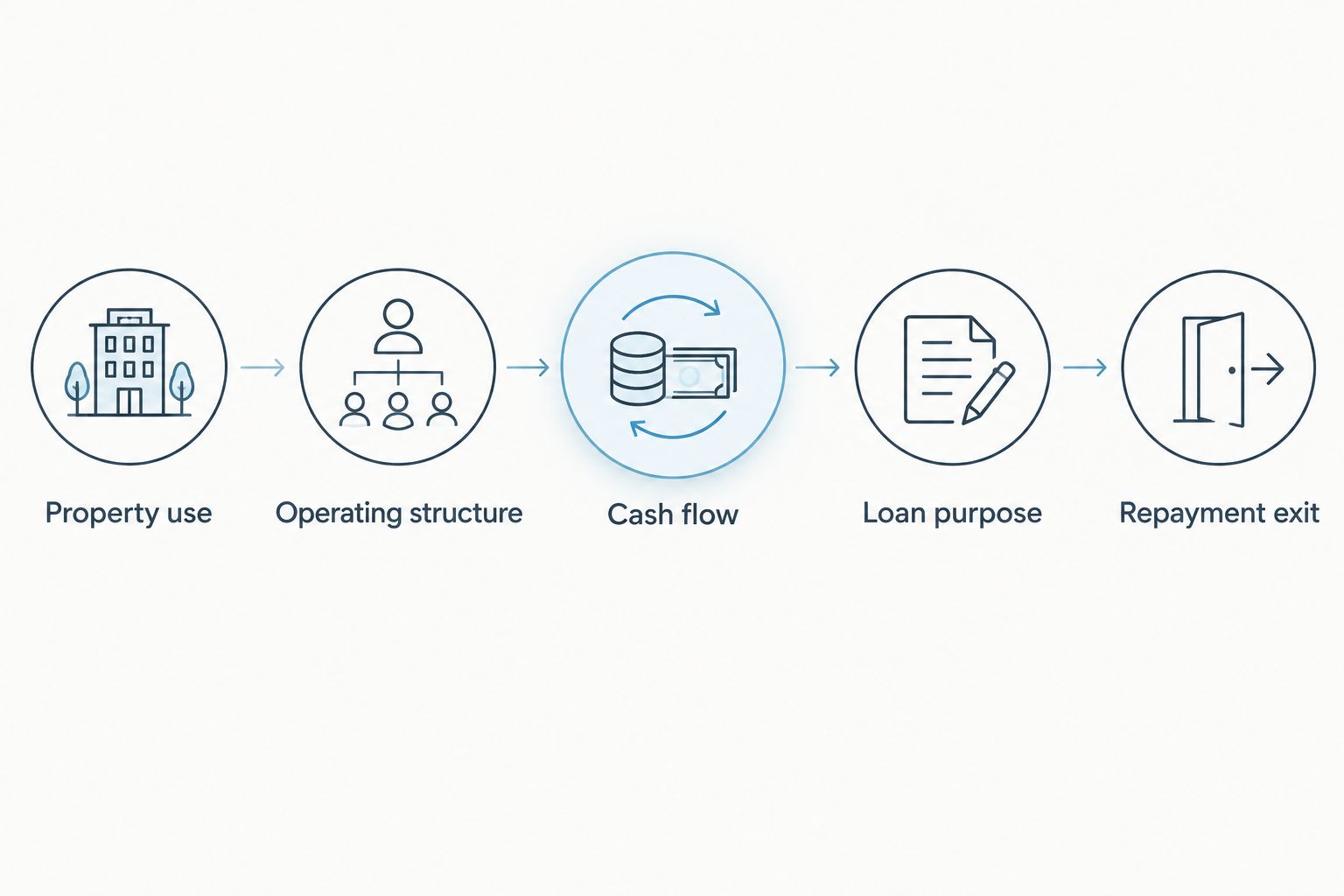
Classify the operation before choosing the financing structure.
Separate property value from business value
An assisted living acquisition can include land, buildings, equipment, and an operating business. Do not assume the entire purchase allocation supports the same mortgage amount. Ask which assets secure the loan and how the lender evaluates each component.
For a New Jersey acquisition, the scope agreed with commercial appraisers in New Jersey should identify whether the assignment addresses real estate, business interests, or a going-concern valuation. The lender's required valuation scope must match the financing decision.
Also confirm how the appraisal treats licensed capacity, occupancy, physical condition, and operator-related income. An appraisal does not replace legal review of licenses, contracts, or transfer requirements.
How these loan options are ranked
This ranking follows property eligibility, cash-flow treatment, operator strength, project stage, and repayment fit. Commercial bank financing takes the default position for an established assisted living acquisition; the other options win for distinct transaction types.
The ranking is not a lender performance score or a promise of approval. For 2026 financing, compare written proposals using the same property facts and operating assumptions.
Which senior housing loan should you choose?
Choose commercial bank financing as your first conversation for an established assisted living facility. Move HUD Section 232 higher when the property qualifies and your strategy is a long-term hold. Screen SBA eligibility when you operate the business.
Use bridge debt for a defined transition, construction debt for development, and rental DSCR financing for eligible non-care housing. Loanguys is a mortgage-broker starting point for investors exploring DSCR and bridge financing, with property eligibility confirmed first.
Discuss your property financing
Explain the property use, operating structure, and financing purpose before selecting a loan program.
FAQ
What's the best loan for buying an established assisted living facility?
A commercial bank loan is the default starting point for an established assisted living acquisition. Compare it with HUD Section 232 or eligible SBA financing based on the property, operator, and ownership structure.
Can I use a DSCR loan to buy an assisted living home?
Do not assume a residential rental DSCR loan accepts an assisted living operation. Confirm the licensed use, resident services, and income treatment with the lender before applying.
Does HUD finance assisted living properties?
HUD Section 232 provides FHA mortgage insurance for eligible assisted living and other residential healthcare facilities. An FHA-approved healthcare lender must evaluate the specific transaction and applicable program requirements.
Can SBA financing fund a senior housing investment?
SBA financing requires an eligible business structure and use of proceeds; an ordinary passive rental investment is generally ineligible. An owner-operated care business needs a separate eligibility review.
Is a bridge loan better than permanent financing for assisted living?
A bridge loan fits a defined transition, while permanent financing fits a supportable long-term hold. Bridge debt requires a documented repayment plan and does not guarantee later refinancing.
Are senior apartments financed the same way as assisted living?
Senior apartments without care operations and licensed assisted living facilities require different eligibility reviews. Age restrictions alone do not establish whether a residential or commercial loan program accepts the property.
What should I prepare before contacting a senior housing lender?
Prepare the property's actual use, licensing information, ownership structure, operating records, and transaction purpose. Separate housing income from care revenue and identify the proposed operator.
One last thing
A residential-looking building is not necessarily a residential mortgage asset. Before paying for loan-specific reports, obtain written confirmation that the lender accepts the property's actual use—not merely its address, appearance, or bedroom count.


