


Best loans for farmland and agricultural rental investors

Best overall for working farmland: an agricultural real estate mortgage. Best for leased agricultural buildings: a commercial investment-property loan. Best for negotiated purchase terms: seller financing. The best loans for farmland and agricultural rental investors in 2026 match the property's legal use, rental income, and repayment plan—not simply its rural address.
TL;DR
- Agricultural mortgages lead loans for farmland and agricultural rental investors buying productive land.
- Commercial investment-property loans suit eligible leased agricultural buildings; confirm the lender accepts their use.
- Residential DSCR loans require eligible rental housing, not merely income-producing acreage.
- Loanguys offers investment-property financing; confirm agricultural collateral eligibility before choosing a program.
Why this matters
Farmland rent, residential rent, and operating-business revenue are different repayment sources. A tenant paying to cultivate acreage does not turn that acreage into a residential rental property. Likewise, a farmhouse does not automatically make an entire working farm eligible for a residential mortgage.
Choose the property category before choosing the loan program. Otherwise, you risk submitting residential rental paperwork for a transaction that needs agricultural or commercial underwriting.
Loanguys is a mortgage broker offering DSCR, bridge, bank-statement, and other investment-property loan programs. For agricultural rental loans, confirm collateral eligibility before assuming that an income-documentation option solves a property-use problem.
What makes the best farmland investment loan?
Use these criteria to compare financing for a 2026 purchase or refinance:
- Property eligibility: Does the lender accept cultivated acreage, pasture, agricultural buildings, residential improvements, or the actual combination?
- Income fit: Does repayment depend on a land lease, building rent, residential rent, or your farming business?
- Repayment structure: Does the payment schedule match the lease's collection schedule, and when is the remaining balance due?
- Collateral review: How does the lender treat access, water rights, easements, conservation restrictions, and improvements?
- Exit flexibility: What happens if you sell, refinance, change tenants, or separate a parcel?
- Documentation fit: Can you substantiate the accepted income with leases, payment records, financial statements, or other required evidence?
A lender's willingness to review a property is not approval. Ask for the eligibility decision and required conditions in writing before committing to a financing-dependent purchase.
Farmland financing options at a glance
Agricultural real estate mortgage
- Best for: Productive farmland held long term
- Standout feature: Underwriting built around agricultural land
- Key limitation: Borrower and lease eligibility differ by lender
Commercial investment-property loan
- Best for: Leased agricultural buildings
- Standout feature: Review of commercial collateral and lease income
- Key limitation: Specialized uses need lender acceptance
Seller financing
- Best for: Purchases with a willing seller
- Standout feature: Direct negotiation of repayment terms
- Key limitation: Balloon and title risks require careful documentation
Agricultural bridge loan
- Best for: Transitional land purchases
- Standout feature: Temporary financing tied to an exit
- Key limitation: Refinancing is not guaranteed
Residential DSCR loan
- Best for: Eligible rural rental homes
- Standout feature: Qualification centered on property rental cash flow
- Key limitation: Farm rent does not establish residential eligibility
Bank-statement mortgage
- Best for: Self-employed buyers of eligible residential property
- Standout feature: Alternative personal-income documentation
- Key limitation: Does not override agricultural-use restrictions
These are financing structures, not interchangeable approvals. Start with the row matching the collateral, then compare lenders within that category.
1. Agricultural mortgage: best for long-term farmland ownership
An agricultural real estate mortgage finances qualifying agricultural land and improvements. It is the strongest starting point for productive acreage you intend to hold, whether you operate the farm or lease it to an operator, subject to lender eligibility.
Agricultural lenders evaluate the land and the repayment source. For a leased investment, ask specifically whether the lender accepts non-operating landowners rather than assuming every farm program serves passive investors.
Agricultural mortgage pros:
- Aligns the financing discussion with agricultural collateral.
- Supports review of agricultural leases and land characteristics.
- Provides a category suited to a long-term ownership strategy.
Agricultural mortgage cons:
- Individual lenders impose different borrower and property restrictions.
- Seasonal or variable lease receipts require careful cash-flow analysis.
- An appraisal must address the actual agricultural property, not just nearby home sales.
Best for: Investors acquiring productive acreage with a documented agricultural repayment source.
For a 2026 application, prepare the lease, rent-payment history, parcel information, and an explanation of who operates the land. Separate ownership income from the tenant's crop sales; the tenant's gross revenue is not your rental income.
Verdict: Buy with an agricultural mortgage when the land and borrower qualify.
2. Commercial investment loan: best for leased agricultural buildings
A commercial investment-property loan is a candidate for agricultural buildings leased to a business, such as qualifying storage or production premises. The lender must accept the building's actual use and specialized features.
This category fits a different question from farmland lending: can the leased premises support the debt, and does the lender accept the collateral? A business lease alone does not answer either question.
Commercial investment loan pros:
- Centers the review on commercial property and its income.
- Allows scrutiny of tenant obligations and lease duration.
- Separates real estate rent from the tenant's business operations.
Commercial investment loan cons:
- Specialized improvements can complicate valuation and resale analysis.
- Tenant concentration makes lease continuity important.
- Environmental and permitted-use questions need resolution.
Best for: Investors buying eligible agricultural buildings under documented commercial leases.
Review responsibility for roof repairs, utilities, insurance, and maintenance. Rent that looks strong before owner expenses can support a different loan amount after those obligations are included.
Verdict: Buy only after the lender accepts the building's agricultural use.
3. Seller financing: best for individually negotiated terms
Seller financing means the seller accepts repayment over time instead of receiving the entire purchase consideration at closing. Your agreement defines the debt, security, payment obligations, default remedies, and any balloon payment.
It is a negotiation route, not an exemption from due diligence. Use qualified legal and title professionals to document the transaction and address existing liens.
Seller financing pros:
- Lets you negotiate directly around the property's circumstances.
- Creates room to discuss payment timing around lease receipts.
- Gives both parties a way to propose a tailored repayment structure.
Seller financing cons:
- Depends on the seller's willingness and financial circumstances.
- A balloon creates a future repayment or refinancing obligation.
- Existing debt and lien priority can complicate closing.
Best for: Buyers with a willing seller and a repayment plan both parties can document.
For a 2026 purchase, negotiate the maturity and release provisions alongside the payment schedule. If you expect to sell part of the acreage, establish how a parcel release works before signing—not after finding a buyer.
Verdict: Buy only with documented security, clear title arrangements, and a workable maturity.
4. Agricultural bridge loan: best for a defined transition
An agricultural bridge loan provides temporary financing for an eligible land transaction while you complete a defined next step. That step might be a sale, lease stabilization, or replacement financing, depending on the lender's permitted purposes.
The exit must be more specific than rising land values. Identify what must happen, who must approve it, and how you will repay if the planned refinance fails.
Agricultural bridge loan pros:
- Separates temporary financing needs from permanent ownership financing.
- Supports a transaction organized around a defined transition.
- Allows you to evaluate the acquisition and exit as distinct decisions.
Agricultural bridge loan cons:
- Creates a maturity deadline before permanent financing is assured.
- Agricultural collateral requires explicit lender acceptance.
- Changes in valuation or lease income can disrupt the exit.
Best for: Investors with an identifiable transition and a credible backup repayment source.
Loanguys offers bridge loans, but its stated program categories do not establish agricultural-land eligibility. Confirm the specific parcel and intended use before treating a bridge program as a fit.
Verdict: Hold until both the collateral and exit pass lender review.
5. Residential DSCR loan: best for eligible rural rental homes
A residential debt-service coverage ratio loan evaluates an eligible rental home's income against the lender's defined debt obligations. Rural location is not the same as agricultural use: a rented house and leased cropland require different eligibility analysis.
For an eligible residential rental, DSCR underwriting focuses on the property's rental cash flow. It does not make a working farm residential collateral merely because that farm earns rent.
Residential DSCR loan pros:
- Focuses qualification on eligible property rental income.
- Matches a residential buy-and-hold investment strategy.
- Provides a useful framework for examining rental-payment coverage.
Residential DSCR loan cons:
- Agricultural acreage and active farming uses need explicit eligibility review.
- Outbuildings and mixed uses can complicate appraisal classification.
- Projected conversions do not establish current residential eligibility.
Best for: Investors purchasing eligible rural homes operated as residential rentals.
Read the guide to DSCR loans for farmland and agricultural rental conversions when evaluating a change of use. Ask Loanguys about residential DSCR financing only after identifying the property's current legal use and proposed collateral.
Verdict: Buy for eligible residential rentals; skip the assumption that farm rent qualifies.
6. Bank-statement mortgage: best for self-employed homebuyers
A bank-statement mortgage uses bank-deposit records within the lender's income-calculation process instead of relying solely on conventional income documentation. It addresses how an eligible borrower documents income—not whether agricultural land is acceptable collateral.
This distinction matters for farmers and agricultural business owners buying a separate eligible residence or residential investment property. Strong business deposits do not erase property restrictions.
Bank-statement mortgage pros:
- Provides an alternative way to document self-employed income.
- Connects income review to recorded account activity.
- Separates personal qualification from residential rental cash-flow analysis.
Bank-statement mortgage cons:
- Gross deposits are not automatically qualifying income.
- Transfers and business expenses require analysis.
- Agricultural collateral restrictions still apply.
Best for: Self-employed agricultural business owners financing eligible residential property.
Loanguys offers bank-statement loans alongside other mortgage programs. Ask how business expenses, seasonal deposits, and account ownership enter the qualification calculation before choosing this route.
Verdict: Buy for an income-documentation fit; skip it as a farmland-eligibility workaround.
How the options rank
This ranking prioritizes property eligibility, then income fit, repayment structure, collateral review, exit flexibility, and documentation. Agricultural mortgages rank first for working farmland because the collateral and financing category align; the other options win only within their stated use cases.
The ranking is not a comparison of lender approval rates or processing performance. Your property's use determines which category deserves a full application.
Check the financing fit before applying
For your 2026 financing file, organize the decision around these questions:
- Property use: What is legally permitted, and what happens on the land today?
- Income source: Who pays you, for what right, and under which agreement?
- Payment coverage: What remains after the expenses you must pay?
- Exit plan: How will the debt be repaid at maturity?
Resolve property use before comparing documentation programs. Then test repayment against the lender's actual calculation, rather than importing a residential formula into an agricultural transaction.
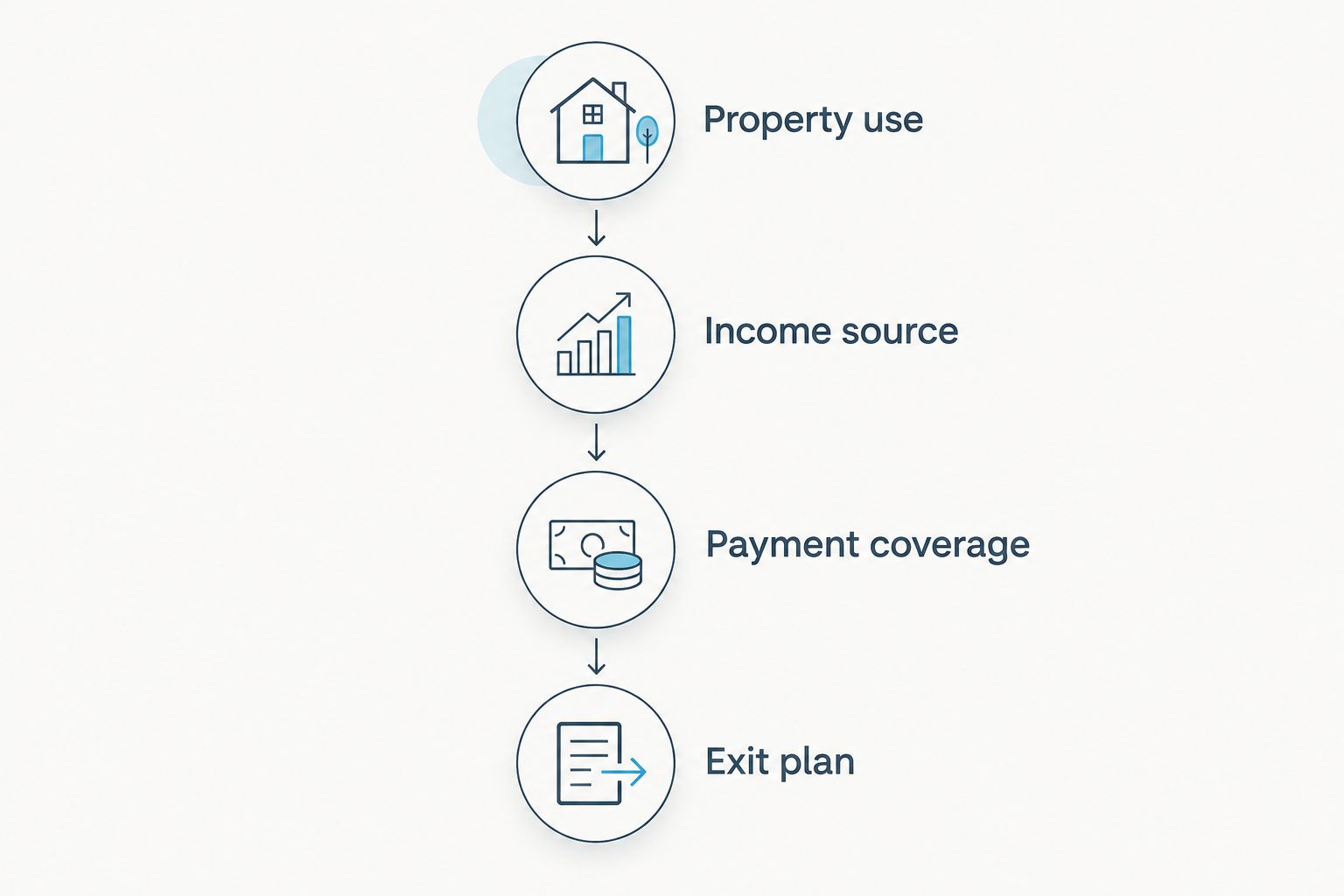
Property eligibility comes before choosing an income-documentation method.
Commercial DSCR generally divides net operating income by debt service. Residential DSCR programs can use rent divided by a defined housing payment instead; ask which expenses enter the denominator.
A 1.00x coverage ratio means accepted income equals the defined payment obligation. That is 100% payment coverage, not a cushion for unexpected expenses. For annual analysis of a monthly-payment loan, include 12 monthly payments in annual debt service. These are calculation definitions, not approval thresholds.
Also ask about loan-to-value, or LTV: the loan balance divided by the lender's accepted property value. The lender's valuation—not your projected resale value—controls that calculation.
Discuss your property's financing fit
Describe the land use, rental income, and borrowing goal before choosing a mortgage program.
Which farmland loan should you choose?
Start with an agricultural real estate mortgage for productive farmland you plan to hold. Choose commercial investment financing for eligible leased buildings, and consider seller financing when the seller will negotiate a sound structure.
For rural rental houses, investigate residential DSCR eligibility. For self-employed buyers, examine bank-statement documentation separately from collateral eligibility. Use bridge financing only when the transition and repayment plan are defined.
Loanguys is a mortgage broker for investors comparing DSCR, bridge, and bank-statement financing. Agricultural collateral requires a separate eligibility decision.
FAQ
What's the best loan for farmland rental investors?
An agricultural real estate mortgage is the strongest starting point for productive farmland held long term. Confirm that the lender accepts non-operating landowners and your agricultural lease structure.
Can I use a residential DSCR loan to buy farmland?
Do not assume a residential DSCR loan accepts farmland. Rental income does not override restrictions on agricultural acreage, working farms, or mixed-use collateral.
Is a rural rental house the same as agricultural property?
No, a rural address does not determine agricultural classification. The lender must evaluate actual use, legal use, acreage, improvements, and appraisal findings.
Can a bank-statement loan finance a working farm?
Bank-statement documentation does not establish working-farm eligibility. It changes how qualifying income is reviewed while the property's collateral requirements remain separate.
Is seller financing better than a farmland mortgage?
Seller financing is better suited to a negotiated purchase when the seller accepts a workable agreement. An agricultural mortgage is the default starting point for a qualifying long-term farmland investment.
What documents should I prepare for an agricultural rental loan?
Prepare the lease, rent-payment records, ownership information, parcel details, and records of owner-paid expenses. The lender will specify additional financial, appraisal, title, and environmental requirements.
Does strong rental income guarantee farmland loan approval?
No, strong rental income does not guarantee approval. The lender must also accept the property, borrower, valuation, title, and proposed loan structure.
One last thing
A lease can produce income without making that income usable for your chosen loan. Before ordering an appraisal or relying on a closing date, ask the lender to confirm both the collateral classification and the accepted repayment source.
For a 2026 transaction, that written confirmation is more useful than a general discussion of mortgage programs. It tells you whether you are comparing real options or pursuing the wrong category.


