


Best loans for manufactured home rental investors

Best starting point: a DSCR loan for an eligible, rent-ready manufactured home with owned land. Best for leased-land homes: investor-eligible chattel financing. Best for a property needing repairs: a bridge loan with a verified refinance exit. This 2026 guide compares loans for manufactured home rental investors by collateral, rental strategy, and qualification method—not by a program name alone.
TL;DR
- DSCR loans for manufactured home rental investors fit eligible, rent-ready properties; manufactured-home acceptance requires separate confirmation.
- Chattel financing addresses home-only purchases, but rental use and leased-land terms need explicit approval.
- Portfolio loans suit property exceptions; bridge loans suit repairs only when a credible exit exists.
- Loanguys offers investor loan programs; confirm manufactured-home eligibility before ordering an appraisal.
Why this matters
The first financing question is what you own—not how much rent you expect. A manufactured home with owned land and real-property status presents a different collateral package from a home titled as personal property on a rented lot.
Loanguys is a mortgage broker offering DSCR, bridge, fix-and-flip, and bank-statement programs. Those program categories are starting points for discussion, not confirmation that a particular manufactured home qualifies.
For a 2026 purchase, establish the home's title status, land ownership, foundation documentation, and permitted rental use before choosing a loan. Strong borrower qualifications do not override an ineligible property.
What makes the best manufactured-home rental loan?
Use these criteria before comparing proposals:
- Collateral fit: Does the lender finance the home, the land, or both—and accept the property's legal classification?
- Investment-use eligibility: Does the specific program permit a non-owner-occupied manufactured home?
- Income fit: Does qualification use property rent, personal income, business deposits, or operating financials?
- Property condition: Can the home qualify as-is, or must repairs happen before permanent financing?
- Exit flexibility: Can you hold the loan through your planned ownership period without an unwanted maturity deadline?
- Documentation clarity: Are title, foundation, appraisal, insurance, and lease requirements identified before you incur expenses?
In 2026, request written confirmation of the property type and investment use together. An answer about manufactured homes generally does not establish eligibility for a manufactured-home rental.
Best loan options at a glance
1. DSCR loan
- Best for: Eligible, stabilized home-and-land rentals
- Standout feature: Qualification centers on rental coverage
- Key limitation: Many programs exclude manufactured homes
2. Portfolio loan
- Best for: Properties outside standardized mortgage rules
- Standout feature: Lender-specific collateral review
- Key limitation: Exceptions remain subject to lender approval
3. Chattel loan
- Best for: Home-only rentals on leased land
- Standout feature: Financing secured by the home rather than land
- Key limitation: Investor use requires a suitable specialist
4. Bridge or rehabilitation loan
- Best for: Acquisitions requiring repairs before a long-term hold
- Standout feature: Temporary financing tied to a transition
- Key limitation: Repayment depends on a workable exit
5. Seller financing
- Best for: Transactions requiring negotiated repayment terms
- Standout feature: Buyer and seller structure the obligation directly
- Key limitation: Title, existing debt, and enforcement need legal review
These are financing structures, not interchangeable approvals. The ranking prioritizes a long-term rental hold; a different collateral structure changes the first option you should investigate.
1. DSCR loans: best for eligible home-and-land rentals
A debt-service coverage ratio loan evaluates rental income against the property's debt obligation. For a manufactured rental, the lender must also accept the home type, investment use, title treatment, foundation, and land arrangement.
DSCR financing is the best starting point for a stabilized manufactured-home rental only after collateral eligibility is confirmed. Loanguys offers DSCR loan programs; ask specifically whether a manufactured-home investment property fits a lender's current guidelines.
DSCR loan pros:
- Centers qualification on the rental property's income.
- Gives buy-and-hold investors a property-level coverage measure.
- Supports a financing discussion focused on the asset rather than salary alone.
DSCR loan cons:
- Manufactured homes are excluded from many DSCR programs.
- Adequate rent does not resolve title or foundation problems.
- Accepted rent calculations and required coverage differ by lender.
Best for: An investor buying an eligible, rent-ready manufactured home with owned land and documented rental demand.
Ask which expenses enter the coverage calculation. A residential DSCR calculation often compares monthly rent with principal, interest, taxes, insurance, and applicable association dues; commercial underwriting can instead use net operating income against debt service.
A 1.00x coverage ratio means the qualifying numerator equals the required denominator. That represents 100% coverage under that calculation—not proof that repairs, vacancy, and every operating expense are covered.
Verdict: Buy with DSCR financing only after the lender confirms both manufactured-home and rental-use eligibility.
2. Portfolio loans: best for property-specific exceptions
A portfolio loan is retained by the lender rather than originated solely to a standardized resale framework. That gives the lender its own underwriting rules, but it does not require the lender to accept unusual collateral.
Investigate this route when the property falls outside a standard program and you can document the reason. Ask for a manufactured-home investment review, not simply an investment-property prequalification.
Portfolio loan pros:
- Allows a lender-specific assessment of the property.
- Creates room to discuss collateral details individually.
- Lets the lender consider the borrower and rental business together.
Portfolio loan cons:
- Property exceptions are discretionary, not guaranteed.
- Geographic and borrower restrictions differ by institution.
- Maturity and repayment terms require careful review.
Best for: An investor whose property needs an individual eligibility decision rather than a standard program match.
Bring the recorded land documents, home-title records, lease, insurance information, and foundation documentation available for the property. Explain any mismatch between tax records and title documents before the application advances.
For your 2026 comparison, ask whether an approval is subject to a later collateral committee review. A borrower prequalification is not the same as acceptance of the manufactured home.
Verdict: Buy with a portfolio loan when the lender accepts the specific exception in writing.
3. Chattel loans: best for home-only purchases on leased land
A chattel loan finances a manufactured home as personal property rather than financing a combined home-and-land real-estate asset. It is the relevant category to investigate when you buy the home but rent the underlying lot.
Do not assume a consumer manufactured-home lender accepts rentals. Confirm investor eligibility, permitted occupancy, and the lender's requirements for the land lease before applying.
Chattel loan pros:
- Matches a home-only collateral structure.
- Does not require the transaction to include land ownership.
- Keeps the financing discussion aligned with personal-property title.
Chattel loan cons:
- Some programs are restricted to owner-occupied homes.
- Lot-lease restrictions can prevent your intended rental use.
- A home-only purchase does not give you control over the land.
Best for: An investor acquiring a manufactured home on leased land where both the lender and community permit rental occupancy.
Review the lot lease separately from the home purchase contract. Check subletting permission, tenant approval rules, lease termination provisions, and responsibility for utilities and maintenance.
Also verify what happens if the land lease ends. The ability to buy and finance the home does not establish a right to keep it on that site indefinitely.
Verdict: Buy with chattel financing only when investment use and the land agreement support the rental plan.
4. Bridge loans: best for repair-to-rental transitions
A bridge or rehabilitation loan provides temporary financing while a property moves toward sale or longer-term financing. For manufactured-home investors, the critical question is whether an acceptable permanent loan will exist after the work.
Loanguys offers bridge and fix-and-flip loan programs. Manufactured-home acceptance, eligible repairs, and a rental-hold exit require separate confirmation; a fix-and-flip label does not establish suitability for a long-term rental strategy.
Bridge loan pros:
- Separates the acquisition-and-repair phase from permanent financing.
- Connects funding decisions to a defined improvement plan.
- Gives investors a structure for transitional property situations.
Bridge loan cons:
- A maturity deadline creates repayment pressure.
- Completion of repairs does not guarantee refinance eligibility.
- Draw conditions and inspections can affect project execution.
Best for: An investor with a documented repair scope and a verified long-term financing path.
Before committing, read the guide to manufactured and mobile home rehab financing. Then ask the proposed permanent lender to review the home's title, foundation, land ownership, and intended rental use—not just the projected finished condition.
Verdict: Hold until the refinance exit is checked; skip a bridge loan that depends on an unverified future approval.
5. Seller financing: best for negotiated transaction terms
Seller financing lets the seller accept repayment over time instead of receiving the full purchase proceeds at closing. The agreement must identify the collateral and the legal documents needed to secure the seller's interest.
This option does not remove title problems or existing lender restrictions. Use a real-estate attorney and the appropriate title or closing professionals to assess the proposed structure.
Seller financing pros:
- Allows direct negotiation of repayment structure.
- Gives both parties control over the proposed agreement.
- Creates an alternative discussion when institutional programs do not fit.
Seller financing cons:
- Requires a seller willing to finance the transaction.
- Existing debt can restrict a transfer or financing arrangement.
- Balloon payments can create a future refinancing deadline.
Best for: A buyer and seller who can document a lawful, secured agreement suited to the property's title structure.
Confirm that the seller owns the home and any land included in the contract. If an existing loan remains, have counsel review transfer restrictions and due-on-sale provisions rather than relying on an informal promise to keep making payments.
Verdict: Buy with seller financing only after legal review confirms the title, security, and repayment structure.
How we ranked these financing options
This ranking follows the collateral, income, condition, and exit criteria above. DSCR financing comes first for an eligible stabilized rental; portfolio lending addresses exceptions; chattel financing addresses home-only ownership; bridge financing addresses transition; seller financing addresses negotiated transactions.
There is no universal winner across different ownership structures. For a 2026 application, screen the property before spending time on borrower documentation for a program that excludes it.
Confirm eligibility before ordering an appraisal
Use this sequence to keep the financing decision tied to the actual asset:
- Verify title: Determine whether the home is personal property or legally part of the real estate.
- Confirm land: Establish whether you own the lot, lease it, or are acquiring an entire community.
- Check rental use: Confirm lender acceptance, local requirements, and any community restrictions.
- Match underwriting: Choose rental-income, personal-income, or transitional underwriting that fits the deal.
- Verify exit: For temporary financing, confirm the requirements for repayment or permanent financing.
A loan on an individual manufactured home is not the same transaction as financing an entire manufactured-home community. If you are buying the community, start with commercial property underwriting rather than assuming a single-home loan applies.
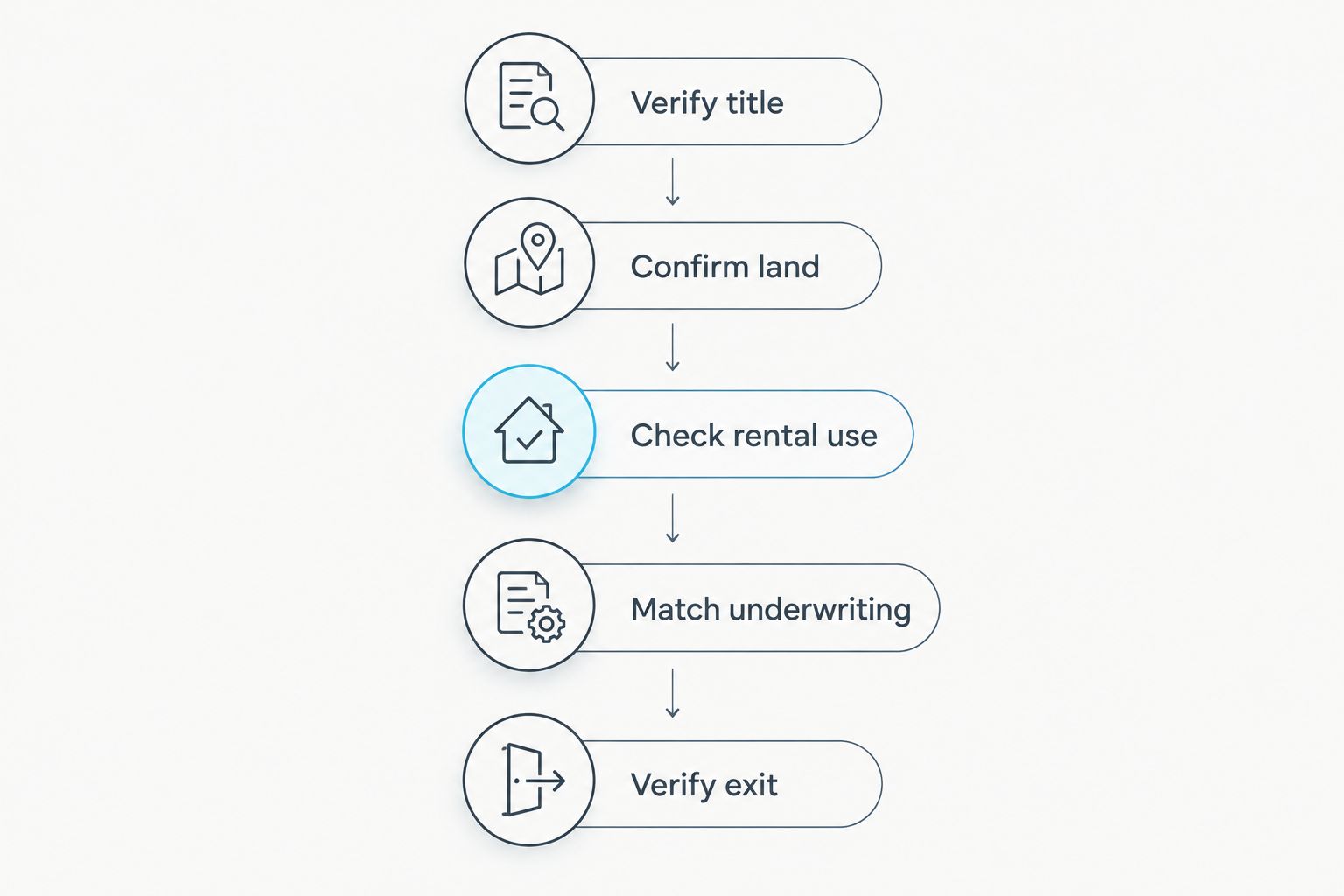
Confirm the collateral structure before selecting the income-qualification method.
Prepare the purchase contract, available title records, land documents, lease information, insurance details, and repair scope before requesting a property-specific review. Identify unresolved documents rather than presenting assumptions as confirmed facts.
Discuss your rental financing options
Ask Loanguys about property eligibility, income documentation, and the right financing structure.
Which manufactured-home rental loan should you choose?
Start with a DSCR eligibility review for a stabilized home-and-land rental. Move directly to chattel specialists for a home-only leased-land purchase, and investigate portfolio lending when a documented property exception prevents a standard fit.
For 2026 acquisitions requiring work, verify the permanent financing route before accepting temporary debt. Choose seller financing only when the legal structure and repayment obligations survive professional review.
FAQ
What's the best loan for a manufactured home I plan to rent out?
A DSCR loan is the best starting point for an eligible, stabilized manufactured home with owned land. For a home on leased land, investigate investor-eligible chattel financing instead; both routes require property-specific acceptance.
Can I get a DSCR loan on a manufactured home?
Only a DSCR program that expressly accepts manufactured-home investment properties is a fit. Confirm title status, foundation, land ownership, and rental use before ordering an appraisal.
Can I finance a manufactured rental home without buying the land?
Chattel financing is the category to investigate for a home-only purchase. The lender must permit investment use, and the lot lease must allow your intended rental arrangement.
Does a permanent foundation guarantee mortgage eligibility?
No, a permanent foundation does not guarantee mortgage eligibility. The lender must also accept the property's legal classification, manufactured-home characteristics, land arrangement, and investment use.
Can I use a bank-statement loan for a manufactured rental?
A bank-statement qualification method does not establish manufactured-home rental eligibility. Confirm that the specific program accepts both the collateral and investment use before evaluating its income-documentation requirements.
Are bridge loans a good choice for manufactured-home rentals?
Bridge financing fits a temporary acquisition or repair phase only when the property qualifies and the repayment exit is credible. Verify the permanent lender's collateral requirements before relying on a refinance.
What should I send a mortgage broker first?
Send the property address, land-ownership details, home-title information, intended rental use, and available condition records. Those facts help establish which financing categories deserve a full application.
One last thing
New income documentation cannot fix an unacceptable collateral type. Before collecting more bank statements or revising rent projections, ask for a written answer to this question: Does this program accept this manufactured home, with this title and land arrangement, as a rental?


