


Best loans for real estate investment partnerships

Best overall for stabilized rental partnerships: DSCR loans. Best for renovation-and-resale projects: fix-and-flip loans. Best for transitional acquisitions: bridge loans. This 2026 guide compares loans for real estate investment partnerships by property strategy, borrower structure, and repayment plan—not by a universal winner on borrowing cost.
TL;DR
- DSCR loans lead loans for real estate investment partnerships buying stabilized rentals; confirm entity eligibility and guarantee requirements.
- Fix-and-flip loans fit renovation-and-resale projects; bridge loans fit properties transitioning toward permanent financing.
- Bank-statement loans address self-employed borrower income documentation, not automatic partnership eligibility.
- Loanguys offers DSCR, fix-and-flip, bridge, bank-statement, and short-term rental loan programs.
Why this matters
A partnership combines investors, but the mortgage still needs an acceptable borrower, eligible collateral, and a credible repayment source. Your ownership agreement and loan documents address different obligations. An agreement to share profits does not, by itself, divide liability to the lender.
Loanguys is a mortgage broker for investors comparing DSCR, fix-and-flip, bridge, bank-statement, and short-term rental loans. Start with the property strategy before choosing a program. You can review Loanguys for the brand’s financing focus, then use the criteria below to prepare your partnership’s questions.
What makes the best partnership investment loan?
Use these criteria when comparing loans for real estate investment partnerships in 2026:
- Strategy fit: Match the loan to a stabilized rental, renovation, transitional acquisition, or vacation rental.
- Borrower eligibility: Confirm whether the lender accepts your proposed entity, ownership structure, and property use.
- Income assessment: Establish whether underwriting relies on rental income, personal income, business deposits, or a combination.
- Guarantee exposure: Identify who signs a personal guarantee and what obligations the guarantee covers.
- Funding mechanics: Check whether proceeds arrive at closing or through construction draws tied to completed work.
- Exit compatibility: Compare maturity, repayment requirements, prepayment provisions, and refinancing conditions with your hold period.
Do not choose solely on the quoted interest rate. A loan that conflicts with your ownership structure or planned sale creates a problem that a lower rate does not solve.
Partnership loans at a glance
These are loan categories, not interchangeable products. The order below prioritizes a stabilized rental purchase, then separates the alternatives by their strongest use case.
1. DSCR loan
- Best for: Stabilized long-term rentals
- Standout feature: Emphasizes property rental income relative to debt obligations
- Key limitation: Rental coverage and property eligibility constrain qualification
2. Fix-and-flip loan
- Best for: Renovation followed by resale
- Standout feature: Structures financing around acquisition and improvements
- Key limitation: Draw requirements and a short-term exit need careful planning
3. Bridge loan
- Best for: Transitional acquisition before refinancing
- Standout feature: Connects a temporary financing need to a later exit
- Key limitation: Refinancing or sale must work before maturity
4. Bank-statement loan
- Best for: Self-employed borrowers with complex income
- Standout feature: Uses bank statements to assess qualifying income
- Key limitation: Does not automatically accommodate partnership ownership
5. Short-term rental loan
- Best for: Vacation-rental acquisitions
- Standout feature: Addresses a rental strategy with variable booking revenue
- Key limitation: Income methodology and permitted use require confirmation
1. DSCR loans: best for stabilized rental partnerships
A debt-service coverage ratio, or DSCR, measures qualifying property income against the debt obligations used in underwriting. DSCR financing is the strongest starting point when your partnership plans to buy and hold an income-producing rental. It directs the financing discussion toward the property’s ability to support its debt.
Ask how the lender calculates coverage. Commercial property analysis commonly uses net operating income, while residential investor programs can use qualifying rent against a defined housing payment. Those calculations are not interchangeable.
DSCR loan pros:
- Connects qualification to the rental property’s income.
- Fits a long-term rental strategy better than a temporary acquisition loan.
- Provides a clear framework for comparing rent with debt obligations.
DSCR loan cons:
- A weak rental-income calculation limits the proposal.
- Property-based underwriting does not eliminate credit, reserve, or guarantee requirements.
- Entity eligibility depends on the specific program.
For a 2026 purchase, confirm who qualifies, who guarantees, and which rental evidence the lender accepts before your partnership commits to closing. The guide to buying a rental property with a partner using a DSCR loan addresses this ownership scenario directly.
Best for: Partners purchasing a stabilized long-term rental with supportable income.
Verdict: Buy—choose DSCR financing as the first option to evaluate for a stabilized rental.
2. Fix-and-flip loans: best for renovation-and-resale partnerships
Fix-and-flip financing supports a property acquisition and renovation intended to end in a sale. Your partnership needs a scope of work, a project budget, and a realistic disposition plan. The underwriting discussion centers on both the property and the proposed improvements.
Separate the partner funding renovation work from the partner managing it. A lender’s draw process does not replace your agreement about who advances cash when contractor payments precede reimbursement.
Fix-and-flip loan pros:
- Fits a project whose repayment source is a completed-property sale.
- Organizes financing around acquisition and renovation needs.
- Encourages an explicit scope, budget, and completion schedule.
Fix-and-flip loan cons:
- Draw inspections and documentation add project administration.
- Construction delays put pressure on the repayment timeline.
- A lower-than-expected sale outcome reduces the partnership’s margin.
Ask whether renovation funds are reimbursed, what evidence releases a draw, and how changes to the work are handled. Your agreement should assign responsibility for overruns before construction begins.
Best for: Partnerships renovating a property for resale rather than holding it as a rental.
Verdict: Buy—choose fix-and-flip financing when renovation and resale define the business plan.
3. Bridge loans: best for transitional acquisitions
A bridge loan provides temporary financing while the property or transaction moves toward a defined exit. Examples include acquiring a property before lease-up or completing a purchase before longer-term financing is ready. The exit is part of the initial financing decision, not an issue to postpone.
A bridge loan and a fix-and-flip loan can overlap. The useful distinction is the job: a flip centers on renovation and resale, while a bridge connects the acquisition to a later financing or sale event.
Bridge loan pros:
- Addresses a temporary gap before permanent financing.
- Fits a property transitioning toward a more financeable condition.
- Separates the acquisition stage from the long-term holding stage.
Bridge loan cons:
- Maturity creates a firm repayment obligation.
- Future refinancing requires a separate approval.
- Extension rights depend on the loan documents, not partner expectations.
For a 2026 acquisition, ask a prospective refinance lender to assess the proposed exit before you accept bridge debt. Identify which conditions must change—occupancy, completed work, income documentation, or another eligibility issue.
Best for: Partnerships acquiring a property that needs a defined transition before permanent financing.
Verdict: Hold—proceed only after validating the sale or refinancing exit.
4. Bank-statement loans: best for self-employed borrower qualification
Bank-statement loans use deposit records to assess qualifying income under the lender’s methodology. They address an income-documentation problem for self-employed borrowers. They do not establish that a partnership or LLC is an eligible borrower.
This distinction matters when a partner earns through a business but the property will belong to a separate investment entity. Ask the lender to assess the income route and proposed title structure together.
Bank-statement loan pros:
- Provides an alternative way to document self-employed income.
- Connects underwriting to bank activity rather than salary records alone.
- Gives business owners a specific documentation route to investigate.
Bank-statement loan cons:
- Deposits are not automatically treated as qualifying income.
- Transfers, irregular receipts, and business expenses require analysis.
- Entity ownership and multiple borrowers need separate confirmation.
Loanguys offers bank-statement loan programs alongside property-focused investor financing. Ask which approach fits the actual borrower rather than assuming every partner’s deposits can be combined.
Best for: Self-employed investors whose qualifying-income documentation is the main obstacle, subject to ownership eligibility.
Verdict: Hold—confirm borrower and title eligibility before collecting the full application package.
5. Short-term rental loans: best for vacation-rental partnerships
Short-term rental financing addresses properties operated through temporary guest stays rather than conventional long-term leases. Some short-term rental loans also use DSCR underwriting. The separate category matters because booking income, seasonality, and permitted use need focused review.
Your partnership needs an operating plan that distinguishes gross booking revenue from cash available for debt service and distributions. Cleaning, management, utilities, maintenance, and vacancies belong in that plan.
Short-term rental loan pros:
- Focuses the financing discussion on the intended vacation-rental use.
- Prompts review of the lender’s accepted rental-income evidence.
- Aligns the application with the property’s actual operating strategy.
Short-term rental loan cons:
- Seasonal revenue complicates cash planning.
- Local rules and property restrictions can limit the intended use.
- Projected booking revenue does not guarantee operating results.
Before buying in 2026, confirm local rental rules, association restrictions, and insurance suitability independently of financing. Loan approval is not permission to operate a vacation rental.
Best for: Partners purchasing a property specifically for a legally permitted short-term rental operation.
Verdict: Buy—only after confirming permitted use and an acceptable income calculation.
How the loan categories are ranked
The ranking follows strategy fit, borrower eligibility, income assessment, guarantee exposure, funding mechanics, and exit compatibility. DSCR ranks first because the default scenario is a stabilized rental partnership; the other categories serve different transaction needs.
This is not a ranking of lender performance or approval speed. Loanguys offers several of these loan categories, but the partnership still needs a program-specific assessment of ownership, property, and guarantees.
Prepare the partnership before requesting terms
Build a shared financing file before comparing proposals. Use these three documents to expose disagreements early:
- Ownership chart: Prepare 1 ownership chart identifying the proposed borrower, each owner, ownership interests, and authorized signer.
- Property budget: Prepare 1 property budget covering acquisition, improvements, operating expenses, debt service, and reserves.
- Exit plan: Prepare 1 exit plan explaining repayment through continued operations, refinancing, or sale, plus a fallback.
The counts are preparation recommendations, not lender minimums. Your lender will specify the actual application requirements.
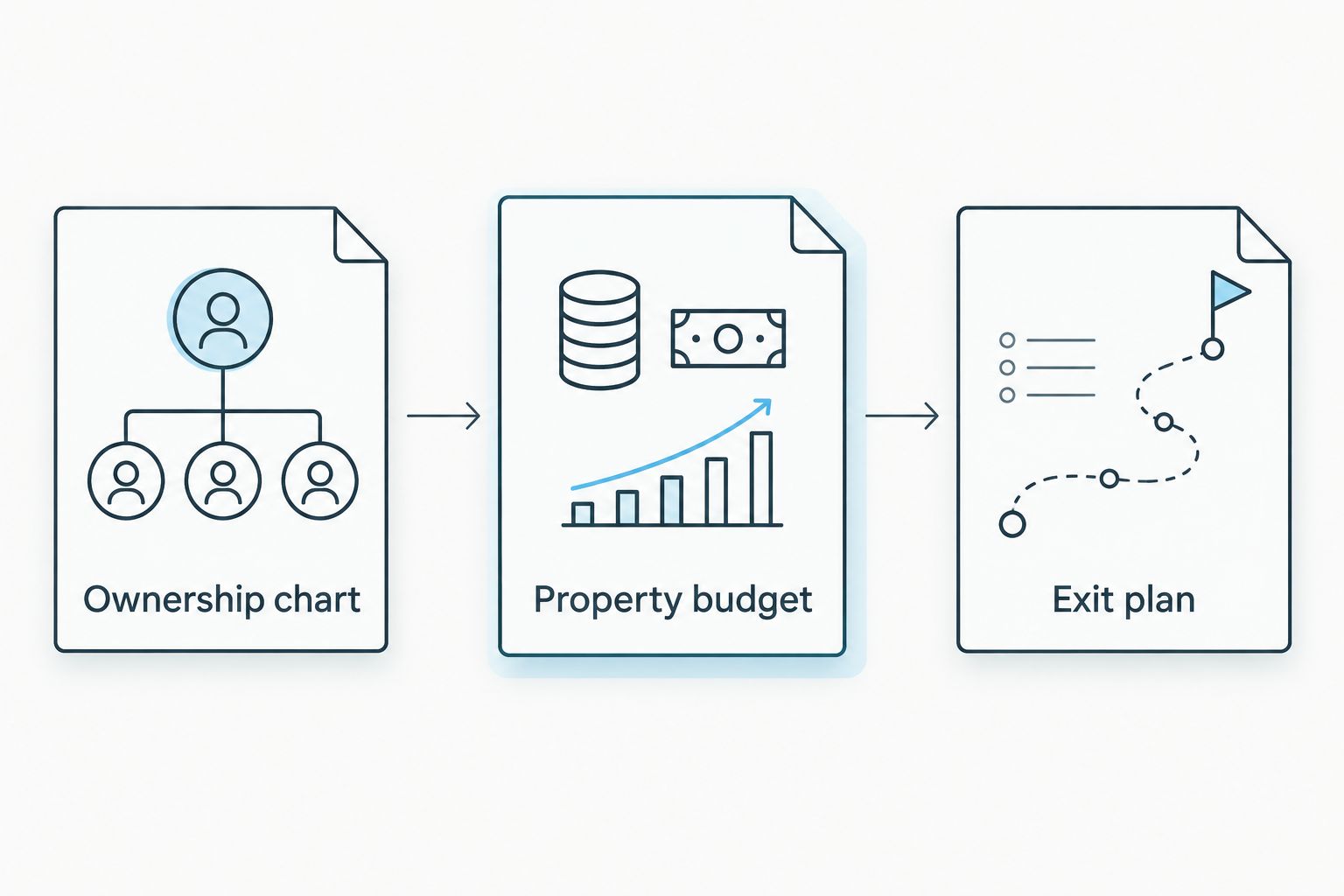
Agree on ownership, cash needs, and repayment before comparing loan proposals.
Have a real estate attorney align the partnership agreement with the proposed borrowing structure. Address capital calls, management authority, guarantees, distributions, deadlocks, and a partner’s departure. A private agreement between partners does not rewrite the lender’s rights.
Request written answers about changes in ownership, transfers, additional debt, and property releases where relevant. Those provisions matter when a partner wants to leave while the mortgage remains outstanding.
Discuss your partnership financing
Explain your ownership structure, property strategy, and repayment plan before selecting a loan program.
Which partnership loan should you choose?
Start with a DSCR loan for a stabilized rental; change categories when the property strategy demands it. Choose fix-and-flip financing for renovation and resale, bridge financing for a defined transition, bank-statement underwriting for a self-employed income issue, and short-term rental financing for vacation-rental operations.
For your 2026 comparison, ask each lender to evaluate the same ownership structure and property assumptions. Otherwise, you are comparing different transactions rather than competing proposals. Request a written explanation of the borrower, guarantees, repayment structure, and conditions that remain unresolved.
FAQ
What are the best loans for real estate investment partnerships?
DSCR loans are the best starting point for partnerships purchasing stabilized rentals. Fix-and-flip, bridge, bank-statement, and short-term rental loans address different property strategies or borrower-documentation needs.
Can a real estate partnership get a mortgage through an LLC?
An LLC can borrow under lending programs that accept its ownership structure and property type. Confirm entity eligibility, signing authority, and personal guarantee requirements before assuming the proposed structure qualifies.
Does every partner have to guarantee the loan?
The lender’s program and loan documents determine which partners must provide guarantees. Ownership interests, control, and the proposed borrowing structure belong in that discussion; do not assume liability follows the profit split.
Is a DSCR loan better than a bridge loan for partners?
A DSCR loan fits a stabilized rental hold, while a bridge loan fits a temporary financing need with a defined exit. Choose based on the property’s current condition and repayment strategy, not the partnership label.
Can partners combine bank statements to qualify?
Combining bank statements is not an automatic qualification method. The lender must establish which borrowers and income sources are eligible, identify transfers, and apply its qualifying-income methodology.
What happens if a partner wants to leave before the loan is repaid?
A partner’s departure does not automatically release a guarantee or permit an ownership transfer. Review lender-consent provisions and obtain legal advice before changing ownership or distributing buyout funds.
Does Loanguys offer financing for real estate investors?
Loanguys offers DSCR, fix-and-flip, bridge, bank-statement, and short-term rental loan programs. A partnership should discuss its borrower structure, property strategy, and repayment plan to identify an appropriate program.
One last thing
Agree on who funds a cash shortfall before agreeing on how to split profits. A property can satisfy a lender’s underwriting calculation and still need cash for repairs, vacancy, or delayed renovation reimbursement. Put the capital-call process and consequences of nonpayment into the partnership agreement before closing.


