


Best Mortgage Lenders After a Short Sale (2026)

A short sale on your credit report doesn't disqualify you from a mortgage in 2026 — it just changes which lender writes the loan. This guide ranks the mortgage options that actually work for borrowers with a short sale, from DSCR loans that skip personal income entirely to the FHA and conventional timelines you're stuck waiting out.
TL;DR
- DSCR loans through LoanGuys are the best mortgage lenders after a short sale for investors buying rental property in 2026.
- Bank-statement loans work for self-employed borrowers with a short sale who can't show clean tax-return income.
- Fannie Mae requires a 4-year wait after a short sale (2 years with extenuating circumstances); FHA requires 3 years.
- Non-QM and hard money lenders often skip the standard seasoning period and underwrite around the short sale instead of despite it.
Why this matters
A short sale means your lender agreed to accept less than what you owed and release the lien so the home could sell. Fannie Mae and Freddie Mac treat it as a serious credit event — the same bucket as a deed-in-lieu — and both agencies attach a mandatory waiting period before you're eligible for a new conventional loan. FHA and VA impose their own timelines too, shorter but still real.
None of that matters if you're not trying to get an agency-backed loan. LoanGuys works with borrowers whose credit file includes a short sale and structures financing around either the property's cash flow or the borrower's actual bank deposits — not the standard credit-score-and-seasoning boxes a bank branch has to check. The best mortgage lenders after a short sale in 2026 are the ones whose underwriting doesn't hinge on that one credit event.
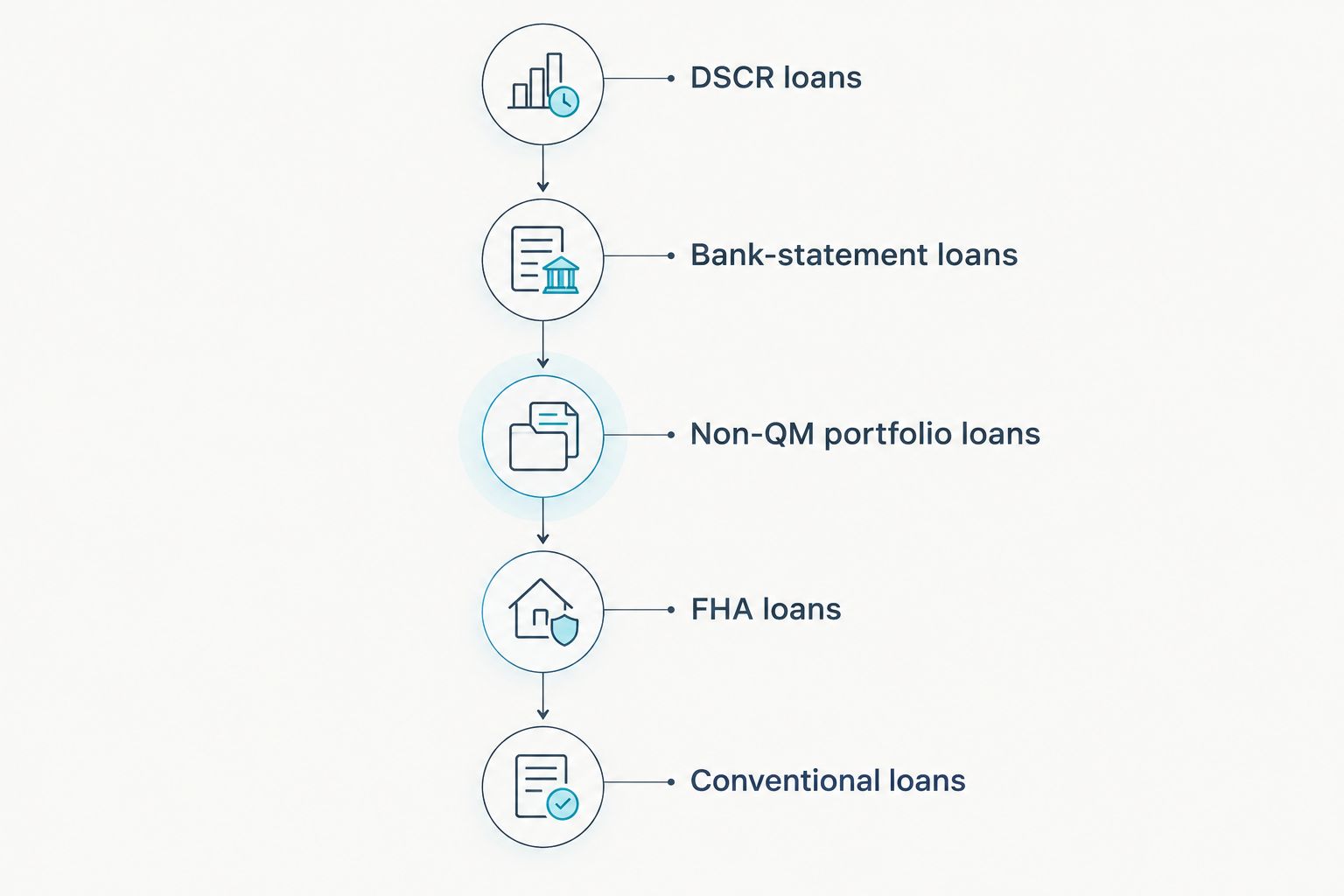
DSCR and bank-statement loans skip the multi-year clock that conventional and FHA loans attach to a short sale.
What makes the best mortgage lenders after a short sale
- Underwriting basis — does approval hinge on your personal credit and income, or on the property's cash flow and your bank deposits?
- Seasoning requirement — how many years or months since the short sale before you're eligible?
- Documentation — tax returns, bank statements, or no income verification at all?
- Down payment expectations — agency loans want less down; non-QM and DSCR programs typically want more equity.
- Speed to close — some programs close in a couple of weeks, others take 45+ days for income verification.
- Use case fit — primary residence vs. investment property changes which program applies to you.
Mortgage options after a short sale, at a glance (2026)
DSCR loans
- Best for: Investors buying rental property
- Standout feature: Qualifies on property cash flow, not personal income
- Key limitation: Property has to cash flow near the mortgage payment
Bank-statement loans
- Best for: Self-employed borrowers
- Standout feature: Qualifies on deposits, not tax returns
- Key limitation: Still reviews credit history and reserves
Non-QM portfolio loans
- Best for: Borrowers inside the agency waiting window
- Standout feature: No fixed seasoning period on many programs
- Key limitation: Rates run above agency loans
FHA loans
- Best for: Owner-occupants who can wait
- Standout feature: Lowest down payment once eligible
- Key limitation: 3-year wait unless the delinquency exception applies
Hard money / bridge loans
- Best for: Investors needing to close fast
- Standout feature: Underwriting keyed to the asset, not the credit story
- Key limitation: Short terms — need a real exit plan
1. DSCR loans through LoanGuys: best mortgage after a short sale for real estate investors
DSCR loans approve investors based on a property's Debt Service Coverage Ratio — basically, does the rent cover the mortgage — instead of pulling two years of tax returns or asking why a short sale shows up on your credit file. LoanGuys underwrites DSCR loans this way for single-family rentals, small multifamily, and short-term rental purchases. The short sale still appears in a credit pull, but it isn't the deciding factor the way it is at a bank branch.
DSCR loan pros:
- No personal income documentation required
- No fixed seasoning period tied specifically to the short sale
- Can close in the name of an LLC
- Works for single-family, 2-4 unit, and short-term rental property
DSCR loan cons:
- The property still has to cash flow near or above the mortgage payment
- Minimum credit score requirements apply regardless of the short sale
- Rates run higher than a conventional owner-occupant loan
- Doesn't apply to a primary residence purchase
Best for: investors buying rental property who have a short sale in their history and don't want to wait years for eligibility. Read the full breakdown in DSCR loans for short sale property purchases.
Verdict: Buy. This is the default answer to "best mortgage lenders after a short sale" for anyone buying investment property.
2. Bank-statement loans through LoanGuys: best option for self-employed borrowers with a short sale
Bank-statement loans qualify you on 12 to 24 months of business or personal deposits instead of tax returns that undersell real income after write-offs. LoanGuys runs this program for self-employed borrowers and business owners, and it works for a primary residence or an investment property. A short sale on your file still gets reviewed here, but the program doesn't attach the multi-year seasoning clock agency loans do.
Bank-statement loan pros:
- Qualifies on deposits, not tax returns
- Works for primary residence and investment purchases
- No fixed seasoning period tied to the short sale on most programs
- Faster document collection than a full income-verification loan
Bank-statement loan cons:
- Lender still reviews credit score, reserves, and payment history
- Deposit-based income calculation can undercount seasonal or irregular earners
- Rates sit above conventional financing
Best for: self-employed borrowers and business owners with a short sale who can't produce W-2-style income documentation. More detail on qualifying in how to qualify for a non-QM loan as a self-employed investor.
Verdict: Buy for self-employed borrowers; Skip if you're a straightforward W-2 employee — a different program fits better.
3. Non-QM portfolio loans: best for borrowers still inside the agency waiting period
Portfolio lenders hold the loan themselves instead of selling it to Fannie Mae or Freddie Mac, so they set their own rules on a short sale. Some have no seasoning requirement at all; others want 12 to 24 months of clean payment history first. Underwriting is manual, meaning a real person looks at your full file instead of running it through an automated agency checklist.
Non-QM portfolio loan pros:
- Manual underwriting looks at the full picture, not just a checkbox
- Flexible on seasoning compared to Fannie Mae and Freddie Mac
- Works for primary residence or investment purchases
Non-QM portfolio loan cons:
- Fewer lenders offer it, so shopping takes longer
- Terms vary widely from one lender to the next
- Typically requires more equity or down payment than an agency loan
Best for: borrowers still inside the 3 to 4 year agency waiting window who need financing now, not in three years.
Verdict: Hold. A solid bridge option — worth comparing two or three lenders before committing.
4. FHA loans: best for owner-occupants who can wait out the standard timeline
FHA generally enforces a 3-year wait after a short sale before you're eligible again. HUD guidelines waive that wait if you weren't delinquent on the mortgage at the time of the short sale and didn't take cash out of the sale — a narrow exception most people never hear about. Once eligible, FHA still offers the lowest down payment of any owner-occupant program.
FHA loan pros:
- 3.5% down payment
- Government-backed and widely available
- Possible to skip the wait entirely under HUD's delinquency exception
FHA loan cons:
- Mortgage insurance premiums for most of the loan term
- Doesn't apply to investment property purchases
- The exception requires payment-history documentation most borrowers don't have on hand
Best for: owner-occupants buying a primary residence who either qualify for the delinquency exception or can wait out the standard 2026 timeline.
Verdict: Wait. Right choice on the calendar, not the fast option.
5. Hard money and bridge loans: best for investors who need to close fast
Underwriting here leans almost entirely on the deal — the property's value, the exit plan, sometimes the borrower's liquidity — which makes a short sale close to irrelevant to approval. LoanGuys funds bridge and fix-and-flip loans this way for investors working on tight timelines.
Hard money / bridge loan pros:
- Closes in days to a few weeks
- Underwriting keyed to the asset, not the credit story
- Works even with a short sale still fresh on the report
Hard money / bridge loan cons:
- Short terms, typically 6 to 24 months
- Rates run above DSCR and non-QM programs
- Requires a real exit — a refinance or sale — lined up before you close
Best for: investors buying a fix-and-flip, teardown, or bridge deal who can't wait on agency timelines.
Verdict: Buy for a time-sensitive investment deal; Skip for a primary residence purchase.
How we ranked these
Each program was measured against the same six criteria: underwriting basis, seasoning requirement, documentation type, down payment expectations, speed to close, and use case fit. DSCR and bank-statement loans rank highest because they remove the short sale from the underwriting equation almost entirely. FHA and conventional loans rank lowest for speed because the calendar, not the file, decides eligibility.
Talk to a broker about your short sale
Get matched to the loan program that fits your credit history and property type.
Which mortgage lender should you choose after a short sale?
If you're buying rental property, DSCR loans through LoanGuys are the default — no tax returns, no seasoning clock tied to the short sale, just the numbers on the lease. If you're self-employed and buying a primary residence, bank-statement loans do the same job with income you can actually document through deposits. If you need agency pricing specifically, budget three to four years and let a non-QM loan bridge the gap in the meantime. The mortgage lenders worth calling first in 2026 are the ones that treat a short sale as one data point, not a life sentence.
FAQ
What's the best mortgage lender after a short sale?
For investors, DSCR loans through LoanGuys are the best mortgage lenders after a short sale in 2026 because approval hinges on the property's rental income, not your personal credit history. Self-employed buyers get similar flexibility from bank-statement loans.
Can I get a DSCR loan after a short sale?
Yes. DSCR loans qualify you on the property's rent-to-mortgage ratio, so a short sale on your credit file doesn't trigger the multi-year seasoning requirement that Fannie Mae and Freddie Mac attach to conventional loans.
How long do I have to wait for a conventional loan after a short sale?
Fannie Mae and Freddie Mac generally require a 4-year wait after a short sale, reduced to 2 years if you can document extenuating circumstances such as job loss or medical hardship.
Does FHA allow a mortgage after a short sale?
FHA generally requires a 3-year wait after a short sale, but HUD waives that wait if you weren't delinquent on the mortgage at the time of the short sale and didn't take cash out of the sale.
Is a bank-statement loan better than a conventional loan after a short sale?
For self-employed borrowers, yes — bank-statement loans qualify you on deposits instead of tax returns and skip the agency seasoning clock, though credit and reserves are still reviewed.
Do hard money lenders check for a short sale on your credit report?
They pull credit, but a short sale rarely blocks approval because hard money and bridge underwriting focuses on the property's value and your exit plan, not your credit history.
How much does a short sale hurt your credit score?
A short sale can drop a FICO score by roughly 85 to 160 points depending on where you started, an impact similar to a foreclosure, according to FICO's own published research.
Can I buy an investment property right after a short sale?
Yes, through a DSCR loan. Agency and FHA waiting periods apply to owner-occupant financing, not to investment loans underwritten on the property's cash flow.
One last thing
Most borrowers assume FHA treats a short sale exactly like a foreclosure and makes everyone wait three years. It doesn't. If your mortgage was current when the short sale closed and you didn't pull cash out, HUD's own guidelines let you skip the wait entirely — the exception most loan officers never bring up because it requires pulling payment history most borrowers don't think to ask for.


