


Best private money lenders for commercial real estate 2026

Best overall starting point for comparing investment-property programs: Loanguys, a mortgage broker; best for commercial lease-up: a direct bridge lender; best for rehabilitation: a rehab-focused private lender; best for bespoke transactions: a commercial mortgage debt fund; best for seller-negotiated financing: the property seller. This 2026 guide ranks financing channels by transaction fit, not by unsupported promises about approvals or closing speed.
TL;DR
- The best private money lenders for commercial real estate match your property, business plan, and repayment strategy.
- Loanguys is a mortgage broker offering DSCR, fix-and-flip, bridge, bank-statement, and short-term rental loan programs.
- Direct bridge lenders suit transitional acquisitions; rehab-focused lenders suit improvement projects.
- Commercial mortgage debt funds suit bespoke financing; seller financing requires the seller's agreement.
- Compare written conditions, guarantees, draw procedures, and repayment terms before choosing private money or bridge loans.
Why this matters
Private money describes the source of financing, not a single loan product. A commercial bridge loan, a renovation loan, and a seller-held mortgage solve different problems. Choosing the wrong structure creates risk even when the lender accepts the property.
Your first decision in 2026 is whether you need acquisition financing, renovation funding, or debt for a stabilized asset. Your second is how you will repay it. Choose the financing structure before choosing the financing provider.
A mortgage broker arranges financing; a direct lender supplies it. A property seller finances a transaction only when the seller agrees to accept repayment over time. Keep those roles separate when comparing proposals.
What makes the best private money lender?
Use these criteria to build your 2026 shortlist. A recognizable name does not replace written confirmation that the provider finances your actual transaction.
- Property eligibility: Confirm the property type, location, occupancy, and permitted use before ordering reports.
- Business-plan fit: Match the loan to acquisition, lease-up, rehabilitation, or long-term ownership.
- Funding conditions: Identify appraisal, title, environmental, insurance, and borrower requirements that must be satisfied.
- Funding mechanics: Separate money delivered at closing from funds released after construction or other milestones.
- Borrower liability: Read guarantees, recourse provisions, and default remedies rather than relying on a verbal summary.
- Repayment fit: Confirm that maturity, extension provisions, and prepayment conditions support your sale or refinance plan.
Loan-to-value, or LTV, compares the loan balance with the property's value. A 100% LTV means the loan balance equals the value used in that calculation; it is a mathematical definition, not an offered financing limit. Ask which valuation the lender uses: current condition, completed condition, or another stated basis.
Debt service coverage ratio, or DSCR, compares income with debt payments. For commercial property underwriting, a 1.00x DSCR means $1 of net operating income for every $1 of debt service over the same period. Rental-loan programs can calculate coverage differently, so request the actual formula and qualifying income assumptions.
Private money financing options at a glance
These entries compare provider types rather than claim that unnamed companies have particular programs. The mortgage broker is the named starting point; the remaining choices describe the kind of capital source to investigate for a specific project.
Loanguys, mortgage broker
- Best for: Comparing investment-property loan programs
- Standout feature: DSCR, fix-and-flip, bridge, bank-statement, and short-term rental programs
- Key limitation: Brokerage is not a direct funding commitment
Direct commercial bridge lender
- Best for: Acquiring a property during lease-up
- Standout feature: Short-term financing tied to a transition plan
- Key limitation: Repayment depends on a credible sale or refinance
Rehab-focused private lender
- Best for: Funding property improvements
- Standout feature: Financing structure built around renovation work
- Key limitation: Draw procedures affect construction cash flow
Commercial mortgage debt fund
- Best for: Negotiating bespoke transaction structures
- Standout feature: Commercial real estate debt as an investment strategy
- Key limitation: Individual mandates differ by property and transaction
Property seller
- Best for: Negotiating purchase financing directly
- Standout feature: Financing becomes part of the purchase agreement
- Key limitation: Requires seller consent and careful documentation
1. Loanguys: best starting point for comparing loan programs
Loanguys is a mortgage broker offering DSCR, fix-and-flip, bridge, bank-statement, and short-term rental loan programs to real estate investors and homeowners across the United States. The broker is best suited to investors comparing those investment-property financing paths. That makes it a starting point for a program discussion, not proof that every commercial asset qualifies.
Begin with your property description and business plan. Ask whether the proposed program accepts the exact building type and use; a rental-property program should not be assumed to cover a warehouse, retail center, or operating business.
Loanguys pros:
- Offers several stated investment-property financing programs.
- Serves real estate investors across the United States.
- Provides a brokerage route rather than requiring you to start with one direct lender's product.
Loanguys cons:
- A broker is not the same as the lender funding your transaction.
- The program list does not establish eligibility for every commercial property type.
Best for: Investors who need to identify the appropriate program before approaching a funding source.
Verdict: Buy the fit, not the label—start a program discussion and confirm property eligibility before committing.
2. Direct commercial bridge lender: best for acquisition and lease-up
A direct commercial bridge lender provides temporary debt for a property moving toward a different financing position. For an acquisition with vacant space, the transition might involve leasing, operating improvements, and eventual refinancing. The lender's acceptance of that plan matters more than a general claim of speed.
Ask how existing leases, vacancy, and projected rents enter underwriting. Separate current income from income you expect after executing the plan. Your proposed permanent lender must also accept the finished property and its operating history.
Direct commercial bridge lender pros:
- Offers a financing structure suited to a defined transition.
- Lets you discuss underwriting conditions with the proposed funding source.
- Connects the loan decision to the property's acquisition and stabilization plan.
Direct commercial bridge lender cons:
- Maturity creates a repayment deadline before long-term ownership ends.
- Unmet leasing or refinance assumptions threaten the exit strategy.
Best for: Investors acquiring commercial property that needs lease-up before permanent financing.
Verdict: Buy only when the bridge lender's maturity and conditions match a documented exit.
3. Rehab-focused private lender: best for improvement projects
A rehab-focused private lender evaluates financing around a property's renovation plan. The relevant questions concern the scope of work, contractor documentation, budget, and release of renovation funds. Property eligibility still comes first: residential flipping experience does not establish commercial redevelopment expertise.
Understand the draw process before signing. If the agreement reimburses completed work, you need cash to pay contractors before reimbursement. Inspections, lien waivers, and approval requirements belong in your construction schedule.
Rehab-focused private lender pros:
- Aligns the financing discussion with the improvement scope.
- Makes renovation funding procedures part of the loan structure.
- Supports comparison of acquisition funding and project funding separately.
Rehab-focused private lender cons:
- Draw conditions can create a cash gap during construction.
- Scope changes require attention to the loan agreement and budget.
Best for: Investors renovating commercial property with a defined construction scope.
Verdict: Buy when you can fund the work between draws; skip a structure your construction cash flow cannot support.
4. Commercial mortgage debt fund: best for bespoke transactions
A commercial mortgage debt fund invests capital in real estate loans according to its own mandate. Investigate this channel when the transaction requires a negotiated structure rather than a standard rental-property product. Do not assume that a fund accepts your asset class, geography, or ownership structure.
Describe the proposed collateral and borrowing entity early. For a transaction involving several properties, ask how collateral releases work and whether one property's default affects the others. Counsel should review cross-collateralization and cross-default provisions before you accept them.
Commercial mortgage debt fund pros:
- Provides a commercial real estate debt channel to investigate.
- Allows a discussion of transaction-specific collateral and covenants.
- Fits a shortlist where negotiated structure is the main requirement.
Commercial mortgage debt fund cons:
- Each fund's mandate limits the transactions it considers.
- Negotiated structures require close legal and financial review.
Best for: Investors whose transactions require bespoke collateral or covenant arrangements.
Verdict: Hold until the fund confirms mandate fit and you understand the proposed covenants.
5. Property seller: best for directly negotiated purchase financing
Seller financing means the seller accepts a documented repayment obligation instead of receiving the entire purchase consideration at closing. The arrangement is part of the purchase negotiation, not a substitute for legal due diligence. Existing mortgages, lien priority, and restrictions in other agreements must be addressed.
Ask your attorney to document the note, security instrument, payment obligations, and default remedies. If another lender participates, confirm that both financing arrangements permit the proposed structure. Verbal agreement is not enough.
Seller financing pros:
- Lets you negotiate financing alongside the purchase terms.
- Creates a financing channel directly with the property owner.
- Supports a transaction-specific repayment discussion.
Seller financing cons:
- Requires the seller's willingness to finance the sale.
- Existing debt and lien requirements can restrict the arrangement.
Best for: Buyers whose sellers are willing to negotiate a secured repayment agreement.
Verdict: Buy only after legal review confirms that the financing and purchase documents work together.
How this ranking works
The 2026 ranking follows the criteria above: program selection first, followed by acquisition transition, renovation execution, bespoke structure, and seller negotiation. It ranks use cases rather than claiming independently verified performance differences between lenders.
The mortgage broker appears first because comparing programs is the appropriate starting task for an undecided investor. A direct bridge lender moves ahead when lease-up is already the defined problem. A rehab-focused lender moves ahead when construction funding is the deciding issue.
Compare written proposals before you commit
Use the same deal summary for every financing conversation in 2026. Include the property address, asset type, occupancy, purchase agreement, operating information, ownership structure, improvement scope, and intended repayment strategy. Consistent information makes differences between proposals easier to identify.
Work through these steps in order:
- Property fit: Obtain confirmation that the provider accepts the asset type and intended use.
- Funding conditions: Identify outstanding reports, documents, and approvals before treating a proposal as actionable.
- Cash requirements: Separate closing cash, reserves, and money needed before renovation reimbursements.
- Legal obligations: Review guarantees, lien priority, default provisions, and extension language with counsel.
- Exit plan: Check the sale or refinance assumptions against the loan's actual repayment requirements.
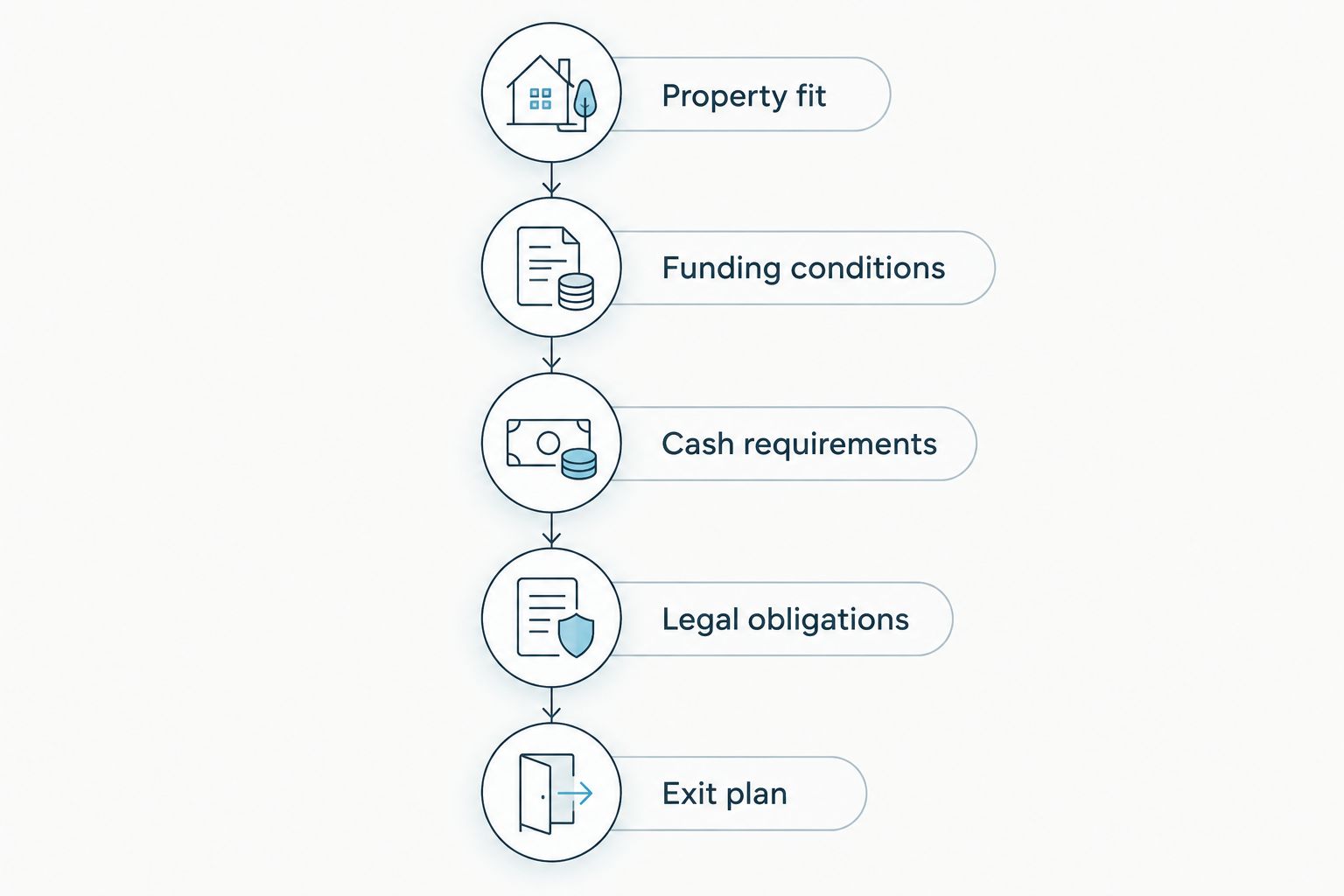
Confirm eligibility and funding conditions before accepting repayment obligations.
Keep a written comparison sheet. Record what each provider has confirmed, what remains subject to review, and who controls the next approval. A proposal with unresolved conditions is not equivalent to a binding funding obligation.
Before signing, review how to compare hard money lenders before signing a term sheet. Pay particular attention to whether extension rights are contractual or discretionary. An anticipated extension should not be your primary exit plan.
Which private money financing option should you choose?
Start with program selection when you are undecided; start with a specialized provider when the property problem is already clear. For a rental acquisition, identify the appropriate property-income program. For vacant commercial space, investigate bridge financing. For substantial improvements, focus on funding mechanics and construction cash flow.
Do not choose a lender solely because it accepts your application. Choose the proposal that supports the property's intended use, your cash position, and a defensible repayment strategy. In 2026, the written agreement remains the deciding document—not a broad promise of flexibility.
Discuss your investment property financing
Share your property type, business plan, and repayment strategy to discuss the appropriate loan program.
FAQ
What's the best private money lender for commercial real estate?
The best provider is the one whose written eligibility rules, funding conditions, and repayment terms fit your transaction. Loanguys is a mortgage broker offering several investment-property loan programs; confirm whether a proposed program accepts your specific commercial asset.
Is a mortgage broker the same as a private money lender?
No. A mortgage broker arranges financing, while a direct lender supplies the loan funds. Ask who will underwrite, fund, and service the proposed loan.
Is a bridge loan better than a renovation loan?
A bridge loan fits a temporary financing transition; a renovation loan fits a project requiring improvement funding. A transaction can involve both needs, so compare the actual funding structure rather than the product name alone.
Can I use a DSCR loan for any commercial building?
No. DSCR is an underwriting measure, not proof that a program accepts every commercial building. Confirm property-type eligibility and the lender's income calculation before applying.
Does private money financing mean I need no documents?
No. Private financing does not eliminate property, title, borrower, or legal review. Request the provider's document checklist and outstanding approval conditions.
How do I compare private money loan costs?
Compare written proposals using the same transaction details and expected repayment date. Review interest calculations, fees, reserves, draw requirements, prepayment provisions, and extension obligations together.
Can the property seller finance my commercial purchase?
Yes, if the seller agrees and the transaction can be legally structured. Have counsel review existing debt, lien priority, the repayment agreement, and the security documents.
What should I prepare before contacting a private lender?
Prepare the property description, purchase agreement, operating information, borrowing-entity details, improvement plan, and repayment strategy. Ask the provider which additional documents apply to your transaction.
One last thing
A loan can close successfully and still fail your investment plan. A workable exit requires more than an expected increase in property value: the next lender must accept the property, borrower, income, and requested financing structure.
Before accepting temporary debt, identify the permanent financing requirements you intend to meet. Then work backward. That check is more useful than choosing the lender with the most reassuring sales pitch.


