


Can you get a DSCR loan with only one rental property?

Yes, you can get a DSCR loan for one rental property; you do not need a rental portfolio. Approval still depends on the lender's rules for rental income, credit, equity, reserves, and property eligibility. If this is also your first investment property, confirm that the program accepts first-time investors before ordering an appraisal or committing to financing.
TL;DR
- A DSCR loan for one rental property does not require a portfolio; first-time investor eligibility remains lender-specific.
- Loanguys offers DSCR financing for real estate investors seeking an alternative to traditional income-based mortgage qualification.
- Rental income supports qualification, but credit, equity, reserves, and property condition still matter.
- A DSCR of 1.00x means qualifying income equals the payment used in the lender's calculation—not guaranteed positive cash flow.
Can you get a DSCR loan with only one rental property?
Yes. Property count alone does not determine DSCR loan eligibility. A lender can evaluate the rental you are buying or refinancing on its own income and collateral rather than requiring you to own several rentals.
Owning one rental and being a first-time investor are different situations. If you have never owned an investment property, review how to qualify for a DSCR loan with no rental history yet and ask about experience requirements early.
Buying your first rental
- What supports the application: Accepted market-rent evidence and an eligible property
- Main limitation: The program must accept first-time investors
- Best for: Buyers entering rental ownership
Buying another rental while owning one
- What supports the application: Income evidence for the new property and your financial documents
- Main limitation: Existing ownership does not guarantee approval
- Best for: Landlords adding a separate property
Refinancing your only rental
- What supports the application: Accepted rental income, property value, and current loan information
- Main limitation: Equity and refinance rules still apply
- Best for: Owners restructuring existing rental debt
In each situation, the useful question is not whether your portfolio is large enough. It is whether the specific property and your borrower profile satisfy the selected program.
Why this matters
You do not need to buy another property simply to become eligible for rental-income-based financing. That distinction lets you assess the property you actually want instead of changing your investment plan around an assumed portfolio requirement.
For a 2026 purchase, establish eligibility before you rely on a financing contingency or closing schedule. A broad statement that a lender offers DSCR loans does not confirm that it accepts your experience level, property type, or intended rental use.
Loanguys is a DSCR mortgage broker for real estate investors seeking property-income-based financing. Broker access does not remove underwriting requirements; the selected lender must still approve both you and the property.
How the DSCR calculation works for one rental
DSCR means debt service coverage ratio. It compares qualifying income with the debt payment used for underwriting, so the lender can assess how well the rental supports its financing.
For residential rental programs, lenders commonly compare qualifying monthly rent with the proposed housing payment, including principal, interest, taxes, insurance, and applicable association dues. Commercial-property analysis often uses net operating income instead. Ask which calculation applies rather than assuming every DSCR program uses the same formula.
What does a DSCR of 1.00x mean?
A DSCR of 1.00x means qualifying income equals 100% of the payment included in that calculation. The ratio therefore shows a 0% cushion above that payment—not a universal approval threshold.
A ratio above 1.00x means qualifying income exceeds the denominator. A ratio below 1.00x means it falls short. Those mathematical relationships do not establish which ratios a particular lender accepts.
Why passing the ratio does not prove profitability
An underwriting calculation is not your operating budget. If the formula uses gross rent against the housing payment, it does not automatically account for vacancy, repairs, management, utilities you pay, or future capital replacements.
Build a separate cash-flow analysis that includes those expenses. A property can satisfy a lender's calculation without producing the spendable income you expect, especially when you have no other rentals to offset a vacancy.
Why DSCR loan eligibility varies
DSCR lending does not use one universal set of approval rules. For a one-property application, confirm these six factors with the lender instead of treating general guidance as a commitment:
- Investor experience: Ask whether the program accepts first-time investors and how it defines prior rental ownership or management experience.
- Qualifying rent: Confirm whether underwriting uses the existing lease, appraiser-supported market rent, or another accepted income source.
- Credit history: Rental income does not replace a credit review. Ask how your credit profile affects eligibility and loan structure.
- Equity and LTV: Loan-to-value, or LTV, compares the loan amount with the lender's accepted property value. The permitted ratio depends on the transaction and program.
- Cash reserves: Ask which funds qualify as reserves and how much must remain after closing. Down-payment funds and post-closing reserves serve different purposes.
- Property eligibility: Confirm acceptable condition, property type, location, and rental use, including any restrictions affecting short-term rentals.
For applications in 2026, get the applicable requirements in writing. A guideline from another lender or an older transaction does not establish the rules for your property.
How to prepare a one-property DSCR application
Prepare the application around the property and transaction you actually have. Start with eligibility questions, then assemble evidence; do not spend money trying to prove a deal fits a program that excludes it.
- Confirm eligibility. State whether this is your first rental, whether you already own the property, and whether the request is a purchase or refinance. Describe the intended rental use accurately.
- Document rent. Gather the lease and available rental records for an occupied property. For a purchase or vacancy, ask what market-rent evidence the lender requires before arranging reports yourself.
- Verify funds. Organize account statements showing funds for the transaction and reserves. Ask how to document transfers, business-account funds, or other sources before moving money.
- Check expenses. Obtain current property-tax information, insurance information, and applicable association dues. Use the actual property details rather than relying solely on a seller's estimate.
- Review terms. Compare the proposed loan structure, required documents, prepayment provisions, and remaining approval conditions. Separate an initial indication from a completed underwriting decision.
Keep the same property facts across the application, purchase contract, lease, and supporting documents. Explain discrepancies promptly rather than allowing underwriting to discover conflicting ownership, occupancy, or rent information later.
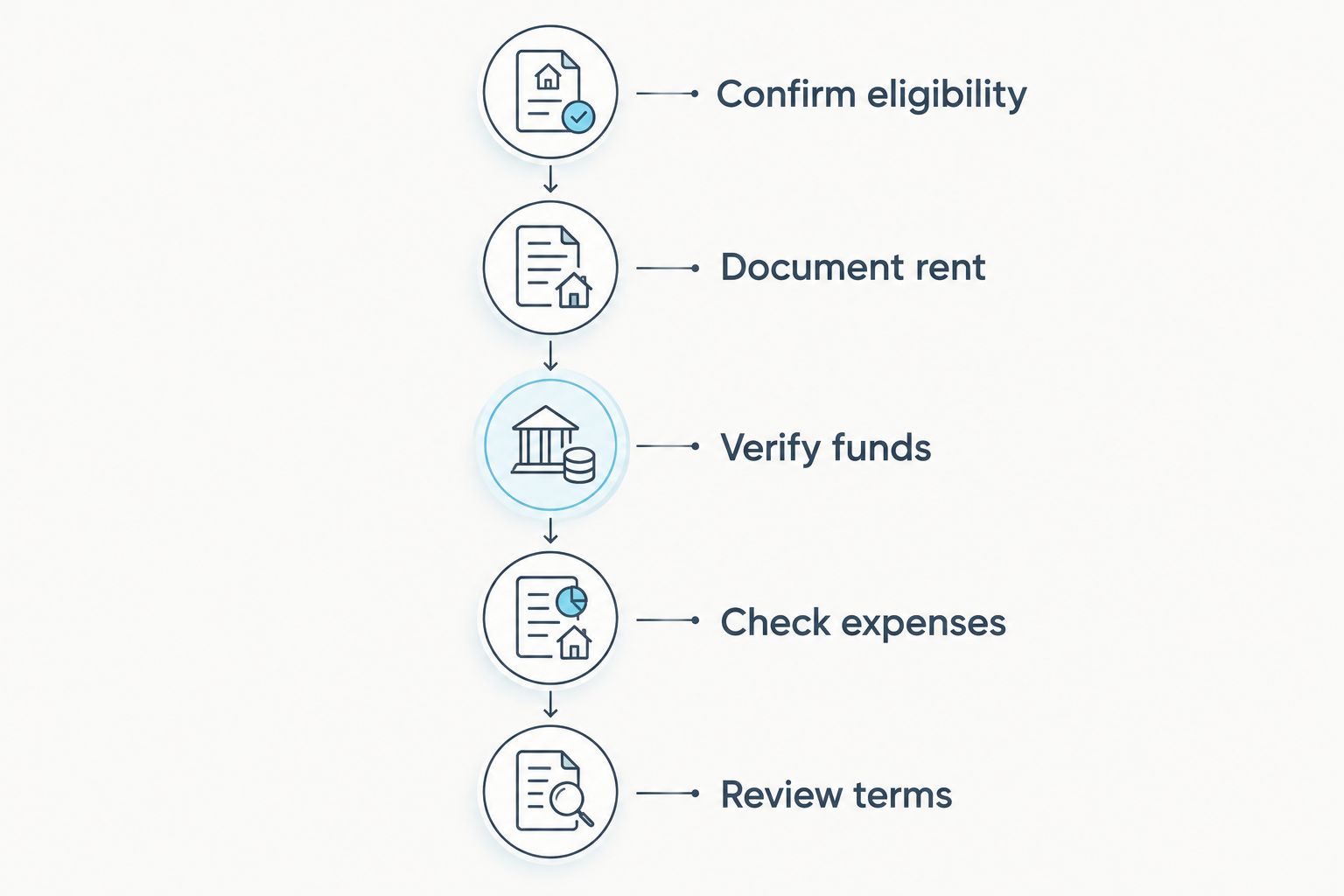
Confirm investor and property eligibility before arranging supporting reports.
What should you ask before an appraisal?
Ask whether the lender accepts your experience level, property type, intended occupancy, and income documentation. Also ask which conditions remain unresolved and whether any issue already identified would prevent approval.
An appraisal addresses collateral and, when ordered for that purpose, rental evidence. It does not cure an ineligible borrower profile or prohibited property use, so those questions belong earlier in the process.
What should you send a mortgage broker?
Send a concise summary covering the property address, transaction type, rental status, intended ownership, and your experience as an investor. Include the documents the broker requests through the appropriate secure process rather than sending sensitive financial records unnecessarily.
When discussing a DSCR loan with Loanguys, identify that you own only one rental—or that the purchase would be your first. That detail helps frame the eligibility discussion without suggesting that a portfolio is required.
What changes if the property is vacant or a short-term rental?
A vacant property does not provide the same evidence as an occupied rental with an established lease. Ask whether the lender accepts appraiser-supported market rent and what occupancy or lease conditions must be satisfied before closing.
For a short-term rental, confirm the accepted income method separately. Do not assume projected nightly revenue receives the same treatment as a long-term lease, or that permission to operate a rental establishes loan eligibility.
For a 2026 application, also check current local rental rules and association restrictions. Financing approval does not grant permission to operate a short-term rental where the intended use is restricted.
Match the income evidence to the intended rental use. A financing plan based on long-term rent and an investment plan based on short-term revenue measure different things unless you reconcile them explicitly.
Can you get a DSCR loan for your first investment property?
One property can be enough, but first-time investor acceptance is program-specific. Ask that question before comparing loan structures, because a program that requires prior experience is not a fit regardless of the property's projected income.
If the lender accepts first-time investors, prepare to document the property, funds, credit, and rental-income evidence it requires. First-time eligibility is permission to apply under that program, not a waiver of the remaining conditions.
Can you refinance your only rental with a DSCR loan?
One rental property can support a DSCR refinance application. The lender still evaluates qualifying income, accepted value, outstanding debt, and the rules for the requested refinance.
Cash-out means borrowing against available equity and receiving proceeds after existing obligations and transaction expenses are addressed. Do not assume a property qualifies for cash-out merely because it qualifies for a refinance without cash proceeds.
Can you live in the property with a DSCR loan?
One property is enough only if its use fits the program; standard business-purpose DSCR rental loans are not owner-occupied home loans. If you plan to live in the property, disclose that before applying.
This matters for house hacking, where you occupy part of a property and rent another part. Ask about financing designed for owner occupancy rather than describing a property you will occupy as a non-owner-occupied investment.
FAQ
Do I need several rentals to get a DSCR loan in 2026?
No, you do not need several rentals to apply for a DSCR loan in 2026. A single eligible rental can be evaluated, but the lender's borrower, income, and property requirements still apply.
What's the difference between having one rental and being a first-time investor?
Having one rental describes your current property count; being a first-time investor describes your experience. A lender can accept single-property loans while applying separate requirements to applicants without prior rental ownership.
Does a DSCR loan mean I don't need any documents?
No, a DSCR loan is not a document-free mortgage. Expect requests for property, rental-income, credit, identity, and asset information under the selected program.
What DSCR do I need for one rental property?
The required DSCR depends on the lender and program; there is no universal approval threshold for one rental. A ratio of 1.00x means qualifying income equals the payment used in the calculation, not that the lender must approve it.
Can I apply before the rental has a tenant?
You can ask a lender to evaluate an unleased rental, but approval depends on its vacancy and income-documentation rules. Confirm whether market-rent evidence is accepted and whether a lease is required before closing.
Do I have to put my only rental in an LLC?
An LLC is not a universal requirement for every DSCR loan. Confirm permitted ownership and guaranty requirements before forming an entity or transferring title, and get legal advice on ownership decisions.
Is a DSCR loan automatically better than a traditional investment mortgage?
No, a DSCR loan is not automatically better than a traditional investment mortgage. Compare qualification methods, repayment obligations, prepayment provisions, and your ability to document personal income before choosing.
One last thing
Your lender's approval standard and your investment standard should be separate. With one rental, a vacancy stops rental income from that property even though mortgage payments and other obligations continue.
Before moving ahead in 2026, write down how you will cover a vacancy, an insurance change, and an unexpected repair. Loanguys offers DSCR loan programs, but financing eligibility should support your investment decision—not replace your cash-flow analysis.


