


Chase alternatives for investment property financing

Chase offers conventional mortgage financing for buyers whose income and property fit standard underwriting. When your investment requires rental-income qualification, alternative income documentation, or renovation funding, compare a different loan structure rather than just another bank. The best Chase alternative in 2026 is Loanguys if you need a mortgage broker offering DSCR, bank-statement, bridge, and fix-and-flip programs; seller financing is the alternative to explore if you need terms negotiated directly with the property owner.
TL;DR
- For Chase alternatives for investment property financing, match the loan structure to your rental, income documentation, and renovation needs.
- Loanguys offers DSCR, bank-statement, bridge, fix-and-flip, and short-term rental loan programs.
- Seller financing requires a willing seller and carefully documented repayment terms.
- Keep Chase in the comparison when conventional investment-property financing fits your income and property.
Why this matters
Changing lenders does not automatically solve a financing mismatch. A completed rental, a vacant renovation project, and a self-employed borrower's purchase present different underwriting questions.
Start by identifying the obstacle. Is the issue how you document income, how the property generates rent, or whether the building needs work before it can support permanent financing? That answer determines which alternative deserves your attention in 2026.
This comparison separates a mortgage broker from individual financing structures. Several programs below sit within the same broker's offering; they are different routes to qualification, not a fabricated ranking of competing companies.
Chase alternatives at a glance
Chase
- Best for: Buyers pursuing a conventional investment-property mortgage
- Standout feature: Established mortgage lending through a bank
- How it differs from Chase conventional financing: The benchmark for a standard mortgage application
- Main limitation: Your income, property, and transaction must meet the selected program's requirements
- Best for: Investors comparing specialized loan programs
- Standout feature: DSCR, bank-statement, bridge, fix-and-flip, and short-term rental programs
- How it differs from Chase conventional financing: A mortgage broker offering several investor-focused financing routes
- Main limitation: Approval and terms depend on the selected lender and program
DSCR financing
- Best for: Rental purchases evaluated through property income
- Standout feature: Rental-income coverage analysis
- How it differs from Chase conventional financing: Changes the qualification focus from a conventional borrower-income approach
- Main limitation: Rent must support the lender's coverage calculation
Bank-statement financing
- Best for: Self-employed buyers documenting business cash flow
- Standout feature: Bank deposits used in income analysis
- How it differs from Chase conventional financing: Changes how qualifying income is documented
- Main limitation: Deposits are not automatically treated as usable income
Fix-and-flip or bridge financing
- Best for: Renovations and transitional property purchases
- Standout feature: Financing built around a temporary project or ownership stage
- How it differs from Chase conventional financing: Addresses a different purpose from a permanent conventional mortgage
- Main limitation: Requires a credible repayment or refinancing exit
Seller financing
- Best for: Buyers with a seller willing to finance the transaction
- Standout feature: Direct negotiation of repayment terms
- How it differs from Chase conventional financing: The seller extends financing rather than a mortgage lender
- Main limitation: Depends on seller agreement and legally sound documentation
Best means best fit for your transaction, not the lowest advertised payment. Compare the same property, ownership plan, and repayment strategy across every proposal.
1. Loanguys: best for comparing specialized investor programs
Loanguys is a mortgage broker offering investment property financing through DSCR, fix-and-flip, bridge, bank-statement, and short-term rental loan programs. The useful distinction is the range of financing structures, not a promise that every application qualifies.
For your 2026 search, begin with the program that addresses the actual obstacle. Rental cash flow, business deposits, and a renovation plan are different evidence; submitting the wrong kind of application wastes attention without changing the underlying deal.
Where this broker shines
- Offers several investor-focused financing categories through one mortgage broker.
- Includes bank-statement programs for borrowers exploring alternative income documentation.
- Includes both temporary project financing and rental-property financing.
- Offers short-term rental programs alongside other investment-property options.
Where this broker falls short
- A broker is not the institution providing every loan; identify the lender on your proposed transaction.
- A broad program menu does not establish eligibility for a particular property or borrower.
- Specialized documentation does not remove the need to substantiate the application.
- A conventional mortgage remains a valid comparison when your situation fits it.
Provider role
- This mortgage broker: Mortgage broker
- Chase conventional financing: Bank mortgage lender
Financing focus here
- This mortgage broker: Multiple specialized investor programs
- Chase conventional financing: Conventional investment-property mortgage
Income route to discuss
- This mortgage broker: DSCR or bank-statement program, depending on the application
- Chase conventional financing: Documentation required by the selected conventional program
Renovation or transition
- This mortgage broker: Fix-and-flip and bridge programs are part of the offering
- Chase conventional financing: Confirm a suitable program directly before assuming a standard mortgage fits
Best for: Investors who need to compare financing structures rather than submit the same conventional application elsewhere.
Verdict: Buy only after the proposed program, actual lender, and repayment structure fit your transaction.
2. DSCR financing: best for evaluating a rental through its income
DSCR means debt service coverage ratio. For residential rental lending, lenders commonly compare qualifying rental income with the property's qualifying mortgage payment, including relevant housing expenses under their program rules.
A coverage ratio of 1.0 times means the income and debt-service amounts used in that calculation are equal. It is not a universal approval threshold, and it does not establish that your rental has positive cash flow after every operating expense.
Where DSCR financing shines
- Centers the financing discussion on the rental property's income coverage.
- Provides a distinct route to compare against conventional borrower-income qualification.
- Connects the underwriting question to your rental investment strategy.
Where DSCR financing falls short
- A rental projection does not guarantee the lender will accept that income figure.
- Vacancy, maintenance, management, and capital repairs still affect your investment returns.
- Short-term rental income requires particular attention to the lender's documentation method.
Best for: Investors buying or refinancing rentals who want to explore property-income-based qualification.
Conventional single-family mortgage categories generally cover 1–4 residential units. A property with 5 residential units enters multifamily commercial territory; do not assume a residential DSCR program accepts it simply because the building produces rent.
Verdict: Buy when the lender confirms property eligibility and the accepted income supports the proposed debt.
3. Bank-statement financing: best for self-employed income documentation
Bank-statement financing uses an alternative approach to documenting income. Business receipts and the income available to repay a mortgage are not the same thing, so the lender must evaluate deposits and relevant expenses.
This route addresses documentation, not property performance. If your main issue is a vacant building or an unfinished renovation, changing the income paperwork alone does not solve it.
Where bank-statement financing shines
- Gives self-employed borrowers an income-documentation route to investigate.
- Brings business cash flow into the qualification discussion.
- Helps you compare an alternative analysis with conventional income documentation.
Where bank-statement financing falls short
- Transfers, borrowed funds, and other non-income deposits require explanation.
- Gross business deposits do not equal qualifying personal income.
- Credit, assets, property eligibility, and other underwriting conditions still matter.
Best for: Business owners and self-employed investors whose financing question concerns how income is documented.
Ask the lender which accounts it needs, how it treats business expenses, and what evidence explains unusual deposits. Get those answers before organizing a full application package.
Verdict: Buy when the accepted deposit analysis accurately supports repayment; Skip if you expect every deposit to count as income.
4. Fix-and-flip or bridge financing: best for transitional projects
Fix-and-flip financing addresses a renovation investment, while bridge financing addresses a temporary funding need. Neither should be treated as a substitute for a permanent rental mortgage without a clear exit plan.
Your decision in 2026 should connect the initial loan to the property's next stage. A planned refinance depends on future underwriting; the first lender's approval is not the next lender's commitment.
Where project financing shines
- Matches a temporary financing structure to a renovation or transition.
- Makes the project scope and repayment strategy central to the discussion.
- Separates acquisition-stage financing from long-term rental financing.
Where project financing falls short
- Delayed construction or leasing can disrupt the exit.
- Renovation funding requires careful review of disbursement and inspection conditions.
- A refinance plan remains exposed to property valuation and future qualification.
Best for: Investors acquiring property for renovation, resale, or a defined transition to permanent financing.
Before signing, identify what happens if the property takes longer to finish or sell. Review maturity, extension conditions, renovation draws, and repayment obligations together—not as isolated contract details.
Verdict: Buy only with a documented exit and a backup plan; Wait when repayment depends on an unconfirmed refinance.
5. Seller financing: best for negotiating directly with the owner
Seller financing means the seller accepts repayment over time under an agreed legal structure. It is a negotiation route, not a loan program you can assume every property offers.
Where seller financing shines
- Lets buyer and seller negotiate repayment terms directly.
- Creates a financing conversation outside a conventional mortgage application.
Where seller financing falls short
- Requires a seller willing and legally able to structure the arrangement.
- Needs careful review of title, existing liens, default provisions, and any balloon payment.
Best for: Buyers whose seller is open to financing and whose transaction receives appropriate legal review.
Verdict: Buy only after an attorney reviews the documents and existing debt; Skip any handshake-only arrangement.
Why investors look beyond Chase
The reason to compare Chase alternatives for investment property financing is a mismatch between the transaction and the proposed mortgage. It is not a claim that Chase has changed its policies, failed to fund a deal, or stopped serving investors.
Use these questions to identify your reason for switching:
- Income documentation: Does your application need a different way to establish self-employed income?
- Rental income: Would a property-income-based financing route better address the qualification question?
- Property condition: Does the acquisition require renovation financing before permanent debt makes sense?
- Ownership structure: Does the proposed borrower and title arrangement fit the program?
- Exit plan: Are you financing a long-term hold, a sale, or a temporary transition?
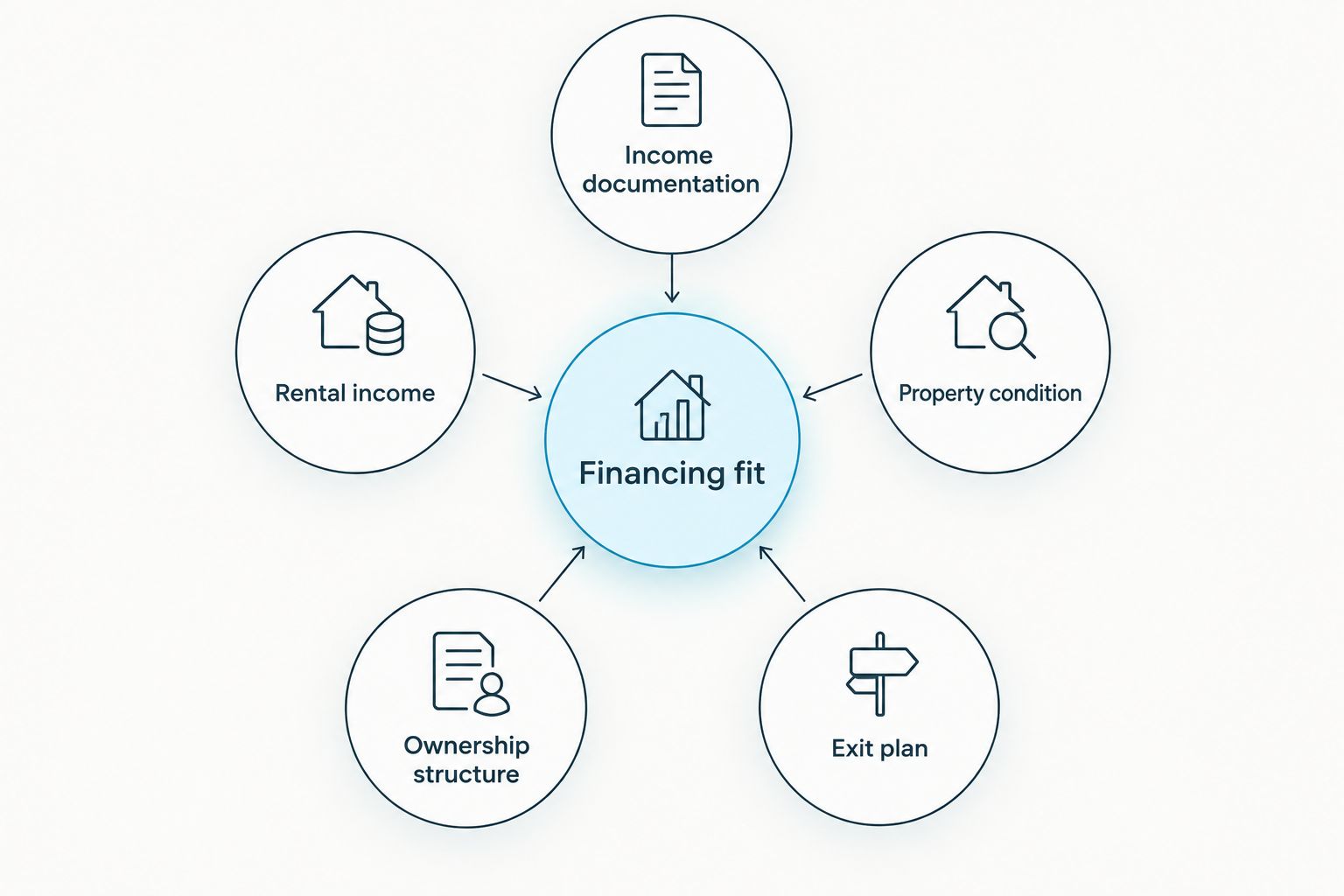
Choose the financing structure that addresses your actual transaction obstacle.
Ask Chase and each alternative provider to evaluate the same facts. Include occupancy, property condition, borrower income source, rental strategy, proposed ownership, and intended repayment path. An approval for a different transaction is not a useful comparison.
How to compare proposals before committing
In 2026, use the written proposal—not the program name—as your decision document. Separate what the lender has confirmed from what remains subject to underwriting.
- Qualification: Identify the income method, required documents, and unresolved approval conditions.
- Collateral: Confirm the property type, condition, occupancy, and rental use are acceptable.
- Structure: Review amortization, maturity, payment changes, and any balloon obligation.
- Restrictions: Read prepayment provisions, entity requirements, and limitations on the property's use.
- Execution: Confirm appraisal, title, insurance, and any renovation funding requirements.
- Repayment: Match the loan's obligations to a hold, sale, or realistic refinance strategy.
LTV means loan-to-value: the loan amount compared with the property's value. Ask which valuation the lender uses; acquisition, renovation, and refinance proposals need not evaluate the same stage of a property's value.
Compare your investment financing options
Explore DSCR, bank-statement, bridge, fix-and-flip, and short-term rental loan programs.
When staying with Chase is the right call
Keep Chase in the comparison when a conventional investment-property mortgage fits your documented income, property, and repayment plan. A specialized program is not automatically a better choice merely because it uses a different qualification method.
Choose the proposal with obligations you understand and can meet. If your property is ready for permanent financing and conventional underwriting works, changing the structure adds no inherent benefit.
FAQ
What's the best Chase alternative for an investment property in 2026?
The best alternative depends on the obstacle: compare a specialized mortgage broker for DSCR, bank-statement, bridge, or fix-and-flip financing. Keep Chase in the comparison when a conventional mortgage fits your income and property.
Is DSCR financing better than a conventional investment-property mortgage?
DSCR financing is a different qualification route, not an automatic improvement. Compare it when rental-income coverage is relevant to your application, and evaluate the repayment obligations alongside conventional financing.
Can I use bank statements to qualify for investment-property financing?
Bank-statement programs provide an alternative income-documentation route for eligible borrowers. The lender evaluates deposits and expenses; gross deposits are not automatically qualifying income.
Does a DSCR ratio of 1.0 mean my rental is profitable?
No. A DSCR ratio of 1.0 means the income and debt-service figures used in that calculation are equal; it does not prove that income covers every operating expense and future repair.
Should I use a bridge loan for a long-term rental?
Use bridge financing only for a defined temporary stage with a credible repayment plan. If you intend to refinance into permanent rental financing, verify the expected exit requirements before committing.
Can seller financing replace a bank mortgage?
Seller financing can fund a purchase when the seller agrees and the transaction is properly structured. Have an attorney review title, existing debt, repayment obligations, and default provisions before signing.
Should I leave Chase if I am self-employed?
Self-employment alone is not a reason to leave Chase. First establish whether conventional income documentation works; compare bank-statement financing when the documentation method is the actual obstacle.
One last thing
A planned refinance is not an approved refinance. Before accepting temporary financing, write down the conditions your exit lender will need and compare them with the property's expected finished condition and income. That check matters more than choosing a lender with the most appealing program name.


