


Commercial Real Estate Loans for Pickleball Facilities 2026
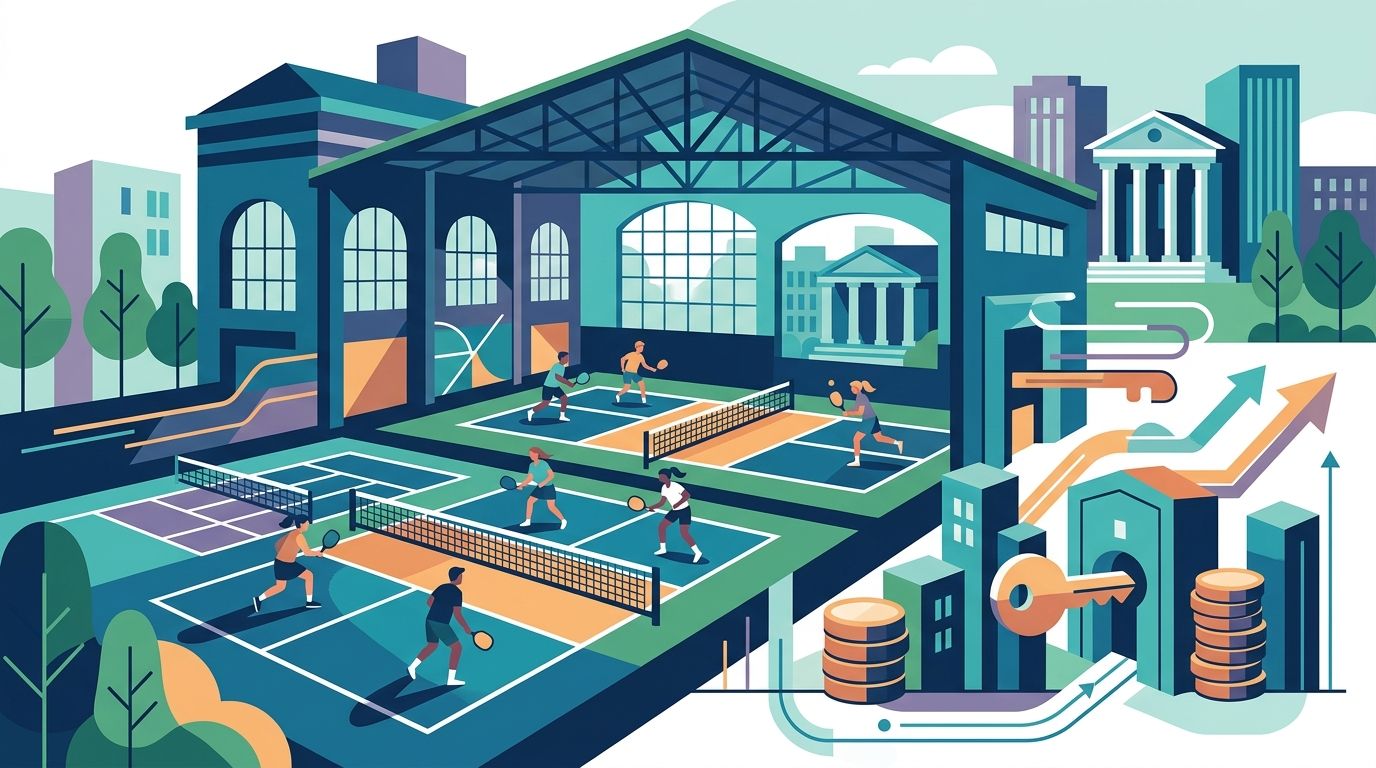
Indoor pickleball facility financing runs through the same commercial real estate loan menu as gyms and trampoline parks — DSCR, SBA 504/7(a), bridge, and bank-statement loans — and the right pick in 2026 depends on whether the facility already books court revenue or you're still converting an empty warehouse. A stabilized facility with a year of rental and membership income qualifies differently than a raw shell you're buying to build out from scratch.
TL;DR
- DSCR loans work once a pickleball facility has 12+ months of seasoned court-rental income; bridge loans cover the gap before that.
- SBA 504/7(a) loans fit owner-operators running the courts themselves, not landlords leasing space to a third-party operator.
- Bank-statement loans help self-employed operators who write off income and can't show qualifying tax-return numbers.
- Budget the real estate and the court build-out separately — most commercial real estate loans for pickleball facilities won't cover both.
- Underwrite year one at conservative, ramp-up revenue, not full-capacity court bookings, before you sign anything.
Why commercial real estate loans matter for indoor pickleball facilities
A conventional lender underwrites a commercial building on its general leasability: if you default, can another tenant walk in and use the space? Indoor pickleball courts fail that test on purpose. Cushioned court flooring, net anchors, sound-dampening panels, and 18-to-20-foot ceiling clearance make the building single-purpose, and that changes how commercial real estate loans get priced and structured for pickleball facilities specifically.
That's why underwriting on an indoor pickleball facility looks closer to indoor sports facility financing than a standard retail or office deal. Lenders want the operating model — court utilization, membership churn, league revenue — not just a building comp from three blocks over.
The verdict: a pickleball facility with seasoned court revenue qualifies for a DSCR loan; a raw conversion project needs bridge or SBA financing first, then a refinance once the doors are open and generating income.
The step-by-step guide to financing an indoor pickleball facility
Confirm your property type and zoning before you shop lenders
Most pickleball conversions land in former big-box retail, light industrial, or vacant warehouse space, and zoning is the first thing that kills a deal, not the loan.
- Confirm the zoning code permits indoor recreation or assembly use, not just general commercial
- Check ceiling height — 18 to 20 feet clear is standard for lobbed shots without hitting HVAC ductwork
- Verify parking ratios against peak-hour play, not off-hours retail traffic
- Pull the fire marshal's occupancy load for assembly space before you sign a purchase contract
- Confirm the building has enough column-free span; standard retail strip bays rarely fit multiple courts side by side
Separate the real estate loan from the build-out and equipment costs
Court flooring, netting systems, scoreboards, lighting retrofits, and point-of-sale hardware typically don't ride on the same note as the building.
- Price court surfacing and striping as a distinct line item, not part of the purchase price
- Get a contractor bid for HVAC and lighting upgrades before closing, not after
- Ask whether your lender's program allows a rehab or construction holdback on top of the acquisition loan
- Keep equipment financing (POS systems, nets, ball machines) separate from the real estate note
- Build a contingency line for permitting delays — assembly-use permits move slower than standard retail buildouts
Run the DSCR math on court-rental income, not just building comps
A DSCR loan qualifies the property on its own income, not your personal tax returns, which matters if you're self-employed or running multiple ventures.
- Total revenue from open-play fees, league dues, memberships, private lessons, and event or tournament bookings
- Subtract operating expenses to get net operating income before debt service
- Divide net operating income by the annual mortgage payment to get your coverage ratio — most DSCR lenders want that ratio at or above 1.0x, with better pricing above 1.2x
- Get a stabilized twelve-month income history before applying; pre-revenue facilities won't clear DSCR underwriting
- Ask whether the lender will count signed league or corporate-event contracts as projected income
Compare bridge loans against SBA and bank-statement programs for early-stage facilities
If you're buying the building before the courts exist, DSCR underwriting doesn't apply yet — you need a program built for pre-revenue purchases.
- A commercial bridge loan covers acquisition and short-term carry costs while you build out the space, with an exit into a DSCR or conventional refinance once income seasons; see how to get a bridge loan for a commercial property purchase for how that structure closes
- SBA 504 and 7(a) programs work for owner-operators who will run the facility themselves, not investors leasing to a separate operator; check SBA lenders for real estate investment properties for how those programs underwrite owner-occupied deals
- Bank-statement loans qualify the buyer's income, not the property's, which fits an operator who writes off income aggressively on tax returns
- Compare prepayment terms across bridge programs — some carry exit fees if you refinance before a minimum hold period
Line up down payment and reserve requirements before you make an offer
Commercial real estate loans generally require higher down payments than residential mortgages, and pickleball facilities, as single-purpose buildings, often sit on the higher end of that range.
- Get a written term sheet on down payment percentage before you tie up earnest money
- Ask what reserve funds the lender requires post-closing — six to twelve months of debt service is common on single-purpose commercial assets
- Confirm whether a personal guarantee is required, and for how long, on non-SBA programs
- Line up proof of liquid reserves separate from the down payment itself
Underwrite year one conservatively, not at full-capacity bookings
Court utilization ramps over months, not weeks, and lenders that have seen pickleball facilities close know this.
- Model revenue at partial capacity for the first two to three quarters, not full peak-hour bookings
- Account for seasonal swings — outdoor pickleball competes for players in warm months in most markets
- Build in membership churn assumptions rather than assuming year-one signups hold flat
- Stress-test your DSCR math against a slower ramp-up before you commit to a rate lock
Comparing loan options for indoor pickleball facilities
DSCR loan
- Best for: A facility with 12+ months of seasoned court and membership revenue
- Key limitation: Rarely qualifies a raw conversion with no operating history
SBA 504/7(a) loan
- Best for: Owner-operators who will run the facility day-to-day
- Key limitation: A landlord leasing to a separate operator generally doesn't qualify
Commercial bridge loan
- Best for: Buying and converting a building before revenue is seasoned
- Key limitation: Higher rate, short term, needs a clear refinance exit
Bank-statement loan
- Best for: Self-employed operators who write off income on tax returns
- Key limitation: Qualifies the buyer's deposits, not the property's court revenue
Conventional commercial mortgage
- Best for: A stabilized facility with strong personal financial statements
- Key limitation: Full documentation and a longer underwriting timeline than DSCR
Common mistakes pickleball facility buyers make
- Comping the deal like residential real estate. Court-based single-purpose buildings get valued on income, not neighborhood comps.
- Assuming the mortgage covers the build-out. Court flooring, netting, and HVAC retrofits almost always need separate financing.
- Signing a purchase contract before confirming zoning. Indoor recreation and assembly use isn't automatic in every commercial zone in 2026, even in buildings that look ready.
- Projecting full-capacity bookings from day one. Court utilization ramps over quarters, and lenders discount aggressive first-year projections anyway.
- Skipping outside financial planning entirely. Owners who never pressure-test their revenue model before closing tend to underprice court time and overestimate membership retention; talking to a financial advisor for business owners before you sign can catch a weak projection while it's still a spreadsheet, not loan collateral.
Get a loan program that fits your pickleball facility
Talk through DSCR, SBA, and bridge options for your deal.
FAQ
What loan is best for buying a building to convert into an indoor pickleball facility?
A commercial bridge loan is the standard pick for a raw conversion, since the building has no court revenue yet. Once the facility opens and posts 12 months of seasoned income, most owners refinance into a DSCR or conventional commercial mortgage.
Can I get an SBA loan for a pickleball facility?
Yes, if you're the owner-operator running the facility yourself. SBA 504 and 7(a) loans generally don't work for investors who plan to lease the space to a separate operator.
Do DSCR loans work for pickleball facilities?
DSCR loans work once the facility has a seasoned income history from court rentals, memberships, and league fees. A brand-new, pre-revenue conversion typically doesn't clear DSCR underwriting.
How much down payment do commercial real estate loans for pickleball facilities require?
Down payments run higher than residential mortgages because the building is a single-purpose commercial asset. Exact requirements vary by lender and program, so get a term sheet before you tie up earnest money.
Can I use a bridge loan to buy the building before I have court revenue?
Yes, a bridge loan is built for exactly this gap. It covers acquisition and carry costs while you build out the courts, with an exit into permanent financing once income seasons.
What credit score do I need for a commercial real estate loan on a pickleball facility?
Most DSCR and bank-statement lenders want a personal credit score in the mid-600s or higher. SBA programs and conventional commercial mortgages generally set their own minimums and document requirements.
Is a bank-statement loan a good fit for pickleball facility owners?
It fits operators who are self-employed and write off income aggressively on tax returns, since the loan qualifies on bank deposits instead of taxable income. It doesn't replace a DSCR loan, which qualifies on the property's own revenue.
How long does it take to close a commercial real estate loan for an indoor pickleball facility?
Bridge and DSCR loans generally close faster than SBA or conventional commercial mortgages, which require fuller documentation. Timelines still depend on appraisal, zoning verification, and how seasoned the facility's income is.
One last thing
Most first-time pickleball facility buyers underestimate the span requirement: a single court needs roughly 30 by 60 feet of clear floor, and running four to six courts side by side often needs 60 to 100 feet of column-free width. That single fact rules out most standard retail strip bays before financing ever enters the conversation — check the column grid before you check the loan program.


