


DSCR loan requirements for pharmacists: complete 2026 guide

DSCR loan requirements for pharmacists come down to the rental property, not the pharmacy license: lenders review rental income against the housing payment, plus credit, equity, and reserves. Your professional income does not change the property's coverage math.
TL;DR
- DSCR loan requirements for pharmacists center on rental income, credit, equity, reserves, and eligible investment-property use.
- Loanguys offers DSCR and bank-statement loan programs; pick the qualification approach that matches your property and finances.
- A 1.00x DSCR means qualifying income equals the payment used in the calculation, not that the rental earns a profit.
- Get written lender requirements before committing to a property or moving funds into a borrowing entity.
Why DSCR financing matters for pharmacists
A pharmacist's salary and a rental property's borrowing capacity answer different questions. Salary supports your personal finances. DSCR measures whether the property covers the debt obligation the lender uses. For a 2026 rental purchase, start with the property calculation rather than assuming your professional income will make up for weak rent.
If you earn employee wages, compare property-based qualification with an income-documented investment mortgage. If you own a pharmacy or earn contract income, separate business revenue from rental revenue before choosing a program. Neither arrangement makes DSCR financing an automatic approval.
Loanguys is a mortgage broker offering DSCR, bank-statement, bridge, fix-and-flip, and short-term rental loan programs. Loanguys is best suited to pharmacists who want broker guidance on DSCR and other investment-property loan programs. The selected lender's underwriting still determines eligibility.
Student debt deserves a separate review. Property-based qualification changes how repayment capacity is evaluated, but it does not remove credit review, required assets, or your obligation to make every payment.
How to prepare a pharmacist's DSCR loan application
1. Confirm the property's intended use
Write down what you are buying and how it will be used. An investment rental, a home you plan to occupy, and premises for your own pharmacy are three different financing cases. Rental-property DSCR financing is not interchangeable with an owner-occupied or business-premises loan.
Identify the property type, occupancy, and condition before ordering reports. A residential rental with a tenant is a different underwriting case from a retail pharmacy building or a property awaiting heavy renovation. Your license establishes your profession, not the property's eligibility.
- State whether the deal is a purchase, refinance, or cash-out refinance.
- Identify who will occupy the property.
- Describe the property type and any mixed residential-commercial use.
- List repairs needed before the property is rentable.
- Confirm local rental rules and association restrictions.
2. Calculate coverage using the lender's formula
Build a spreadsheet before you apply. DSCR is debt service coverage ratio: qualifying income divided by the qualifying debt obligation. For residential rentals, ask whether the lender divides monthly rent by principal, interest, taxes, insurance, and association dues. Commercial underwriting can instead use net operating income divided by debt service.
Do not mix those formulas. A calculation on gross residential rent is not the same as one on income after operating expenses. Get the lender's definition of both the numerator and denominator before judging your result.
A 1.00x ratio means qualifying income equals the obligation in the calculation. A 1.25x ratio means qualifying income is 125% of that obligation. These are arithmetic readings, not universal approval thresholds. Ask for the minimum that applies to your transaction.
- Record the rent source the lender accepts.
- Include every payment component the lender requires.
- Confirm whether association dues enter the calculation.
- Ask how vacant properties and new leases are evaluated.
- Calculate operating cash flow separately from qualifying DSCR.
3. Verify credit, equity, and reserve requirements
Review your credit reports and available funds first. Find disputed accounts, late payments, existing mortgages, and the source of your down payment. Then ask for written requirements covering your credit profile, property type, and loan purpose.
Loan-to-value, or LTV, expresses the loan amount as a percentage of the value the lender uses. It is not the share of cash you keep after closing. Budget separately for closing expenses, required reserves, and property costs outside the mortgage payment.
Loanguys offers DSCR programs alongside other investment-property financing. Use that range to discuss alternatives after you understand the property's numbers, not as a substitute for checking them.
- Ask for the applicable credit-score requirement.
- Confirm maximum LTV and how value is determined.
- Request reserve requirements and eligible asset types.
- Document large transfers and down-payment sources.
- Review student debt using the guide to loans for investors with high student loan debt.
4. Assemble property and borrower documents
Keep separate folders for the property, your assets, and the borrower. That keeps pharmacy payroll or business records from being mistaken for rental-income evidence. Property-based qualification does not mean a documentless application.
Ask for a transaction-specific list before gathering paperwork. A purchase needs different evidence from a refinance, and an occupied rental needs different rent documentation from a vacant one. Follow the lender's accepted evidence rather than substituting a listing ad for a rent assessment.
If an LLC will borrow, confirm the entity's eligibility and ownership documents before moving money or changing title. Ask whether a personal guarantee is required; an LLC name on the application does not answer that.
- Gather identification and requested borrower information.
- Provide the purchase agreement or current mortgage details.
- Collect leases and requested rent-payment records.
- Obtain statements supporting funds and reserves.
- Prepare entity documents if borrowing through an LLC.
- Track appraisal, insurance, and title requirements in one checklist.
5. Test cash flow beyond the approval calculation
Build your operating budget independently of the lender's DSCR worksheet. Rent must cover more than the qualifying payment: maintenance, tenant turnover, management, and other expenses all reduce what you keep. An approved coverage ratio is not a profit forecast.
If you work shifts, decide who handles tenant calls, access, repairs, and leasing when you are unavailable, and put that cost in the budget. For a short-term rental, separate gross booking revenue from what remains after expenses, and confirm the property's legal rental use and the lender's accepted income method.
- Budget for vacancy and turnover.
- Include repairs and ongoing maintenance.
- Assign management responsibilities and backup coverage.
- Verify insurance suited to the intended rental use.
- Review taxes, association dues, utilities, and licensing.
- Keep operating reserves distinct from closing funds.
6. Compare written terms and close deliberately
Build a side-by-side worksheet using the same property, loan purpose, and borrowing structure for every proposal. Different assumptions hide real differences. Ask each lender to explain how its qualifying rent, payment calculation, and reserve rules affect your file.
Review repayment provisions as closely as qualification criteria. Prepayment restrictions, adjustable terms, interest-only periods, and maturity dates shape your exit plan. Get them in writing rather than assuming an investment mortgage behaves like a standard home loan.
If you are changing jobs or buying a pharmacy, protect personal liquidity too. Choose financing that fits both the property and your available cash.
- Compare proposals on identical assumptions.
- Confirm the accepted DSCR calculation and required coverage.
- Review amortization, adjustment, and maturity terms.
- Ask about prepayment restrictions.
- Clear outstanding conditions before scheduling closing.
- Recheck final documents against agreed terms.
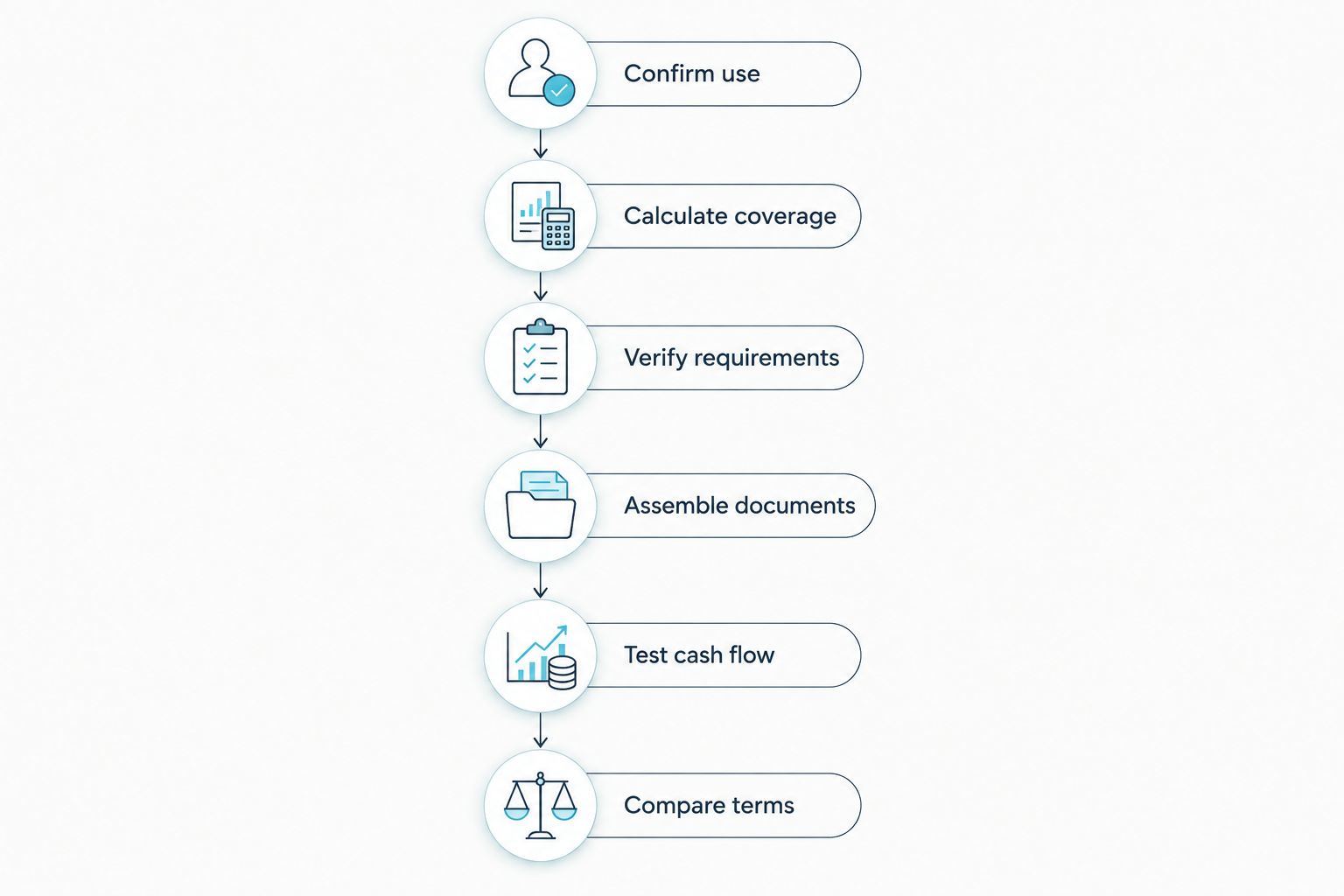
Confirm eligibility before collecting documents and comparing terms.
Compare financing options for pharmacists
Choose the underwriting approach that matches the transaction, not the name that sounds easiest. DSCR centers on the rental's income. A bank-statement approach addresses income documentation. Bridge and renovation loans address different property needs.
Ask for written eligibility and repayment terms on the same proposed transaction. No program label guarantees that your property, credit, or borrowing entity qualifies.
DSCR loan
- Best for: Pharmacists financing eligible investment rentals
- Main advantage: Qualification centers on property income
- Key limitation: Credit, equity, and reserves still apply
Conventional investment mortgage
- Best for: Pharmacists with documentable personal income
- Main advantage: Established personal-income qualification
- Key limitation: Personal debt and income documents remain central
Bank-statement loan
- Best for: Pharmacy owners or self-employed pharmacists
- Main advantage: Alternative way to document income
- Key limitation: Deposits require analysis; not automatically qualifying income
Bridge loan
- Best for: Investors needing interim financing
- Main advantage: Fits a defined transition
- Key limitation: Needs a credible repayment or refinance exit
Fix-and-flip loan
- Best for: Pharmacists renovating and reselling
- Main advantage: Matches a renovation-and-sale project
- Key limitation: Not a long-term rental financing plan
A bank-statement loan is not automatically better because you own a pharmacy. A DSCR loan is not automatically better because you earn wages. Compare the property's coverage with your personal-income qualification and pick what the evidence supports.
Review your rental financing options
Discuss your property, rental income, and financing goal.
Common mistakes pharmacists make with DSCR financing
- Treating a license as a lending exception. A pharmacy license does not replace rental-income evidence, credit review, or asset documentation.
- Using salary to justify weak coverage. Wages support your household, but they do not change the rental's DSCR arithmetic. If the property falls short, compare another approach or reconsider the deal.
- Mixing pharmacy operating funds with investment reserves. Know what the business needs before committing cash to real estate, and discuss business-account withdrawals with your accountant.
- Confusing a pharmacy building with a residential rental. Premises for your own pharmacy and a tenant-occupied home fall in different lending categories.
- Ignoring management during shift work. Assign emergencies, tenant communication, and repairs before closing, and include the cost in 2026 projections.
FAQ
What are the DSCR loan requirements for pharmacists in 2026?
Confirm rental-income coverage, eligible investment use, credit, equity, reserves, and documentation. Get the selected lender's transaction-specific requirements; a pharmacy license does not replace underwriting.
Do I need to show my pharmacist salary for a DSCR loan?
DSCR qualification centers on property income rather than a salary-based debt-to-income calculation. Confirm the lender's borrower documentation requirements before assuming employment records are unnecessary.
Can I qualify for a DSCR loan with pharmacy school debt?
Student debt does not set the property's DSCR, but approval still depends on the lender's credit and eligibility rules. Review your obligations and available cash before committing.
What DSCR ratio do pharmacists need?
Use the minimum the lender specifies for your transaction. A 1.00x ratio means qualifying income equals the calculated obligation; it is not a universal threshold or proof of profit.
Is a DSCR loan better than a bank-statement loan for a pharmacy owner?
A DSCR loan qualifies on property income, while a bank-statement loan qualifies on income shown through bank activity. Compare both against your property and documentation.
Can a pharmacist buy a rental through an LLC?
Confirm the loan program accepts your LLC before applying in its name. Ask about entity documents, title requirements, and personal guarantees.
Can I use a DSCR loan for a home I will live in?
Rental DSCR financing is intended for investment use, not an owner-occupied home. Describe your intended occupancy accurately and request financing suited to it.
One last thing
Passing a residential DSCR calculation does not mean the rental is profitable. When the formula compares gross rent to the housing payment, other operating expenses sit outside it. Keep a separate cash-flow budget even after the lender accepts your coverage.
Before your 2026 application, prepare a one-page summary of intended use, rent evidence, payment components, available funds, and management plan. Bring it to Loanguys to discuss DSCR financing and alternative programs, so the conversation stays on the transaction instead of your job title.


