


DSCR loan requirements for postal and government employees: complete 2026 guide

Government employee DSCR financing is rental-property borrowing that uses the property’s income to assess repayment capacity rather than qualifying primarily on your salary. This guide explains DSCR loan requirements for government employees and postal workers, including rental income, credit, down-payment funds, reserves, and the difference between an investment property and a home you occupy.
TL;DR
- DSCR loan requirements for government employees center on rental income, credit, property eligibility, and documented funds—not your job title.
- Compare DSCR financing with a conventional investment-property mortgage before choosing how to qualify.
- Loanguys offers DSCR financing through a mortgage broker; approval depends on the selected program and property.
- A qualifying DSCR calculation does not prove the rental will cover maintenance, vacancy, and management.
Why DSCR financing matters for government employees
Your government paycheck and your rental property answer different underwriting questions. A salary-based mortgage examines your personal income and debts. DSCR financing focuses on the investment property’s ability to support its financing, while still requiring borrower and property checks.
For a postal worker, municipal employee, or federal employee buying a rental in 2026, the decision is not whether public employment makes you eligible. The decision is whether salary-based qualification or property-income qualification better fits the transaction. Start with the guide to investment property loans for W2 employees with side rentals if you want to compare those paths.
Government employment does not establish a universal DSCR credit minimum, down payment, or reserve requirement. Those conditions belong to the lender’s program. Likewise, DSCR financing is not a government employee benefit or a government-backed mortgage simply because you work for a public agency.
Keep your household budget separate from the rental analysis. Your salary can help you handle unexpected expenses, but it does not change the rent accepted in a property-based coverage calculation.
How to prepare for a DSCR loan in 2026
1. Confirm the property’s intended use
Start with a written description of how you will use the property. State whether you are purchasing, refinancing, or taking cash out, and whether tenants will occupy the entire property. This costs nothing and prevents you from comparing programs built for different purposes.
Use an investment-property program for an investment-property transaction. Do not describe a property as a rental if you intend to live there. A duplex you will partly occupy and a duplex rented entirely to tenants require different financing discussions.
Postal and government employees should also distinguish a future relocation plan from current occupancy intent. Tell the lender what you actually intend to do, rather than choosing the description that appears easiest to approve.
- Write down your intended occupancy at closing.
- Identify long-term rental or short-term rental use.
- Record the property type and number of units.
- Disclose renovations needed before tenants can move in.
- Confirm that local rules and association restrictions permit the intended rental use.
2. Calculate coverage using the lender’s formula
Build a spreadsheet before requesting quotes. For residential DSCR programs, lenders commonly compare qualifying monthly rent with the monthly housing payment, including principal, interest, taxes, insurance, and applicable association dues. Ask which components the specific program includes; commercial calculations can use net operating income instead.
Compare like with like. Monthly income must be divided by monthly payment obligations, not annual debt service. Use the lender’s accepted rent figure rather than your preferred listing rent.
The ratio’s arithmetic is straightforward: 1.00x coverage means qualifying income equals the included payment obligations; 1.20x coverage means income is 20% above those obligations; 0.90x coverage means income is 10% below them. These are mathematical interpretations, not approval thresholds.
- Request the program’s exact DSCR definition.
- Confirm how taxes, insurance, and association dues enter the calculation.
- Identify whether lease rent or appraised market rent controls.
- Check how interest-only payments are evaluated, if applicable.
- Keep a separate operating budget for vacancy, repairs, and management.
3. Verify rental income before relying on it
Gather the lease, rent records, and any available rental analysis yourself first. An advertised rent is not the same as lender-accepted income. If the property is vacant, ask how the lender evaluates market rent and whether that program accepts properties without an existing lease.
Short-term rentals need a separate discussion. Do not substitute projected nightly bookings for accepted qualifying income without confirming the program’s documentation rules and calculation method.
Loanguys offers DSCR, short-term rental, bridge, fix-and-flip, and bank-statement loan programs. Its broker role gives you a place to discuss different financing paths, but it does not replace appraisal, documentation, or program eligibility checks.
Loanguys is best for investors seeking a mortgage broker offering DSCR and other property-financing programs. Bring the property facts first so the discussion addresses an actual transaction rather than a generic qualification estimate.
- Collect current leases and amendments.
- Separate scheduled rent from rent actually collected.
- Flag vacant units and concessions.
- Provide available rental history for a short-term rental.
- Ask what happens if the appraisal supports less rent than expected.
4. Review credit and document your available funds
Check your credit reports and make a list of available funds before applying. DSCR financing does not eliminate credit review or the need to document money used in the transaction. Public employment does not override these requirements.
Separate the down payment, closing funds, and reserves. Reserves are assets the lender accepts as a financial cushion after closing; they are not automatically interchangeable with funds you plan to spend on the purchase.
For government employees, a retirement account deserves particular care. An account balance, a withdrawal, and a retirement-plan loan have different consequences. Confirm the mortgage program’s treatment of those funds and the retirement plan’s rules before moving money.
- Review credit reports for errors and unresolved accounts.
- Request the program’s credit requirements in writing.
- Identify the source of each contribution to closing.
- Ask which assets qualify as reserves.
- Document transfers and large deposits.
- Preserve a household emergency fund outside the rental budget.
5. Check property eligibility and ownership structure
Create a property checklist before paying for transaction-specific reports. Ask about condition, insurance, title, rental restrictions, and the proposed borrower. A property can have attractive rent and still fail a program’s eligibility rules.
Loan-to-value, or LTV, compares the loan amount with the property value used by the lender. The valuation basis depends on the transaction and program, so confirm how the lender handles purchase value, appraised value, and refinance value.
An LLC is not a substitute for borrower qualification. Entity borrowing also does not automatically mean the lender waives a personal guarantee. If you plan to buy through an entity, settle the ownership structure before closing documents are prepared.
- Confirm the property type is accepted.
- Identify repairs, safety concerns, and unresolved code issues.
- Obtain insurance information for the intended rental use.
- Ask how the program determines the LTV denominator.
- Confirm whether the borrower will be an individual or an entity.
- Ask about guarantees and required entity documents.
6. Compare written terms against a conventional mortgage
Request a conventional investment-property mortgage comparison alongside the DSCR proposal. As a salaried employee, you have a reason to examine income-based qualification rather than assuming alternative documentation is automatically better.
Use the same property, ownership plan, and transaction purpose for both requests. Otherwise, apparent differences can come from comparing different scenarios rather than different financing methods.
For your 2026 comparison, review more than the qualifying ratio. A prepayment provision can affect your exit plan, and an interest-only period changes payment structure without eliminating the principal balance. Choose financing that fits both the rental and your intended holding period.
- Compare documentation requirements.
- Review fixed or adjustable payment structures.
- Ask about prepayment restrictions and exceptions.
- Confirm amortization and any interest-only period.
- Compare reserve and entity-borrowing requirements.
- Request a written list of conditions still outstanding.
7. Organize the application around your work schedule
Build a shared document folder and a short question list before submitting the application. Group files by borrower, funds, property, rental income, and entity documents. Clear organization reduces avoidable back-and-forth without promising a particular closing speed.
If your postal route, agency schedule, or worksite limits your availability, establish a reliable contact window. Make sure the lender knows who can answer questions and whether another owner must sign documents.
Loanguys DSCR financing discussions should start with your property information, rental evidence, and funding plan. Ask for the selected program’s requirements rather than assuming a broad description applies to your transaction.
- Submit readable, complete documents through the lender’s designated channel.
- Keep names and ownership details consistent across files.
- Respond to property and funding questions together when possible.
- Track open conditions in one checklist.
- Confirm signing arrangements before the scheduled closing.
Compare financing options for government employees
DSCR financing is best for property-income qualification; a conventional investment-property mortgage is best for testing salary-based qualification. Neither label guarantees approval. Match the financing method to the property’s condition, your documentation, and your exit plan.
This 2026 comparison separates each option’s practical benefit from its main limitation. Bank-statement financing belongs in the discussion when you have qualifying self-employment income, not simply because your government salary arrives by direct deposit.
DSCR financing
- Best for: Investors seeking rental-income-based qualification
- Main benefit: Focuses qualification on the property’s income
- Key limitation: Rent, credit, funds, and property eligibility still require review
Conventional mortgage
- Best for: Employees able to document qualifying salary and personal debts
- Main benefit: Uses an income-based qualification path
- Key limitation: Personal income and debt calculations remain central
Bridge financing
- Best for: Investors addressing a transitional property or financing need
- Main benefit: Supports a transaction before permanent financing
- Key limitation: Requires a credible repayment or refinance exit
Bank-statement financing
- Best for: Borrowers with qualifying self-employment income
- Main benefit: Uses a different income-documentation approach
- Key limitation: Deposits require analysis; ordinary payroll deposits do not establish program fit
A bridge loan is not a cure for a rental that cannot support permanent financing. Verify the intended refinance requirements before using temporary debt. Likewise, a bank-statement program does not solve a weak property-income calculation merely by changing documents.
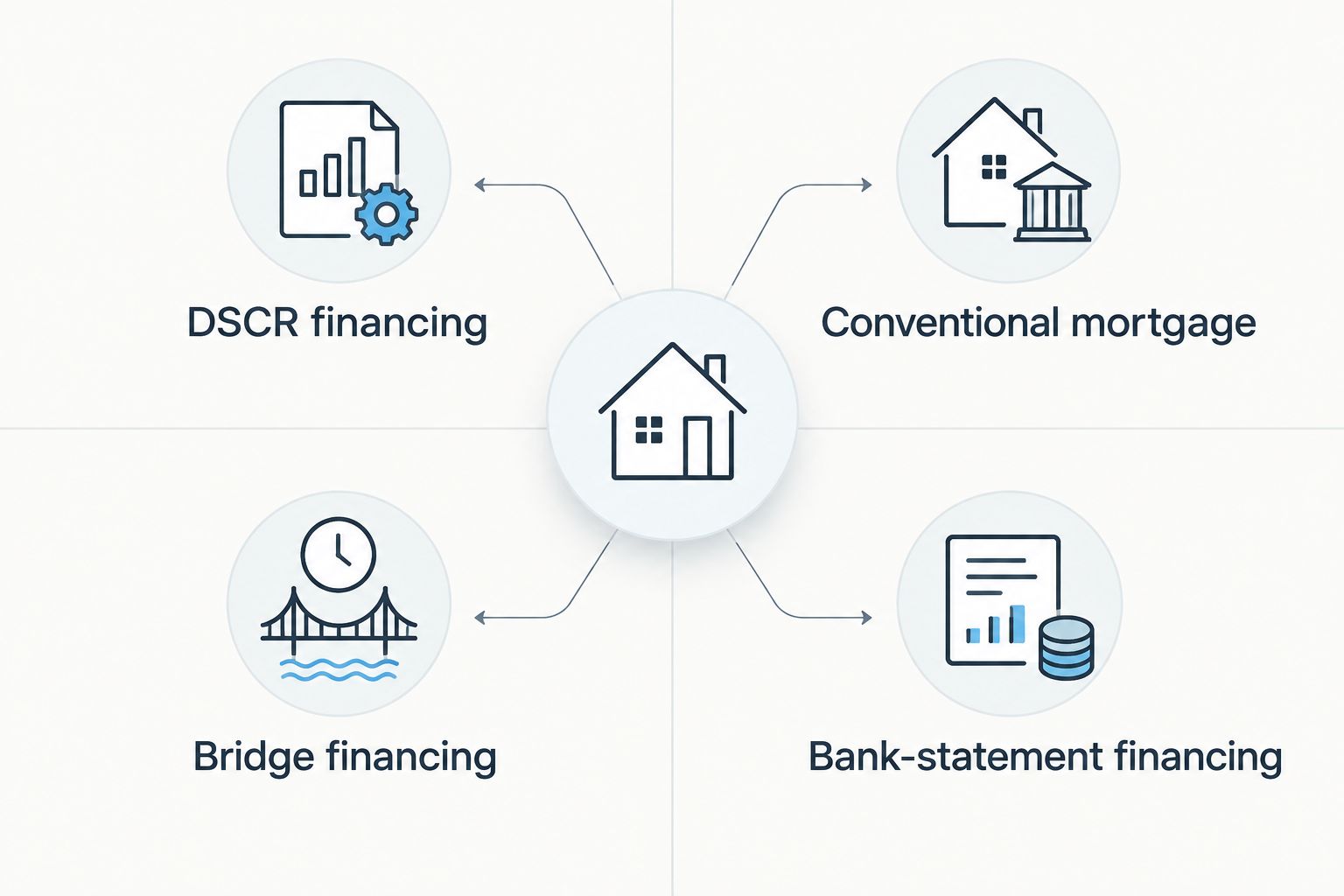
Choose the qualification method and repayment structure that fit the transaction.
Common mistakes government employees make
Treating public employment as a DSCR exception
A government position does not create a universal exception to credit, reserves, or property requirements. Ask for the selected program’s rules, not an employee-category promise. Keep any employer housing benefit separate from the investment-loan discussion.
Confusing payroll deposits with bank-statement qualification
Your paycheck appearing on a bank statement does not automatically make a bank-statement mortgage the appropriate option. Compare salary-based underwriting with DSCR financing first; discuss bank-statement qualification when relevant self-employment income is part of your application.
Counting overtime as rental-property coverage
Postal overtime or agency shift differentials belong in your personal income discussion, not in the rental-income numerator of a DSCR calculation. Your household budget can include employment income, but the property’s qualifying income must follow the lender’s method.
Calling a future residence an investment property
A transfer, reassignment, or retirement plan can affect where you expect to live. Disclose your actual intended occupancy and ask which program fits. Do not sign investment-use representations that conflict with your plans.
Using every available retirement dollar for closing
Closing with little financial cushion leaves both your household and rental exposed to unexpected expenses. Confirm reserve treatment before making a withdrawal or taking a plan loan, and review the tax and retirement implications with the appropriate professional.
FAQ
Can postal workers and government employees qualify for a DSCR loan?
Yes, postal workers and government employees can apply for DSCR financing for eligible investment properties. Qualification depends on the selected program’s rental-income, credit, funds, and property requirements—not public employment alone.
What are DSCR loan requirements for government employees in 2026?
DSCR loan requirements for government employees in 2026 include acceptable property income, credit, documented transaction funds, and an eligible investment property. The lender sets the exact coverage threshold, down payment, reserves, and documentation rules.
Does a DSCR loan require government pay stubs or tax returns?
DSCR qualification generally relies on property income rather than qualifying salary through pay stubs or personal tax returns. That does not make the application document-free; ask the lender which borrower, asset, and property records the selected program requires.
Is a DSCR loan better than a conventional mortgage for a government employee?
A DSCR loan is better suited to property-income-based qualification, while a conventional mortgage is better suited to testing salary-based qualification. Compare written terms for the same transaction before choosing either path.
Can I live in a property financed with a DSCR investment loan?
A DSCR investment-property program is not the appropriate route for a property you intend to occupy as your home. Disclose your occupancy plan and discuss financing that permits it.
Can I qualify before my rental has a tenant?
Some DSCR programs evaluate vacant rentals using appraised market rent. Confirm whether the selected program accepts a vacant property and how it determines qualifying income before relying on projected rent.
Does government employment give me a lower DSCR minimum?
Government employment does not establish a universal lower DSCR minimum. Request the selected lender’s coverage requirements and ask how they interact with credit, LTV, property type, and reserves.
Can Loanguys help me compare DSCR and other investor financing?
Loanguys offers DSCR, bridge, fix-and-flip, bank-statement, and short-term rental loan programs through its mortgage brokerage. Discuss your property and transaction purpose to identify which program requirements need review.
One last thing
A rental can satisfy a lender’s DSCR calculation and still need money from your paycheck. The qualifying payment calculation and the full operating budget are not identical. Repairs, vacancy, tenant turnover, and management belong in your investment decision even when they are outside a program’s coverage formula.
Before committing in 2026, prepare both calculations: the lender’s qualifying DSCR and your rental’s operating cash flow. If the property only works because you expect extra shifts or overtime, reconsider the purchase rather than treating loan approval as proof of a sound investment.


