


DSCR Loans for HOA-Restricted Rentals: 2026 Guide
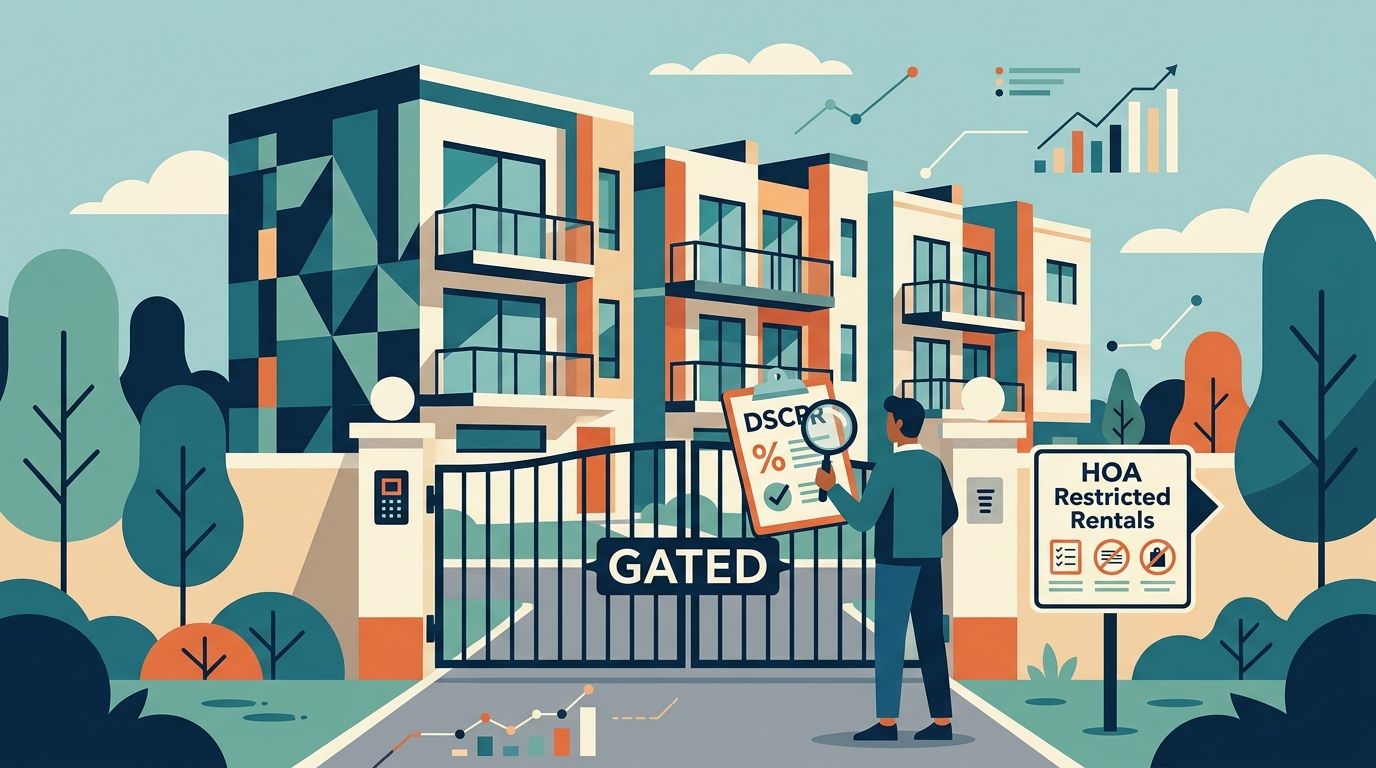
DSCR loans for HOA-restricted rentals let real estate investors qualify for gated-community and condo-association properties using the property's rental income instead of personal tax returns or W-2s. The goal is simple: close on units that traditional lenders flag as too complicated because of rental caps, minimum lease terms, or non-warrantable condo status. Investors in these deals face a second underwriter that conventional mortgages never account for — the HOA itself, with its own rules about who can rent, how long, and how often.
TL;DR
- DSCR loans for HOA-restricted rentals qualify investors on rental income, not tax returns, which matters when HOA rules complicate conventional financing.
- Pull the HOA rental restriction document before you underwrite anything — rental caps and lease-term minimums kill deals faster than rates do.
- HOA dues count against gross rent in the DSCR calculation, so a 1.20 ratio on paper can slip below 1.0 once fees are added.
- Non-warrantable condos and rental-capped gated communities still qualify in 2026 through lenders who price for them specifically.
- LLC ownership is common in these deals, but the HOA's governing documents must permit entity title first.
Why DSCR loans matter for HOA-restricted rental investors
HOA and gated-community boards write their own rental rules, and those rules sit on top of whatever your lender requires. Some associations cap the number of units that can be leased at once. Others mandate a minimum lease term of 30, 90, or 365 days, which rules out short-term rental strategies outright. A few ban rentals entirely for a set period after purchase.
Conventional lenders often reject these properties once they see a rental cap or a non-warrantable condo questionnaire. DSCR loans work around this because they underwrite the property's cash flow and the borrower's credit profile, not a debt-to-income ratio built from tax returns. A DSCR lender still needs to confirm that the lease terms the HOA allows match the rent your projection assumes. Get that wrong and the ratio you calculated won't survive underwriting in 2026.
The DSCR loan programs built for this segment ask for the HOA questionnaire early and price the loan around what the association actually permits, not around a generic condo checklist.
Pull the HOA's rental restriction document before you underwrite anything
Every gated community and condo association publishes — or can produce on request — a document covering rental caps, minimum lease terms, and tenant approval requirements. Read it before you run numbers.
- Request the Covenants, Conditions & Restrictions (CC&Rs) and any rental addendum
- Check for a waitlist; capped associations often require you to join one before leasing
- Confirm the minimum lease term in writing, not from a listing agent's summary
- Ask whether short-term rentals are banned specifically, separate from the general lease-term rule
- Verify whether each tenant needs board approval, which adds turnaround time to your income assumptions
Confirm the loan program fits the association's lease-term rules
A DSCR loan calculates the ratio off rent the property can realistically generate under its actual lease terms — not market rent for an unrestricted comparable. If the HOA requires a 12-month minimum lease, your projection reflects long-term rent, not a nightly rate the association would never allow.
- Match your rent comp set to properties under the same lease-term restriction
- Exclude short-term rental income entirely if the HOA bans it
- Confirm in writing whether the restriction transfers with the deed or applies only to the current owner
- Ask the lender whether they have closed DSCR loans in the same association or a comparable one
Get the condo or HOA questionnaire ready early
Non-warrantable condos — units in associations with high rental concentration, pending litigation, or thin reserves — trip up conventional lenders but are routine for DSCR programs built around investor properties.
- Order the HOA questionnaire at the start of the process, not after you are under contract
- Flag litigation, reserve fund percentage, and owner-occupancy ratio up front
- Ask the lender directly whether they price non-warrantable condos differently
- Confirm the association's master insurance policy meets the lender's coverage minimums
Non-warrantable status alone does not disqualify a DSCR loan for condotels and non-warrantable condos in 2026. It changes which lenders can price it, not whether the deal is financeable.
Calculate DSCR using the actual allowable rent structure
This is where most gated-community deals go wrong. Investors run the math off gross rent and forget that HOA dues, special assessments, and mandatory amenity fees sit in the expense line of that ratio.
- Pull the current dues figure, not a stale listing sheet number
- Ask about pending or planned special assessments; a new roof or gate system can shift monthly obligations by hundreds of dollars
- Include mandatory amenity fees billed separately from dues
- Recalculate DSCR with the full expense stack before locking a rate, not after
A property showing 1.20 DSCR without HOA fees can drop to 0.95 once dues and assessments are added, and a ratio under 1.0 changes which programs are available. Interest-only DSCR loans can close that gap by lowering the payment side of the ratio, but the fee math has to be right first.
Structure ownership through an LLC only if the bylaws allow it
Investors building portfolios want every rental titled under an LLC for liability separation. Gated communities and condo associations do not always allow entity ownership without board approval, and some restrict voting rights or amenity access for LLC-titled units.
- Read the CC&Rs specifically for language on entity or trust ownership
- Ask the management company whether LLC title requires a separate application
- Confirm the lender's DSCR program supports LLC borrowers in that state
- Check whether LLC ownership changes the HOA's tenant approval process
DSCR loans for LLC-owned rental properties are standard in this segment, but HOA approval comes before lender approval, not after.
Get a DSCR loan built for HOA restrictions
Talk through your association's rental rules before you lock a rate.
Budget for HOA-specific closing costs before you sign
Transfer fees, capital contribution fees, and estoppel letter costs add up fast in gated communities, and they land on top of standard loan closing costs.
- Request the estoppel letter early; it lists transfer fees and any outstanding dues on the unit
- Ask about one-time capital contribution fees, common in golf-course and amenity-heavy communities
- Confirm whether a working capital fee applies at every resale or only the first sale
- Add these figures to your closing cost estimate before comparing loan quotes
Standard DSCR loan closing costs already cover appraisal, underwriting, and title. HOA charges stack on top of that baseline.
Choose a lender that has closed loans in restricted associations
Not every DSCR lender has underwriting experience with gated communities, rental caps, or non-warrantable condos. Ask directly before you apply.
- Ask how many HOA-restricted deals the lender closed in the past 12 months
- Confirm the HOA questionnaire is reviewed in-house rather than outsourced, which adds weeks
- Check whether the lender adjusts DSCR for HOA fees automatically or expects revised numbers from you
- Compare rate and term across two or three lenders; pricing on restricted properties varies more than on standard DSCR deals
Comparison: financing options for HOA-restricted rental properties
DSCR loan
- Best for: Investors buying rental-restricted condos or gated units personally or under an LLC
- Key limitation: Ratio drops fast once dues and assessments are included
- Verdict: Buy — the standard fit for this segment in 2026
Conventional investment mortgage
- Best for: Warrantable condos with no rental cap
- Key limitation: Rejects non-warrantable associations and most rental-restricted HOAs
- Verdict: Skip for restricted properties
Blanket or portfolio loan
- Best for: Investors holding several units in the same community
- Key limitation: Cross-collateralizes properties, adding risk if one unit's HOA status changes
- Verdict: Hold — useful at 2+ units, not for a first purchase
Cash purchase
- Best for: Investors avoiding HOA financing scrutiny entirely
- Key limitation: Ties up capital that could scale a portfolio
- Verdict: Wait — only if leverage is not the priority
Pricing across these categories differs enough that it pays to review how DSCR lenders compare on rates, terms, and minimums before committing to one program.
Common mistakes HOA-restricted rental investors make
- Running DSCR math on gross rent alone. Dues, assessments, and amenity fees belong in the expense line. Skip them and the ratio you show a lender will not hold.
- Assuming a rental cap does not apply to them. Caps and waitlists apply regardless of how the unit was financed, and missing this means owning a property you cannot legally lease yet.
- Financing a non-warrantable condo like a standard purchase. Standard DSCR pricing assumes warrantable status; non-warrantable units need a lender who prices for it.
- Titling under an LLC without HOA sign-off. Some associations restrict voting rights or amenity access for entity-owned units, or require a separate application.
- Projecting short-term rental income under a long-term lease rule. A nightly-rate projection is worthless if the HOA enforces a 12-month minimum.
FAQ
Can you get a DSCR loan on a property with a rental cap?
Yes. DSCR loans in 2026 finance properties with HOA rental caps as long as the specific unit is not already blocked from leasing under that cap. Confirm the waitlist status and cap percentage before applying, since a full cap can delay leasing even after closing.
Does an HOA rental restriction affect DSCR loan approval?
It affects the ratio calculation more than the approval decision. HOA dues and mandatory fees count against gross rent, which can push the ratio below a lender's minimum on a property that otherwise qualifies.
Are non-warrantable condos eligible for DSCR loans?
Non-warrantable condos are routinely financed through DSCR programs because these loans underwrite property cash flow and borrower credit rather than requiring conventional warrantability standards. Pricing differs by lender, so compare at least two quotes.
How much do HOA fees affect the DSCR ratio?
Dues, special assessments, and mandatory amenity fees are added to the expense side of the calculation, which can move a ratio from 1.20 to under 1.0 depending on the fee structure. Always use the current dues statement, not a listing sheet estimate.
Can an LLC buy a rental property in a gated community with a DSCR loan?
Most DSCR lenders support LLC borrowers, but the HOA's governing documents must permit entity ownership first. Some associations restrict voting rights or require a separate approval application for LLC-titled units.
Do short-term rental bans affect DSCR loan qualification?
A short-term rental ban does not block qualification, but it changes the rent figure a lender will accept. If the HOA requires a 12-month minimum lease, the ratio has to be calculated off long-term rent.
What documents does a DSCR lender need for an HOA-restricted property?
Lenders typically request the CC&Rs, rental addendum, HOA questionnaire, current dues statement, and estoppel letter. Gathering these early speeds up underwriting, since HOA paperwork is the most common delay in these deals.
Is a gated community a good investment for rental property buyers?
Gated communities can produce solid rental cash flow, but the restrictions require due diligence before purchase. Confirm the rental cap, lease-term minimum, and full fee structure before trusting any DSCR projection.
One last thing
The number that sinks more HOA-restricted deals than any rate quote is the gap between gross rent and net rent after dues. An investor projecting $2,400 in monthly rent on a unit carrying $450 in dues and a $75 amenity fee is really underwriting against $1,875 — a 22% gap that changes the ratio, the loan amount, and sometimes program eligibility outright. Run that math in 2026 before you fall for the listing photos.


