


DSCR Loans for LTR-to-STR Rental Conversion (2026 Guide)
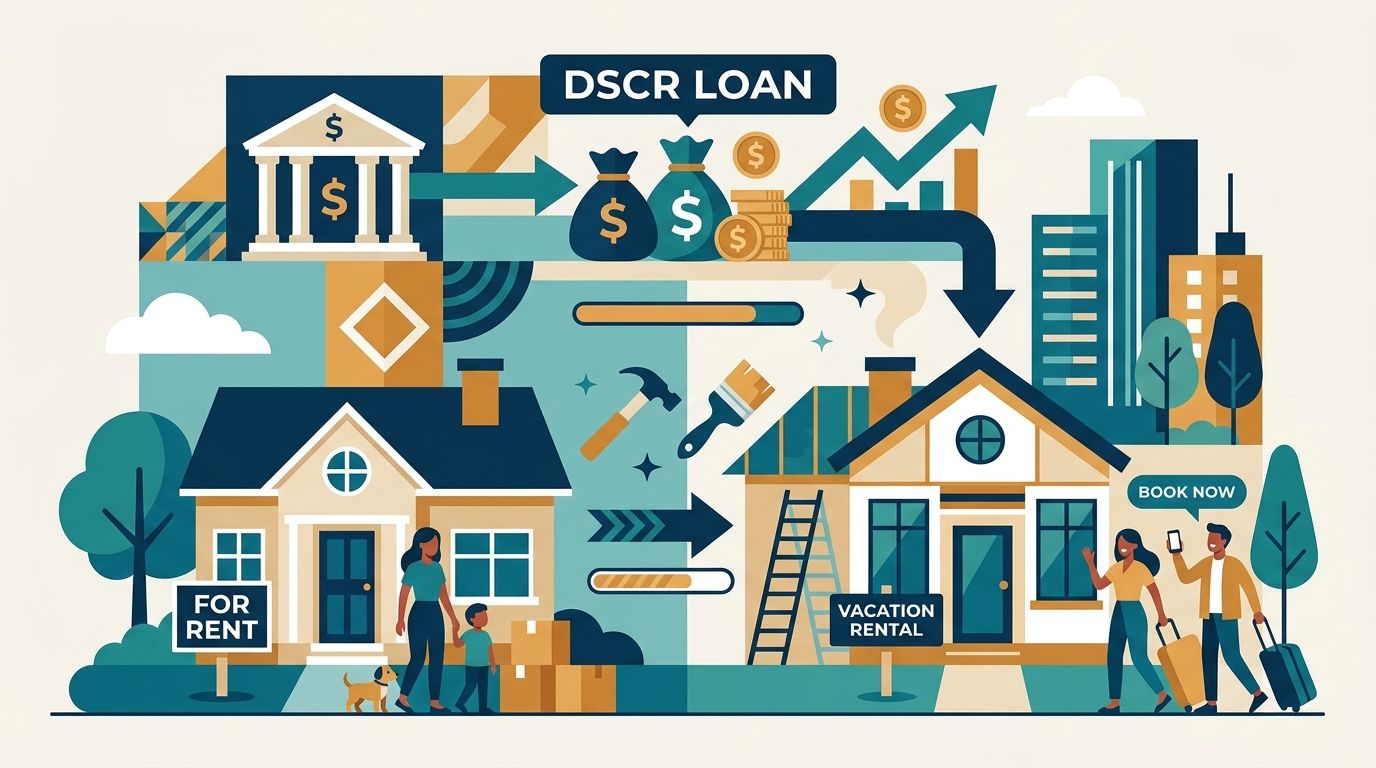
Converting a long-term rental into a short-term rental changes how a lender looks at the deal, and it changes what documents get you approved. A DSCR loan for long-term to short-term rental conversion qualifies the property off projected or comparable rental income instead of your personal tax returns, which is exactly what a mid-conversion property needs when the old 12-month lease doesn't reflect the new nightly-rate business plan.
TL;DR
- DSCR loans for long-term to short-term rental conversion qualify off market-comparable STR income, not a completed 12-month rent roll.
- LoanGuys underwrites conversions using an appraiser's short-term rental comparable schedule or third-party market data like AirDNA when no Airbnb history exists yet.
- Typical DSCR loans in 2026 target a 1.0x-1.25x debt coverage ratio and loan-to-value up to 75-80% depending on the lender.
- Insurance has to switch from a landlord policy to a short-term rental or commercial policy before closing, and lenders check for it.
- Best fit: an investor holding a leased property who wants to relist it as a nightly rental without waiting a year to prove the new income.
Why DSCR loans matter for this conversion
A property mid-conversion sits in a gap. The lease-based rent roll undersells what the unit will earn as a short-term rental, but there's no 12-month STR track record to hand a lender either. Traditional mortgage underwriting wants tax returns and a stable income history — neither exists yet for a unit that just turned over its last long-term tenant.
DSCR loans solve this because they never touch your personal income in the first place. The lender divides the property's rental income by its housing debt (principal, interest, taxes, insurance, and HOA where applicable). If that ratio clears the lender's minimum, usually somewhere around 1.0x to 1.25x in 2026, the loan qualifies on the asset. For a conversion property, the income side of that math comes from a short-term rental comparable schedule instead of an existing lease, which is the detail that makes this loan type fit the situation banks can't touch.
The conversion qualification path
Confirm the property qualifies for short-term rental use
Before any lender pulls comps, verify the property can legally operate as a short-term rental where it sits. Zoning and HOA restrictions kill more STR conversion deals than underwriting does.
- Check city or county STR permit and licensing requirements
- Review HOA bylaws for nightly-rental prohibitions
- Confirm the property isn't in a designated long-term-rental-only zone
- Verify any existing lease has a termination or non-renewal date on record
- Flag condotel or non-warrantable condo status early, since it changes lender options
Pull comparable short-term rental income
Without 12 months of Airbnb statements, the lender needs another income source. Most DSCR programs accept an appraiser's short-term rental income schedule (a 1007-style form built for STR comps) or a market data report.
- Order an appraisal that includes a short-term rental comparable rent schedule, not just a long-term rent schedule
- Pull an AirDNA or similar market report showing average daily rate and occupancy for comparable listings nearby
- Use the more conservative of the two numbers if they diverge significantly
- Keep any existing long-term lease as backup documentation in case the file needs a fallback income figure
- Ask the lender in advance which comp source they'll accept, since not every DSCR lender treats AirDNA data the same way
Choose the right DSCR ratio structure
Not every DSCR loan targets the same coverage ratio, and the structure you pick changes your rate and your cash-in requirement.
- A standard DSCR loan needs coverage around 1.0x-1.25x for the best pricing tiers
- A no-ratio DSCR loan skips the ratio test entirely, useful when a conversion property's projected STR income still looks thin on paper
- An interest-only DSCR loan lowers the monthly payment during the first STR season, which helps the ratio clear while occupancy ramps up
- Confirm whether the lender allows a DSCR loan with no rental history yet, since some programs are built specifically for that gap
Line up short-term rental insurance before you apply
A landlord policy written for a long-term tenant doesn't cover nightly guest turnover, and lenders check the policy type before closing.
- Get a quote for a short-term rental or commercial hospitality policy, not a standard landlord policy
- Confirm liability coverage limits match what the lender requires for STR use
- Ask whether the policy needs to list the lender as mortgagee before the closing date
- Budget for the STR policy's typically higher premium versus a long-term landlord policy when you model cash flow
Match your loan-to-value target to your cash position
DSCR loans on conversion properties commonly max out around 75-80% loan-to-value in 2026, and that number moves with credit profile, property type, and whether the deal is a purchase or a refinance.
- Run the numbers at 75% LTV and 80% LTV separately to see the payment difference
- Factor in reserve requirements most DSCR lenders hold for STR-specific files
- Compare a rate-and-term refinance against a cash-out structure if the goal is funding renovations for the conversion
- Ask about 40-year DSCR loan terms if a lower monthly payment helps the ratio clear
Get pre-approved before you relist the property
Sequencing matters. A lender that pre-approves the deal before the unit goes live on Airbnb can lock financing around the projected numbers instead of forcing a scramble mid-conversion.
- Submit the appraisal comp schedule or market report as part of the pre-approval package
- Lock the loan structure (ratio, interest-only, or no-ratio) before furnishing or listing the unit
- Confirm the closing timeline against any lease termination date on the current tenant
- Loop in bank-statement loan options as a fallback if the DSCR file needs more time to season
Re-forecast after the first STR season
Once the property has real nightly-rate data, that history replaces the projected comps for any future refinance or portfolio expansion.
- Track actual occupancy and average daily rate against the original appraisal projection
- Refinance into a standard DSCR loan once 12 months of STR income exists if the projected file carried a rate premium
- Use the seasoned income to qualify for a second property acquisition sooner
- Consider a cash-out refinance to pull equity for the next conversion once performance is proven
Comparing financing options for this conversion
Standard DSCR loan (no history)
- Best for: Investors converting a leased unit with no STR track record
- Underwriting basis: Appraisal STR comp schedule or market data report
- Key limitation: Rate premium versus a seasoned-income DSCR file
Interest-only DSCR loan
- Best for: Investors managing thin cash flow during ramp-up
- Underwriting basis: Same comp-based income, lower monthly payment
- Key limitation: Higher balance carried longer since principal isn't reduced
No-ratio DSCR loan
- Best for: Deals where projected STR income doesn't clear a standard ratio
- Underwriting basis: Property value and reserves, minimal income test
- Key limitation: Typically requires more cash down or reserves
Bank statement loan
- Best for: Owner-operators with existing STR deposit history
- Underwriting basis: Personal or business bank deposits
- Key limitation: Doesn't work for brand-new conversions with no deposit trail
Verdict: a DSCR loan built around an STR comp schedule is the right fit for most long-term to short-term conversions in 2026 — bank statement loans work better once the property already has a deposit history to show.
Get your conversion pre-approved
Talk through your DSCR loan options before you relist the property.
Common mistakes on LTR-to-STR conversion files
- Applying with the old lease as the only income document. A long-term lease undersells a property built for nightly rates, and it drags the DSCR ratio down artificially.
- Skipping the insurance switch until after closing. Lenders check policy type, and a landlord policy on a unit marketed as an Airbnb can stall the closing date.
- Ignoring local STR permit timelines. Some cities take months to issue a short-term rental license, and a lender won't fund a deal that can't legally operate as advertised.
- Using AirDNA numbers without cross-checking the appraisal comps. When the two income sources disagree by a wide margin, underwriters lean conservative, so build your cash-flow model around the lower figure from the start.
- Assuming every DSCR lender treats STR income the same way. Comp acceptance policies vary lender to lender, which is why confirming the income source before ordering the appraisal saves a rejected file.
FAQ
Can you get a DSCR loan for a property with no short-term rental history?
Yes. Lenders use an appraisal short-term rental comparable schedule or a market data report like AirDNA to project income when no 12-month STR history exists. This is the standard path for converting a leased property into an Airbnb in 2026.
How does a DSCR loan for STR conversion differ from a standard rental DSCR loan?
The income calculation swaps a long-term lease amount for a projected nightly-rate comparable. The debt coverage math stays the same, but the income input comes from market data instead of an existing rent roll.
What DSCR ratio do I need to qualify for a conversion property?
Most lenders in 2026 look for coverage around 1.0x to 1.25x for standard pricing. No-ratio DSCR programs exist for deals where projected income falls short of that threshold.
Do I need short-term rental insurance before closing?
Yes, most DSCR lenders require proof of a short-term rental or commercial hospitality policy before funding, since a standard landlord policy doesn't cover nightly guest turnover.
What loan-to-value can I get on an STR conversion DSCR loan?
LTV typically runs up to 75-80% depending on credit profile, property type, and whether it's a purchase or refinance. Cash-out refinances usually cap lower than rate-and-term deals.
Is a bank statement loan better than a DSCR loan for STR conversion?
A bank statement loan works once the property already has a deposit history from operating as a short-term rental. For a fresh conversion with no history, a DSCR loan using comp-based income is the more direct path.
Can I refinance into a better rate once my STR has 12 months of income?
Yes. Once actual occupancy and rate data replace the original projection, many investors refinance into a standard seasoned-income DSCR loan to remove the rate premium tied to projected income.
Does the HOA or local permit status affect DSCR loan approval?
Yes. Lenders check that short-term rental use is legally permitted before funding, so an HOA restriction or missing STR license can stall or kill the loan regardless of the income numbers.
One last thing
The detail that trips up most conversion files isn't the DSCR ratio, it's the appraisal. An appraiser unfamiliar with short-term rental comps will default to a long-term rent schedule unless the loan officer specifically requests the STR version, and that single form determines whether the deal clears the ratio at all. Confirm the appraisal order explicitly asks for a short-term rental comparable schedule before it goes out — catching that after the report comes back costs weeks, not days.


