


Fix and Flip Loans for Container Homes: 2026 Guide
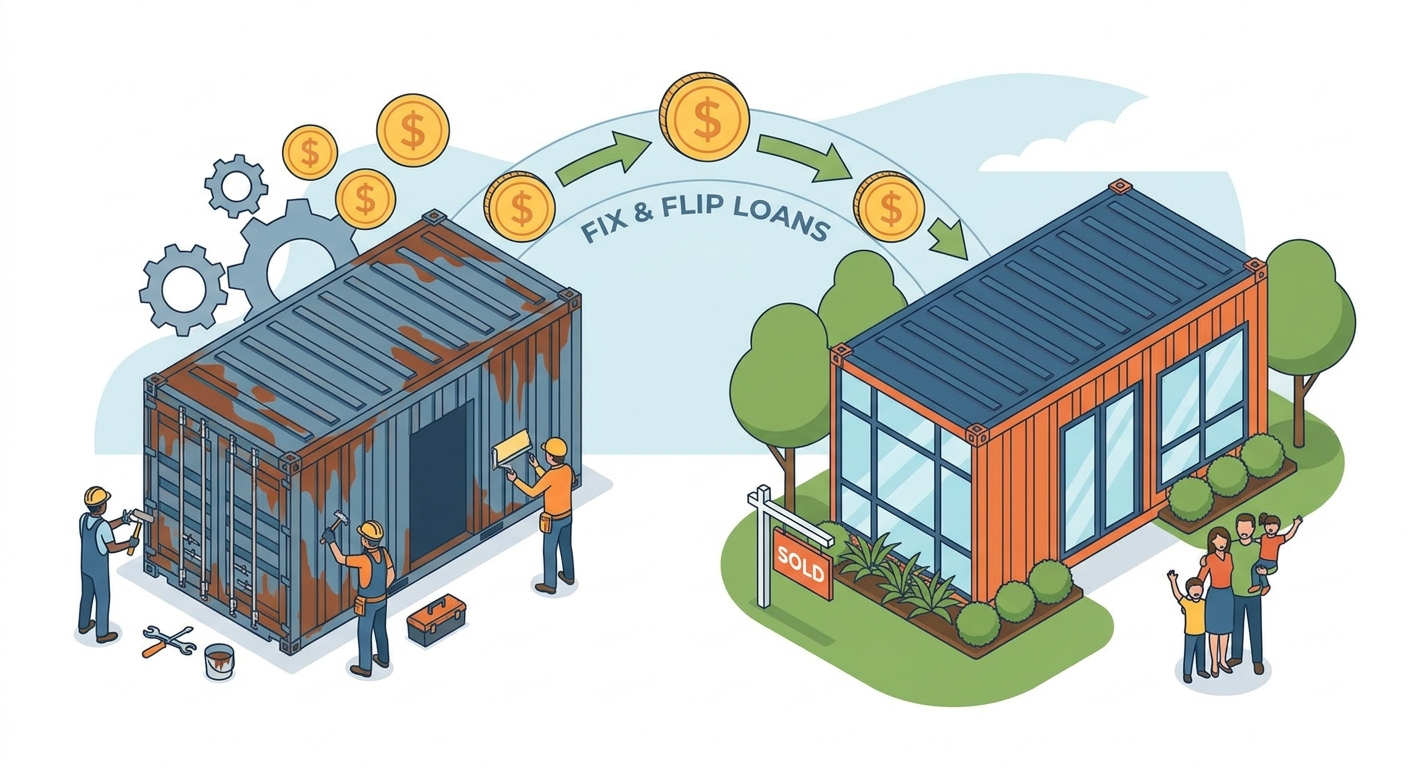
Shipping container home builds sit outside what most banks will underwrite in 2026, and fix and flip loans for container homes fill that gap with fast, asset-based financing built around the after-repair value instead of comparable stick-built sales.
TL;DR
- Fix and flip loans for container homes fund purchase and build costs off ARV, not bank comps.
- Hard money lenders typically cover 90% of costs and up to 70% of ARV on container conversions in 2026.
- Traditional banks decline most container home fix and flips over thin comparable-sale data.
- No-experience and no-money-down structures exist for first-time container flippers who qualify on the deal.
- 12 to 18 month interest-only terms match container build timelines better than 30-year products.
Why this matters
Container homes appraise differently than framed houses. Underwriters can't pull five comparable sales within a mile because there usually aren't five comparable sales — there might be zero. That single fact is why banks pass and why fix and flip loans for container homes exist as a separate category in 2026, priced and structured around the deal's numbers rather than the neighborhood's sales history.
A fix and flip loan for a container conversion looks at purchase price, projected rehab or build cost, and after-repair value as an appraiser's cost-approach estimate. Programs built for first-time flippers with no experience matter here because most container home investors are newer to construction lending even if they've flipped conventional houses before — the build process, permitting, and inspection draws work differently.
Who this is for
This guide is for investors and small builders converting shipping containers into single-family flips, ADUs, or short-term rental units, and who need a lender that already understands non-comparable, non-traditional construction. If your project involves stacking, welding, and insulating containers on a foundation rather than a standard framed build, a conventional 30-year mortgage lender will not touch the deal before completion — you need a bridge or hard money product that funds the build and gets refinanced or sold out afterward.
What to look for in fix and flip loans for container home builds
ARV-based underwriting, not comp-based underwriting
A lender that insists on three comparable container home sales within your zip code will stall your deal for months. The programs that close container flips price off after-repair value using a cost-approach appraisal, weighing materials, labor, and finished square footage instead of matching to nearby sales.
Draw schedules built for non-standard construction
Container builds don't follow a framing-drywall-paint sequence. Draws need to release around milestones like container delivery, structural welding, insulation, and utility rough-in — a lender using a standard five-draw stick-built schedule will hold your money at the wrong moments and slow the crew down.
Experience flexibility
Most container home investors are on their first or second build, even if they've flipped conventional houses for years. Look for lenders willing to fund based on the deal's equity and your general contractor's track record rather than requiring three completed flips in your own name.
Rehab and build cost coverage
Hard money lenders funding container conversions typically cover up to 90% of total project cost (purchase plus build) and cap total leverage near 70% of ARV. Anything asking you to bring more than 20-25% of total cash into the deal is pricing the risk wrong for you.
Zoning and jurisdiction flexibility
Container home permitting varies by county — some jurisdictions treat them as standard residential construction, others require additional engineering review. A lender that's funded container builds before will ask the right permitting questions upfront instead of discovering a zoning problem at draw three.
Exit strategy built in
The best programs map a path from short-term construction financing into a takeout — either a sale or a refinance into a longer-term rental loan if you decide to hold and rent the finished unit instead of flipping it.
Top picks for financing a container home flip
New construction fix and flip financing — the standard pick. Container builds are legally new construction even when the shell already exists, and programs built for fix and flip loans on new construction projects fund ground-up costs with draw schedules that match phased build timelines rather than renovation-only milestones. Typical terms run 12-18 months interest-only at rates in the 10-13% range as of 2026. Buy if your project is a ground-up container build on owned or newly acquired land.
No-money-down structuring — the wildcard. Some lenders will structure 100% of purchase and build costs using a combination of hard money and gap funding when the deal has strong equity, a concept detailed in guidance on how to finance a fix and flip with none of your own money. This works when ARV leaves real spread, not on thin-margin deals. Consider if your cash is tied up in another project and the numbers leave at least 25-30% projected profit.
Standard hard money bridge loan — the safe pick. A straightforward bridge product covering 90% of cost and 70% of ARV, funded in 10-15 business days, is the default choice for a single container flip with a general contractor already lined up. Buy for most one-off container conversions with a realistic 4-6 month build timeline.
Out-of-state investor programs. Container builds cluster in states with permissive zoning and lower land costs, which means a lot of investors are financing a build they won't personally supervise. Options built for fix and flip loans for out-of-state investors account for remote oversight and third-party inspection draws instead of assuming the borrower walks the site weekly. Buy if your build site is more than a few hours from home.
DSCR refinance-to-hold exit. If the finished container home performs better as a rental than a sale — common with short-term rental container units in tourist markets — the exit isn't a sale, it's a refinance into a long-term DSCR loan based on projected rental income rather than personal income. Consider this exit only after your build is complete and has at minimum a certificate of occupancy.
Get Financing For Your Container Build
Talk through purchase, build cost, and ARV numbers with a loan officer.
What to avoid
- Conventional 30-year construction-to-perm loans. They exist for framed houses with local comps and can take 60-90 days to close — container builds move faster than that approval timeline allows.
- Lenders with no container-specific draw experience. A generic five-draw schedule built for drywall-and-paint renovations will stall payouts at container delivery and welding milestones, the two points where your crew needs cash fastest.
- Appraisers using pure sales-comparison approach. If the appraiser can't or won't run a cost approach, the valuation will come in low regardless of your actual build quality, and your loan amount gets capped on a bad number.
Verdict comparison
New construction fix and flip
- Best For: Ground-up container builds
- Typical LTC / ARV: 90% LTC / 70% ARV
- Term: 12-18 months
- Verdict: Buy
No-money-down structure
- Best For: Strong-equity deals, cash tied up elsewhere
- Typical LTC / ARV: Up to 100% of cost
- Term: 12-18 months
- Verdict: Consider
Standard hard money bridge
- Best For: One-off single container flips
- Typical LTC / ARV: 90% LTC / 70% ARV
- Term: 10-15 day close
- Verdict: Buy
Out-of-state investor program
- Best For: Remote-managed builds
- Typical LTC / ARV: 90% LTC / 70% ARV
- Term: 12-18 months
- Verdict: Buy
DSCR refinance exit
- Best For: Post-completion rental hold
- Typical LTC / ARV: Based on rental income
- Term: 30-year amortized
- Verdict: Consider
FAQ
What's the best loan for a shipping container home flip in 2026?
A hard money or bridge loan underwritten on after-repair value, not comparable sales, is the best fit for most container home flips in 2026. Standard bank construction loans require local comps that container builds usually lack.
Is a fix and flip loan better than a construction-to-permanent loan for a container home?
For a flip, yes — fix and flip loans close in 10-15 business days versus 60-90 days for bank construction products. Construction-to-permanent loans only make sense if you plan to hold the finished unit long-term.
How much does it cost to finance a container home build?
Rates on fix and flip loans for container homes typically run 10-13% in 2026, with lenders covering up to 90% of total project cost and capping leverage near 70% of after-repair value. Total cost varies with your specific project size and location.
Can I get a fix and flip loan for a container home with no experience?
Yes, several programs qualify borrowers on the deal's equity and the general contractor's track record rather than requiring prior completed flips. Expect slightly higher rates or more reserves required than an experienced-flipper program.
Why do banks reject container home appraisals?
Banks rely on sales-comparison appraisals that need multiple recent comparable sales, and container homes rarely have enough local comps to satisfy that method. Cost-approach appraisals, which hard money lenders accept, solve this by valuing materials and labor directly.
How long does a container home flip take to build?
Most container conversions take 4-6 months from delivery to completion, depending on permitting and site prep. Bridge and hard money terms of 12-18 months build in a buffer for delays.
Can I refinance a container home into a long-term rental loan?
Yes, once construction is complete and the property has a certificate of occupancy, a DSCR loan can refinance the short-term build loan based on projected rental income instead of personal income documentation.
Do out-of-state investors need a different loan for container home builds?
Not a different loan type, but a lender comfortable with remote oversight and third-party draw inspections, since many container investors don't live near their build site. This changes the inspection process more than the underwriting itself.
One last thing
The appraisal is the part of a container home flip that trips up more deals than financing does — lenders who insist on a sales-comparison appraisal will undervalue a well-built container home every time, so confirm before you apply whether your lender's appraiser will run a cost approach. That single question, asked before you sign a term sheet, saves more container home flips in 2026 than any rate shopping does.


