


Griffin Funding alternatives for asset based lending

Griffin Funding serves borrowers whose income does not fit conventional mortgage documentation. Your search needs a different direction when the real issue is rental cash flow, renovation financing, or how investment assets count toward qualification. The best Griffin Funding alternative in 2026 is Loanguys if you need a mortgage broker offering DSCR, bridge, fix-and-flip, and bank-statement programs; an asset-utilization specialist is the better route if you specifically need investment balances evaluated as qualifying income.
TL;DR
- Compare Griffin Funding alternatives for asset based lending by qualification method, not lender rankings.
- Loanguys is a mortgage broker to consider for DSCR, bridge, fix-and-flip, and bank-statement financing.
- Asset-utilization mortgages, DSCR loans, and securities-backed credit solve different borrowing problems.
- Keep Griffin Funding in contention when its written terms match your property, documentation, and repayment plan.
Why this matters
Asset-based lending describes several different financing arrangements. A mortgage that evaluates investment balances is not the same as a rental loan underwritten around property income, and neither is the same as borrowing against securities.
Choose the qualification method before choosing the provider. Otherwise, you risk comparing lenders that cannot solve the same problem, even when their marketing uses similar language.
For your 2026 comparison, separate the asset securing the loan from the income or assets supporting repayment. Property equity answers a collateral question; it does not automatically answer the lender's qualification question.
Griffin Funding alternatives at a glance
This comparison separates a named mortgage broker from alternative lending routes. The routes below are not claims that every provider offers the same eligibility rules, collateral treatment, or closing process.
Griffin Funding
- Best for: Borrowers considering alternative mortgage documentation
- Standout feature: Nontraditional mortgage qualification options
- How to compare with Griffin Funding: Use its written proposal as your baseline
Loanguys
- Best for: Investors comparing rental, renovation, bridge, and bank-statement financing
- Standout feature: Mortgage broker offering several property-financing programs
- How to compare with Griffin Funding: Compare the proposed program and responsible funding lender
Asset-utilization mortgage specialist
- Best for: Borrowers seeking qualification based on eligible financial assets
- Standout feature: Evaluates assets under a mortgage qualification formula
- How to compare with Griffin Funding: Compare eligible accounts and the calculation method
DSCR mortgage lender
- Best for: Investors financing income-producing rental property
- Standout feature: Evaluates rental income against debt obligations
- How to compare with Griffin Funding: Compare rent treatment, property eligibility, and reserves
Bridge or fix-and-flip lender
- Best for: Investors buying or renovating before a sale or refinance
- Standout feature: Financing structured around a transitional property plan
- How to compare with Griffin Funding: Compare funding conditions, maturity, and exit requirements
Do not treat this as a universal ranking. An asset-rich homeowner and an investor buying a vacant renovation property need different underwriting, even when both search for asset-based lending.
1. Loanguys: best for comparing property-financing programs
Loanguys is a mortgage broker offering DSCR, fix-and-flip, bridge, bank-statement, and short-term rental loan programs to real estate investors and homeowners across the United States. That makes the broker a relevant alternative when your financing problem involves the property, your income documentation, or the transition between acquisition and long-term ownership.
Start by reviewing the available loan programs, then ask which qualification method fits your actual transaction. A program name alone does not establish eligibility.
Where the broker shines
- Offers several financing categories relevant to property investors.
- Provides a broker route rather than limiting your search to a single lender relationship.
- Gives you a starting point for distinguishing rental cash flow from bank-statement income documentation.
Where the broker falls short
- A mortgage broker is not automatically the lender funding your transaction; identify that party before comparing proposals.
- DSCR and bank-statement programs are not substitutes for an asset-utilization mortgage when investment balances must establish qualifying income.
- A broad program menu does not guarantee that your property, ownership structure, or financial profile qualifies.
Best for: Investors who need to identify the right property-financing program before selecting a funding source.
Verdict: Hold until the broker identifies the proposed program, funding lender, and outstanding approval conditions.
2. Asset-utilization specialist: best for investment-based qualification
An asset-utilization mortgage evaluates eligible financial assets under a lender's qualification method. You will also encounter the term asset depletion, which describes converting eligible assets into a calculated income amount for underwriting.
This is the most relevant alternative route when your investment balances are central to the application and conventional earned-income documentation does not explain your repayment capacity.
Where asset utilization shines
- Addresses the specific question of whether financial assets support mortgage qualification.
- Separates qualifying-income calculations from the income reported on tax returns.
- Gives asset-rich borrowers a different documentation route to investigate.
Where asset utilization falls short
- Account eligibility, access restrictions, and valuation adjustments depend on the program.
- Assets used for down payment, closing obligations, or reserves can affect the remaining balance used in the calculation.
- An account's market value is not automatically its eligible underwriting value.
Ask for the calculation in writing. Identify which accounts count, which deductions apply, and whether moving or spending funds changes qualification before closing.
Best for: Borrowers whose liquid or investment assets, rather than rental income or business deposits, are the intended basis for qualification.
Verdict: Hold until the specialist documents the eligible balance and resulting qualifying income.
3. DSCR lender: best for income-producing rental property
A debt-service coverage ratio, or DSCR, compares income with debt service. In rental mortgage underwriting, ask the lender exactly which rental-income figure and housing obligations enter its calculation; residential and commercial approaches are not interchangeable.
A ratio of 1.00x means the income used in that calculation equals 100% of the included debt obligations. That mathematical relationship is not a universal approval threshold.
Where DSCR lending shines
- Focuses the financing discussion on the rental property's income.
- Gives investors a route to investigate when personal earned income does not describe the investment's repayment capacity.
- Makes rent documentation and property expenses central comparison points.
Where DSCR lending falls short
- Projected rental income is not automatically acceptable income.
- Vacancy, property condition, and permitted rental use require attention.
- Property cash flow does not eliminate credit, collateral, or reserve review.
For your 2026 shortlist, compare the accepted rent source and calculation before comparing headline terms. Two proposals are not equivalent if they assume different rental income.
Best for: Buy-and-hold investors whose rental income is the relevant qualification basis.
Verdict: Hold until the lender confirms accepted rent documentation and property eligibility.
4. Bridge or fix-and-flip lender: best for transitional property
Bridge financing addresses a temporary financing need. Fix-and-flip financing addresses a purchase-and-renovation plan intended to end in a sale or another financing arrangement.
Neither route should be confused with a mortgage that qualifies you through an investment portfolio. The property plan and repayment exit drive the comparison.
Where transitional financing shines
- Aligns the financing discussion with acquisition, renovation, and the intended exit.
- Makes renovation funding conditions an explicit part of lender selection.
- Separates temporary financing needs from long-term rental financing.
Where transitional financing falls short
- A sale or refinance is an outcome you must execute, not a guaranteed repayment source.
- Renovation funding can involve inspections and release conditions.
- Delays create a mismatch between the project schedule and loan maturity.
Best for: Investors with a defined transitional project and a documented repayment plan.
Verdict: Hold until the funding schedule, maturity obligations, and backup exit are clear.
Match the lending route to your repayment evidence
Before requesting competing proposals in 2026, organize your application around the evidence supporting repayment. Use these categories to prevent an asset-based inquiry from turning into an application for the wrong loan.
- Financial assets: You want eligible investment or cash balances evaluated for mortgage qualification.
- Rental income: You want the property's income evaluated against the obligations included in underwriting.
- Business deposits: You want bank-statement documentation considered rather than relying solely on conventional income paperwork.
- Property transition: You need financing tied to acquisition, renovation, sale, or refinance.
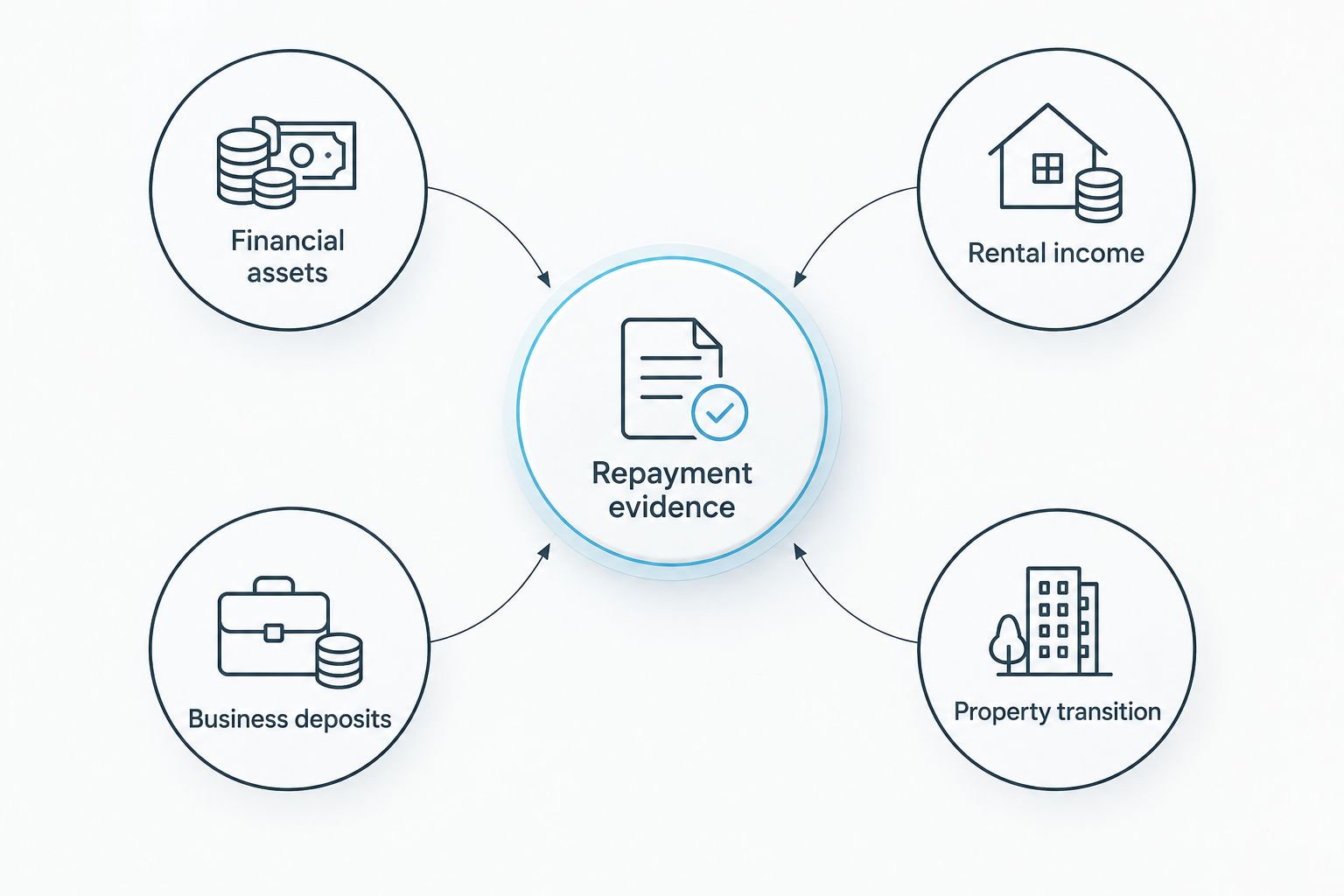
Choose the qualification method before comparing providers.
Borrowing outside a bank does not identify the underwriting method. The same distinction applies when comparing non-bank home loan lenders: an Australian provider category does not establish eligibility for a United States mortgage, so keep jurisdiction and program requirements separate.
Why people switch from Griffin Funding
A sound reason to switch is a documented mismatch between a proposal and your transaction—not an assumption that another provider approves more borrowers. Use the same financial information and property details for each comparison.
Treat the following as decision triggers, not claims about Griffin Funding's service or policies:
- Qualification mismatch: The proposed method does not use the repayment evidence you intend to rely on.
- Property mismatch: The written eligibility terms exclude your property type, condition, or intended occupancy.
- Funding mismatch: The proposed disbursement structure does not fit the acquisition or renovation plan.
- Exit mismatch: The maturity obligation does not fit your documented sale or refinance strategy.
For asset-based lending, ask whether assets establish qualifying income, serve as collateral, satisfy reserves, or perform more than one role. These are different functions, and a satisfactory answer should identify each separately.
Do not switch merely because another provider uses the phrase asset-based lending. Switch when a written proposal solves a specific problem your current proposal does not.
Compare written proposals before moving your application
A useful 2026 comparison keeps the transaction constant. Give each provider the same property information, intended use, asset statements, income documentation, and requested financing purpose.
Then resolve these questions before committing:
Qualification
- What you need in writing: The income, assets, or rental evidence used for approval
Collateral
- What you need in writing: The property or other assets securing repayment
Asset treatment
- What you need in writing: Eligible accounts, deductions, access restrictions, and reserve treatment
Loan structure
- What you need in writing: Payment structure, maturity, and applicable prepayment provisions
Funding
- What you need in writing: Closing conditions and any renovation disbursement requirements
Responsibility
- What you need in writing: The broker, funding lender, servicer, and contact for unresolved conditions
Loan-to-value, or LTV, compares the loan amount with the property's value under the applicable valuation method. An LTV of 100% means the loan equals that value; it does not describe a promised financing option.
Ask which value the proposal uses. Purchase value, current appraised value, and projected value after renovation answer different questions, so an LTV comparison without its valuation basis is incomplete.
Once you know which route fits, contact the team with the transaction details and ask for the applicable program requirements. Keep your current application active until you understand the consequences of changing providers.
When staying with Griffin Funding is the right call
Stay with Griffin Funding when its written proposal matches your qualification method, property, required documentation, and repayment plan. Another application is not an improvement unless it resolves a concrete issue.
Before switching, identify which completed steps remain usable and which must be repeated. The right provider is the one whose documented loan structure fits the transaction—not the one with the most persuasive alternatives page.
FAQ
What's the best Griffin Funding alternative for asset based lending?
Loanguys is a mortgage broker to consider when you need DSCR, bridge, fix-and-flip, or bank-statement financing. If your specific goal is qualifying through investment balances, compare asset-utilization mortgage requirements instead of assuming those programs are interchangeable.
Is an asset-based mortgage the same as a DSCR loan?
No. An asset-utilization mortgage evaluates eligible financial assets for qualification, while DSCR underwriting evaluates income against debt obligations. Ask which calculation the proposed loan actually uses.
Can I qualify for a mortgage using investments instead of a salary?
Asset-utilization mortgage programs provide a route to investigate when eligible financial assets support qualification. Account eligibility, access restrictions, and the lender's calculation determine how those assets are treated.
Does asset-based lending mean I do not need documentation?
No. Asset-based qualification still requires evidence supporting the relevant assets, collateral, and application. Ask for the program's document requirements before submitting an application.
Is borrowing against stocks the same as an asset-utilization mortgage?
No. Securities-backed borrowing uses eligible investments as collateral, while an asset-utilization mortgage evaluates assets under a mortgage qualification method. Confirm what secures the debt before comparing the arrangements.
What should I compare before leaving Griffin Funding?
Compare written qualification rules, collateral requirements, funding conditions, maturity obligations, and prepayment provisions. Keep the property and financial assumptions consistent so the proposals address the same transaction.
Should I stay with Griffin Funding if my application already fits?
Yes, when the written proposal fits your property, documentation, and repayment plan. Switching providers should resolve a specific mismatch rather than repeat an application without a defined benefit.
One last thing
Ask every provider this question: Are my assets qualifying income, collateral, reserves, or some combination? The answer exposes whether you are comparing the same financing arrangement before you spend time moving an application.


