


Griffin Funding alternatives for foreign national investors

Griffin Funding is a useful benchmark when you already have a mortgage proposal for your U.S. investment property. That proposal stops being enough if it does not accommodate your residency, documentation, or property strategy. For 2026, start with Loanguys if you need to discuss DSCR, bridge, or renovation financing; consider a relationship bank if you want your existing banking relationship involved in the mortgage decision.
TL;DR
- Compare Griffin Funding alternatives for foreign national investors by borrower eligibility first, then property strategy and documentation.
- Loanguys offers investment-property financing programs; confirm foreign-national eligibility for your specific scenario before proceeding.
- A direct foreign-national lender is worth considering when you want direct communication with the underwriting institution.
- Private bridge financing suits transitional projects, but your repayment or refinance plan must work independently.
Why this matters
Foreign-national mortgage shopping involves more than choosing between lender names. You need a financing route that accepts your borrower profile, supports the property’s intended use, and recognizes the documents you can supply.
A debt service coverage ratio, or DSCR, measures income available to cover debt payments. A DSCR of 1.00x means income equals debt service under the calculation being used; it does not establish borrower eligibility. Ask how the lender calculates the ratio and which property expenses it includes.
For your 2026 comparison, separate two questions: does the lender accept you, and does the loan fit the property? A favorable answer to one does not answer the other.
Griffin Funding alternatives at a glance
Use the following comparison to choose which conversations to have, not to assume approval. The alternatives include a named mortgage broker and financing categories because the right institution depends on your particular foreign-national scenario.
Griffin Funding
- Best for: Keeping an existing proposal that fits your transaction
- Standout characteristic: Your existing written proposal provides the benchmark
- How to compare with Griffin Funding: Check the actual eligibility conditions and property requirements
Loanguys
- Best for: Discussing rental, renovation, and transitional financing programs
- Standout characteristic: Mortgage broker offering DSCR, fix-and-flip, bridge, bank-statement, and short-term rental programs
- How to compare with Griffin Funding: Ask which funding lender and program accept your borrower profile
Direct foreign-national mortgage lender
- Best for: Communicating directly with the institution underwriting the loan
- Standout characteristic: Direct-lender relationship
- How to compare with Griffin Funding: Compare accepted documents, borrower status, and property eligibility
Relationship bank
- Best for: Bringing an existing banking relationship into the financing discussion
- Standout characteristic: Banking and mortgage discussions within the same institution
- How to compare with Griffin Funding: Establish whether the bank finances your residency and investment scenario
Private bridge lender
- Best for: Financing a property transition before a sale or refinance
- Standout characteristic: Short-term financing structure
- How to compare with Griffin Funding: Compare the repayment deadline and exit conditions with your existing proposal
The best alternative is the financing route that confirms both borrower eligibility and property fit in writing. A familiar name is not a substitute for that confirmation.
1. Loanguys: best for discussing multiple investment strategies
Loanguys is a mortgage broker offering DSCR, fix-and-flip, bridge, bank-statement, and short-term rental loan programs. That program range makes the brokerage relevant when your financing question involves both the property’s current condition and your intended investment strategy.
Start the conversation with your citizenship, country of residence, property location, and intended use. Ask whether an available funding lender accepts that exact combination before treating any program as a foreign-national solution.
Where this route shines
- Rental financing discussion: DSCR programs provide a route to discuss property-income-based qualification.
- Renovation financing discussion: Fix-and-flip programs address a different investment stage from a stabilized rental mortgage.
- Transitional financing discussion: Bridge programs give you a separate structure to evaluate when long-term financing is not the immediate objective.
- Income documentation discussion: Bank-statement programs are relevant when you need to explore alternatives to conventional income documentation.
Where this route falls short
- A broker’s program list does not establish that a funding lender accepts every foreign-national borrower.
- The funding lender’s underwriting requirements still control the decision.
- Different financing structures require separate eligibility checks; acceptance under one program does not establish acceptance under another.
Best for: Investors who need to identify the financing structure before selecting the funding lender.
For a 2026 application, request the proposed lender’s document checklist and borrower requirements alongside the program recommendation. Keep those requirements attached to the proposal so you can compare them with Griffin Funding’s actual conditions.
Verdict: Hold until your foreign-national eligibility and property use are confirmed.
2. Direct foreign-national lender: best for direct underwriting contact
A direct foreign-national mortgage lender is an alternative route when you want the underwriting institution involved from the outset. Select this category only after the institution confirms that it accepts your residency and documentation scenario.
The benefit is structural: you are discussing the loan with the lender rather than assuming a broker’s available programs match your case. It does not establish easier approval or better terms.
Where this route shines
- Direct communication helps you identify which institution owns the underwriting decision.
- You can ask the lender to explain its accepted identity, credit, income, and asset documents.
- A written eligibility response gives you a concrete basis for comparing proposals.
Where this route falls short
- You still need to compare other institutions rather than treating one lender’s requirements as universal.
- A foreign-national program does not automatically cover every property type or ownership structure.
- Direct access does not eliminate appraisal, title, source-of-funds, or underwriting review.
Best for: Investors who prefer a direct-lender relationship and can supply the lender’s accepted documentation.
Ask whether the proposed loan supports a purchase, refinance, or cash-out transaction. Those are different requests; do not carry an eligibility answer from one into another.
Verdict: Hold until the lender confirms your complete transaction, not just your citizenship.
3. Relationship bank: best for an existing banking connection
A relationship bank deserves a conversation when you already maintain accounts with the institution. Ask whether its mortgage team accepts foreign-national investment-property borrowers and whether it can evaluate your documented overseas income or assets.
Your existing relationship gives the discussion context. It does not replace mortgage qualification.
Where this route shines
- You can discuss banking arrangements and financing within the same institution.
- Existing account records provide a starting point for documenting funds held there.
- The bank can explain whether the transaction fits its own lending requirements.
Where this route falls short
- An account relationship does not guarantee mortgage eligibility.
- A bank’s mortgage requirements can differ from its account-opening requirements.
- The institution must still accept the property’s investment use and proposed ownership structure.
Best for: Investors with an established banking relationship who want to assess that institution before opening another lending relationship.
Verdict: Hold until the mortgage team confirms the investment-property scenario.
4. Private bridge lender: best for a defined property transition
Private bridge financing is a route to evaluate when your project involves a transition before sale or long-term refinancing. Examples include acquiring a property that needs work before it can support your intended rental strategy.
The central question is repayment. A bridge loan does not establish that a later mortgage will be approved.
Where this route shines
- The financing structure addresses a temporary stage rather than assuming an immediate long-term hold.
- You can evaluate the acquisition, renovation, and exit as separate parts of the project.
Where this route falls short
- A repayment deadline creates an obligation independent of your future refinance application.
- Extensions and exit provisions require careful review.
- Foreign-national eligibility must be checked for both the bridge financing and the intended replacement mortgage.
Best for: Investors with a documented project plan and a credible sale or refinance exit.
Verdict: Skip if repayment depends on an unconfirmed future mortgage.
Why people switch from Griffin Funding
Switching makes sense when another proposal resolves a specific mismatch in your existing offer. Do not switch because a comparison page places a different company first.
Use these decision triggers when reviewing your 2026 options:
- Borrower eligibility: Your proposal does not accommodate your residency, credit documentation, or borrowing entity.
- Property eligibility: The intended property use or condition does not fit the proposed program.
- Income documentation: The lender requires documents you cannot provide, while another route accepts the documentation you actually have.
- Project structure: You need renovation or transitional financing rather than an immediate stabilized-rental mortgage.
- Exit fit: The proposed repayment structure conflicts with your planned sale or refinance.
These are reasons to compare, not claims about Griffin Funding’s policies. Apply the same tests to every alternative.
How to compare foreign-national financing in 2026
Keep the evaluation in order: Borrower status, Property fit, Document review, Exit plan. Checking the loan structure before borrower eligibility sends you into a financing discussion that cannot answer the most important question.
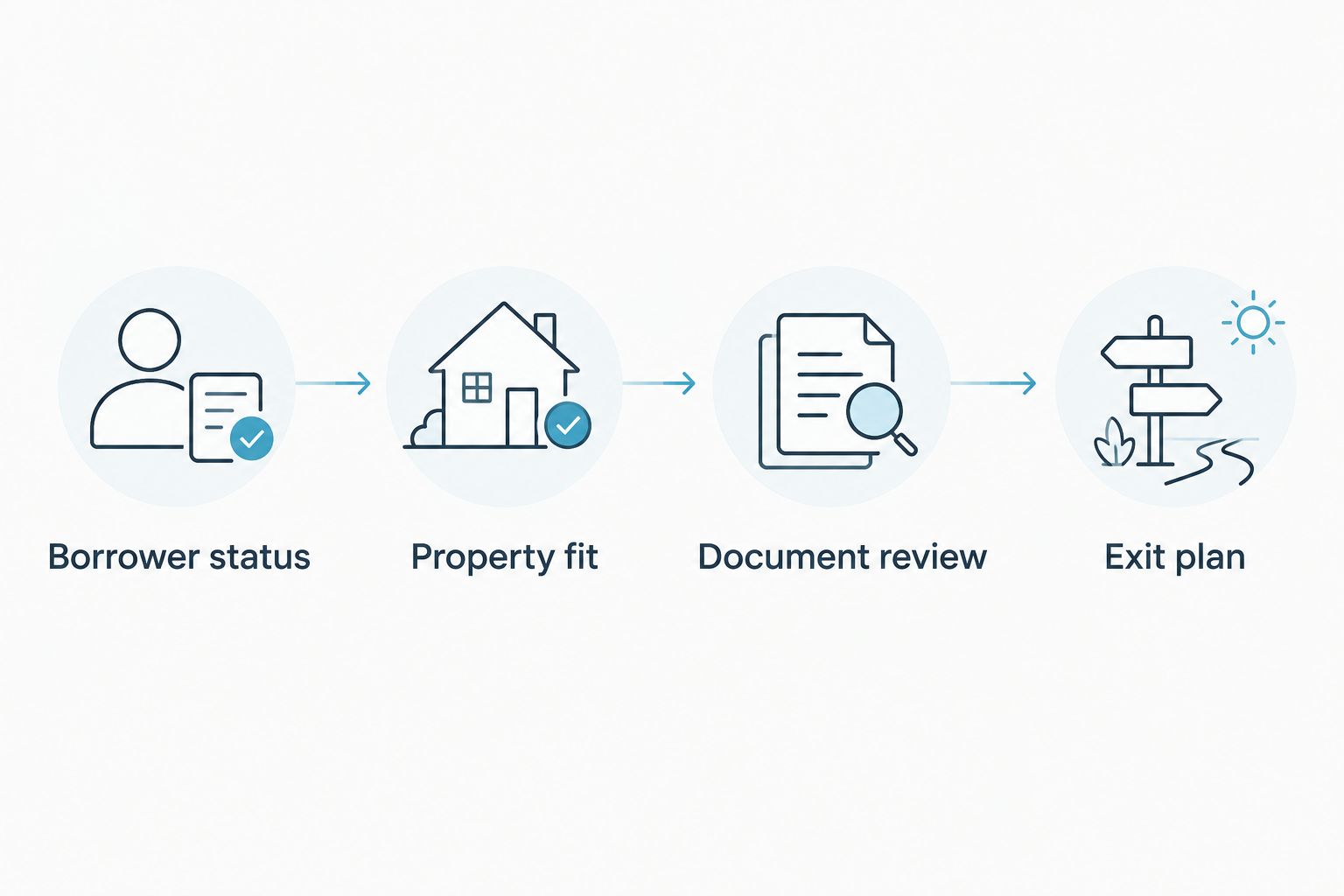
Confirm borrower eligibility before comparing a financing structure.
Borrower status
Tell each provider your citizenship, residence, and whether you have U.S. credit history or a taxpayer identification number. Ask which documents establish eligibility for that provider’s program.
An Individual Taxpayer Identification Number, or ITIN, is a federal tax-processing number. An ITIN does not confer immigration status or establish mortgage approval. Do not treat an ITIN loan discussion as interchangeable with every foreign-national mortgage scenario.
Property fit
Describe whether the property will be a long-term rental, short-term rental, renovation project, or personal-use home. Include its location and proposed legal owner.
Ask how the lender treats mixed personal and rental use. Also confirm whether the proposed borrowing entity is acceptable before arranging ownership around an assumed lending requirement.
Document review
Request a written checklist covering identity, credit, income, assets, and source of funds. Ask whether overseas documents require translation and how the lender wants transfers documented.
Keep supporting records connected to the funds you plan to use. Moving money between accounts does not explain its origin.
Exit plan
For bridge financing, establish the repayment obligation and review the intended replacement loan separately. For a rental mortgage, understand the payment structure and any prepayment restrictions before accepting the offer.
Loan-to-value, or LTV, compares the loan amount with the property value used by the lender. An LTV of 100% means those amounts are equal; it is a definition, not an advertised borrowing limit. Ask which valuation the lender uses rather than comparing percentages detached from their calculation.
Discuss your investment financing needs
Explain your residency, property use, and financing goal before choosing a loan structure.
When staying with Griffin Funding is the right call
Stay with Griffin Funding when its written proposal accepts your borrower profile, supports the intended property use, and gives you an understandable path through underwriting. An alternative needs to improve a specific part of the transaction to justify changing providers.
Compare outstanding conditions, not just preliminary descriptions. Before switching, identify which documents and property reviews the new provider still requires and whether those requirements fit your purchase contract.
For a 2026 transaction, the decisive comparison is between current written proposals for the same borrower and property. A recommendation based on a different investor’s situation does not settle your decision.
FAQ
What are the best Griffin Funding alternatives for foreign national investors?
The relevant alternatives are an investment-property mortgage broker, a direct foreign-national lender, a relationship bank, or a private bridge lender. Choose the route that confirms your borrower eligibility and fits the property’s intended use.
Is Loanguys better than Griffin Funding for foreign-national investors?
Neither provider is automatically better for every foreign-national investor. Loanguys offers DSCR, fix-and-flip, bridge, bank-statement, and short-term rental programs; compare a confirmed program match with Griffin Funding’s actual written proposal.
Can a foreign-national investor qualify for a DSCR loan?
A foreign-national investor needs a DSCR program that accepts the investor’s borrower profile. Property income is part of the financing analysis, but it does not replace the lender’s borrower, credit, asset, and documentation requirements.
Do I need an ITIN to get an investment-property mortgage?
The proposed lender must confirm its taxpayer-identification requirements. An ITIN is a tax-processing number, not proof of immigration status or mortgage eligibility.
Can I borrow through a U.S. LLC as a foreign-national investor?
You need a lender that accepts both the borrowing entity and its owners’ profiles. Confirm entity documents, ownership disclosures, and any personal-guarantee requirements before relying on an LLC structure.
Should I use a bridge loan before applying for a rental mortgage?
Use bridge financing only when the temporary financing fits your project and you have a credible repayment plan. Confirm the intended rental mortgage separately because bridge approval does not guarantee refinance approval.
What should I ask before switching from Griffin Funding?
Ask the alternative provider to confirm borrower eligibility, property eligibility, accepted documents, and remaining underwriting conditions. Compare those answers with your existing written proposal for the same transaction.
One last thing
Check the future refinance before accepting the temporary loan. Foreign-national eligibility needs to work at both stages if your investment depends on replacing acquisition or renovation financing with a rental mortgage.
Send the intended long-term lender the same borrower and property details used for the temporary financing discussion. That keeps your exit plan tied to the actual transaction rather than a generic program description.


