


Hard Money Loans for Condemned Properties (2026 Guide)

Hard money loans for condemned properties give real estate investors a fast, asset-based way to buy structures a bank won't touch, with the goal of closing and starting repairs before a city's demolition order becomes final. This segment isn't flipping a dated kitchen — it's buying a red-tagged shell with a code enforcement file, a compliance deadline, and zero chance of a conventional mortgage.
TL;DR
- Hard money loans for condemned properties fund on after-repair value, not current condition, so red-tagged houses still qualify.
- Loan Guys underwrites investment property loans around the repair scope and exit plan, not the code violation itself.
- Expect 6- to 24-month terms and lender advances tied to after-repair value rather than the property's current appraised state.
- The biggest risk in 2026 isn't the loan — it's missing the city's correction deadline before funding closes.
Why this matters for condemned-property buyers
A condemned or code-violation property fails the basic test every conventional and most DSCR lenders apply: is it habitable and insurable right now? It usually isn't. Banks decline the file at underwriting, insurers won't bind a policy on an unsecured structure, and the seller — often a bank-owned asset manager or a city land bank — wants a fast, all-cash-equivalent close.
That combination is exactly what hard money lending exists to solve. A hard money lender bases the loan on the property's after-repair value (ARV) and the borrower's exit plan, not on whether the house currently has a working roof or a valid certificate of occupancy. For an investor working condemned inventory, that's the difference between closing in two to three weeks and losing the deal to a cash buyer while a bank underwriter is still requesting a habitability inspection.
Confirm the condemnation status before you make an offer
Don't take the listing agent's word for it. Pull the actual code enforcement file from the city or county — condemnation, red-tag, and simple code-violation notices are three different legal statuses with three different timelines.
- Request the full violation history from the building or code enforcement department, not just the current notice
- Check whether the file lists a demolition date — this is the number that drives your entire timeline
- Confirm whether occupancy is barred (condemned) or just restricted (open violations)
- Ask if there are outstanding fines or liens attached to the property, since these often transfer with title
- Note the correction window the city has given; many municipalities set 30- to 90-day windows before escalating to demolition
Order a title and lien search before you bid
Code violations frequently travel with municipal liens, and those liens can sit ahead of your future loan in priority. Skipping this step is how investors end up buying a house and a five-figure fine in the same transaction.
- Pull a full title search, not just a quick lien check from the county recorder
- Flag any municipal code enforcement liens, demolition liens, or nuisance abatement charges
- Confirm whether unpaid property taxes are attached, since tax liens can trigger a separate foreclosure clock
- Ask the title company directly whether they'll insure over a condemnation notice at closing
- Get a payoff or release estimate for any lien you plan to clear at or before funding
Build a repair-scoped budget for the code violations, not just cosmetics
A rehab budget for a condemned property has to start with what got it condemned — structural, electrical, plumbing, or fire damage — before a single dollar goes toward finishes. Underwriters at hard money loans for condemned properties want to see the violation list mapped to line items, not a general contractor allowance.
- List every cited violation from the code enforcement report as its own budget line
- Get a licensed contractor bid specifically scoped to the items that triggered the notice
- Add a 15-20% contingency on top of the base bid for hidden damage typical of vacant structures
- Separate "cure the violation" costs from "finish for resale or rent" costs in the draw schedule
- Include securing costs — boarding, fencing, tarping — as day-one line items, not afterthoughts
Securing the structure the day you close is not optional on a condemned file. Cities re-inspect vacant properties on their own schedule, and an unsecured house can draw a second violation notice even after you've bought it. A vendor's public rundown of emergency board-up costs is a useful sanity check for that line item before you finalize the budget, since boarding and securing a multi-window structure runs a wide range depending on size and damage.
Line up a lender who underwrites on ARV, not current condition
This is where the manual approach — cash savings, a HELOC on another property, or a private individual lender — runs into a ceiling. Most investors don't have $150,000-$300,000 sitting in cash for a condemned acquisition plus rehab, and HELOC capacity dries up fast once you've used it on one deal.
A hard money lender that specializes in investment property loans, including Loan Guys, prices the loan against ARV rather than the distressed as-is value, which is the only way most condemned-property deals pencil. Loan Guys structures fix-and-flip and bridge financing around the repair scope and the exit, so a red-tagged property with a solid ARV and a documented contractor bid can still close.
- Ask the lender directly whether they've funded condemned or red-tagged files before, not just fire-damaged ones
- Get the advance rate in writing — most hard money lenders cap loans at 65-75% of ARV
- Confirm draw disbursement is tied to inspected milestones, since that protects your cash flow during the correction period
- Compare interest-only versus amortizing structures; interest-only preserves cash for the rehab itself
- Check whether the lender requires proof the violation is being actively cured before releasing draws
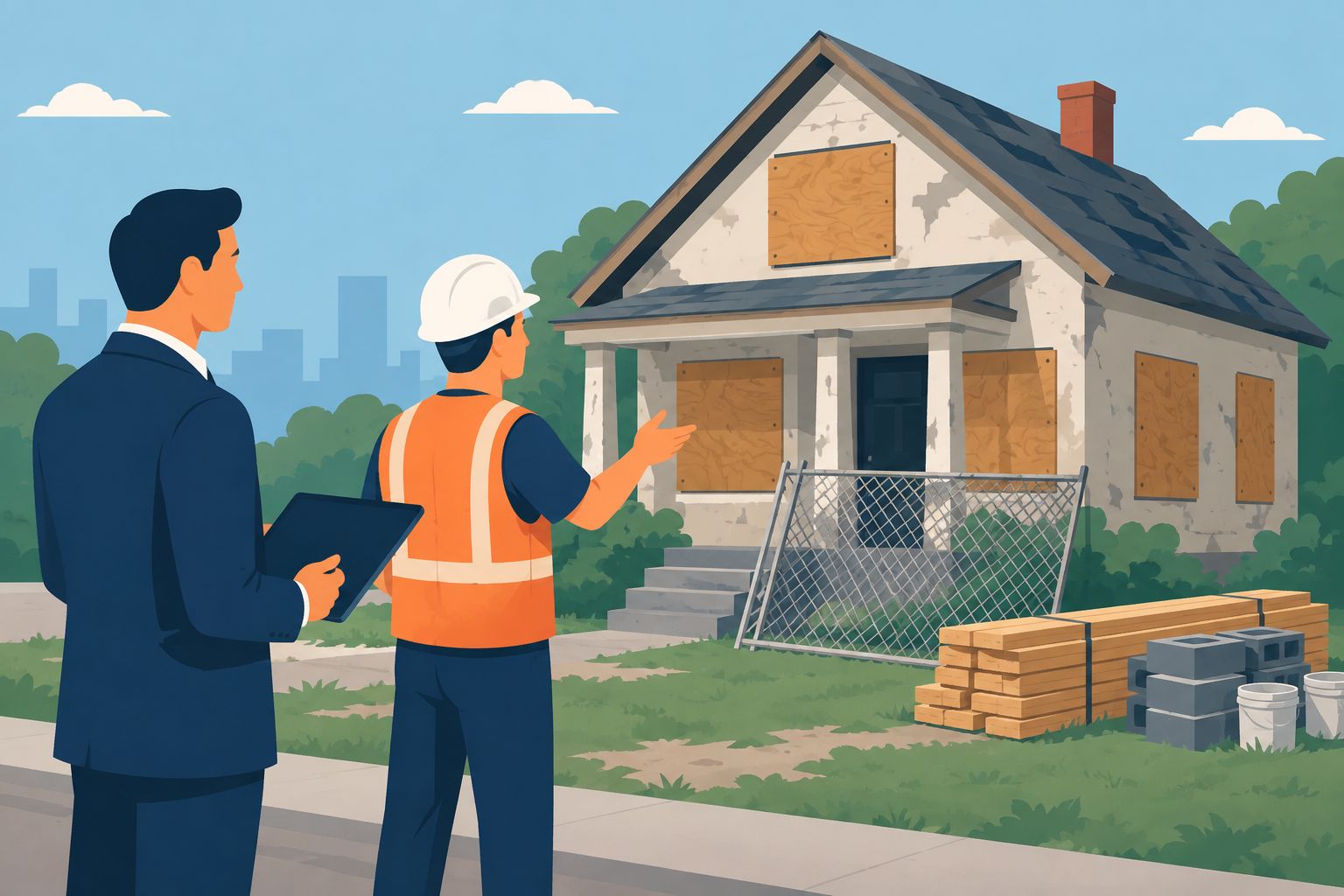
Securing the structure the same day you close protects against a second code violation.
Clear the violations with code enforcement in writing
Funding the loan doesn't end your obligation to the city. Get every corrected item signed off in writing before you consider the property stabilized, because an unresolved violation can still trigger a re-inspection or a lien even mid-rehab.
- Schedule a re-inspection with the code enforcement office once major items are cured
- Request a written closure letter or clearance for each cited violation
- Keep dated photos of every repair stage in case the city disputes completion
- Notify the city in writing if you request a deadline extension, and get their response in writing too
- Confirm the title company will remove any recorded violation notice once cleared
Plan your exit before your hard money term expires
Hard money loans for condemned properties are built to be short. Waiting until month 10 of a 12-month term to think about the exit is the single most common way investors lose margin to default interest or forced sale.
- Decide early whether the plan is retail resale, rental hold, or wholesale to another investor
- If holding as a rental, start the refinance conversation with a DSCR lender once the certificate of occupancy is reissued
- Model the refinance or sale timeline against your loan maturity date, not the other way around
- Ask your lender directly whether extensions are available and on what terms
- Line up a backup buyer or refinance lender before you're 60 days from maturity
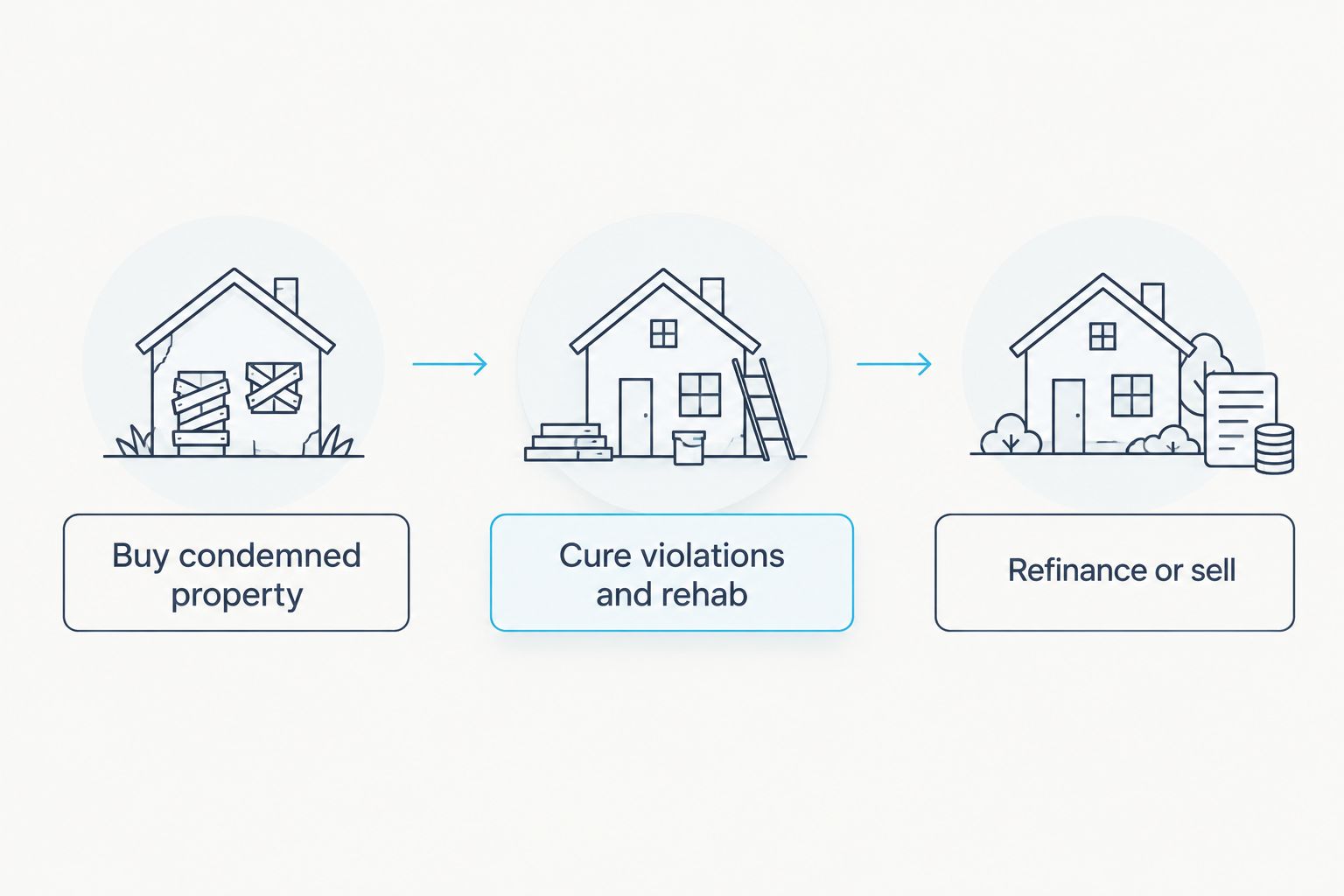
The exit decision should be made before the loan closes, not after the roof is fixed.
Investors who plan to hold the finished property as a rental often move straight from the hard money bridge into a DSCR loan once the C.O. is reissued — a step worth mapping out on how to refinance a hard money loan into a DSCR loan before you ever sign the original term sheet.
Track your draw schedule against the city's inspection calendar
Draw releases and city re-inspections rarely run on the same clock, and a delayed draw can stall repairs right when the city is watching for progress.
- Request the lender's draw turnaround time in writing before closing
- Schedule city re-inspections a few days after, not before, funds are expected to clear
- Keep a running log of every draw request date versus release date
- Flag any pattern of delay to your loan officer immediately rather than after two missed draws
Financing options compared for condemned-property buyers
Hard money / bridge loan
- Best for: Investors who need to close fast on a red-tagged property and rehab against a deadline
- Key limitation: Short term (typically 6-24 months) means the exit has to be planned upfront
All-cash purchase
- Best for: Investors with liquid capital who want zero financing friction
- Key limitation: Ties up capital that could fund multiple deals
HELOC on another property
- Best for: Investors with equity elsewhere who need a quick draw source
- Key limitation: Capacity is capped by existing equity and can't scale across multiple condemned deals
Seller financing
- Best for: Distressed sellers, banks, or land banks motivated to move inventory off their books
- Key limitation: Terms vary deal-by-deal and aren't guaranteed to be available
Conventional or FHA mortgage
- Best for: Not viable for condemned or red-tagged status
- Key limitation: Occupancy and habitability requirements disqualify most condemned files outright
Verdict: hard money loans for condemned properties are the practical financing path for investors in 2026, best suited to buyers with a scoped repair budget and a clear exit, not a first-time flipper hoping the deal figures itself out.
Investors expanding beyond a single distressed file, including probate acquisitions or fire-and-water-damaged inventory, run the same underwriting logic — see how it plays out on fix-and-flip loans for fire and water damaged properties and fix-and-flip loans for probate property purchases.
Common mistakes condemned-property buyers make
- Bidding before pulling the code enforcement file — the demolition date, not the listing price, is the number that kills deals
- Underbudgeting the structural cure items — cosmetic rehab budgets don't cover the electrical, plumbing, or structural work that got the property condemned in the first place
- Leaving the property unsecured after closing — a second violation notice can restart the enforcement clock even after you own it
- Waiting until the last month of the loan term to plan the exit — refinance and resale timelines both take longer than investors expect near a maturity date
- Assuming every hard money lender treats condemned files the same as standard fix-and-flip files — ask specifically about condemnation experience before signing a term sheet
Running more than one lender quote side by side before signing anything is worth the extra day — how to compare hard money lenders before signing a term sheet covers the questions that expose weak draw schedules early.
Talk through your condemned-property deal
Get a read on ARV-based financing before your offer deadline.
FAQ
Can you get a hard money loan on a condemned property?
Yes. Hard money loans for condemned properties are underwritten against after-repair value and the borrower's exit plan rather than the property's current habitability, which is what disqualifies it from conventional and most DSCR financing.
How fast can a hard money loan close on a red-tagged house?
Hard money closings on distressed and condemned files typically run two to three weeks once title, lien search, and a contractor bid are in hand, far faster than a conventional mortgage timeline.
What loan-to-value can investors expect on condemned properties?
Most hard money lenders advance 65-75% of after-repair value on condemned or code-violation properties, with draws released against inspected repair milestones rather than upfront.
Do banks lend on condemned real estate?
No. Banks and conventional mortgage programs require habitability and a valid certificate of occupancy, both of which a condemned property lacks until violations are cured.
What happens if the rehab isn't finished before the loan term ends?
Most hard money lenders offer extensions on a case-by-case basis, but they typically carry higher default-rate interest, so lining up a refinance or sale buyer 60 days before maturity avoids the cost.
Can you refinance a condemned property once it's repaired?
Yes. Once the code violations are cleared and a certificate of occupancy is reissued, investors typically refinance the hard money bridge into a DSCR loan for a long-term rental hold.
Do municipal liens on a condemned property transfer to the buyer?
Often, yes. Code enforcement and demolition liens frequently attach to the property itself, which is why a full title and lien search before bidding is non-negotiable.
Is seller financing available on condemned properties?
Sometimes, particularly when the seller is a bank-owned asset manager or municipal land bank motivated to move distressed inventory, but terms vary deal by deal and aren't guaranteed.
One last thing
The deal that kills investors on condemned inventory in 2026 usually isn't a bad rehab budget — it's a demolition clock that outruns the closing timeline. Pull the code enforcement file first, every time, before you run a single repair number.


