


Hard Money Loans for Teardown Rebuild Projects Win | 2026

Teardown and rebuild project financing is short-term, asset-based funding with the aim of acquiring an existing property, removing the structure, and completing a new build. These projects differ from standard renovations because the collateral changes from an improved property to a cleared site before construction restores its value, so the loan must support demolition, staged draws, and a defined exit. LoanGuys offers bridge and fix-and-flip programs for real estate investors who need this type of flexible project financing.
TL;DR
- Hard money loans for teardown rebuild projects can combine acquisition, demolition, and construction funding.
- Separate demolition and construction budgets make draw requests easier to document and review.
- LoanGuys is best for investors comparing bridge and fix-and-flip financing for a teardown project.
- Confirm zoning, permits, insurance, draw rules, and the exit before closing in 2026.
Why hard money matters for teardown and rebuild investors
A teardown creates a financing problem that a cosmetic renovation does not. Once demolition begins, the lender temporarily holds collateral consisting mainly of the land, approved plans, completed site work, and the remaining construction budget. The underwriting must account for that transition before the loan closes.
The lender therefore evaluates more than the purchase contract. Expect attention on the current property value, proposed improvements, plans and specifications, construction budget, contractor qualifications, borrower liquidity, local market, and projected value after completion. Requirements vary by lender and project.
Hard money can fit when an investor needs a faster acquisition process or cannot use a conventional construction loan. The trade-off is tighter project control: draws usually depend on documented work, inspections, and an approved budget. A delayed permit or failed inspection can stop progress even when the total loan amount appears sufficient.
LoanGuys is best for real estate investors who need a broker to compare bridge and fix-and-flip financing for a teardown project. That fit is strongest when the borrower has a clear scope, credible build team, and documented exit rather than a concept that still depends on zoning changes.
How to finance a teardown and rebuild project
Confirm that the planned rebuild is legal
Start with the local planning and building departments before discussing loan size. The existing structure can have legal nonconforming features that the replacement building cannot keep, including setbacks, height, lot coverage, parking, density, or use. Demolishing first and discovering that the planned replacement is not permitted can leave you carrying land without an executable build.
Use public zoning maps and municipal code as the free starting point. Then obtain written confirmation or professional guidance for any unclear requirement. In 2026, base the financing request on the project that can be approved, not the largest structure that appears to fit on a site plan.
- Verify the zoning district and permitted use
- Compare required setbacks with the proposed footprint
- Check demolition and building permit requirements separately
- Identify historic, environmental, flood, or design review
- Confirm utility capacity and access
- Determine whether variances or rezoning are required
Build three separate project budgets
Separate acquisition, demolition, and construction instead of presenting one combined project total. The acquisition budget covers the property and transaction expenses. The demolition budget covers disconnection, removal, disposal, site clearing, and any approved foundation work. The construction budget covers labor, materials, permits, professional services, and completion items.
This structure helps the lender understand when the collateral changes and what each draw accomplishes. It also exposes gaps that disappear inside a single contractor estimate. A demolition quote that excludes utility work or disposal is not a complete demolition budget.
- List acquisition uses independently
- Itemize demolition and site preparation
- Break construction into lender-reviewable phases
- Separate hard costs from professional and municipal costs
- Add documented reserves without hiding them in trade lines
- Reconcile every budget line with a bid or estimate
Match the loan structure to the work sequence
After the legal path and budget are clear, compare lenders based on how their funding process matches the project. One structure can fund the acquisition and hold construction proceeds for later draws. Another can provide short-term bridge financing for the purchase while separate construction financing is arranged. The right structure depends on what the lender permits and when the project becomes ready to build.
LoanGuys can help an investor compare bridge and fix-and-flip programs, but the term sheet still needs project-specific review. Use this hard money lender comparison checklist to examine draw controls, extensions, required documentation, default provisions, and exit conditions before signing in 2026.
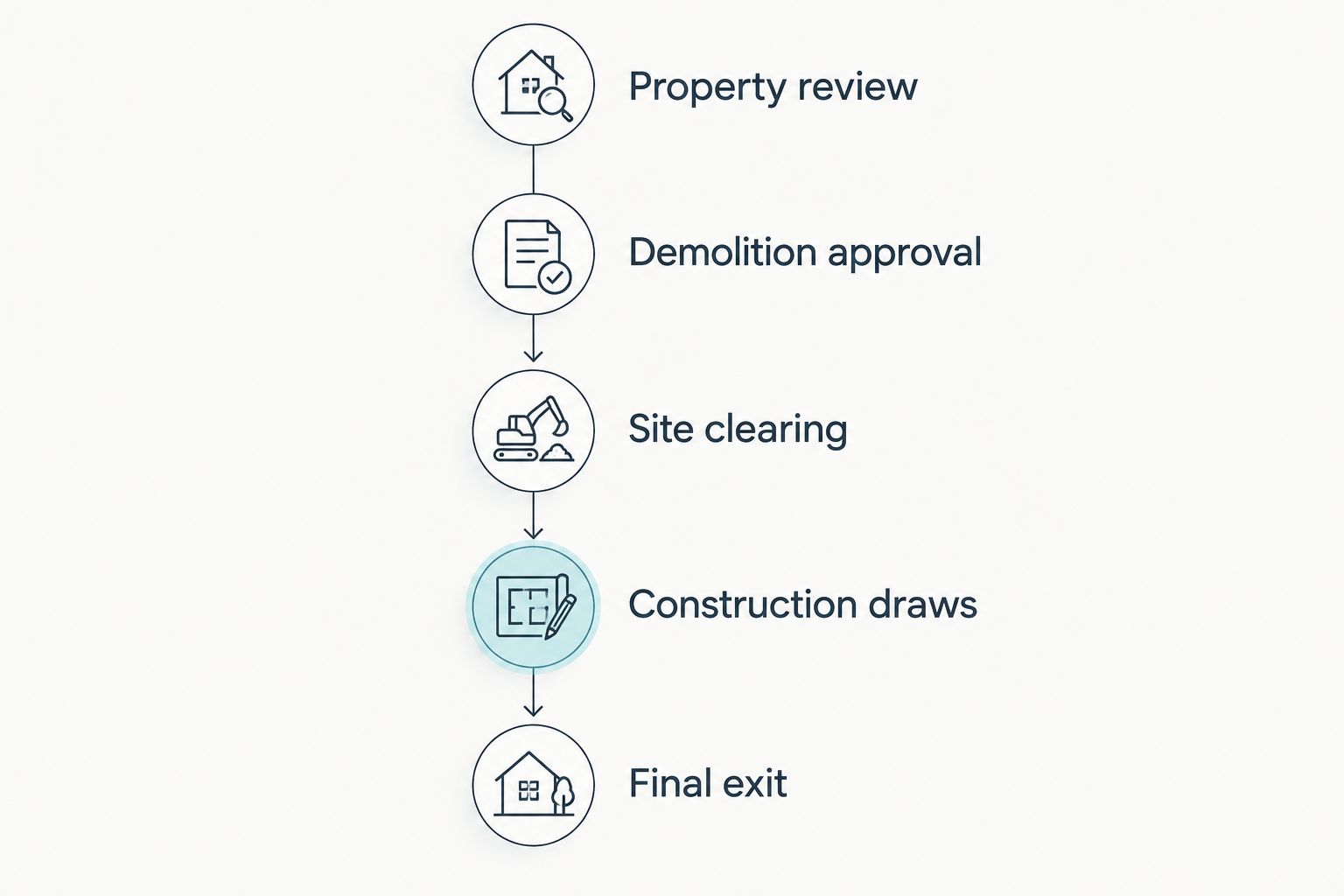
The financing structure should follow the actual order of demolition and construction work.
- Confirm whether acquisition and construction share one facility
- Ask when interest begins on held construction funds
- Review how completed work is verified
- Confirm whether draws reimburse costs or fund approved invoices
- Identify extension and maturity conditions
- Compare recourse and guaranty requirements
Document the value after completion
A teardown loan depends heavily on the projected value of a building that does not yet exist. Support that value with plans, specifications, a realistic construction budget, and comparable completed properties. Renovated homes are weak comparisons when the subject will be entirely new construction.
The appraiser needs enough detail to understand what is being built. Material changes to square footage, unit count, layout, quality, or use can affect both the appraisal and loan approval. Submit a consistent project across the plans, budget, contractor agreement, and valuation assumptions.
- Use comparable new builds where available
- Match property type, use, size, and location
- Give the appraiser complete plans and specifications
- Align the contractor budget with the submitted design
- Document assumptions behind the projected sale or rental use
- Update the lender before making material scope changes
Prepare the demolition draw
Demolition is not simply the first construction task. It can require separate permits, utility disconnections, environmental review, contractor credentials, disposal records, and an inspection before the next draw. Clarify these conditions before scheduling equipment or crews.
Some lenders reimburse completed work, while others use controlled disbursements tied to invoices and inspections. Do not assume the lender will release the full demolition allocation at closing. The written draw policy controls, and the contractor payment schedule should match it.
- Obtain the demolition permit before work begins
- Document required utility disconnections
- Use an appropriately licensed and insured contractor
- Match contractor invoices to approved budget lines
- Keep disposal and completion records
- Request inspection using the lender's process
Control construction draws and changes
The construction phase requires disciplined documentation. Each request should show completed work, approved invoices, inspection status, and remaining budget. If one trade exceeds its allocation, explain how the difference will be funded before moving money from another line.
Change orders deserve immediate lender review because they can alter cost, design, completion timing, and finished value. An unapproved upgrade can consume funds needed for required work. In 2026, maintain one current budget rather than separate versions held by the borrower, contractor, and lender.
- Use the lender's required draw form
- Submit invoices and evidence of completed work
- Track approved, spent, and remaining funds by line
- Obtain written approval for material changes
- Collect lien waivers when required
- Keep contingency funds separate from routine spending
- Resolve failed inspections before requesting the next draw
Lock the exit before the loan matures
The exit is either a sale, refinance, or other documented payoff source acceptable to the lender. A sale strategy needs a finished product supported by local demand and a realistic marketing plan. A rental strategy needs projected rent, operating expenses, and permanent financing that fits the completed property.
For a hold strategy, a DSCR loan evaluates the property's rental cash flow rather than relying only on personal income. Review the steps for refinancing hard money into a DSCR loan before construction ends. The certificate of occupancy, leases, appraisal, title, and seasoning rules can affect the refinance timeline.
If the acquisition is part of a Section 1031 exchange, the federal identification deadline is 45 days and the exchange period is 180 days. New construction and improvement exchanges require specialized tax and legal planning because work completed after the taxpayer receives the replacement property generally does not increase the exchange value.
- Choose sale or refinance as the primary exit
- Keep a documented backup payoff plan
- Start permanent-loan review before project completion
- Track maturity and extension notice dates
- Prepare completion, title, insurance, and lease documents
- Coordinate exchange deadlines with qualified advisers when applicable
Discuss your teardown financing
Review the acquisition, demolition budget, construction draws, and planned exit.
Teardown and rebuild financing options
No single loan type wins for every project. The best option depends on acquisition timing, permit status, borrower documentation, intended use, and whether the property will be sold or retained.
Hard money acquisition and construction loan
- Best for: Investors with an approved scope who need short-term acquisition and draw funding
- Key limitation: Draw controls and maturity create execution pressure
Bridge loan followed by construction financing
- Best for: Buyers who must acquire before plans or permits are complete
- Key limitation: A second approval is still required before building
Fix-and-flip loan allowing ground-up work
- Best for: Experienced investors whose lender expressly permits demolition and rebuilding
- Key limitation: Many renovation programs exclude full teardowns
Conventional construction loan
- Best for: Borrowers with more time and documentation who want construction financing through a bank
- Key limitation: Underwriting and closing generally demand more documentation
Cash or equity funding
- Best for: Investors who want direct control over payments and draws
- Key limitation: Concentrates the investor's capital in one project
Hard money wins on flexibility and acquisition speed. Conventional construction financing wins when the borrower can satisfy bank documentation and wait through its approval process. Cash provides control but reduces liquidity available for overruns or another acquisition.
A loan marketed for renovations is not automatically valid for ground-up construction. Get written confirmation that complete demolition is permitted and that the lender approved the plans, contractor, budget, and draw schedule. Investors evaluating land-heavy deals should also review hard money loans for land acquisition and development.
Common teardown financing mistakes
Treating a rebuild like a heavy renovation
A heavy renovation retains meaningful parts of the existing structure. A teardown removes the collateral that supported the initial property valuation. If the lender approved renovation but not demolition, removing the structure can violate the loan documents and stop future draws.
Closing before confirming buildability
An attractive purchase does not fix zoning, access, utility, environmental, or title problems. Verify the proposed use and footprint before the loan closes. A conceptual design is not a substitute for municipal review.
Using one undifferentiated budget
Combining demolition, site work, vertical construction, and professional expenses hides missing scope. Separate budgets give the lender and contractor a shared basis for approving draws and identifying overruns.
Ignoring the draw payment gap
Contractors expect payment on their schedules, while lenders release funds under written draw procedures. If those schedules conflict, work can stop even when the loan has undisbursed construction funds. Align them before signing contracts.
Waiting until completion to plan the refinance
A completed property does not guarantee permanent financing. Property use, rent, appraisal, title, insurance, borrower structure, and loan seasoning can all affect the next approval. LoanGuys should enter the permanent-financing discussion before the hard money maturity date becomes urgent.
FAQ
What are hard money loans for teardown rebuild projects?
They are short-term, asset-based loans used to acquire a property, demolish the existing structure, and fund approved construction draws. The lender evaluates the land, project plan, budget, borrower, and expected completed value.
Can a hard money loan pay for demolition?
Yes, a hard money loan can pay approved demolition expenses when the lender permits a full teardown. The budget, permits, contractor documents, invoices, and inspection process must satisfy the loan's draw requirements.
Is a teardown loan the same as a fix-and-flip loan?
No, a teardown loan is not automatically the same as a fix-and-flip loan. Many fix-and-flip programs are designed for renovations, so the lender must expressly approve demolition and ground-up construction.
How much can I borrow for a teardown and rebuild?
The available amount depends on the property, land value, completed value, approved budget, borrower contribution, liquidity, and lender guidelines. Request a term sheet based on complete plans and itemized costs rather than an early concept.
Can I close before receiving building permits?
Some lenders allow acquisition before final building permits, but construction draws can remain unavailable until required approvals are issued. A bridge structure can fit that timing, although it leaves the borrower responsible for permit and refinancing risk.
How do construction draws work on a teardown loan?
Construction draws release approved funds as documented work is completed or eligible invoices become payable. The lender can require inspections, lien waivers, updated budgets, and evidence that prior funds were used correctly.
Can I refinance the completed property into a DSCR loan?
Yes, an investor can refinance an eligible completed rental into a DSCR loan if the property and transaction meet the permanent lender's rules. Start early because completion documents, leases, appraisal, title, insurance, and seasoning can affect closing.
What should I compare between hard money lenders in 2026?
Compare permitted project scope, draw procedures, maturity, extensions, recourse, appraisal method, contractor requirements, reserves, and default provisions. Review the full loan documents rather than choosing from a headline term alone.
One last thing
The most important teardown question is not whether a lender finances construction. It is whether the lender permits the existing structure to be removed before the new work restores collateral value. Get that approval in writing, tie it to the submitted plans and budget, and make the demolition draw a distinct project phase.
For 2026 deals, keep the primary exit and backup exit visible in every budget update. LoanGuys can compare the bridge, fix-and-flip, and DSCR stages, but the borrower still needs permits, contractor control, sufficient funds, and a build that supports the final valuation.


