


Non-QM Loan for Second Home Self Employed: 2026 Guide
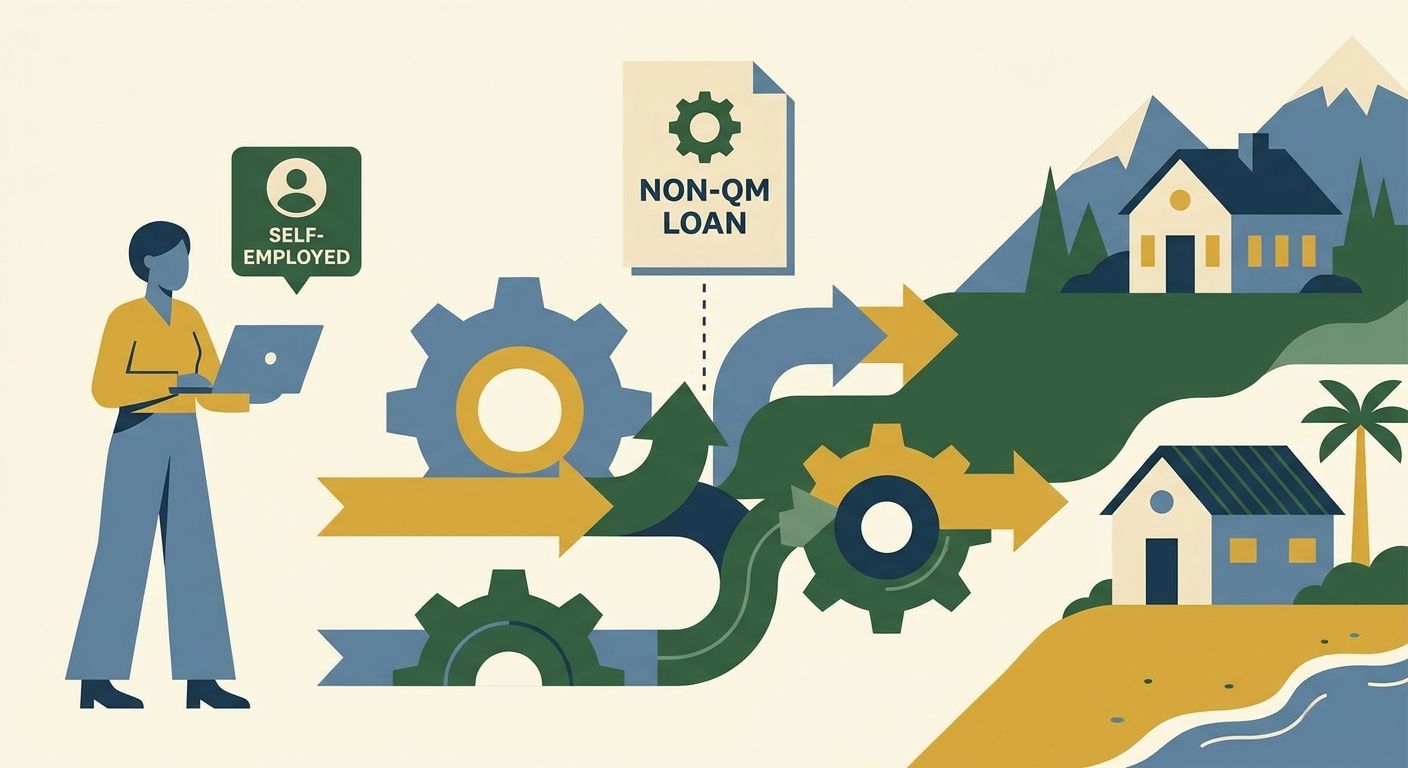
Self-employed buyers qualify for a second home through a non-QM loan by proving income with bank statements, asset depletion, or projected rental cash flow instead of tax returns and W-2s. The process trades tax-return underwriting for alternative documentation, a larger down payment, and a rate premium over a conventional second-home mortgage — but it gets deals done that banks reject outright.
TL;DR
- A non-qm loan for second home self employed buyers replaces tax returns with 12-24 months of bank statements or a DSCR-style rental income test.
- Expect a down payment in the 10-25% range depending on credit and program, higher than most conventional second-home loans.
- Bank statement, asset depletion, and DSCR-style loans are the three non-QM paths self-employed buyers actually use in 2026.
- LoanGuys structures non-QM second home files around cash flow, not net income after write-offs.
Why this matters
Self-employed income looks thin on paper because write-offs, depreciation, and business expenses shrink the net income a conventional underwriter can count. A business owner with $300,000 in gross deposits might show $60,000 in taxable income after deductions — enough to run a household but not enough to satisfy a debt-to-income calculation built for W-2 wages.
A non-QM loan for a self-employed borrower sidesteps that math entirely. Underwriters look at deposits, assets, or the property's own rental potential instead of the number on line 11 of a tax return, which is exactly why non-QM lending exists for people who own their business rather than draw a paycheck from someone else's.
How self-employed buyers qualify for a second home with a non-QM loan
The path is procedural, not mysterious. Every non-QM second home file moves through the same five steps regardless of which program a borrower ends up using.
- Pick the documentation type that matches your income shape. Freelancers and gig workers usually fit bank statement programs; retirees or high-net-worth buyers often fit asset depletion; buyers planning to rent the second home part of the year lean toward DSCR-style underwriting.
- Pull 12-24 months of bank statements or asset records. Personal statements work for sole proprietors; business statements with a CPA letter confirming expense ratios work for LLCs and S-corps.
- Check credit and reserve requirements before shopping. Non-QM lenders generally want a mid-600s credit score or better and several months of reserves after closing — thin-file or recent-derogatory scenarios push rates and reserve requirements higher.
- Get pre-qualified on cash flow, not net income. A lender averages deposits (minus an expense factor) or calculates rental income against the mortgage payment, then issues a pre-qualification based on that number.
- Lock the loan and close. Non-QM closings run on a similar timeline to conventional loans once documentation is complete, though appraisal and title steps still apply.
Bank statement loans for a self-employed second home purchase
Bank statement loans average 12-24 months of personal or business bank deposits to establish a qualifying income figure, then apply a standard debt-to-income calculation against that number. Business owners who show strong deposits but low taxable income after deductions are the classic fit.
The bank statement loan programs built for 1099 contractors follow the same core logic for a second home: the lender wants consistent deposit activity, not a specific job title. Verdict: Buy — bank statement loans are the default non-QM route for most self-employed second-home buyers in 2026.
Asset depletion and asset-based loans for second homes
Asset depletion loans convert liquid assets — brokerage accounts, retirement funds, cash — into a monthly income figure by dividing the asset balance over a set number of months. This program fits buyers sitting on savings or investments but without steady deposit income to document, such as recent retirees or sellers of a business.
Verdict: Hold for asset-rich, income-light buyers — a strong choice if the tax-return or bank-statement math doesn't work, but it requires substantial documented liquid assets to qualify at a meaningful loan amount.
DSCR-style loans when the second home earns rental income part of the year
DSCR (debt service coverage ratio) underwriting qualifies the property on its own rental income rather than the borrower's personal income, using a ratio that compares rent to the mortgage payment. Lenders generally look for a ratio around 1.00 to 1.25, meaning the property's rent covers the payment with some cushion.
This path fits second homes with seasonal rental potential — a lake house or ski condo listed part of the year — more than a home used purely for personal use. Verdict: Buy for hybrid personal-use-plus-rental properties, Skip for a second home you'll never rent.
Why non-QM qualification requirements vary
Non-QM terms shift from lender to lender and file to file. The factors that move rate, down payment, and documentation load include:
- Credit score tier — buyers above the mid-700s typically see better pricing than those in the mid-600s.
- Property use — a true second home carries different underwriting than an investment property, even under the same non-QM umbrella.
- Documentation type chosen — bank statement, asset depletion, and DSCR each have their own down payment and reserve floors.
- Cash reserves on hand — more reserves after closing generally offsets a thinner income file.
- Entity structure — buying in an LLC versus personal name changes which programs apply and how income is verified.
- Loan amount relative to property value — loan-to-value ratio drives both rate and required down payment.
Get pre-qualified for a non-QM second home loan
Talk through bank statement, asset depletion, and DSCR options for 2026.
Can you use a DSCR loan to buy a second home?
Yes, a DSCR loan can finance a second home when the property generates or is expected to generate rental income for part of the year. Lenders qualify the file on the rent-to-payment ratio instead of personal income, which is why seasonal rental properties are the strongest fit for this structure.
How much down payment do you need for a non-QM second home loan?
A non-QM second home loan typically requires a 10-25% down payment in 2026, depending on the program, credit score, and loan-to-value target. Bank statement and DSCR-style programs tend to sit at the higher end of that range compared to conventional financing, and stronger credit or larger reserves can pull the requirement down.
Do non-QM loans have higher rates than conventional loans?
Yes, non-QM loans generally carry a rate premium over conventional second-home mortgages because the lender is taking on documentation risk instead of a fully verified tax-return income file. The tradeoff buys qualification flexibility for self-employed borrowers who can't otherwise show enough net income on paper.
FAQ
What is a non-qm loan for a second home when you're self employed?
It's a mortgage that qualifies self-employed buyers using bank statements, assets, or rental income instead of tax returns and W-2s. It's built for business owners whose taxable income doesn't reflect their real cash flow.
Can a self-employed borrower get a second home loan without tax returns?
Yes, bank statement and asset depletion non-QM programs skip tax returns entirely and qualify on deposits or asset balances instead. Some DSCR-style programs skip personal income documentation altogether and look only at the property's rental potential.
How many months of bank statements does a non-QM second home loan need?
Most bank statement programs require 12 to 24 months of personal or business statements in 2026. Shorter statement windows are less common and usually come with tighter credit or reserve requirements.
Is a DSCR loan the same as a non-QM loan?
DSCR loans are one type of non-QM loan, not a separate category. Non-QM covers bank statement, asset depletion, DSCR, and other alternative-documentation programs.
What credit score do you need for a non-QM second home loan?
Most non-QM lenders want a credit score in the mid-600s or higher for a second home purchase in 2026. Scores above the mid-700s typically qualify for better pricing and lower reserve requirements.
Can you use rental income to qualify for a second home loan?
Yes, DSCR-style non-QM underwriting qualifies the loan using the property's own rental income against the mortgage payment. This works best for second homes with genuine seasonal rental potential rather than homes used purely for personal stays.
Do non-QM loans require a bigger down payment than conventional loans?
Generally yes — non-QM second home loans run 10-25% down in 2026, often higher than a comparable conventional second-home loan. The exact figure depends on credit score, program type, and loan-to-value target.
Why would a self-employed buyer choose a non-QM loan over a conventional one?
Because tax returns understate their real income after business write-offs, which fails conventional debt-to-income math. A non-QM loan qualifies them on deposits, assets, or rental cash flow instead, at the cost of a higher rate.
One last thing
The detail most self-employed buyers miss: a CPA letter confirming a lower expense ratio than the lender's default assumption can raise the qualifying income on a bank statement loan without adding a single deposit. Ask about this before assuming a file won't work in 2026 — it's a documentation fix, not a financing gimmick.


