


Finance a Spec Home with a One-Time-Close Loan (2026)
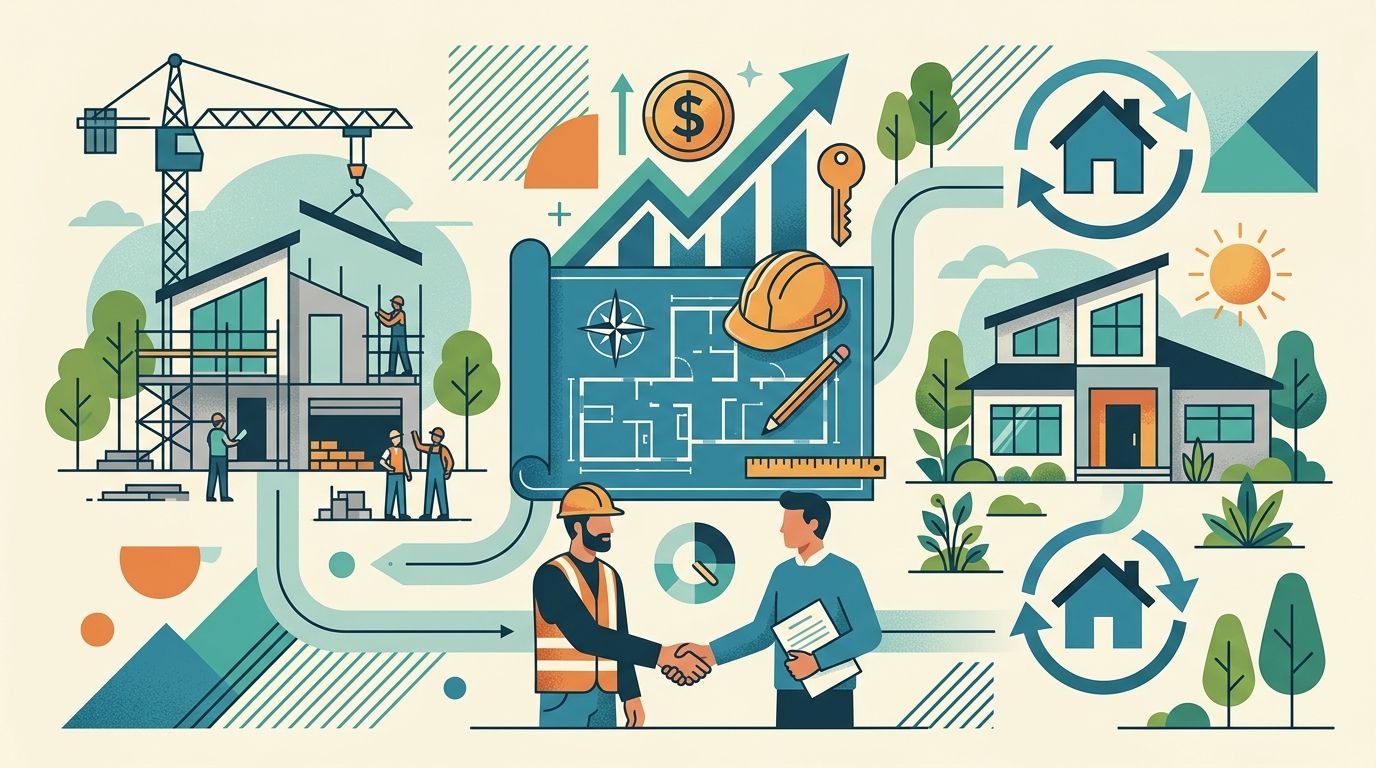
A one-time-close loan finances the construction phase and the permanent mortgage on a spec home in a single closing, with the loan converting automatically to term financing once the certificate of occupancy is issued. Lenders underwrite these deals on loan-to-cost, not loan-to-value, so a builder who shows up without land equity or a contingency reserve stalls the draw schedule before the foundation is poured.
TL;DR
- A one-time-close loan covers land, construction, and the permanent mortgage in one closing, saving a second round of closing costs.
- Most lenders cap loan-to-cost at 80-85%, so spec builders need land equity or cash to cover the gap.
- Draws release in stages tied to inspections, not lump sums, so a stalled inspection stalls cash flow.
- Builders selling at completion need an exit plan built into the loan; builders holding as a rental typically roll into a DSCR loan.
- LoanGuys.com structures one-time-close construction financing that converts without a second underwriting cycle.
Why this matters
A spec home has no buyer under contract, which makes it a harder underwrite than a build-to-suit project. Traditional banks want a completed appraisal and a permanent buyer before they'll touch the deal, which leaves spec builders stuck financing land, materials, and labor with cash or a patchwork of short-term loans.
A one-time-close loan solves the sequencing problem. You close once on the land purchase, the construction budget, and the permanent (or DSCR) loan that follows completion, instead of closing twice and re-qualifying for the second loan under whatever rate environment exists when the home is finished. In 2026, with construction costs still moving month to month, locking the exit financing at the start protects the builder from a rate shock at the finish line.
Builders working with LoanGuys.com often pair a one-time-close construction loan with a DSCR exit so the property qualifies on projected rental income if it doesn't sell fast, rather than the builder's personal income.
How to finance a spec home build with a one-time-close loan
The process runs in six steps, and skipping any one of them is what turns a smooth build into a stalled draw schedule.
- Lock the land and finalize plans. You need a purchase contract or clear title on the lot, stamped architectural plans, and a licensed, bonded builder before a lender will quote the deal.
- Get an as-completed appraisal. The appraiser values the home as if it were finished, using plans, specs, and recent comparable sales — this figure, not the raw construction cost, sets the loan ceiling.
- Submit the full construction budget. Line-item costs for site work, framing, mechanicals, and finishes, plus a contingency reserve, go into the underwriting file together — lenders reject budgets with no reserve line.
- Close once. Construction loan documents and the permanent (or DSCR) loan documents sign at the same table, on the same day — this is the entire point of a one-time-close structure.
- Draw funds in stages. The builder requests draws as phases complete; an inspector signs off before each release, so the schedule moves at the pace of the build, not the calendar.
- Convert automatically at completion. Once the certificate of occupancy is issued, the loan rolls into its permanent terms with no second application and no second closing cost.
One-time-close vs. two-time-close: which fits a spec build
Closings required
- One-time-close: 1
- Two-time-close: 2
Rate lock risk at completion
- One-time-close: Locked upfront
- Two-time-close: Re-priced at conversion
Total closing costs
- One-time-close: Lower — one set of fees
- Two-time-close: Higher — fees paid twice
Qualification
- One-time-close: Underwritten once, at the start
- Two-time-close: Re-qualify at conversion
Best for
- One-time-close: Builders who know their exit (sale or hold)
- Two-time-close: Builders who want flexibility on the exit loan
Verdict: a one-time-close loan wins for spec builders with a defined exit — sell or hold — and costs less over the life of the project; a two-time-close loan only makes sense if you genuinely don't know yet whether you'll refinance with a different lender.
Why one-time-close terms vary
The loan-to-cost cap, draw count, and rate a builder gets in 2026 depend on a handful of factors lenders weigh every time:
- Builder track record. A builder with a documented history of completed spec homes qualifies for a higher loan-to-cost ratio than a first-time builder.
- Land equity. Owning the lot free and clear, or having significant equity in it, reduces the cash a builder needs at closing.
- Contingency reserve size. A thin reserve (under 5% of budget) is the single most common reason a draw schedule freezes when costs run over.
- Exit strategy. A defined sale price or a DSCR-qualifying rental income makes underwriting faster than an undecided exit.
- Credit profile. Non-QM and hard money-adjacent lenders underwrite the deal and the builder's experience together, not credit score alone.
- Draw schedule complexity. More phases and more inspectors mean more opportunities for a delay to ripple into a funding gap.
Can a spec home builder use a one-time-close loan if they plan to sell instead of hold?
Yes — a one-time-close loan works for a sale exit as long as the loan structure includes payoff terms for a sale before conversion, so the builder isn't forced into permanent financing on a home that's already under contract. Builders who expect to sell within months of completion should confirm the prepayment terms before closing, since some construction-to-permanent structures assume a hold.
How many draws does a one-time-close construction loan typically include?
Most one-time-close construction loans use somewhere between 4 and 8 draws, tied to milestones like foundation, framing, mechanicals/rough-in, and final finishes. Fewer draws mean less paperwork per phase but larger cash gaps between inspections, so builders with tight cash flow often request more, smaller draws instead.
What's the difference between a one-time-close and a construction-to-permanent loan?
A one-time-close loan is a type of construction-to-permanent loan — the terms are often used interchangeably, but not every construction-to-permanent loan closes only once. Confirm with the lender whether the permanent phase requires a second closing before assuming the two terms mean the same thing.
Get your spec build financing structured right
One-time-close construction loans that convert to DSCR or permanent terms at completion.
Builders comparing lenders for this exact structure should look at how each one prices construction loans for spec home builders before signing a term sheet — the loan-to-cost cap and draw process matter more than the headline rate. For builders planning to hold the finished home as a rental instead of selling it, pairing the construction phase with DSCR financing for new construction rentals sets up the exit before the first draw is even requested.
FAQ
What is a one-time-close construction loan?
A one-time-close construction loan combines the land purchase, construction budget, and permanent mortgage into a single closing that converts automatically once the home is finished. It replaces the two-loan, two-closing process most banks require for new construction.
How much land equity do you need for a one-time-close spec loan?
Most lenders cap loan-to-cost at 80-85% in 2026, so a builder without free-and-clear land typically needs 15-20% of total project cost in cash or equity. Owning the lot outright reduces that requirement significantly.
Can you get a one-time-close loan without a licensed general contractor?
No. Nearly every one-time-close construction lender requires a licensed, bonded, and insured general contractor on the application. Owner-builders without a licensed GC on record typically get routed to hard money or private construction financing instead.
What credit score is needed for a spec home construction loan?
Credit requirements vary by lender and loan type, and non-QM or asset-based construction lenders weigh builder experience and project equity alongside credit. A completed application with a clean draw history from prior builds carries more weight than a single credit number.
What happens if the spec home doesn't sell before the loan converts?
If the sale falls through before conversion, the loan rolls into its permanent or DSCR terms as structured at closing, and the builder holds it as a rental instead. This is why confirming the conversion terms upfront matters more than chasing the lowest construction rate.
Is a one-time-close loan more expensive than a two-time-close loan?
A one-time-close loan usually costs less overall because it avoids a second round of closing costs and a second underwriting fee. The tradeoff is less flexibility to shop a different permanent lender at conversion.
Can a DSCR loan follow a one-time-close construction loan?
Yes. Many spec builders who decide to hold instead of sell convert into a DSCR loan at completion, qualifying on the property's projected rental income rather than personal income. This is one of the most common exit paths for builders who change plans mid-project.
How long does a one-time-close construction loan take to close?
Closing timelines depend on how complete the plans, budget, and as-completed appraisal are at application, since incomplete construction budgets are the most common cause of delay. A builder with finalized plans and a licensed GC in place moves through underwriting faster than one still finalizing scope.
One last thing
The deal that falls apart most often isn't the one with a weak credit score — it's the one where the as-completed appraisal comes in under the builder's projected sale price because the finishes were priced above what the neighborhood comps support. Get a preliminary appraisal opinion before finalizing the finish package, not after the construction loan is already funded in 2026.


