


Interest Rate Buydown DSCR Loan Programs: 2026 Verdict
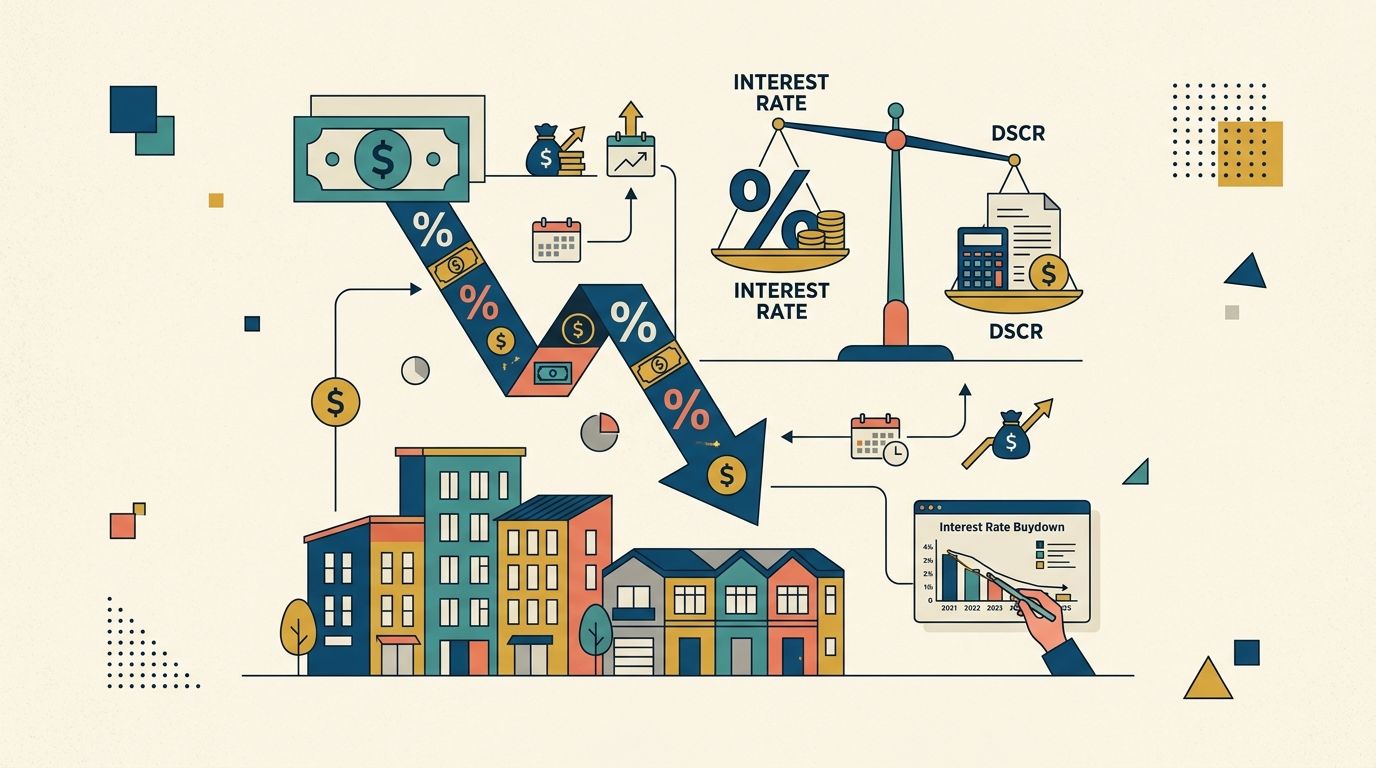
Interest rate buydown DSCR loan programs let real estate investors lower the note rate on a rental property loan for a set period or for the life of the loan, cutting the monthly payment enough to push a marginal deal's debt service coverage ratio into approval range. Unlike a homeowner buydown that just softens a family budget, a DSCR buydown exists to move one number: the ratio between rental income and the mortgage payment that DSCR underwriters actually check.
TL;DR
- Interest rate buydown DSCR loan programs cut year-one payments by 1-2 points, best for investors whose debt service coverage ratio is close but not quite there in 2026.
- Temporary 2-1 buydowns save the most upfront but revert to the full note rate by year three, so run the break-even math before you commit.
- Permanent buydowns (discount points) only pay off if you plan to hold the rental past the point recoup period.
- LoanGuys.com structures DSCR rental property loans with buydown options for investors who need the ratio to work at closing, not three years from now.
Why interest rate buydowns matter for DSCR rental property investors
DSCR loans qualify a rental purchase on the property's own cash flow, not the borrower's W-2s or tax returns. The ratio most lenders check is rental income divided by PITIA (principal, interest, taxes, insurance, and association dues), and most programs want that number at 1.0 to 1.25 or higher before they'll approve the file.
When note rates sit high, that math breaks on properties that would have sailed through underwriting two years ago. A buydown that shaves 1-2 percentage points off the rate in year one is often the difference between a 0.95 DSCR (declined) and a 1.10 DSCR (approved) on the same purchase price and the same rent roll. That's the entire reason this financing tool exists for investors — it's not a payment comfort feature, it's a qualification lever.
For DSCR rental property investors, the buydown decision isn't about whether the payment feels lighter. It's about whether the deal clears the coverage ratio at closing and whether it still clears that ratio once the buydown expires.
First things first
Before comparing structures, pull your own numbers: monthly market rent, taxes, insurance, and HOA if applicable. LoanGuys runs DSCR loan applications against these exact inputs, and knowing your ratio before you call a lender saves a round of back-and-forth on structure.
Structure the deal: step by step
Compare buydown structures before you lock a rate
Not every buydown works the same way, and the label on the term sheet matters more than the headline rate.
- Ask for a 2-1 buydown quote: rate drops 2 points in year one, 1 point in year two, then reverts to the note rate in year three.
- Ask for a 1-0 buydown quote: rate drops 1 point in year one only, then reverts.
- Ask about a permanent buydown using discount points, where the rate cut lasts the life of the loan instead of resetting.
- Get the amortization schedule showing the exact payment for each year, not just the average savings.
- Confirm whether the buydown funds sit in an escrow account or get paid directly at closing.
Calculate your break-even point on paid points
A lower rate isn't free — you're either paying points upfront or a seller/lender is covering them on your behalf. Either way, run the math before you agree to anything.
- Divide the dollar cost of the points by the monthly payment savings to get your break-even month.
- Compare that break-even month to how long you actually plan to hold the property.
- If you expect to refinance or sell within 18-24 months, a permanent buydown rarely recoups its cost.
- Factor in DSCR loan closing costs alongside the buydown, since points stack on top of standard fees, not instead of them.
Stress-test your DSCR at the note rate, not just the buydown rate
This is the step most investors skip, and it's the one that causes trouble in year three.
- Run your DSCR calculation twice: once using the reduced buydown-year rate, once using the full reversion rate.
- If the ratio drops below 1.0 at reversion, treat the buydown as a bridge to better rents or a future refinance, not a permanent fix.
- Ask the lender directly what DSCR floor their program enforces at origination versus what happens after the buydown expires.
- Model a 5-10% rent increase scenario to see if organic rent growth alone gets you back to a workable ratio by year three.
Negotiate seller concessions into the buydown
In a buyer's market, the seller — not you — can fund some or all of the buydown cost.
- Structure your purchase offer to request a seller credit earmarked for a rate buydown.
- Check your lender's max seller-concession limit before you negotiate; investment property loans usually cap this lower than owner-occupied loans.
- Use a buydown request as a negotiating chip on properties that have sat on the market past 60-90 days.
Document the funding source for buydown costs
DSCR underwriting skips your income documents, but it still checks where your closing money comes from.
- Show seasoned funds (typically 60 days in the account) if you're paying the buydown out of savings.
- Keep a clean paper trail on any gift funds or business-account transfers used to cover points.
- Confirm with your loan officer whether business entity funds need extra sourcing documentation for an LLC-held purchase.
Time the buydown to your exit or refinance plan
The right buydown structure depends entirely on how long you'll actually hold the loan.
- Match a temporary 2-1 or 1-0 buydown to a hold period you're already planning around — a bridge to a 2027-2028 refinance, for example.
- Choose a permanent buydown only for a straightforward buy-and-hold play where you're not banking on rates dropping.
- Reassess after any rent increase, since a higher rent roll changes your break-even math on points.
Structure your DSCR buydown correctly
Get your DSCR loan reviewed against buydown options before you lock a rate.
Comparing buydown options for DSCR rental property investors
Temporary 2-1 buydown
- Best for: Investors bridging to a rent increase or refinance
- How it works: Rate cut 2 points year one, 1 point year two, reverts year three
- Key limitation: Full-cost reversion by year three; ratio must hold on its own after that
Temporary 1-0 buydown
- Best for: Investors who need one year of breathing room
- How it works: Rate cut 1 point in year one only
- Key limitation: Shortest savings window of the three structures
Permanent buydown (discount points)
- Best for: Long-term buy-and-hold investors
- How it works: Points paid at closing reduce the rate for the life of the loan
- Key limitation: Ties up cash at closing that could otherwise fund reserves
Seller-paid or lender credit
- Best for: Investors negotiating in a slower market
- How it works: Seller or lender covers the point cost instead of the investor
- Key limitation: Depends entirely on deal leverage; not guaranteed on every purchase
See how DSCR lenders compare on rates, terms, and minimums before picking a structure — buydown availability and caps vary lender to lender, and not every DSCR program offers all four options above.
Verdict: the temporary 2-1 buydown is the strongest fit for most DSCR rental property investors in 2026 because it solves the immediate coverage-ratio problem without permanently tying up cash — but only if the rent roll or a planned refinance can carry the ratio once the rate reverts.
Common mistakes DSCR rental property investors make
- Buying permanent points on a property they'll refinance within a year. The break-even math never gets a chance to work, and the point cost is gone.
- Checking DSCR only at the buydown rate. A deal that clears 1.15 at the discounted rate can fall to 0.90 the moment the buydown expires.
- Assuming buydown funds are refundable if the loan pays off early. Some structures forfeit unused escrow; confirm the terms before closing.
- Treating a seller concession as guaranteed. Lenders cap concessions on investment properties, and sellers aren't obligated to offer them.
- Skipping the total-cost comparison. Investors compare monthly savings but rarely total the full points cost against total savings across the hold period.
FAQ
What is an interest rate buydown on a DSCR loan?
An interest rate buydown on a DSCR loan temporarily or permanently lowers the note rate on an investment property loan, usually to help the debt service coverage ratio clear a lender's minimum at closing. Temporary structures like a 2-1 buydown revert to the full rate after one to two years; permanent buydowns use discount points to lower the rate for the life of the loan.
Is a 2-1 buydown better than a permanent buydown for a rental property?
A 2-1 buydown is usually better for investors planning to sell or refinance within two to three years, since it delivers the biggest short-term savings without a large upfront points cost. A permanent buydown suits long-term buy-and-hold investors who won't refinance and want the lower rate to last the life of the loan.
Can a seller pay for my DSCR loan rate buydown?
Yes, sellers can often fund a rate buydown as a negotiated concession, subject to the lender's maximum seller-concession limit on investment properties. This is more common on properties that have sat on the market for 60 days or longer.
Does a rate buydown help me qualify for a DSCR loan?
Yes, a buydown lowers the payment used in the debt service coverage ratio calculation, which can push a marginal deal from a declined ratio to an approved one. The catch is that the ratio needs to hold up again once a temporary buydown expires and the rate reverts.
How much does a DSCR loan buydown cost?
Cost varies by lender, loan amount, and the size of the rate reduction, and is typically quoted as a percentage of the loan amount rather than a flat fee. Ask your loan officer for an amortization schedule showing the exact dollar cost against the monthly savings before agreeing to points.
What happens when a temporary buydown expires on a rental property loan?
The rate reverts to the original note rate, which raises the monthly payment and can lower the debt service coverage ratio if rents haven't grown to offset it. Investors should stress-test their DSCR at the reversion rate before choosing a temporary buydown structure.
Are DSCR loan buydowns available for LLC-owned rental properties?
Yes, buydown structures are generally available regardless of whether the rental property is held personally or through an LLC, since DSCR underwriting is based on the property's cash flow rather than the borrower's entity type. Funding-source documentation still applies to whichever entity pays for the points.
One last thing
The number investors miss most often isn't the rate — it's the reversion date. Mark the exact month your temporary buydown expires on your own calendar, not just the lender's servicing system, and revisit your DSCR that month using actual current rent, not the rent you underwrote at closing. A property that cleared 1.10 on paper in 2026 can quietly slip under 1.0 by 2028 if rent growth stalls, and the first sign of it is usually a late notice, not a warning call.


