


Investment Property Loans for Contractors Overseas 2026

Investment property loans for government contractors stationed overseas work through DSCR and bank-statement programs that qualify the property's rental income or the contractor's overseas pay stubs instead of a traditional US-based W2 file. The best programs skip standard employment verification entirely and close around deployment schedules, not around a loan officer's comfort with a foreign mailing address.
TL;DR
- DSCR loans qualify contractors on the property's rental income, not overseas employment history — the strongest fit for most deployments.
- Bank-statement programs work when a contractor's 1099 pay stubs come from a US-based prime contractor or agency.
- Reserve requirements and remote closing logistics matter more than credit score for this segment in 2026.
- Property management lined up before departure prevents the single most common financing delay.
Why investment property loans matter for government contractors stationed overseas
A government contractor on a 12-24 month rotation to Ramstein, Bahrain, or a State Department post doesn't have a W2 a conventional underwriter recognizes the way a domestic employer's does. Pay comes through a defense contractor, a staffing firm, or direct 1099 status, often with per diem and hazard pay mixed into the total. Conventional lenders want two years of tax returns and a US employer letter that matches a US mailing address — none of which lines up cleanly with an overseas assignment.
That mismatch is exactly why DSCR loans for American expats with US rental properties exist as a category. The underwriting question shifts from "what does this borrower earn" to "does this property's rent cover the mortgage payment." For a contractor stationed abroad, that shift removes the biggest obstacle in the file.
Update your income documentation before you deploy
Most financing delays for overseas contractors trace back to paperwork gathered too late, after the borrower is already six time zones away from a fax machine or a notary.
- Pull two years of tax returns or 1099s before departure, not after
- Get a letter from the prime contractor confirming assignment length and pay structure
- Set up a US-based mailing address that matches bank statements
- Line up a power of attorney if signing authority overseas will be limited
Choose a loan program built for absentee borrowers
Once documentation is in order, the loan structure decision matters more than the rate. Bank-statement programs work well when a contractor has clean 1099 deposits; DSCR loans work when the rental income alone can carry the payment.
- DSCR loans qualify on the subject property's rent-to-payment ratio
- Bank-statement loans use 12-24 months of deposits instead of tax returns
- Programs built for W2 employees with side rentals fit contractors who still draw a domestic W2 alongside overseas assignments
- Veteran contractors with military service history should compare DSCR loans for veteran real estate investors against standard DSCR terms
Structure the down payment and reserves before you leave
DSCR programs generally cap loan-to-value in the 75-80% range for investment properties, and most require 6-12 months of payment reserves sitting in a US account — both standard across the category in 2026, not unique to overseas borrowers, but harder to fund once you're mid-deployment.
- Wire down payment funds to a US account before departure, not during transit
- Keep 6-12 months of reserves liquid and traceable
- Avoid large, unexplained deposits in the 60 days before closing
- Confirm the lender accepts foreign-sourced funds if reserves originate overseas
Set up US-based property management before closing
A contractor stationed in Djibouti cannot show up for a leaky faucet call. Lenders underwriting long-distance owners want to see a management plan on file, and tenants want a responsive point of contact that isn't nine time zones behind.
- Sign a property management agreement before the loan closes, not after
- Confirm the manager handles maintenance calls, not just rent collection
- Set up automatic rent deposit and mortgage payment through a US bank
- Keep a local contact (spouse, family member, attorney-in-fact) for emergencies
Handle the appraisal and closing remotely
Remote closings are routine for this segment in 2026, but only when the loan file anticipates them from the start.
- Confirm the title company supports remote online notarization or mail-away closing
- Schedule the appraisal around a trusted local contact who can grant access
- Use e-signature platforms the lender has already vetted
- Build in extra days for international mail if wet-ink signatures are required
Time your purchase around rotation and contract dates
A loan that closes two weeks before a contract renewal or a mid-tour rotation creates unnecessary risk. Contractors on PCS-style relocation orders face similar timing pressure, and the same discipline applies here.
- Close at least 30-60 days before a scheduled rotation, not during one
- Avoid closing during a contract renewal gap when income documentation is thin
- Build a buffer for visa or travel-order delays that can push closing dates
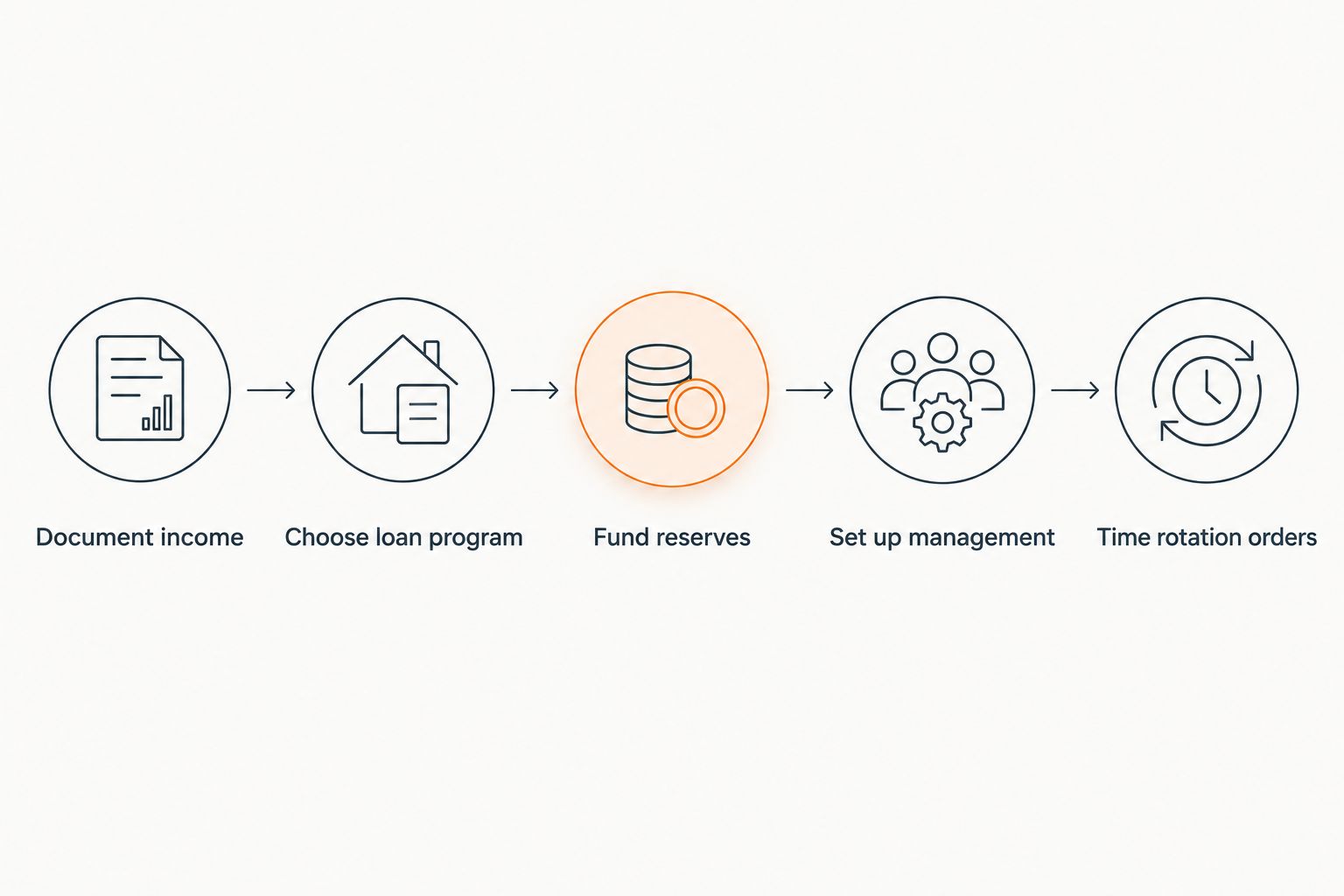
Each step gets harder to complete once the contractor is already deployed.
Loan options compared for overseas government contractors
DSCR loan
- Best for: Contractors relying on rental income to qualify, no US employer file needed
- Key limitation: Rate typically runs higher than a conventional owner-occupied loan
Bank-statement loan
- Best for: Contractors with clean 12-24 month 1099 deposit history
- Key limitation: Requires consistent deposits; irregular per diem or hazard pay can complicate the file
Conventional W2 mortgage
- Best for: Contractors who retain a domestic W2 alongside the overseas assignment
- Key limitation: Full income and employment verification still required
VA loan (eligible veterans)
- Best for: Veteran contractors buying a multi-unit property to house hack before deployment
- Key limitation: Occupancy requirements limit use for a straight rental purchase
Bridge loan
- Best for: Contractors closing on a fast timeline before rotating out
- Key limitation: Short term structure means a refinance or sale exit plan is required
DSCR loans are the strongest fit for most government contractors stationed overseas because the property carries the file, not the borrower's overseas paycheck. Bank-statement loans are the fallback when the property alone can't cover the DSCR ratio a lender wants to see, typically somewhere near 1.0 to 1.25.
Common mistakes overseas government contractors make
- Using a foreign mailing address on the loan application. Mismatched addresses between the application, bank statements, and tax filings slow underwriting and sometimes trigger a second round of documentation requests.
- Waiting until deployment to gather income documents. Notarizing a power of attorney or pulling a prime contractor letter is far easier from home soil.
- Skipping a property management contract. Lenders and tenants both want a local point of contact on file before closing, not after a maintenance emergency.
- Ignoring state residency and tax questions. A contractor's legal state of residence affects loan disclosures and can create confusion if it doesn't match the property's location.
- Closing too close to a rotation date. A closing that lands during a contract gap or mid-tour move creates avoidable timing risk on funding day.
Ready to finance a US rental from overseas?
Get matched with a DSCR or bank-statement program built for deployed contractors.
FAQ
Can a government contractor stationed overseas qualify for a US mortgage in 2026?
Yes, through DSCR loans qualifying on rental income or bank-statement loans qualifying on 1099 deposits, both of which skip standard US employer verification. Conventional financing remains an option only if the contractor still holds a domestic W2.
What is a DSCR loan and why does it fit overseas contractors?
A DSCR loan qualifies a borrower using the subject property's rent-to-payment ratio instead of personal income documentation. That structure removes the need for a US pay stub, which is the main obstacle for contractors paid through overseas assignments.
How much down payment does an overseas contractor need for a DSCR loan?
DSCR programs generally cap loan-to-value in the 75-80% range for investment properties in 2026, meaning a down payment in the 20-25% range plus reserves. Exact terms vary by lender and property type.
Can a loan close remotely while the contractor is deployed?
Yes, remote online notarization and mail-away closings are standard for this segment. The appraisal still needs a local contact who can grant property access on the scheduled date.
Do veteran government contractors get better loan terms?
Veteran status opens VA loan eligibility for a multi-unit house-hack purchase, but a straight rental purchase without owner occupancy typically routes through a DSCR or bank-statement program regardless of veteran status.
What income documents does a bank-statement loan require?
Most bank-statement programs require 12-24 months of consistent deposit history from a US bank account. Irregular per diem or hazard pay mixed into deposits can complicate qualification.
What's the biggest mistake overseas contractors make when financing a rental?
Waiting until after deployment to gather income documentation, set up property management, or execute a power of attorney. Every one of those tasks is easier to complete before leaving US soil.
Should an overseas contractor use property management or self-manage?
Property management is the practical answer for anyone stationed overseas, since maintenance calls and tenant issues can't wait for a time-zone-delayed response. Lenders also look more favorably on a file with a management contract in place.
One last thing
The reserve requirement, not the interest rate, is what sinks most overseas contractor files in 2026 — 6-12 months of payments sitting untouched in a US account is non-negotiable on most DSCR programs, and it has to be there and seasoned before the contractor boards a flight, not wired in during underwriting.


