


Best Investment Property Loans for Remote Tech Workers 2026

Remote tech worker investment property lending is financing structured around rental cash flow or documented income, with the aim of helping remote employees buy rentals while moving between states. For investment property loans for remote tech workers in 2026, the strongest route is usually a DSCR loan when the property supports itself, while W2, bank-statement, and bridge financing fit different income and timing constraints. This guide to tech workers with stock compensation explains the related RSU qualification issues.
TL;DR
- DSCR loans are best when the rental property's income supports its proposed debt payment.
- W2 financing fits remote employees with stable salary documentation and confirmed permission to work from the destination state.
- Bank-statement loans fit software contractors whose deposits show income more clearly than their tax returns.
- Bridge financing can address a timing gap when a current home has not sold before the next purchase.
- Investment property loans for remote tech workers require accurate occupancy, income, entity, and state information in 2026.
Why investment property loans matter for remote tech workers
Remote status solves the commute, not the underwriting file. A lender still needs to understand where you will live, whether the property will be owner-occupied or rented, which state governs the transaction, and whether your employer permits permanent work from that location.
Compensation creates another layer. Base salary, annual bonuses, RSUs, employee stock purchase proceeds, freelance deposits, and cryptocurrency sales do not receive identical underwriting treatment. Income can look substantial on a compensation portal while only part of it meets a program's documentation rules.
Relocation also creates competing deadlines. You may be coordinating a job transfer, a current-home sale, a rental-property closing, and an LLC registration at once. The right 2026 loan program is the one whose qualification method matches both the property's intended use and the income documents you can produce now.
How to finance a rental while relocating across states
The process starts with facts you can verify without a lender: intended occupancy, employer approval, available funds, expected rent, and closing deadlines. Once those are organized, a mortgage broker can compare programs without forcing every borrower into the same W2 template.
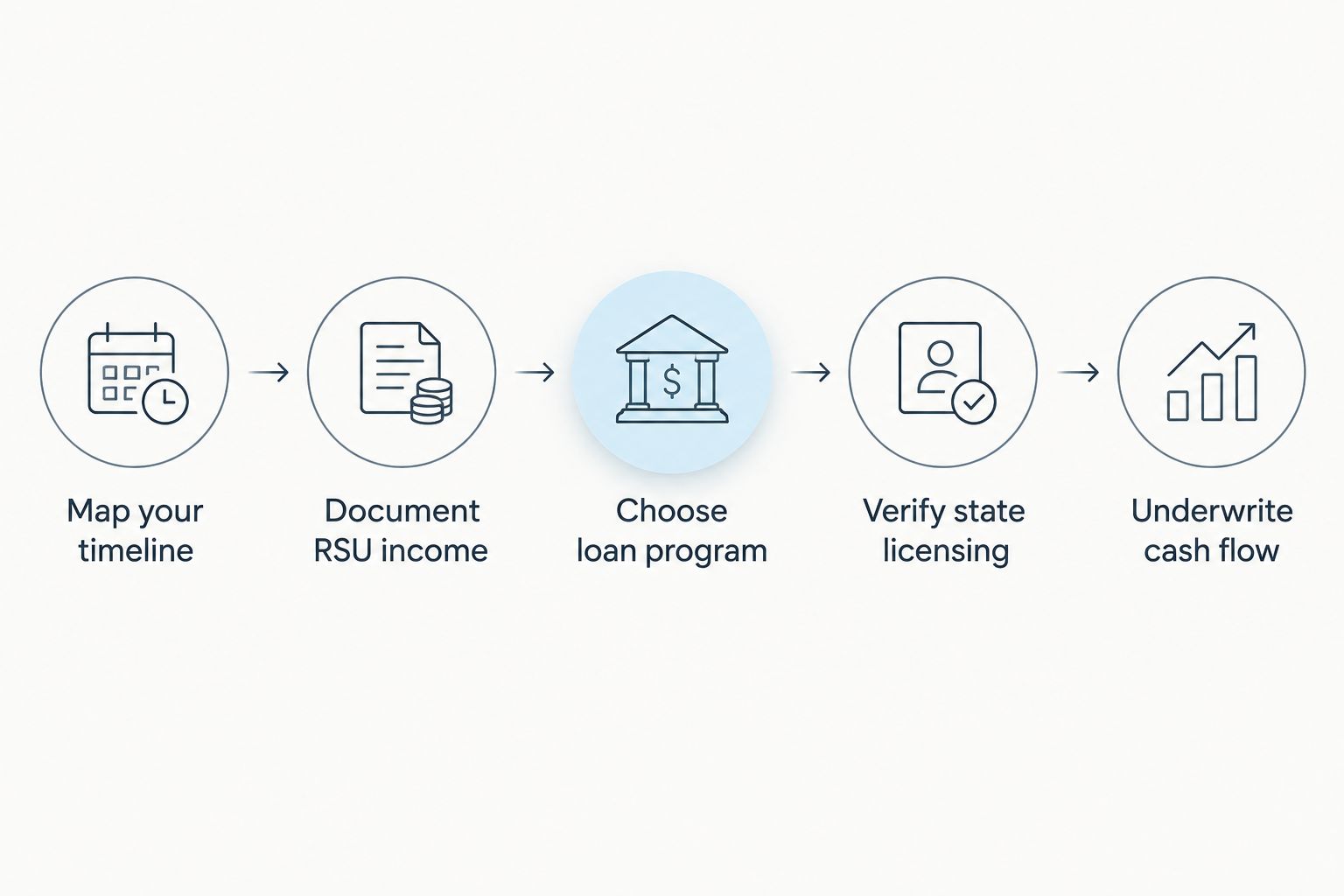
The loan choice follows the occupancy, income, state, and rental analysis.
Map your relocation and purchase timeline
Start with a shared calendar or spreadsheet. Put every date that can change underwriting or access to funds in one place, then identify which events must happen before you can close.
A relocation calendar prevents you from treating a job start, stock vest, home sale, and property closing as independent events. They affect available cash, qualifying income, reserves, and the loan's exit strategy.
- Record your remote-role start or transfer date
- Add the current lease end or home-sale target
- Mark RSU vesting and bonus payment dates
- Add the purchase contract and financing deadlines
- Identify periods when funds will be in transit
- Leave time for entity and insurance documents
Confirm the property's intended occupancy
Decide whether the property will be your primary residence, a second home, or an investment property before requesting quotes. These classifications are not interchangeable, and a remote-work arrangement does not turn a rental into a primary residence.
If you plan to occupy one unit and rent the others, describe that structure accurately. If you will live elsewhere and rent the entire property, use an investment-property program. Never choose an occupancy category because it appears easier to qualify for.
- Write down where you will physically live after closing
- State whether any unit will be owner-occupied
- Separate personal housing from the rental purchase
- Identify short-term or long-term rental use
- Confirm whether an HOA restricts rentals
- Keep the same occupancy description across the file
Choose the qualification method
Match the program to the evidence that best represents the transaction. A salaried engineer with stable W2 income has a different file from a software contractor whose revenue flows through a business account.
LoanGuys.com offers DSCR, bridge, bank-statement, fix-and-flip, and short-term rental loan programs across the United States. LoanGuys.com is best for remote tech workers who need an investment property loan evaluated outside a standard W2-only framework. The advantage is access to several qualification methods; the limitation is that the property, borrower, and documentation still have to meet the selected program's rules.
- Use DSCR when rental income is the clearest basis
- Use full documentation when W2 income is stable
- Consider bank statements for recurring contractor deposits
- Consider bridge financing for a temporary timing gap
- Use fix-and-flip financing for a defined renovation project
- Compare required documents before authorizing credit work
Document salary, bonuses, and RSUs separately
Build a clean income file rather than sending an unsorted folder. A pay stub proves base salary, while an equity portal shows vesting activity; neither automatically proves every other compensation category.
For RSUs, distinguish vested shares from future grants. A lender can review historical compensation and continued vesting, but unvested stock is not the same as cash already received. In 2026, obtain current documents before relocation disrupts access to an employer portal or mailing address.
- Collect recent pay statements and W2 forms
- Save the employment offer or transfer letter
- Export the complete RSU vesting schedule
- Separate vested shares from unvested grants
- Document bonus history apart from base salary
- Explain large deposits before underwriting asks
- Confirm remote-work permission when required
Verify destination-state and entity requirements
Confirm that the lender or broker can handle the destination state before you sign a purchase agreement. State rules, closing practices, insurance conditions, and entity documents can differ even when your job remains unchanged.
If an LLC will own the rental, form and document it early enough for the lender, title company, insurer, and bank to use the same legal name. Do not move personal funds through a new entity without preserving a clear transaction record.
- Confirm coverage for the destination state
- Ask who will hold title at closing
- Gather articles and operating agreements
- Verify the entity's exact legal name
- Keep records for transferred purchase funds
- Match insurance to ownership and rental use
Underwrite the rental cash flow
Calculate the property's debt-service coverage ratio before relying on a DSCR program. At its simplest, DSCR compares qualifying rental income with the debt obligation used by the lender. A ratio of 1.0 means the measured income equals the measured debt obligation.
Do not rely on an optimistic listing estimate. Review actual lease information when available, comparable market rent, taxes, insurance, association dues, and the lender's treatment of each item. Different programs can calculate qualifying rent and debt differently.
- Gather the current lease and rent schedule
- Check comparable rents in the immediate market
- Include taxes, insurance, and association dues
- Model the payment using current loan terms
- Ask how vacant property rent will be documented
- Recalculate after appraisal and insurance updates
Prepare alternative income documentation
Contractors, consultants, and founders should organize bank statements before applying. Some bank-statement programs review 12 months of activity, while others request 24 months; the applicable period and expense treatment depend on the program.
Use a simple spreadsheet to identify business revenue, transfers, equity-sale proceeds, reimbursements, and one-time deposits. Clean labeling does not replace lender review, but it reduces avoidable questions and prevents transfers from being mistaken for operating income.
- Download every statement in the requested period
- Separate business and personal accounts
- Identify transfers between your own accounts
- Label RSU, stock-sale, and crypto proceeds
- Explain unusually large one-time deposits
- Keep a current profit-and-loss statement available
Compare the full approval conditions
A prequalification is only useful when you understand its assumptions. Ask what still needs verification and which changes could require the file to be reworked before closing.
LoanGuys.com can compare investment property loan structures after the occupancy, income, property, and state details are clear. The faster path is not skipping documentation; it is choosing a program that asks for documents you can actually provide.
- Confirm the qualification method in writing
- Review required reserves and available funds
- Check appraisal and rent-review conditions
- Identify employment verification requirements
- Ask what happens if the closing date moves
- Review prepayment terms in the loan documents
- Keep funds stable until the transaction closes
Plan your interstate rental financing
Compare DSCR, bridge, and bank-statement routes for your property and income structure.
Loan options for remote tech workers
No single program wins for every interstate move. Compare how each option qualifies you, where it works best, and what can prevent approval.
DSCR loan
- Best for: A non-owner-occupied rental with supportable rent
- Qualification basis: Property rental income relative to debt
- Main advantage: Reduces reliance on personal employment income
- Key limitation: Property cash flow and program rules still control approval
Full-documentation investment loan
- Best for: A remote W2 employee with stable documented income
- Qualification basis: Salary, assets, credit, debts, and property
- Main advantage: Uses established employment income
- Key limitation: Variable compensation can require added history and documentation
Bank-statement loan
- Best for: A consultant or contractor with recurring deposits
- Qualification basis: Eligible deposits over the program's review period
- Main advantage: Can reflect cash flow not shown clearly on tax returns
- Key limitation: Transfers and nonbusiness deposits require careful separation
Bridge loan
- Best for: A buyer facing a temporary purchase or sale timing gap
- Qualification basis: Collateral, repayment plan, and borrower profile
- Main advantage: Addresses a defined short-term gap
- Key limitation: Requires a credible and documented exit strategy
Fix-and-flip loan
- Best for: A remote investor buying and renovating a property
- Qualification basis: Purchase, project, collateral, and exit plan
- Main advantage: Aligns financing with a renovation project
- Key limitation: Not designed as permanent rental financing
DSCR wins when the rental supports the proposed obligation without depending on your remote salary. Full-documentation financing wins when salary is simple and stable. Bank-statement financing wins when recurring deposits represent income better than tax returns, while bridge and fix-and-flip loans solve narrower transaction problems.
Common mistakes remote tech workers make
Mixing relocation housing with investment occupancy
A property cannot be described as a full rental in one document and a primary residence in another. Decide the intended use first, then make the purchase contract, insurance application, entity documents, and loan file consistent.
Assuming remote status eliminates location questions
A lender can still ask whether your employer authorizes work from the destination state and whether compensation will change after relocation. Get written confirmation before underwriting if your employment arrangement depends on location.
Treating every equity event as recurring income
A vested RSU sale can produce cash without establishing future recurring income. Keep grant documents, vesting history, brokerage statements, and payroll records separate so the underwriter can classify each item correctly.
Moving funds without a paper trail
Relocation often triggers transfers among brokerage, checking, business, and LLC accounts. Preserve statements and confirmations for each transfer instead of creating unexplained deposits shortly before closing.
Choosing a program before checking the property
A DSCR strategy depends on acceptable rent and debt calculations. A bridge loan depends on a defensible exit. A fix-and-flip loan depends on the renovation and sale or refinance plan. LoanGuys.com investment property financing starts with the transaction facts, not a preferred product label.
FAQ
What are the best investment property loans for remote tech workers in 2026?
DSCR loans are best when the rental property's qualifying income supports its debt obligation. W2, bank-statement, bridge, and fix-and-flip financing can fit better when the borrower's income structure or transaction plan drives qualification.
Can I get a rental property loan while relocating to another state?
Yes, you can finance a rental while relocating if the lender handles the destination state and the file accurately states occupancy, income, ownership, and property use. Confirm state coverage before signing a purchase agreement.
Does remote W2 income qualify for an investment property loan?
Remote W2 income can qualify when it is stable, documented, and expected to continue. A lender may also verify that the employer permits work from the destination state and whether relocation changes compensation.
Can RSUs count as mortgage income?
RSU compensation can be considered when the applicable loan program accepts it and the borrower documents vesting and receipt history. Future unvested grants should be separated from vested compensation already reported through payroll or brokerage records.
Is a DSCR loan better than a bank-statement loan?
A DSCR loan is better when the property's rental income is the strongest qualification basis. A bank-statement loan is better when recurring personal or business deposits provide the clearest evidence of borrower income.
Can I buy an investment property through an LLC after moving states?
An LLC can hold an investment property when the selected program permits entity ownership. The legal name, formation documents, bank records, title, and insurance should remain consistent throughout the transaction.
How many bank statements will a lender request?
The required review period depends on the bank-statement program. Common structures examine 12 months or 24 months, but borrowers must confirm the exact period and eligible-deposit calculation before applying.
Can LoanGuys.com help with an interstate investment property purchase?
LoanGuys.com offers DSCR, bridge, bank-statement, fix-and-flip, and short-term rental loan programs across the United States. The suitable route depends on occupancy, property type, rental income, borrower documentation, and the destination state.
One last thing
Do not wait for a signed purchase contract to discover that your employer letter, entity name, title instructions, and loan application describe four different arrangements. In 2026, the most effective preparation is a one-page transaction summary listing where you will live, what the property will be used for, who will own it, how income will be documented, and which event repays the loan.
That page will not replace underwriting, but it exposes contradictions before they become closing problems. LoanGuys.com can then match the investment property loan to the actual interstate move rather than forcing the move into the wrong program.


