


Investment Property Mortgage Rates: How to Lock in the Best Deal in 2026

The best rate in 2026 usually comes from fixing the loan setup first, not from chasing ads. If I want a lower rate on an investment property, I need to focus on credit score, down payment, DSCR, reserves, fees, and lock timing.
Here’s the short version:
- Conventional investment loans often run about 6.75% to 7.60%
- DSCR loans can land near 6.125% to 6.625% for strong files
- Bank statement loans often fall around 7.25% to 8.25%
- Bridge and fix-and-flip loans often start near 9.00% and can go past 12.00%
A few numbers matter a lot:
- Dropping from 80% LTV to 70% LTV can cut about 0.25% to 0.40%
- Moving from 680 to 720 FICO can trim about 0.50% to 0.75%
- Getting DSCR from 1.05 to 1.25+ can lower pricing by about 0.375% to 0.50%
- A longer rate lock can cost more, with 45-day, 60-day, and 90-day locks often priced above a 30-day lock
The main idea is simple: I should pick the loan that fits the deal, tighten the file before locking, and compare APR, points, prepay terms, and closing timeline - not just the note rate.
Quick Comparison
| Loan type | Typical 2026 rate | Best fit | Main trade-off |
|---|---|---|---|
| Conventional | 6.75%–7.60% | Borrowers with clean income docs | Stricter approval rules |
| DSCR | 6.125%–6.625% for top files | Rental investors using property cash flow | Pricing shifts with DSCR, LTV, and property type |
| Bank statement | 7.25%–8.25% | Self-employed borrowers | Higher rate than full-doc options |
| Bridge / Fix-and-flip | 9.00%–12.00%+ | Short-term deals, rehab, fast closings | High cost and short term |
If I want the lowest total cost, I need to look at the whole loan structure before I lock.
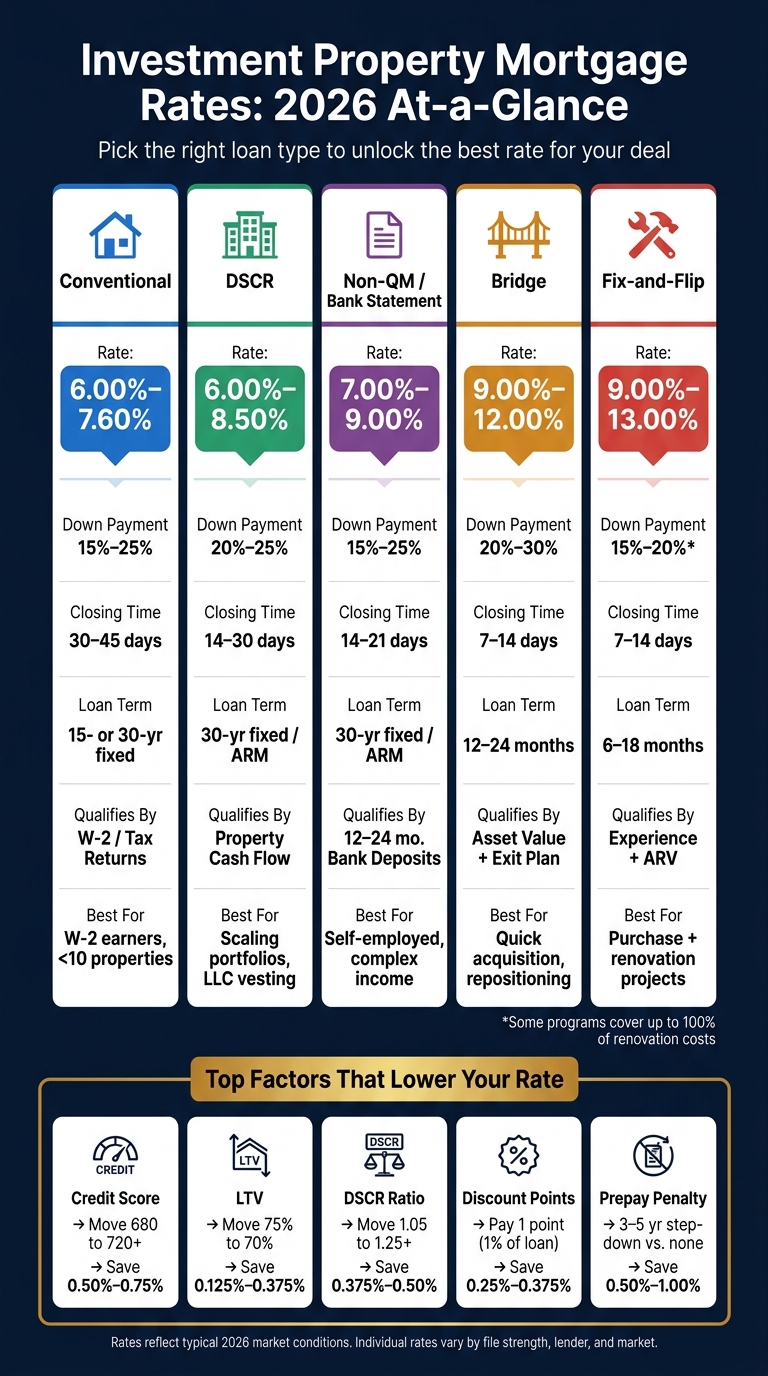
Investment Property Loan Types: 2026 Rate & Feature Comparison
2026 Mortgage Rates & Lending Update for Real Estate Investors | Mortgage Rates Explained
sbb-itb-e7c549b
1. Know what drives your investment property rate
Lenders price the risk in the deal. And in most cases, a small group of borrower and property details drives most of the rate spread.
LTV, credit score, and reserves
These three factors usually move pricing more than almost anything else on the borrower side.
Loan-to-value (LTV) is simple: the less you borrow compared with the property's value, the less risk the lender takes on. Rate tiers often shift in 5% steps, and moving from 80% LTV to 70% LTV can cut your rate by 25 to 40 basis points on the same deal.
Credit score is often the biggest pricing lever of all. A 100-point FICO drop - from 760 to 660, for example - can push your rate up by about 200 basis points. Even a smaller jump can matter. Moving from 700 to 740 can shave off 50 to 100 basis points. Put plainly, lenders care a lot about credit, and the pricing can change fast as scores fall.
| FICO Band | 75% LTV Rate | 80% LTV Rate |
|---|---|---|
| 760+ | 6.86% – 7.00% | 7.00% – 7.15% |
| 740–759 | 6.95% – 7.15% | 7.10% – 7.30% |
| 700–719 | 7.40% – 7.75% | 7.60% – 8.00% |
| 660–679 | 8.40% – 9.00% | 8.65% – 9.30% |
Reserves also matter more than many borrowers think. Lenders often want to see 3 to 12 months of PITIA - Principal, Interest, Taxes, Insurance, and Association dues - in liquid reserves after closing. If reserves look thin, you may get a higher rate or a lower LTV cap. Keeping at least 6 months of post-closing liquidity can help you avoid that hit.
DSCR, property type, and property use
With rental property loans, the property has to qualify too - not just the borrower. That’s where Debt Service Coverage Ratio (DSCR) comes in.
DSCR measures how well the property can cover its debt payments. A ratio of 1.25 or higher usually gets you into the best pricing tiers. Ratios below 1.00 can lead to steep premiums or lower leverage.
That’s also why the same file can price in different ways from one lender to another. DSCR, leverage, and property type all shift the risk tier.
Property type and use matter as well. Single-family long-term rentals are usually the baseline for the lowest rates. Short-term rentals often add 25 to 100 basis points, and 2–4 unit properties plus non-warrantable condos usually come with pricing add-ons too.
That puts the loan program itself in the spotlight as the next big pricing lever.
Loan program and documentation type
Conventional loans usually price the best, but they come with full-documentation rules and tighter DTI limits. They’re also usually capped at 10 financed properties. DSCR loans and other non-QM loans use property cash flow or other forms of documentation, which gives borrowers more room to work with.
The trade-off is pretty simple: less documentation usually means a higher rate, because the lender is pricing in more uncertainty.
If your income is hard to document, picking the right program can save you more than chasing a slightly lower headline rate.
2. Pick the loan type that fits your deal and qualification profile
The loan you choose affects both price and approval. Conventional loans may show the lowest advertised rates, but they can fall apart if your income, property count, or title setup doesn't fit the program. In plain English: the lowest-cost deal is the one that fits your file and keeps the rate, fees, and timeline in check.
From there, the right option depends on what matters most in the deal. Sometimes it's property cash flow. Sometimes it's your tax setup. And sometimes it's just getting to the closing table on time.
DSCR and rental property loans for buy-and-hold deals
For a stabilized rental, a DSCR loan is often the cleanest path. The lender looks at the property's rent compared with its debt payments, not your personal income. That makes it a strong fit for self-employed investors and borrowers who have already hit the 10-property cap on conventional financing.
Conventional rental loans can still offer some of the lowest rates - about 6.00% to 7.60% in 2026 - but they require full income documentation and usually don't work well for purchases held in an LLC. DSCR loans, on the other hand, can close in 14 to 21 days and allow entity ownership. In top-tier cases, a 760+ FICO, 1.25x+ DSCR, and 75% LTV or lower can push pricing down to 5.95% to 6.75%.
If a DSCR loan doesn't work for the file, the next route is usually a non-QM loan built around bank statements or assets.
Non-QM mortgages for self-employed and complex income borrowers
When tax returns make your income look smaller than it is, bank statement or asset depletion loans give underwriters another way to qualify you. Bank statement programs use 12 to 24 months of deposits to calculate qualifying income. That's useful when a business throws off solid cash but the tax return doesn't show it cleanly. Asset depletion programs qualify you by spreading liquid assets over 60 to 360 months.
These loans come with higher rates - about 7.00% to 9.00% for bank statement programs - but that's the trade-off for getting access to financing. If conventional underwriting rejects your file, a higher-rate non-QM loan can still be the better deal if it gets the property closed.
If the property isn't ready for permanent financing yet, short-term debt is the next lane.
Bridge and fix-and-flip financing for short-term projects
Short-term loans play by a different set of rules. Bridge loans are built for speed, with 12- to 24-month interest-only terms and closing times as fast as 7 to 14 days. Investors use them to buy, rehab, or stabilize a property before moving into permanent financing.
Fix-and-flip loans take that one step further. They can fund both the purchase and the renovation budget through draw-based structures, and pricing also depends on borrower experience.
| Loan Type | Typical 2026 Rate | Down Payment | Closing Timeline | Term | Qualification Method | Best Fit |
|---|---|---|---|---|---|---|
| Conventional | 6.00% – 7.60% | 15% – 25% | 30 – 45 days | 15- or 30-year fixed | W-2 / tax returns | W-2 earners, fewer than 10 properties |
| DSCR | 6.00% – 8.50% | 20% – 25% | 14 – 30 days | 30-year fixed / ARM | Property cash flow (DSCR ratio) | Scaling portfolios, LLC vesting |
| Non-QM (Bank Statement) | 7.00% – 9.00% | 15% – 25% | 14 – 21 days | 30-year fixed / ARM | 12–24 mo. bank deposits | Self-employed, complex income |
| Bridge | 9.00% – 12.00% | 20% – 30% | 7 – 14 days | 12 – 24 months | Asset value + exit plan | Quick acquisition, repositioning |
| Fix-and-Flip | 9.00% – 13.00% | 15% – 20%* | 7 – 14 days | 6 – 18 months | Experience + ARV | Purchase + renovation projects |
*Some fix-and-flip programs can cover up to 100% of renovation costs through a loan-to-cost structure.
Once you've picked the loan type, the next move is to tighten up the file before you lock.
3. Improve your pricing before you lock the rate
Before you lock, work on the few factors that move pricing the most. Once you’ve matched the loan type to the deal, the next step is simple: tighten the file before you ask for final pricing.
Push DSCR higher and bring LTV down
A small change here can make a big dent in rate. Moving from a 1.05 DSCR to 1.25+ can lower pricing by 0.375% to 0.50%.
In many cases, the fastest fix is a bigger down payment. That lowers LTV and reduces monthly PITIA, which can help the numbers work in your favor. If putting more money down isn’t practical, check the rent docs instead. An updated lease at market rent or a current market rent schedule (Form 1007) may support a stronger DSCR and lead to better pricing.
Build credit and show stronger post-closing reserves
Credit score still matters. A lot. Lenders often price in 20-point bands, so a 40-point jump - say, from 680 to 720 - can mean a 0.50% to 0.75% rate gap.
The best move is to start about 6 months before applying:
- Pay down revolving balances
- Avoid new credit inquiries
- Build liquid reserves
Showing 3 to 12 months of post-closing PITIA in liquid reserves can help you avoid rate add-ons and lower LTV caps.
Use points, term length, and loan structure to your advantage
Discount points can work, but only if you keep the property long enough to earn that money back. On a $350,000 DSCR loan, paying 2 points ($7,000) drops the rate from 8.25% to 7.25%, which saves $242 per month. The breakeven is 29 months.
That can make sense for a long hold. If you expect to refinance or sell in the next couple of years, it usually doesn’t.
Prepay structure matters too. A 3- to 5-year step-down prepayment penalty can cut the rate by 0.50% to 1.00% compared with no penalty. If you plan to hold the property and don’t expect to sell or refinance during that period, that trade can pencil out.
Main pricing levers:
| Factor | Action | Typical Rate Benefit |
|---|---|---|
| Credit Score | Move from 680 to 720+ | 0.50%–0.75% reduction |
| LTV | Move from 75% to 70% | 0.125%–0.375% reduction |
| DSCR Ratio | Move from 1.05 to 1.25+ | 0.375%–0.50% reduction |
| Discount Points | Pay 1 point (1% of loan) | 0.25%–0.375% reduction |
| Prepayment Penalty | 3- to 5-year step-down vs. none | 0.50%–1.00% reduction |
Once the file looks stronger, compare lenders on APR, fees, and lock terms before you make a call.
4. Compare offers and lock at the right time
Once your file is tight, the next move is simple: compare the total cost of each loan and lock before pricing shifts.
Look beyond the rate: APR, points, prepayment terms, and closing speed
If the deal still works at today’s rate and your file is ready, it’s time to compare offers and lock.
The note rate only tells part of the story. APR gives you a better side-by-side view because it rolls in origination charges, points, and other lender fees.
You’ll also want to check the prepayment penalty against how long you expect to hold the property. Many DSCR and non-QM loans come with a 3- to 5-year step-down setup. If there’s a decent chance you’ll sell or refinance earlier, make sure those terms still line up with your plan. In many cases, a step-down structure gives you more room than yield maintenance.
Closing speed matters too. A slower loan usually means you need a longer lock, and that brings more extension risk. That’s where a cheap-looking quote can start getting expensive.
Pick the right lock period for your transaction
After you figure out which offer has the lowest total cost, line up the lock period with your actual closing timeline.
A 30-day lock is the standard starting point. A 45-day lock usually adds about +0.125%, a 60-day lock adds about +0.25%, and a 90-day lock can add about +0.375% to 0.50% to your rate.
The goal is to choose the shortest lock that still gives underwriting and closing enough time. Longer locks cost more. Extensions tack on extra fees. It’s a bit like paying for extra parking time you may not even need.
Before you lock, make sure your LLC documents, insurance binders, and reserve documentation are ready to go. The best lock is the shortest one that gets you to the finish line without an extension.
Work with a lender focused on investment property financing
Not every lender is set up for investor deals.
A lender that spends its time on DSCR, non-QM, bridge, and fix-and-flip loans is often in a better position to move fast and shape the loan around the property and the borrower’s qualification profile.
Conclusion: Match the loan, improve the file, and lock with a clear plan
A competitive investment property rate in 2026 usually comes down to three things: picking the right loan, tightening up the file, and locking at the right moment. Your rate isn’t random. It reflects the loan setup you choose and the strength of the file you bring to the table.
FICO, LTV, DSCR, and reserves all shape pricing. If you improve even one of those, your rate can drop in a meaningful way.
When a file doesn’t fit conventional underwriting, loan choice becomes the main pricing lever. If standard income documentation doesn’t work for your file, a DSCR or non-QM loan may be the better route for approval and solid pricing.
And note rate alone doesn’t tell the whole story. Total loan cost matters more. Match the loan to the deal, improve the file where you can, compare the full cost, and lock once the timeline is clear. That’s how investors get the best deal in 2026.
FAQs
Which loan type is best for my investment property?
The best loan comes down to what you’re trying to do and how you qualify.
If you have strong W-2 income and you’re still early in your investing journey, a conventional mortgage is often the best place to start. It usually comes with the lowest rates, which can make the numbers work better from day one.
If you’re self-employed, already own several properties, or need to close fast without handing over tax returns, a DSCR loan may make more sense. And if the plan is a short-term renovation or a property repositioning play, bridge loans and fix-and-flip financing give you more room to move, though they usually come with higher rates and fees.
How much can my rate improve if I raise my credit score or lower my LTV?
Improving your credit score and lowering your LTV are two of the best ways to cut your mortgage rate.
The difference between a 740 score and a 660 score is often 150 to 200 basis points. And if your score falls in the 620 to 660 range, your rate can jump by 250+ basis points.
Your LTV matters too. Dropping it from 80% to 75% or less often gets rid of a 15 to 50 basis point premium.
When should I lock my investment property mortgage rate?
Lock your investment property mortgage rate once the deal already hits your cash flow and return targets. At that point, certainty usually matters more than trying to guess the next rate move. Short-term swings are hard to call, and waiting for a slightly better rate can backfire fast.
Lock the rate if:
- Closing is within 45 days
- A 0.25% rate bump would kill the deal
- Market volatility is stressing you out
If closing is more than 60 days away, floating can make sense. But that only works if you're comfortable with the risk that rates could move higher before you close.


