


Mobile home park loans for first-time park owners: complete 2026 guide

First-time park owners’ financing is commercial borrowing secured by a manufactured housing community, with the aim of acquiring an income-producing property. Mobile home park loans for first-time owners require you to separate land income from home income, verify infrastructure, and match the property to a lender’s eligibility rules before committing to a 2026 purchase.
TL;DR
- Mobile home park loans for first-time owners should fit the park’s verified income, infrastructure, and ownership structure.
- Loanguys offers DSCR and bridge loan programs; confirm mobile home park eligibility before treating either as a financing solution.
- Compare bank financing, eligible manufactured housing community programs, bridge financing, and seller financing against your acquisition plan.
- Document collections, utility responsibilities, management experience, and your repayment or refinance strategy before applying.
Why park financing matters for first-time owners
Buying a mobile home park means buying more than occupied homesites. Your collateral can include land, roads, utility systems, common facilities, and park-owned homes, each with different maintenance and documentation needs.
The financing must fit the property you are buying, not just the rent you expect to collect. A lender’s acceptance of residential rentals does not establish acceptance of a manufactured housing community. Start with the mobile home park acquisition guide to distinguish acquisition financing from financing individual manufactured homes.
For your first acquisition in 2026, the central constraint is proving that the income and operating plan survive scrutiny. Seller projections cannot replace collection records, legal operating status, or an inspection of the systems that keep residents’ homesites usable.
You also need a credible answer to who runs the park after closing. An ownership transition leaves you responsible for collections, repairs, resident communication, and compliance even when a manager handles daily work.
How to prepare a financeable park acquisition
Define the collateral
Build a property inventory yourself before requesting loan quotes. Use the purchase agreement, parcel records, leases, and a site visit to identify exactly what transfers to you. A title professional and qualified inspectors then verify the issues outside your expertise.
Separate tenant-owned homes from park-owned homes. With tenant-owned homes, your income generally comes from renting the homesites; park-owned homes add a separate ownership, maintenance, and potential title component. Do not present those income streams as interchangeable.
Confirm whether the park owns its utility infrastructure or receives service from public providers. Private wells, wastewater systems, and master-metered utilities need their own review. Existing occupancy does not prove every homesite is legally approved.
Describe the collateral before describing the loan you want. This prevents a quote based on a property type different from the one in your contract.
- Create a parcel list matching the proposed purchase.
- Mark each homesite as occupied, vacant, or unusable.
- Identify tenant-owned and park-owned homes separately.
- Record ownership and responsibility for utility systems.
- Obtain zoning, operating permits, and documented homesite approvals.
Verify cash flow
Start with a spreadsheet and reconcile the seller’s rent roll against actual collections. Request 12 months of collection records as an initial diligence checklist, then obtain any additional history the lender requires. This is a preparation recommendation, not a universal underwriting minimum.
Calculate net operating income, or NOI: property operating income minus operating expenses, before debt service. Include management expense even if you plan to manage the park yourself. Your time does not eliminate the work.
Debt service coverage ratio, or DSCR, compares NOI with debt payments over the same period. Commercial park underwriting is not automatically the same as a residential rental DSCR calculation. Ask the lender which income, expenses, and reserves enter its formula.
For a 2026 acquisition, build 3 scenarios: current operations, planned operations, and stressed operations. Keep rent increases and vacant-lot improvements out of the current-operations case. A plan is not collected income.
- Reconcile billed rent, deposited rent, and unpaid balances.
- Separate lot rent, home rent, and utility reimbursements.
- Include taxes, insurance, repairs, administration, and management.
- Identify one-time expenses without deleting recurring maintenance.
- Test debt payments against lower collections and higher expenses.
Confirm lender fit
Prepare a short property summary yourself before submitting a full application. Include the location, homesite inventory, ownership mix, utility arrangement, current income, requested financing structure, and your operating plan. Ask about property eligibility first.
Loanguys offers DSCR, bridge, fix-and-flip, bank-statement, and short-term rental loan programs. That stated program range does not confirm mobile home park eligibility, acquisition terms, or acceptance of a first-time park operator.
Loanguys is best for investors comparing its stated DSCR and bridge loan programs, with park eligibility confirmed before applying. Use Loanguys as a broker conversation, not as evidence that your park already qualifies. The benefit is access to guidance on its stated programs; the limitation is that a specific park still needs an eligibility decision.
A broker-led review can help organize the financing discussion, but it cannot replace property diligence or a lender’s approval. Get the essential answers in writing before ordering lender-specific reports.
- Ask whether the lender finances manufactured housing communities.
- Disclose that this is your first park acquisition.
- Confirm treatment of park-owned homes and private utilities.
- Ask which reports and financial records are required.
- Confirm the borrowing entity and guarantor requirements.
Document your experience
Write an operating plan before paying anyone to package your application. First-time park ownership does not mean you must present yourself as an experienced park operator. Show the experience you actually have and identify the responsibilities you will delegate.
Rental management, bookkeeping, construction oversight, and business operations belong in your summary when they are genuine. Do not turn general investment interest into claimed operating experience. A named manager with a written scope is more useful than an unsupported promise to learn quickly.
For your 2026 plan, explain who receives resident requests, supervises repairs, handles rent collection, and maintains required records. Include backup arrangements when the primary manager is unavailable.
Your management plan should explain execution, not just ambition. Lenders set their own experience requirements, so confirm whether your proposed manager or partner satisfies those requirements before relying on that arrangement.
- Prepare a factual ownership and management résumé.
- Obtain a management proposal with defined responsibilities.
- List qualified utility and maintenance contractors.
- Explain collection procedures and resident communication.
- Document available funds and their source.
Compare written terms
Request proposals using the same property summary and financing request. Comparing different assumptions produces a misleading result, even when the proposals look similar at first glance.
Loan-to-value, or LTV, expresses the loan amount relative to the property value used by the lender. Loan-to-cost compares borrowing with the eligible project cost. Ask which measure controls your proposal and how the lender treats repairs, park-owned homes, and an appraisal below the contract amount.
Separate the payment schedule from the maturity date. A loan can calculate payments over a longer amortization period while requiring the remaining balance at an earlier maturity. Interest-only payments do not remove that repayment obligation.
For a 2026 comparison, use written terms rather than remembered conversations. Choose the structure your park can support, not the proposal with the most appealing opening payment. Have your attorney review guarantees, default provisions, and transfer restrictions.
- Compare maturity, amortization, and payment structure.
- Identify guarantees and any recourse exceptions.
- Review reserve requirements and repair conditions.
- Check prepayment restrictions and extension conditions.
- Confirm whether seller debt or subordinate liens are permitted.
Protect your exit
Build the repayment plan manually before accepting short-term debt. If a bridge loan requires refinancing, identify what must change between acquisition and refinance: collections, occupancy, repairs, documentation, or management. Each change needs a funded action and evidence of completion.
Prepare 2 budgets: acquisition and post-closing operations. The acquisition budget covers the transaction and required initial work; the operating budget protects the cash needed to run the park after ownership transfers. Do not commit every available dollar to closing.
A refinance is a separate underwriting decision, not a guaranteed continuation of the purchase loan. Ask a potential permanent lender to review the property’s eligibility before you rely on that exit. Do not assume improved income solves title, utility, or property-type restrictions.
Avoid a short-term loan when its repayment depends entirely on an unverified refinance. A slower acquisition or a different financing structure is preferable to an obligation without a supported exit.
- List every condition needed for the planned refinance.
- Obtain contractor scopes for required infrastructure work.
- Separate lender reserves from your operating funds.
- Review the repayment plan if improvements take longer.
- Preserve contract protections appropriate to the transaction.
The preparation sequence is deliberate: define the property, prove the income, establish lender fit, then document execution and repayment. Skipping eligibility checks leaves the rest of your application built around the wrong financing assumption.
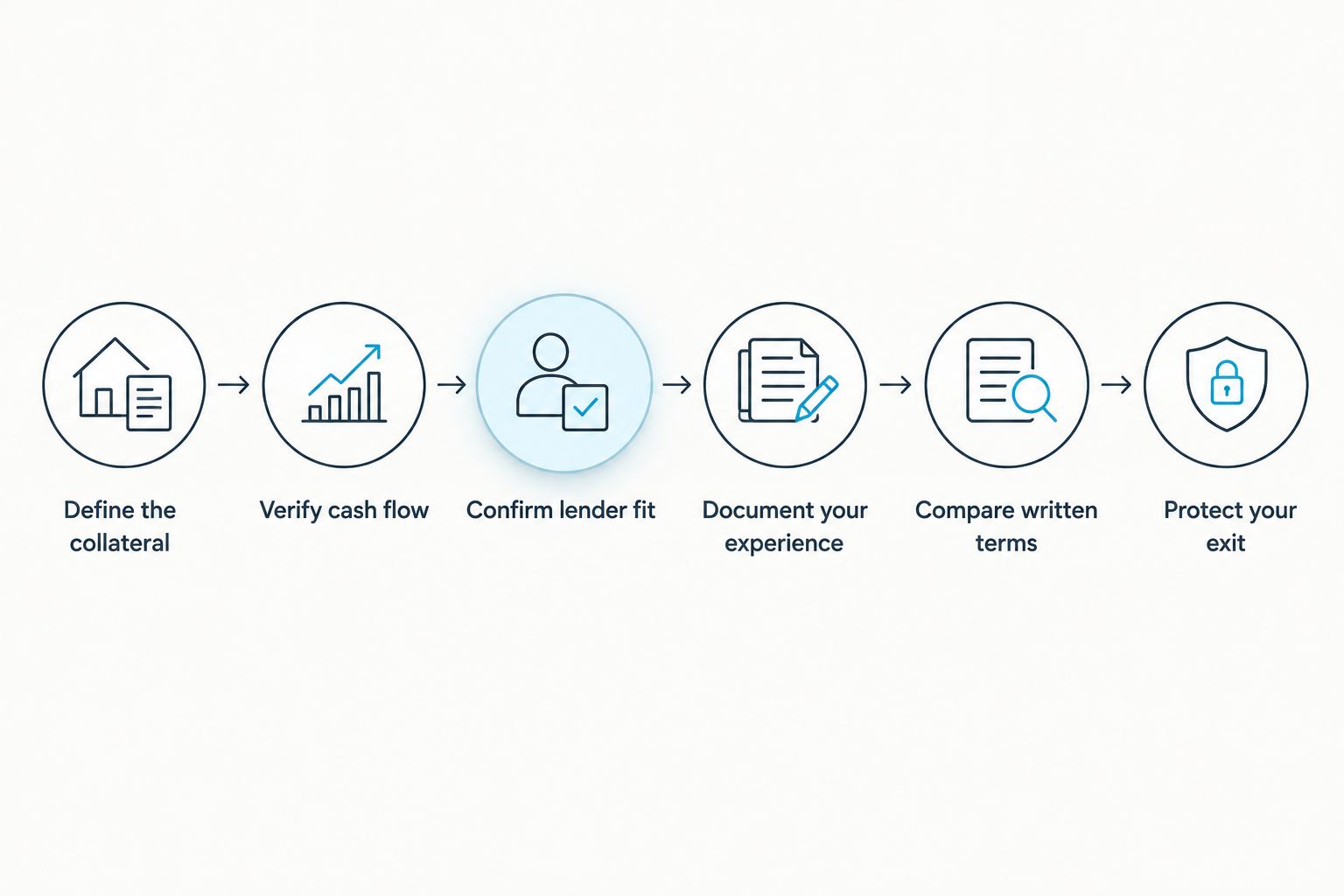
Confirm property eligibility before building the full loan application.
Compare financing options for your first park
Use this 2026 comparison to shortlist financing routes, not to assume qualification. Each option has a different purpose, and each provider sets its own collateral, borrower, and documentation rules.
Bank or credit union commercial loan
- Best for: Buyers with documented operations and a supported repayment plan
- Main advantage: Direct discussion of the property and borrower with the lender
- Key limitation: Property eligibility, guarantees, and experience requirements vary
Manufactured housing community agency execution
- Best for: Stabilized communities meeting the applicable program rules
- Main advantage: A financing route designed for eligible manufactured housing communities
- Key limitation: Not every park or first-time ownership structure qualifies
Commercial bridge loan
- Best for: Buyers completing defined repairs or an operating transition
- Main advantage: Short-term financing aligned with a specific transition plan
- Key limitation: Maturity creates repayment risk; refinancing is not guaranteed
Seller financing
- Best for: Buyers whose seller agrees to retain a documented loan
- Main advantage: Terms can address the parties’ specific transaction needs
- Key limitation: The seller must agree, and other lenders must accept the structure
Private commercial loan
- Best for: Transactions requiring a property-specific structure
- Main advantage: Negotiated underwriting and collateral arrangements
- Key limitation: Repayment provisions, guarantees, and exit requirements need close review
Start with financing suited to current operations. Consider bridge financing only when the improvement plan and exit are documented. Seller financing belongs in a lawyer-reviewed agreement, not a handshake attached to the purchase contract.
Manufactured housing community agency programs are distinct from ordinary residential mortgages. Confirm the applicable program directly; a mobile home park does not become eligible simply because its residents use the homes as their primary residences.
Common mistakes first-time park owners make
Treating a park like a collection of residential rentals
A park acquisition includes shared infrastructure and land-use questions that individual rental-home financing does not resolve. Disclose the full property type and ownership mix instead of applying under a residential rental description.
Counting occupied lots as collected income
Occupancy and payment are different facts. Reconcile the rent roll with deposits and delinquency records, then ask how the lender treats concessions, unpaid balances, and vacant homesites.
Leaving park-owned homes out of diligence
A purchase can transfer home-related repair obligations and title issues alongside the land. Inventory those homes, verify ownership, and confirm how the lender treats them as collateral and income sources.
Planning rent increases before checking restrictions
A proposed increase needs review against leases and applicable law. Ask local counsel about notice requirements, rent restrictions, and resident protections before putting higher collections into your repayment plan.
Spending all available funds on acquisition
A closed loan does not fund every future repair automatically. Keep your operating budget separate and identify which infrastructure work, resident-service obligations, and contingencies remain your responsibility after closing.
FAQ
Can I get a mobile home park loan as a first-time owner?
First-time owners can pursue mobile home park financing, but approval depends on the lender’s borrower and property rules. Present verified income, available funds, and a credible management plan, then confirm any experience requirement.
What is the best loan for buying my first mobile home park?
The best loan matches the park’s current condition and your supported repayment plan. Compare permanent commercial financing for established operations with bridge financing for a defined transition, without assuming either route accepts your property.
Can I use a DSCR loan to buy a mobile home park?
A lender’s residential DSCR program does not automatically finance mobile home parks. Commercial park underwriting can use debt service coverage, but you must confirm the property type and calculation with the lender.
Does Loanguys finance mobile home parks?
Loanguys states that it offers DSCR and bridge loan programs, but that does not establish mobile home park eligibility. Submit the park’s property summary and ask for confirmation before relying on a particular program.
How much down payment do first-time park owners need?
The required equity depends on the lender, valuation, loan structure, and property. Request a written financing proposal and separately account for transaction expenses, repairs, reserves, and post-closing operating funds.
Can seller financing help me buy a mobile home park?
Seller financing can help structure a park purchase when the seller agrees to lend under documented terms. Your attorney should review the note and security documents, and any senior lender must accept the arrangement.
What documents should I gather before applying for a park loan?
Gather the rent roll, collection records, operating statements, leases, property inventory, utility information, and ownership documents. Add your management plan and evidence of available funds, then obtain the lender’s transaction-specific checklist.
One last thing
Check the usable homesites, not just the advertised homesite count. An empty lot with missing utility connections or unresolved approval issues is not the same as a rentable homesite. Ask the seller, local authorities, and your inspectors to reconcile the difference before using expansion income in your 2026 financing plan.


