


No Doc Business Loans for Gym Owners: 2026 Verdict

Gym-owner no-doc business financing is funding based mainly on business deposits or revenue with the aim of covering equipment, payroll, renovations, or expansion without relying on tax returns. Fitness studios have recurring membership revenue, seasonal enrollment changes, and substantial operating deductions, so their bank activity can present a clearer picture than taxable income in 2026. LoanGuys is best for gym owners who need bank-statement mortgage or commercial property financing; owners seeking general working capital should also compare dedicated business lenders.
TL;DR
- No doc business loans for gym owners use deposit history or revenue instead of tax returns as the main underwriting evidence.
- No doc does not mean no paperwork; lenders still verify identity, ownership, bank activity, and the intended use of funds.
- LoanGuys fits property-related financing, while dedicated business lenders cover general working capital and operating expenses.
- Compare repayment frequency, total repayment, collateral requirements, and prepayment terms before accepting a 2026 offer.
Why no-doc financing matters for gym owners
Gym owners often deduct equipment, repairs, marketing, software, rent, and other operating expenses. Those deductions reduce taxable income, but they can also make conventional income documentation look weaker than the cash moving through the business.
The broader guide to no doc business loans for small business owners explains the central trade-off: reduced tax-return reliance does not remove underwriting. A lender still needs enough evidence to decide whether the business can support the proposed payment.
Gyms also face revenue patterns that require context. Memberships can recur monthly, personal training packages can create uneven deposits, and class-based studios can see enrollment change through the year. A clean 2026 application separates operating revenue from transfers, refunds, borrowed funds, and owner contributions.
LoanGuys bank-statement mortgage programs address a related but distinct problem: qualifying for property financing when tax returns do not fully reflect available cash flow. That distinction matters because a loan for payroll is not the same as financing for the building occupied by the gym.
How to pursue no doc business loans for gym owners
Organize your bank statements
Start with the manual method: download each statement directly from every business account receiving gym revenue. Many bank-statement programs review either 12 or 24 months, although the required period depends on the lender and product.
Your statements should make the operating history easy to follow. Do not submit screenshots, incomplete transaction exports, or selected pages that omit account details.
- Keep membership revenue in a dedicated business account
- Include every page of each requested statement
- Identify transfers between business accounts
- Explain returned payments and overdrafts
- Reconcile merchant deposits with the corresponding bank activity
- Separate owner contributions from customer revenue
Calculate average monthly deposits
Add eligible operating deposits across the review period, then divide by the number of months. Exclude transfers, prior loan proceeds, and owner-funded deposits so the result reflects revenue rather than money moved into the account.
Calculate the average manually before applying. This shows whether recent deposits are above or below the longer trend and exposes any month that needs an explanation.
- Total recurring membership deposits
- Add personal training and class revenue
- Include merchandise sales only when documented as business revenue
- Remove internal transfers and borrowed funds
- Mark refunds and chargebacks
- Compare recent activity with the full statement period
Define the exact funding purpose
A no doc business loan for gym owners must match the expense being financed. Working capital, equipment, tenant improvements, and real estate are different needs with different underwriting methods.
LoanGuys property financing belongs in the conversation when the request involves buying, refinancing, or bridging real estate. A dedicated business lender is the clearer fit when the request covers payroll, advertising, supplies, or another operating expense unrelated to property.
- List the expense being funded
- Obtain equipment or contractor documentation when available
- Separate property costs from operating expenses
- Set a maximum payment the gym can support
- Avoid borrowing without a defined use
Gather the supporting records
No-doc lending reduces income paperwork; it does not eliminate verification. Prepare the records that confirm the gym exists, the applicant owns it, and the receiving account belongs to the business.
A complete file prevents avoidable back-and-forth during a 2026 review. It also helps the lender distinguish legitimate revenue from unexplained deposits.
- Government-issued identification
- Business formation records
- Employer identification documentation
- Current business license when applicable
- Voided business check or bank verification
- Commercial lease or property statement
- Merchant processing records when requested
Compare the full repayment structure
Do not compare offers by approval amount alone. Review how frequently payments are collected, how the total repayment is calculated, whether collateral is required, and what happens if you repay early.
Interest-bearing loans and factor-based financing are not presented the same way. Convert every proposal into the same set of comparison points before deciding.
- Total amount received
- Total amount repaid
- Payment frequency
- Repayment period
- Collateral or personal guarantee requirements
- Prepayment provisions
- Default and late-payment terms
Test the payment against a slower month
A payment that works during a membership surge can strain the gym when cancellations rise or class attendance falls. Use a slower historical month rather than the best month when testing affordability.
Run the payment through the gym's existing obligations before signing. Include rent, payroll, equipment leases, software, insurance, utilities, and current debt payments.
- Start with actual slower-month deposits
- Subtract fixed operating expenses
- Add existing debt obligations
- Account for refunds and chargebacks
- Preserve cash for payroll and rent
- Reject a payment that depends on uninterrupted growth
Apply deliberately
Submit the same revenue figures and funding purpose across every application. Conflicting numbers create questions and make it harder to compare offers accurately.
Limit simultaneous applications to lenders or brokers that fit the stated use of funds. In 2026, the fastest offer is not automatically the best fit if the payment schedule conflicts with the gym's revenue cycle.
- Confirm the lender serves fitness businesses
- Ask which deposits count as revenue
- Verify the required statement period
- Request all repayment terms in writing
- Review automatic debit authorization
- Keep a copy of every submitted document
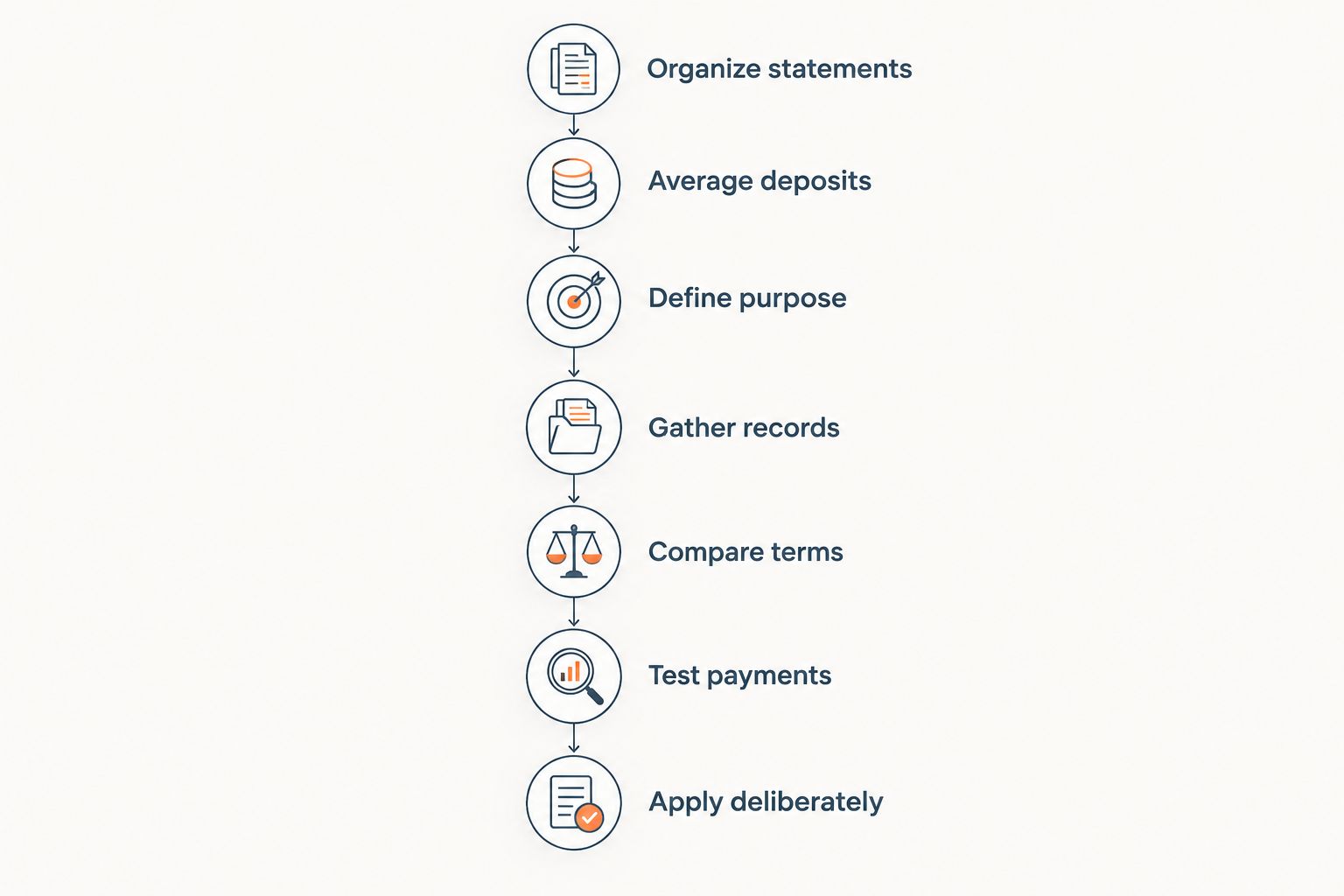
A clear funding purpose and verified deposits come before comparing loan offers.
Compare financing options for a gym or fitness studio
The right option depends on whether you need operating cash, equipment, or property financing. Each choice has a clear use case and a limitation.
No-doc term loan
- Best for: Established gyms needing a defined amount for working capital
- Documentation basis: Business deposits and ownership records
- Main limitation: Fixed payments can pressure cash flow during slower months
Business line of credit
- Best for: Recurring repairs, supplies, or short cash-flow gaps
- Documentation basis: Revenue history, bank activity, and credit review
- Main limitation: Access and repayment rules vary by lender
Revenue-based financing
- Best for: Businesses with frequent, trackable deposits
- Documentation basis: Bank or merchant processing activity
- Main limitation: Payments tied to revenue can reduce daily operating cash
Equipment financing
- Best for: Purchasing machines or other eligible equipment
- Documentation basis: Business records and information about the equipment
- Main limitation: Funds cannot generally be redirected to unrelated expenses
SBA 7(a) loan
- Best for: Established businesses able to provide full documentation
- Documentation basis: Tax returns, financial statements, and standard underwriting records
- Main limitation: The documentation process is heavier than no-doc financing
LoanGuys property financing
- Best for: Buying or refinancing a gym building or investment property
- Documentation basis: Program-specific bank-statement, property, or cash-flow documentation
- Main limitation: It is not general-purpose working capital
Gym owners buying the property occupied by the business should review commercial real estate loans for gyms and fitness centers. That route evaluates the real estate transaction rather than treating the request as a general operating loan.
Discuss your financing scenario
Review bank-statement, bridge, or property financing based on your documented needs.
Common no-doc financing mistakes gym owners make
Treating no doc as no verification
A lender still verifies business activity, ownership, identity, and deposits. Submitting an incomplete file delays the review and can prevent the lender from distinguishing revenue from transfers.
Applying with mixed personal and business activity
Personal transfers, owner contributions, and customer payments in one account create avoidable questions. Maintain a dedicated operating account and label unusual deposits before submitting statements.
Comparing only the approved amount
A larger approval is not automatically better. Payment frequency, repayment period, collateral, guarantees, and prepayment provisions determine whether the financing fits the gym's actual cash flow.
Borrowing for property through the wrong product
A general business loan is not a substitute for properly structured commercial property financing. Gym owners purchasing or refinancing their location should compare real estate products separately from working-capital options.
Using the strongest month as the baseline
Building the repayment plan around a peak month leaves no room for cancellations, refunds, equipment repairs, or seasonal softness. Test the proposed payment against a documented slower month before accepting a 2026 offer.
FAQ
What is a no doc business loan for gym owners?
A no doc business loan for gym owners uses bank deposits or business revenue as the main underwriting evidence instead of relying primarily on tax returns. The lender still verifies ownership, identity, account history, and repayment capacity.
Can a gym owner qualify without providing tax returns?
Yes, some lenders offer bank-statement or revenue-based underwriting that does not require tax returns as the main income document. Approval still depends on the lender's rules, deposit history, credit review, and intended use of funds.
How many bank statements does a no-doc lender request?
Many bank-statement programs request 12 or 24 months of statements, but the exact requirement varies by lender and loan type. Provide every page for the requested period and identify transfers that are not operating revenue.
How much can a gym owner borrow with a no-doc loan?
There is no universal amount because lenders size financing from documented deposits, existing obligations, credit, and repayment structure. Consistent eligible revenue supports a clearer application than unexplained or volatile deposits.
Is a no-doc business loan the same as a merchant cash advance?
No. A no-doc term loan has a defined loan structure, while a merchant cash advance is generally purchased future receivables repaid through agreed deductions. Compare total repayment and collection frequency rather than treating the products as interchangeable.
Can no-doc financing pay for gym equipment?
It can when the lender permits equipment as an eligible use of funds. Dedicated equipment financing is another option, but those funds are normally tied to the approved equipment purchase.
Can a new fitness studio get a no-doc business loan?
A new studio has fewer bank-statement options because it lacks an established deposit history. The owner should compare startup financing, equipment financing, and any product that accepts the available operating history.
Should a gym owner use business financing to buy the building?
A commercial real estate loan is the more appropriate category for buying the building occupied by the gym. Property financing evaluates the real estate, borrower, and transaction rather than treating the purchase as ordinary working capital.
One last thing
The phrase no doc describes the underwriting route, not the absence of accountability. The strongest 2026 application is easy to audit: deposits match business activity, transfers are labeled, the funding purpose is specific, and the proposed payment works during a slower month.
Decide first whether the need is working capital, equipment, or real estate. That single choice prevents you from comparing products built for different problems and keeps the application focused on the records that matter.


