


Can You Refinance a Bridge Loan? Your Exit Options Explained

Yes - you can refinance a bridge loan, but only if the property and your file are ready before the maturity date. In most cases, your exit comes down to 3 paths: refinance into a long-term loan, sell the property, or use another permanent loan type if the deal does not fit a standard rental refinance.
Here’s the short version:
- Bridge loans usually run 6 to 24 months
- Rates in 2026 often fall around 8% to 14%
- Extension fees can cost 1 to 2 points
- Most refinance lenders want the property fully finished, leased, and appraised high enough
- DSCR loans often want at least 3 to 6 months of rent history
- Cash-out refinance limits are often lower than rate-and-term limits
If I strip it down even more, the question is simple: Can the next lender say yes before your balloon payment comes due?
That usually depends on:
- Seasoning: how long you have owned the property
- Value: whether the appraisal supports the loan amount
- Income: whether rent covers the new payment
- Borrower profile: credit, cash reserves, and loan fit
What is Commercial Bridge Financing and Loan Exit Plans Explained
sbb-itb-e7c549b
Quick Comparison
| Exit option | Best for | Main hurdle | Typical result |
|---|---|---|---|
| DSCR refinance | BRRRR and rental holds | Rent, seasoning, stabilization | Pays off bridge and moves debt into a long-term loan |
| Conventional refinance | Borrowers with strong W-2 or tax return income | Tighter income and property rules | Lower-cost long-term financing if you qualify |
| Non-QM refinance | Borrowers with doc or credit issues | Lower leverage and lender-specific rules | Backup path when conventional does not work |
| Cash-out refinance | Deals with added equity after rehab | Lower LTV caps and pricing hit | Pays off bridge and may return some cash |
| Sale | Flips or weak refinance deals | Market timing and buyer demand | Full payoff through sale proceeds |
| Portfolio/permanent loan | Mixed-use, 5+ unit, or other outside-box assets | More paperwork and stricter property review | Long-term debt for deals standard rental lenders may not take |
Bottom line: if the rehab is done, the unit is leased, the numbers work, and you start 60 to 90 days before maturity, refinancing is often possible. If not, selling or shifting to another loan type may be the cleaner exit.
Now I’ll walk through how to tell which path fits your deal.
What Determines Whether You Can Refinance a Bridge Loan
Permanent financing usually comes down to four lender tests: seasoning, value, income, and borrower strength. Those are the filters a long-term lender uses to decide if your bridge loan can be paid off with a new loan. Some lenders also split seasoning into two parts: title seasoning and rent seasoning. So the time you've owned the property and the time the property has produced documented rental income may be judged on separate tracks.
Seasoning, Appraised Value, and LTV Limits
Seasoning is simply how long you've owned the property. It matters because it affects how much value the lender will recognize.
For properties owned 0 to 3 months, lenders often use the lower of the appraised value or the cost basis. Cost basis usually means the purchase price plus documented rehab costs. After 6 months, lenders use the full appraised value.
This is a big deal for BRRRR investors. You may have put a lot of work into the property and created a jump in equity, but if you try to refinance around month four, the lender may not give you full credit for that new value.
Then there's the LTV cap. A rate-and-term refinance will often go up to 75% to 80% LTV. A cash-out refinance is usually capped about 5 points lower, often around 70% to 75%, and is priced 25 to 50 basis points higher.
Rental Income, DSCR, and Property Stabilization
A DSCR lender is focused on one main thing: can the property carry the debt?
DSCR is calculated by dividing the monthly rental income by the monthly loan payment, taxes, insurance, and HOA fees. Most programs want at least 1.0x, but the best pricing usually starts around 1.20x to 1.25x.
Before that math even matters, the property has to be stabilized. In plain English, that means:
- Renovations are 100% complete
- The property is rent-ready with no major deferred maintenance
- For multifamily, occupancy is usually around 85% to 90%
Lenders also usually underwrite using the lower of the actual lease amount or the appraiser's market rent estimate.
Most DSCR programs also want 3 to 6 months of rent seasoning or documented rent rolls before they finalize the loan. That's why DSCR financing only works when the property is already rent-ready. If the unit still needs work, or rent history is thin, the deal can stall fast.
Borrower Credit, Liquidity, and Reserves
The property does a lot of the heavy lifting, but the borrower still matters.
Most DSCR lenders look for a minimum credit score around 600, and pricing usually gets better once you're above 700. Strong credit helps, but it won't save a deal with weak property numbers.
Lenders also check liquidity and reserves. In many cases, they want 6 to 12 months of PITI per property. So even if your score looks solid, thin reserves can still shut the loan down.
DSCR and other non-QM rental loans put much more weight on property income than on personal tax returns. What still has to be there is simple: a property that pencils, documented leases or rent rolls, and enough reserves to show you can handle a vacancy or repair.
Once the property clears those tests, the next step is figuring out which takeout loan fits the deal.
Refinance Option 1: Move the Bridge Loan Into a DSCR, Conventional, or Non-QM Rental Loan
Once the property clears seasoning, value, and income tests, the next move is picking the long-term loan that actually fits. That choice comes down to one thing: which underwriting standard the property and borrower can pass.
DSCR Refinance for BRRRR and Rental-Hold Properties
A DSCR refinance makes sense when the rehab is done, the property is leased, and the rent can carry the new payment. And there’s a simple reason investors like to move fast here: the sooner you get out of bridge debt, the less you spend on interest and extension fees.
In 2026, DSCR rates usually land around 7% to 10%, while bridge rates tend to sit between 8% and 14%.
| Feature | Bridge Loan | DSCR Loan |
|---|---|---|
| Term Length | 6–24 months | 15–30 years |
| Underwriting Focus | Property potential / ARV (after-repair value) | Property cash flow (NOI) |
| Documentation | Minimal; asset-based | Lease agreements and rent rolls; no personal income docs |
| Payment Structure | Interest-only; balloon at maturity | Principal + Interest; fixed rate |
| Maturity Risk | High - hard deadline | Low - long-term amortization |
When Conventional Financing Is a Better Fit
Conventional financing fits best when the borrower is the strong part of the file. That usually means solid W-2 or tax-return income, good credit, low DTI, and room under property-count caps. If the borrower profile lines up with agency rules, this path can work well.
When Non-QM Rental Loans Are the Realistic Backup
Non-QM rental loans come into play when the property is ready for a long-term loan, but the borrower does not fit conventional rules. That can happen for a few common reasons: a recent credit issue, heavy write-offs, or a property type that agency loans won’t take.
These loans lean on alternative income docs and may look at both personal income and property cash flow. In plain English, they give lenders more room to work with deals that don’t fit the usual box.
Non-QM rental loans usually cap leverage at about 70% to 75% LTV, so the deal needs enough equity to make the refinance pencil out.
| Feature | DSCR Loan | Conventional Loan | Non-QM Rental Loan |
|---|---|---|---|
| Income Documentation | None (property income only) | Full (tax returns, W-2s) | Alternative (bank statements / VOE) |
| Primary Metric | Property cash flow | Personal income | Both |
| Seasoning Sensitivity | Moderate (3–6 months) | High (often 6–12 months) | Flexible; varies by lender |
| Max Leverage (LTV) | 75%–80% | Up to 80% | 70%–75% |
| Best-Fit Borrower | Self-employed; portfolio builders | High-credit; W-2 employees | Investors with credit or doc gaps |
If the property still doesn’t work for a rental refinance, the next exits are a cash-out, a sale, or a payoff using other long-term financing.
Refinance Option 2: Cash-Out Refinance, Sale, or Payoff With Other Permanent Financing
If DSCR, conventional, or non-QM rental financing isn't a fit, you still have a few clear ways out: a cash-out refinance, a sale, or a permanent loan that fits the property better.
Cash-Out Refinance When the Rehab Created Enough Equity
When the rehab added enough equity, a cash-out refinance can do two jobs at once: pay off the bridge loan and put cash back in your pocket for the next deal.
But here's the catch. Cash-out refinancing usually has tighter limits than a rate-and-term refinance. Lenders look closely at seasoning, appraised value, and LTV. That means the property has to create enough equity to fit under a lower leverage cap - often about 75% LTV instead of 80%. You also usually pay a rate premium of about 25 to 50 basis points.
If the equity doesn't get you under that LTV cap, a sale may be the cleaner move.
Sell the Property When the Numbers Favor an Exit Now
Sometimes the best exit is the simple one: sell.
That makes sense when the property was fixed up to trade, when rent won't support a refinance, or when the market lets you lock in a better return today. A sale gives you all of your equity in one shot, but it also ends the monthly income. A cash-out refinance works differently. You keep the property and the cash flow, but you only pull out part of the equity, and you take on a new monthly payment.
If equity isn't the issue and the structure of the asset is what's causing trouble, portfolio debt may be the only path that works.
Use a Portfolio or Permanent Loan When the Asset Falls Outside Standard Guidelines
Some properties just don't fit the usual rental-loan box. Think mixed-use buildings, small multifamily with five or more units, or other transitional assets.
In those cases, portfolio or other permanent financing may make more sense when the property doesn't meet standard rental-loan rules. These loans often ask for more paperwork and a property that's further along than what you'd need for a standard rental refinance.
| Feature | Cash-Out Refinance | Property Sale | Portfolio / Permanent Loan |
|---|---|---|---|
| Timeline Certainty | Moderate - depends on seasoning and appraisal | Low - depends on market demand | Moderate - depends on stabilization |
| Equity Access | Partial - typically up to 75% LTV | Full - all net proceeds after debt | Varies by asset performance |
| Documentation Burden | High - leases, reserves, appraisal | Moderate - sales contract, title | Very high - full financials, entity docs |
| Long-Term Cash Flow Impact | Preserves monthly income; increases debt load | Eliminates future income entirely | Stabilizes long-term debt cost |
Next, match the exit to the deal type and the time left before maturity.
How to Choose the Right Exit Before Your Bridge Loan Matures
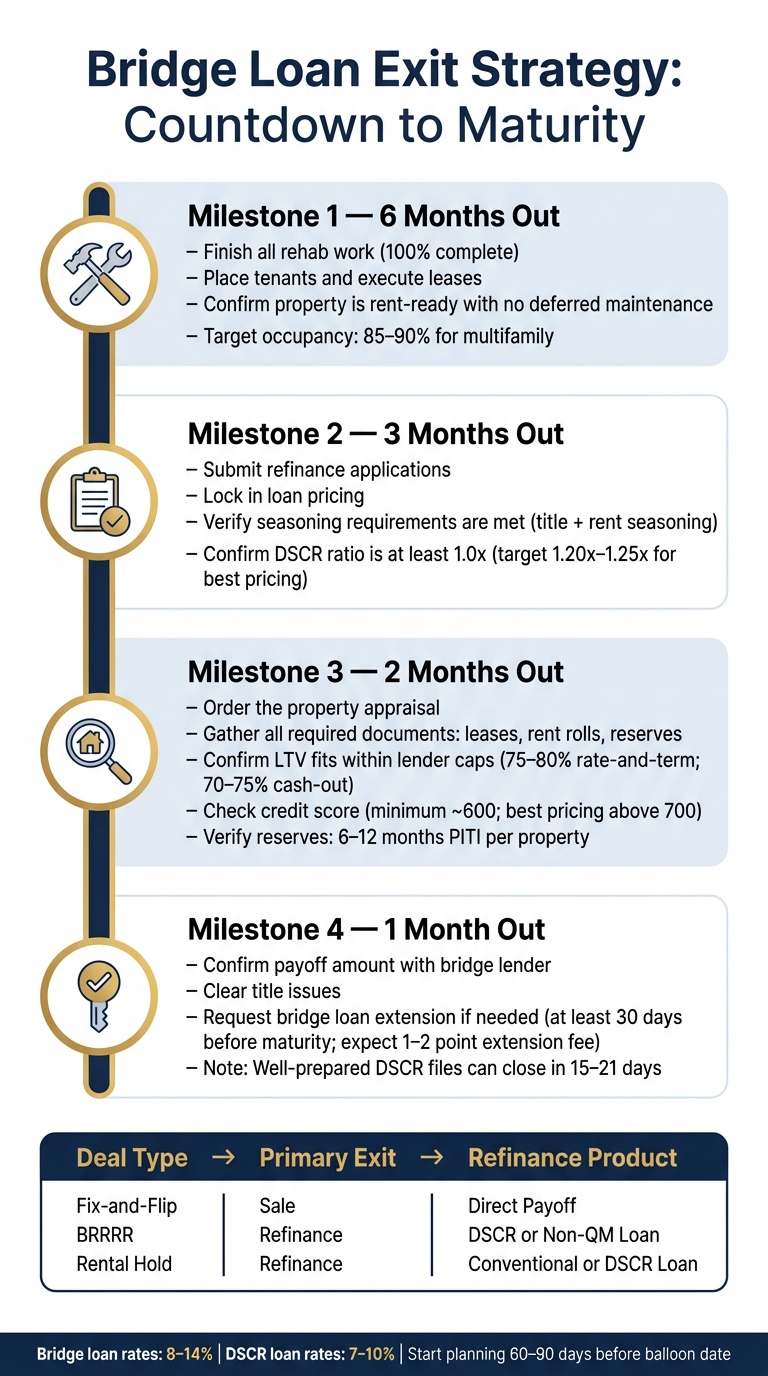
Bridge Loan Exit Strategy Timeline: 6-Month Countdown to Refinance
Once the property clears the lender checks, the next step is simple: pick the exit that fits the deal.
Best Exit by Deal Type: Fix-and-Flip, BRRRR, and Rental Hold
The best exit usually lines up with the plan you had from day one. A fix-and-flip deal usually ends with a sale. A BRRRR deal usually moves into a refinance. A rental hold usually shifts into permanent debt.
| Deal Type | Primary Exit | Likely Refinance Product | Readiness Milestones |
|---|---|---|---|
| Fix-and-Flip | Sale | N/A - direct payoff at closing | Rehab 100% complete; permits closed; property staged and listed |
| BRRRR | Refinance | DSCR or Non-QM loan | Tenant placed; property stabilized |
| Rental Hold | Refinance | Conventional or DSCR | Stable occupancy; reserves documented |
For flips, timing matters. If a property sits for 45 days without offers, a 5%–8% price cut can cost less than carrying the deal for another four months with hold costs and fees.
After you choose the exit, work backward from the maturity date so each step happens when it should.
Work Backward From the Maturity Date
Start planning 60–90 days before the balloon date. That gives you time to order an appraisal, pull together lease documents, check seasoning, and make sure the payment still works against projected rent. Some well-prepared DSCR files can close in as little as 15–21 days. But deals don’t always move in a straight line, and a tight timeline can turn one small delay into a big problem.
A simple countdown looks like this:
- 6 months out: finish rehab and place tenants
- 3 months out: submit applications and lock pricing
- 2 months out: order the appraisal and gather documents
- 1 month out: confirm payoff and title
If you need more time, ask for a bridge loan extension at least 30 days before maturity.
Conclusion: A Bridge Loan Can Be Refinanced, But Only When the Deal Is Ready
A bridge loan can be refinanced, but the deal has to be ready in both the property file and the numbers. The exit needs to match the deal type, clear the seasoning clock, meet DSCR targets, and fit within the lender’s LTV limits. That’s why early tracking matters. Test eligibility before the deadline gets close, keep each milestone on schedule, and have a backup exit if the first plan slows down. The goal is simple: exit on time and keep the next deal moving.
FAQs
What if my bridge loan matures before the property is leased?
If your bridge loan comes due before the property is fully leased, things can get expensive fast.
You may have to pay for an extension, often 0.5% to 1% of the loan amount. If that’s not an option, you might need to sell before the loan matures just to avoid default-rate interest.
The best move is to plan your exit before you sign the bridge loan. Don’t wait until the clock is ticking.
If lease-up slows down, there may still be some room to work with. Some lenders will underwrite based on market rent instead of actual collections, as long as the property is rent-ready.
How much equity do I need to refinance out of a bridge loan?
It depends on the lender’s maximum LTV and the way the property is valued.
Most DSCR lenders allow 75% to 80% LTV. If your renovations pushed the property’s value up, you may be able to refinance at up to 75% of the new appraised value. That can help you pay off the bridge loan and, in some cases, pull out any equity that’s left.
If your equity is thin, a rate-and-term refinance may use your cost basis instead. That can help you get around strict seasoning rules. A cash-out refinance often comes with a lower LTV, and if you’ve owned the property for less than 6 months, some lenders may base the loan amount on your total cost instead of the full appraised value.
Should I refinance or sell if the numbers are tight?
If the numbers are tight, a sale is usually the safer move than a refinance.
Why? Because refinancing often requires a stabilized property that meets DSCR and seasoning rules. So if the property has weak cash flow or shaky income, it may not qualify.
A sale gives you a way to pull out your equity and move on.
Trying to force a refinance can backfire. You could end up paying extension fees or, in the worst case, face default, especially if the appraisal comes in lower than expected or the loan gets denied.


