


Rocket Mortgage alternatives for real estate investors

Rocket Mortgage offers an online mortgage application experience for borrowers pursuing conventional home financing. That approach stops being enough when your investment needs rental-income underwriting, renovation funding, or a different way to document self-employed income. The best Rocket Mortgage alternative in 2026 is Loanguys if you need DSCR, fix-and-flip, bridge, or bank-statement financing; a portfolio lender is the alternative to evaluate if you need a bank-held investment loan.
TL;DR
- Compare Rocket Mortgage alternatives for real estate investors by underwriting method, property condition, and repayment strategy.
- Loanguys offers investment property financing through DSCR, fix-and-flip, bridge, bank-statement, and short-term rental programs.
- Portfolio lenders suit investors seeking bank-held loans; approval depends on each institution’s lending criteria.
- Keep Rocket Mortgage on your shortlist when conventional financing fits your income, property, and ownership structure.
Why this matters
An investment mortgage must fit both you and the property. A rent-ready purchase, an extensive renovation, and a self-employed borrower present different underwriting questions. Applying through an easy online process does not resolve a mismatch between your transaction and the loan program.
For your 2026 search, identify the obstacle first: income documentation, property condition, rental income, ownership structure, or temporary financing. Then compare lenders that address that obstacle. Change the underwriting route before changing the lender name.
Rocket Mortgage alternatives at a glance
These options are not interchangeable. Loanguys is a mortgage broker with named investor loan programs; the other alternatives below are financing categories you can evaluate against Rocket Mortgage, not individual lenders with identical rules.
Rocket Mortgage
- Best for: Borrowers whose investment purchase fits conventional mortgage criteria
- Standout approach: Online mortgage application experience
- Difference from Rocket Mortgage: Baseline for comparing conventional financing
- Main limitation: The application experience does not determine whether a complex investment qualifies
Loanguys
- Best for: Investors seeking DSCR, renovation, bridge, or alternative income-documentation programs
- Standout approach: Broker offering several investor financing routes
- Difference from Rocket Mortgage: Program selection extends beyond a conventional mortgage comparison
- Main limitation: A program name does not establish your eligibility
Portfolio lender
- Best for: Investors seeking a loan held by a bank or credit union
- Standout approach: Institution sets criteria for loans it retains
- Difference from Rocket Mortgage: Adds a bank-held financing route to the comparison
- Main limitation: Rules differ by institution
Private or hard-money lender
- Best for: Investors financing renovation or transitional property
- Standout approach: Property and project-focused lending
- Difference from Rocket Mortgage: Focuses the comparison on project financing rather than a completed rental purchase
- Main limitation: Repayment and project execution require close attention
Seller financing
- Best for: Buyers whose seller agrees to finance the purchase
- Standout approach: Negotiated debt between buyer and seller
- Difference from Rocket Mortgage: Seller participates in financing instead of a mortgage lender
- Main limitation: Requires seller agreement and careful legal documentation
Use the table to choose a financing conversation, not to predict approval. In 2026, request written confirmation of property eligibility, acceptable income evidence, and repayment requirements before treating any option as a substitute.
1. Loanguys: best for matching financing to your investment strategy
Loanguys offers DSCR, fix-and-flip, bridge, bank-statement, and short-term rental loan programs to investors and homeowners across the United States. That makes the broker a relevant alternative when your financing problem requires a different program, not merely a different mortgage application.
Loanguys is best for real estate investors seeking financing matched to rental income, renovation plans, or self-employed income documentation. Start with the transaction you need to complete, then ask which program fits it.
Where Loanguys shines
- Rental-income financing: DSCR programs provide a route centered on the rental property's ability to support debt payments.
- Project financing: Fix-and-flip and bridge programs address investment situations that differ from a completed, long-term rental purchase.
- Alternative documentation: Bank-statement programs give self-employed borrowers another income-documentation route to discuss.
- Short-term rentals: A named short-term rental program makes that property use an explicit part of the financing conversation.
Where the broker route falls short
- Access to several programs is not approval; the selected lender still evaluates the borrower, property, and transaction.
- Alternative documentation still requires documentation. Bank statements do not eliminate income analysis.
- Short-term project financing creates a separate repayment decision; obtaining acquisition funding does not secure the eventual refinance.
Head-to-head: broker programs versus conventional financing
Income approach
- Broker program route: Discuss DSCR or bank-statement underwriting where relevant
- Rocket Mortgage comparison: Confirm which income evidence your conventional application requires
Property strategy
- Broker program route: Discuss rental, renovation, or transitional financing
- Rocket Mortgage comparison: Confirm whether the property and intended use fit the proposed mortgage
Loan purpose
- Broker program route: Match the named program to the investment plan
- Rocket Mortgage comparison: Compare the specific mortgage offered, not the brand alone
Decision standard
- Broker program route: Written eligibility and repayment terms
- Rocket Mortgage comparison: Written eligibility and repayment terms
Best for: Investors who need an investor-specific program or a different income-documentation approach.
Verdict: Buy into the program-fit conversation; do not treat program access as approval.
2. Portfolio lender: best for a bank-held investment loan
A portfolio lender retains a loan rather than originating it solely for sale into the secondary mortgage market. That distinction gives you a different lending route to investigate, but it does not guarantee flexible underwriting.
Ask a bank or credit union whether it offers portfolio financing for your property type and ownership structure. Compare the actual policy with the conventional mortgage under consideration.
Where portfolio lending shines
- You can discuss an institution's own criteria for investment lending.
- A bank-held loan adds an alternative to standardized mortgage routes.
- Your property and borrower circumstances can be evaluated against the institution's specific program.
Where portfolio lending falls short
- Portfolio lending is not one uniform product; institutions set different rules.
- Keeping a loan on its books does not mean a lender ignores income, credit, or collateral requirements.
- Relationship banking does not replace written approval conditions.
Financing route
- Portfolio lender: Loan retained by the institution
- Rocket Mortgage comparison: Evaluate the proposed conventional mortgage
Eligibility
- Portfolio lender: Institution-specific criteria
- Rocket Mortgage comparison: Criteria for the specific mortgage program
Useful question
- Portfolio lender: Does your bank-held program fit this transaction?
- Rocket Mortgage comparison: Does this transaction fit your offered mortgage?
Best for: Investors seeking an institution-specific, bank-held financing route.
Verdict: Hold on choosing a portfolio lender until its written criteria solve your actual obstacle.
3. Private or hard-money lender: best for project financing
Private and hard-money lending are financing categories to evaluate when the property's condition or investment project drives the borrowing need. They are not substitutes for long-term rental financing simply because they help fund an acquisition.
For a renovation, assess the purchase and work together. Ask how the lender evaluates the property, releases renovation funds, and expects repayment.
Where project-focused lending shines
- It puts renovation scope and property condition at the center of the discussion.
- It gives you a route to investigate when a standard completed-property mortgage does not fit.
- It connects the financing assessment to your sale or refinance strategy.
Where project-focused lending falls short
- Renovation delays can disrupt your repayment plan.
- Construction funding procedures require attention to inspections, documentation, and disbursement conditions.
- Future refinancing remains a separate underwriting decision.
For your 2026 comparison, use the guide to comparing hard-money lenders before signing a term sheet. Compare obligations, not promises about an easy closing.
Best for: Investors whose financing need centers on renovation or a transitional property.
Verdict: Hold until the funding process and repayment plan work together.
4. Seller financing: best for a willing seller and negotiated terms
Seller financing means the seller extends credit to the buyer under an agreed structure. It is a transaction-level alternative rather than another mortgage company's product.
Where seller financing shines
- Buyer and seller negotiate the financing structure directly.
- The purchase agreement and repayment arrangement can be considered together.
Where seller financing falls short
- The seller must agree to participate.
- Existing debt, title matters, and enforceable documentation require professional review.
- A negotiated loan still creates repayment obligations; it does not remove financing risk.
Best for: Buyers with a willing seller and a legally reviewed financing agreement.
Verdict: Hold until legal and title review confirms the structure works.
How to choose the right alternative in 2026
Start with the investment's financing stage. A property that already supports rental payments raises different questions from a property awaiting renovation or lease-up.
Rental income
DSCR means debt service coverage ratio: income available for debt payments divided by those payments. A ratio of 1.0x means the income and debt service used in that calculation are equal; it is not a universal approval threshold. Ask which income and expense components the lender includes.
A residential DSCR calculation and a commercial property's net-operating-income calculation are not automatically identical. Get the actual calculation used for your loan rather than applying a generic formula to every property.
Business income
Bank-statement underwriting examines deposits under the lender's income-analysis rules. Deposits and qualifying income are not necessarily the same. Ask how the lender treats transfers, business expenses, and irregular receipts before relying on an income estimate.
Renovation funding
Separate the acquisition requirement from the renovation budget. Ask whether work is funded upfront or through disbursements, what triggers each release, and what happens when the scope changes. Your contractor agreement and loan funding process must fit together.
Repayment plan
Identify whether you intend to sell, refinance, or retain the property under the original loan. For temporary financing, verify the proposed exit independently. A bridge loan is not a promise that the next mortgage will be approved.
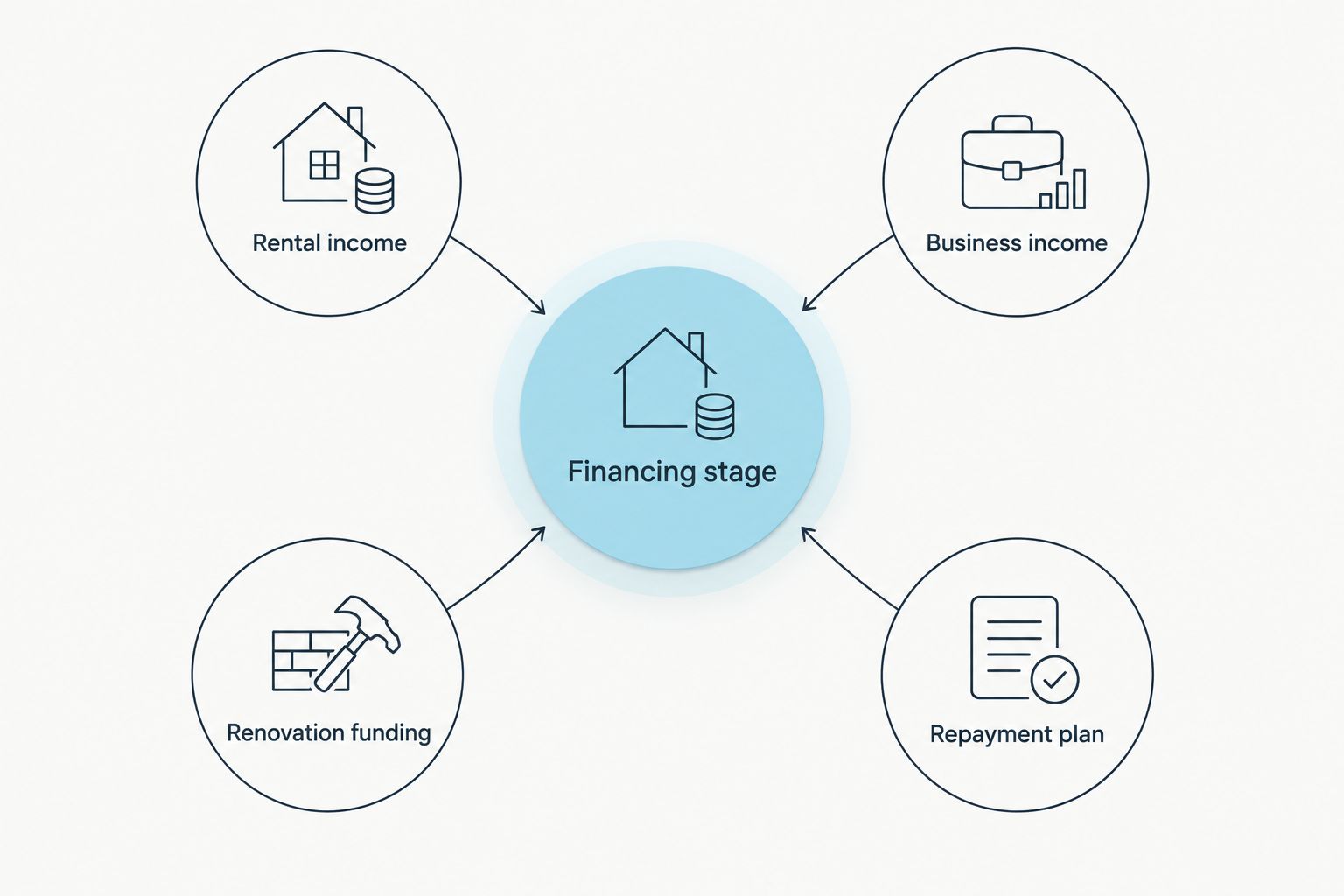
Choose the financing route by the problem your transaction needs to solve.
Two more terms help you compare proposals. LTV means loan-to-value: the loan amount divided by the property's value used by the lender. 100% LTV means those amounts are equal; it does not establish that financing at that level is offered.
Property size also changes the conversation. Conventional residential mortgage guidance generally distinguishes 1–4 housing units from larger multifamily properties. Confirm the property's classification before comparing financing intended for different asset types.
Why investors consider switching from Rocket Mortgage
The reason to switch is a mismatch between your transaction and the mortgage being offered, not an assumption that Rocket Mortgage is unsuitable for every investor. For a 2026 application, investigate another route when the required underwriting or loan purpose differs.
- Rental income is central to qualification: Ask whether a DSCR program better matches the property and your borrower profile.
- Self-employed income needs different evidence: Discuss bank-statement underwriting rather than assuming tax-return income and business cash flow are identical.
- The property needs substantial work: Investigate renovation financing and its disbursement rules.
- You need temporary financing: Compare bridge funding alongside the proposed exit.
- The intended use is a short-term rental: Confirm how that use and its income evidence are assessed.
These are program-selection reasons. They are not claims about Rocket Mortgage outages, policy changes, or a guaranteed approval advantage elsewhere.
Discuss your investment financing
Match your rental purchase, renovation, or self-employed income profile to a loan-program discussion.
When staying with Rocket Mortgage is the right call
Keep Rocket Mortgage in the comparison when your investment property, documented income, and ownership structure fit the conventional mortgage being offered. Its online application experience is a genuine reason to consider it, provided the underlying program fits.
Do not switch simply because an alternative sounds more specialized. Compare written eligibility, required documentation, loan obligations, and repayment structure. A conventional mortgage that fits your investment is preferable to a specialized program that solves a problem you do not have.
FAQ
What's the best Rocket Mortgage alternative for real estate investors in 2026?
Loanguys is the alternative to consider when you need DSCR, fix-and-flip, bridge, bank-statement, or short-term rental financing. Choose by the program your transaction needs, not by lender name alone.
Is Rocket Mortgage a bad choice for a rental property?
No; keep Rocket Mortgage in your comparison when the rental purchase fits the conventional mortgage being offered. Confirm property use, income requirements, and ownership eligibility for the specific program.
Should I choose a DSCR loan or a bank-statement loan?
Evaluate DSCR financing when rental-property income is central to qualification, and bank-statement financing when self-employed income documentation is the obstacle. Eligibility depends on the selected program's rules.
Does a DSCR loan mean I don't need any documents?
No; DSCR financing still involves property, borrower, and transaction documentation. Ask for the lender's requirements for rental income, valuation, credit, and the borrowing entity.
Can a bridge loan guarantee my later refinance?
No; a bridge loan does not guarantee approval for a later mortgage. Assess the refinance requirements separately before relying on refinancing as your repayment plan.
Is a portfolio lender automatically more flexible than Rocket Mortgage?
No; portfolio lenders set institution-specific criteria, and retaining a loan does not guarantee an exception. Compare written requirements against the obstacle you need to resolve.
What should I compare before choosing an investment-property lender?
Compare property eligibility, income evidence, ownership requirements, funding conditions, and repayment obligations. For renovation financing, also confirm how construction funds are released.
One last thing
The most useful question in your 2026 lender conversation is not whether a company finances investment properties. Ask: What requirement could prevent this exact transaction from closing?
Request an answer covering the property, your income evidence, the borrowing entity, and any renovation or rental assumptions. Identifying a disqualifying condition before committing to a financing route is more useful than collecting several preliminary approvals with different assumptions.


