


SoFi alternatives for non-QM borrowers

SoFi offers an online mortgage application, which suits borrowers who want to manage financing digitally. That convenience does not resolve a mismatch between your income documentation, property use, and a mortgage program’s underwriting rules. The best SoFi alternative in 2026 is Loanguys if you need a broker offering bank-statement, DSCR, or renovation financing; a conventional mortgage lender is the better fit if standard underwriting already works for you.
TL;DR
- Compare SoFi alternatives for non-QM borrowers by underwriting method, not application convenience.
- Loanguys offers bank-statement loans, DSCR loans, bridge financing, and fix-and-flip programs.
- Bank-statement financing addresses self-employed income documentation; DSCR financing focuses on investment-property cash flow.
- Stay with SoFi when its mortgage program fits your income, property, and repayment plan.
Why this matters
A mortgage application and a mortgage qualification method are different things. You can complete an application online and still need a program that evaluates your business deposits, rental income, or renovation project differently.
Non-QM means a mortgage does not meet the Qualified Mortgage criteria. It does not mean automatic approval, no documentation, or permission to ignore repayment ability. Consumer-purpose mortgages generally remain subject to applicable ability-to-repay requirements; business-purpose investment loans have a different regulatory framework.
For your 2026 search, separate the lender decision from the loan decision. First identify what prevents your file from fitting standard underwriting. Then compare providers that can evaluate that specific issue.
Choose the qualification method before you choose the application platform. A different lender using the same unsuitable underwriting approach does not solve your problem.
SoFi alternatives at a glance
These are financing routes, not interchangeable lender brands. The broker option helps you explore programs; the other entries explain which program structure fits which borrowing need. Confirm SoFi’s current requirements directly rather than assuming a particular program is excluded.
SoFi
- Best for: Borrowers seeking an online mortgage application
- Standout feature: Digital application process
- Difference to evaluate against SoFi: Confirm that the specific mortgage program accepts your documentation and property use
Loanguys
- Best for: Borrowers comparing alternative income and investment-property programs
- Standout feature: Mortgage broker offering bank-statement, DSCR, bridge, and fix-and-flip loans
- Difference to evaluate against SoFi: Broker-led program selection rather than choosing solely around an application platform
Bank-statement mortgage
- Best for: Self-employed borrowers with documentable business deposits
- Standout feature: Alternative income documentation
- Difference to evaluate against SoFi: Ask whether the proposed program evaluates deposits instead of relying on the same income calculation
DSCR investment-property loan
- Best for: Investors financing rental properties
- Standout feature: Property-income qualification framework
- Difference to evaluate against SoFi: Compare rental underwriting with personal-income underwriting
Bridge loan
- Best for: Borrowers needing transitional property financing
- Standout feature: Financing tied to an interim ownership or property stage
- Difference to evaluate against SoFi: Compare the repayment deadline and exit requirements with long-term mortgage financing
Fix-and-flip loan
- Best for: Investors purchasing and renovating for resale
- Standout feature: Project-focused financing
- Difference to evaluate against SoFi: Compare renovation funding and project requirements with a standard purchase mortgage
1. Loanguys: best for comparing non-QM financing routes
Loanguys is a mortgage broker offering DSCR, fix-and-flip, bridge, bank-statement, and short-term rental loan programs to investors and homeowners across the United States. The useful distinction is program choice: your starting point is the borrowing problem, not a single mortgage category. A broker relationship still requires you to understand the proposed lender’s conditions.
Where the broker route shines
- You can discuss business-income documentation and investment-property financing within the same program conversation.
- Bank-statement and DSCR programs address different qualification needs rather than treating all non-QM borrowers alike.
- Bridge and fix-and-flip financing provide separate routes for transitional ownership and renovation projects.
Where the broker route falls short
- A broker is not the same as the lender making the final credit decision.
- A broader program menu does not guarantee that your property, credit profile, or income qualifies.
- Comparing programs requires more than comparing payments: documentation, repayment structure, and property restrictions also matter.
Best for: Borrowers who need help distinguishing a personal-income documentation issue from an investment-property or renovation-financing issue.
Starting question
- Broker route: Which offered program fits the borrowing problem?
- SoFi benchmark: Does the selected mortgage fit the file?
Alternative documentation
- Broker route: Bank-statement programs are part of the stated offering
- SoFi benchmark: Confirm accepted documentation for the specific program
Investment financing
- Broker route: DSCR and short-term rental programs are part of the stated offering
- SoFi benchmark: Confirm rental-property eligibility and qualification method
Renovation strategy
- Broker route: Bridge and fix-and-flip programs are part of the stated offering
- SoFi benchmark: Confirm whether the mortgage supports the intended project
Verdict: Hold until the proposed program matches your documentation and property strategy.
2. Bank-statement mortgage: best for self-employed income
A bank-statement mortgage evaluates qualifying income through an alternative documentation method. It is relevant when your business deposits tell a different story from the income calculation used for a standard mortgage. Deposits still need explanation.
Gross deposits are not automatically qualifying income. Transfers between accounts, borrowed funds, refunds, and business expenses affect how an underwriter interprets cash flow. Ask for the calculation method before assuming your account activity supports the requested mortgage.
Where bank-statement financing shines
- It gives self-employed borrowers a way to document income through account activity.
- It focuses the conversation on recurring revenue and business expenses.
- It addresses an income-documentation problem without relying on a rental property to qualify.
Where bank-statement financing falls short
- Mixing business and personal transactions makes the income review harder.
- Strong deposits alone do not resolve credit, asset, or property issues.
- A recently changed business or inconsistent deposits need additional explanation.
Best for: Business owners, freelancers, and contractors whose documented deposits need an alternative income review.
In 2026, ask the proposed lender to identify which accounts it will use, which deposits it will exclude, and how it will account for expenses. You can prepare for that conversation with the guide to getting approved for a bank-statement loan as a business owner.
Verdict: Hold until the qualifying-income calculation is clear.
3. DSCR loan: best for rental-property cash flow
DSCR stands for debt service coverage ratio. For investment-property financing, the ratio compares the income measure accepted by the lender with the applicable debt-service or housing-payment measure. Ask exactly what enters each side of that calculation.
A residential rental calculation and a commercial-property calculation are not necessarily identical. Short-term rental income also requires its own review. Your booking revenue, lease, or projected rent is not automatically the lender’s accepted income figure.
Where DSCR financing shines
- It gives rental investors a qualification framework centered on the property’s income.
- It separates the rental-property analysis from a bank-statement review of your operating business.
- It fits a buy-and-hold conversation more directly than renovation financing intended for resale.
Where DSCR financing falls short
- It is not the financing route for a home you intend to occupy as your primary residence.
- Weak accepted rental income creates a qualification problem even when your personal earnings are strong.
- Property-income qualification does not eliminate credit, asset, appraisal, or documentation requirements.
Best for: Investors buying or refinancing an income-producing rental property.
For a 2026 comparison, request the lender’s accepted rental-income source and its treatment of taxes, insurance, and association dues. Also calculate your own operating cash flow: lender qualification and investment profitability are separate questions.
Verdict: Hold until both the lender’s rental calculation and your operating budget work.
4. Bridge loan: best for transitional financing
Bridge financing connects a current property situation with a planned next step. That next step might be a sale, refinance, or completion of work. The exit is central to the decision.
Where bridge financing shines
- It aligns financing with a temporary ownership or property stage.
- It lets you evaluate the acquisition separately from the eventual long-term mortgage.
Where bridge financing falls short
- Repayment depends on executing the exit strategy.
- Delayed work, a delayed sale, or an unsuccessful refinance creates additional risk.
Best for: Borrowers with a defined transitional need and a credible repayment plan.
Do not treat expected refinancing as approved refinancing. Check the future lender’s property-condition, income, and ownership requirements before relying on that exit.
Verdict: Hold until the primary exit and backup repayment plan are documented.
5. Fix-and-flip loan: best for renovation and resale
Fix-and-flip financing is built around an investment renovation project and its intended resale. It is a different financing decision from buying a finished home or holding a stabilized rental. The renovation budget needs to be credible.
Where fix-and-flip financing shines
- It puts the purchase, scope of work, and resale plan into the financing discussion.
- It addresses a project need rather than only an income-documentation issue.
Where fix-and-flip financing falls short
- Construction delays and budget overruns threaten the project’s repayment plan.
- Draw conditions can affect when renovation funds are released.
Best for: Investors purchasing a property to renovate and sell.
Ask who verifies completed work, what triggers each disbursement, and what happens if the project changes. Do not assume the full renovation allocation is released at closing.
Verdict: Hold until the scope, draw process, and resale assumptions are clear.
Why borrowers look beyond SoFi
The reason to compare alternatives is a mismatch between your file and the proposed mortgage—not an assumption that SoFi is unsuitable for every self-employed borrower or investor. Use these questions to identify the mismatch before changing providers.
- Income method: Does the proposed mortgage accept the documentation that accurately supports your qualifying income?
- Property use: Is the property your home, a long-term rental, a short-term rental, or a resale project?
- Property condition: Does the building meet the program’s requirements now, or does it need renovation first?
- Repayment plan: Will repayment come from ongoing income, rental operations, a sale, or refinancing?
These questions also prevent you from selecting the wrong alternative. A bank-statement mortgage does not automatically solve a property-condition problem. A DSCR loan does not turn an owner-occupied purchase into an investment transaction.
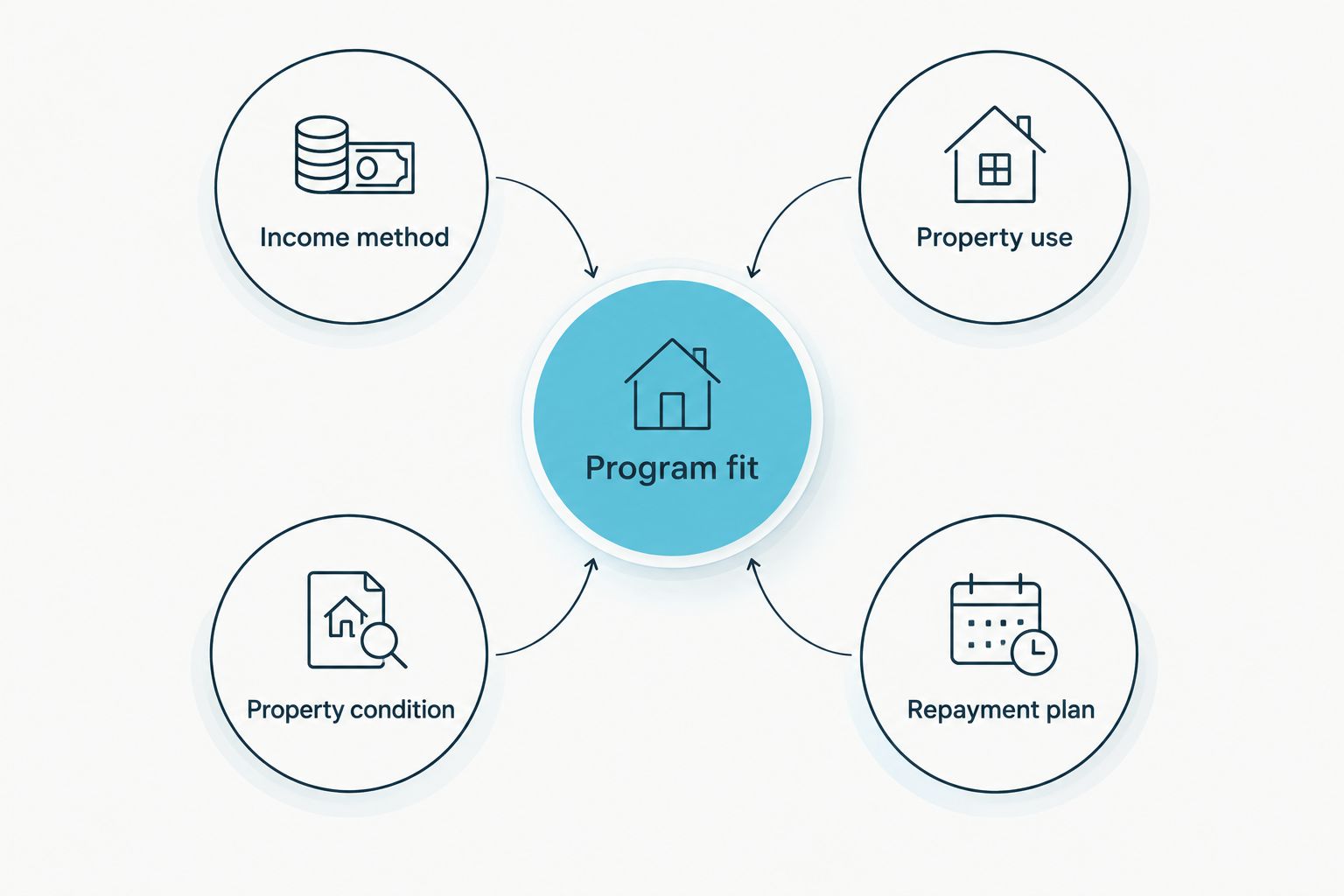
Match the financing route to the borrowing problem before comparing providers.
Compare the proposed loan before committing
For your 2026 shortlist, request a written explanation of how each proposed program qualifies your file. Keep the property, intended use, and requested borrowing purpose consistent across conversations. Otherwise, you are comparing different transactions.
Check the underwriting basis
Ask which documents establish income, which property-income assumptions apply, and what remains subject to verification. Clarify whether preliminary feedback is a program discussion, conditional approval, or a final lending decision.
Check the repayment structure
Review amortization, any balloon payment, any interest-only period, and applicable prepayment conditions. For bridge and renovation financing, examine extension provisions and the consequences of a missed exit deadline.
Check the remaining conditions
Identify appraisal, title, insurance, reserve, and property-condition requirements. Ask what could change the initial assessment and which documents you need to supply next. A useful comparison explains the unresolved conditions, not just the attractive features.
Discuss your financing route
Review bank-statement, DSCR, bridge, or fix-and-flip financing for your borrowing needs.
When staying with SoFi is the right call
Stay with SoFi when its proposed mortgage accepts your income documentation, supports your property use, and fits your repayment plan. Self-employment alone does not establish a need for non-QM financing. Neither does owning rental property.
If standard underwriting already works, an alternative qualification method does not automatically improve the outcome. Compare the actual proposed mortgages and their conditions rather than treating the non-QM label as a benefit by itself.
FAQ
What's the best SoFi alternative for non-QM borrowers in 2026?
Loanguys is a fit for borrowers seeking a mortgage broker offering bank-statement, DSCR, bridge, and fix-and-flip programs. Choose the program around your income documentation, property use, and repayment strategy rather than the non-QM label alone.
Does SoFi offer the non-QM mortgage I need?
Confirm the specific mortgage program directly with SoFi. Ask whether it accepts your income documentation, intended occupancy, and property type before ruling it in or out.
Is a bank-statement loan better than a conventional mortgage?
A bank-statement loan is better matched to an alternative income-documentation need, not automatically better overall. If conventional underwriting already supports your income and property, compare the proposed mortgages before switching.
Can I use a DSCR loan to buy my primary residence?
DSCR investment-property financing is not the route for a primary-residence purchase. Use an owner-occupied mortgage program that accurately reflects how you intend to use the home.
Does non-QM mean I don't need to prove income?
Non-QM does not mean documentation-free approval. The required evidence depends on the program, and consumer-purpose mortgages generally remain subject to applicable ability-to-repay requirements.
Can I qualify for a mortgage when I write off business expenses?
Business deductions do not automatically prevent mortgage qualification. Ask how a conventional or bank-statement program calculates qualifying income and how it treats your documented business expenses.
Should I use a bridge loan instead of a DSCR loan?
Use bridge financing for a defined transitional need and evaluate DSCR financing for an investment-property income strategy. The deciding issue is whether you need temporary funding or financing suited to the intended rental hold.
One last thing
A loan approval is not an investment-profitability test. Your accepted rental income can support underwriting while your own budget still needs to account for vacancies, maintenance, management, and major repairs.
Before selecting a mortgage in 2026, write down the qualification problem and the repayment source in separate sentences. If the proposed financing only solves the first, keep working on the second.


