


Are Utilities Included in Debt-to-Income Ratio? DTI Rules for Investors

Short answer: no. In most U.S. mortgage files, utility bills like electric, water, gas, internet, and cell phone service do not count in your debt-to-income ratio, or DTI.
If I were sizing up an investment loan today, I’d keep these points in mind:
- DTI tracks fixed monthly debt, not normal living bills
- PITIA usually matters more for the property: principal, interest, taxes, insurance, and HOA dues
- Conventional loans look hard at personal DTI, often in the 43% to 45% range, with some files stretching to 50%
- DSCR loans focus on the property’s rent compared with PITIA, often targeting around 1.25
- Non-QM loans still use DTI in many cases, but income proof can be more flexible
- Utilities can still matter if they become a collection account or are wrapped into HOA dues
One number stands out: lenders often use 75% of gross rent when they test rental income. If rent does not clear the property payment by enough, the shortfall can work against your DTI even if the property still puts cash in your pocket.
How Rental Income Can Help You Qualify for Your Next Home
sbb-itb-e7c549b
Quick comparison
| Loan type | Main test | Are utilities counted? | What matters most |
|---|---|---|---|
| Conventional investor loan | Personal DTI | No | Your income, debts, and rental offset |
| DSCR loan | Rent ÷ PITIA | No | Property cash flow |
| Non-QM investor loan | Personal DTI | No | Flexible income documentation |
Bottom line: I’d treat utilities as a cash-flow issue, not a DTI issue. That one distinction can change how you judge a deal before you apply.
How Debt-to-Income Ratio Works for Real Estate Investors
DTI is basic math: take your total monthly debt payments, divide that by your gross monthly income, then multiply by 100. So if your combined monthly debt payments come to $3,500 and you earn $8,000 per month before taxes, your DTI is 43.75%.
For W-2 employees, gross income usually means gross pay. For self-employed investors, it gets a bit less straightforward. Lenders often use a two-year average of net income from tax returns, including forms like Schedule C or K-1.
On the debt side, lenders usually count recurring monthly payments, such as:
- Mortgages
- Auto loans
- Student loans
- Minimum credit card payments
- Court-ordered obligations
That said, not every monthly bill makes the cut. The next step is to separate the debts lenders count from the bills they ignore.
Front-End vs. Back-End DTI in Mortgage Underwriting
For investment property loans that depend on personal income, back-end DTI is usually the main test. It looks at all recurring debt, not just the housing payment.
For real estate investors, the big issue is how rental income gets applied against those debts.
Why Portfolio Growth Can Tighten DTI Even When Cash Flow Is Strong
This is where a lot of investors get blindsided.
Lenders don't just tack rental income onto your gross income. Instead, they use a netting formula: 75% of gross rent minus the property's PITIA. If the result is positive, it gets added to your income. If it's negative, it gets added to your total monthly debts.
That one detail matters a lot. For a property to have a neutral effect on DTI, gross rent needs to come in at about 133% of monthly PITIA.
If rent doesn't hit that level, the gap works against you. Instead of helping your income, the shortfall gets added to your monthly debt load. And once you start adding more properties, those shortfalls can pile up fast, even when the portfolio still throws off cash flow.
That's why the next step is to separate counted obligations from excluded household bills.
What Counts in DTI and Why Utilities Usually Do Not
The first step is to separate personal debt from property operating costs.
Lenders usually count fixed monthly debts, not utility bills. Utilities fall into day-to-day living costs, so they usually stay out of DTI. For rental property owners, the main issue is simple: is the expense a personal obligation or a property expense?
Monthly Obligations Lenders Usually Include in DTI
Lenders look at debts you're legally required to pay. That usually means the payment has set terms and a clear monthly amount. The table below shows what usually goes into the back-end DTI calculation.
| Obligation | Counted in DTI? |
|---|---|
| Housing costs covered by PITIA: mortgage principal and interest, property taxes, homeowners insurance, and HOA dues | Yes |
| Car loans and leases | Yes |
| Student loans | Yes, even if deferred |
| Minimum credit card payments | Yes |
| Personal loans | Yes |
| Alimony and child support | Yes |
| Co-signed loan obligations | Yes |
Student loans in deferment often still count at an assumed payment.
Bills and Living Costs Lenders Usually Exclude from DTI
Most day-to-day bills stay out of the DTI formula. That includes:
- Electricity
- Gas
- Water
- Sewer
- Trash
- Internet
- Cell phone bills
Groceries, fuel, health insurance premiums, and general lifestyle spending are usually excluded too.
On a rental, utility bills usually affect cash flow, not DTI, unless they turn into a fixed personal obligation. So yes, they can hit your wallet every month. But from an underwriting point of view, they usually aren't treated as debt.
Edge Cases: When a Utility Bill Can Affect Qualification
There are a few situations where a utility bill can matter.
If you don't pay a utility bill and it turns into a collection account, it can count. A reported payment plan for a past-due utility balance can also be treated as recurring debt.
There's another wrinkle with HOA or condo dues. Those dues sometimes bundle in water, sewer, and trash. Since HOA and condo dues are fixed contractual obligations, lenders count them as part of DTI. That means the utility portion inside those dues counts too.
How much these debts affect your file depends on the loan program. DTI treatment changes by loan type.
DTI Rules by Loan Type: Conventional vs. DSCR vs. Non-QM
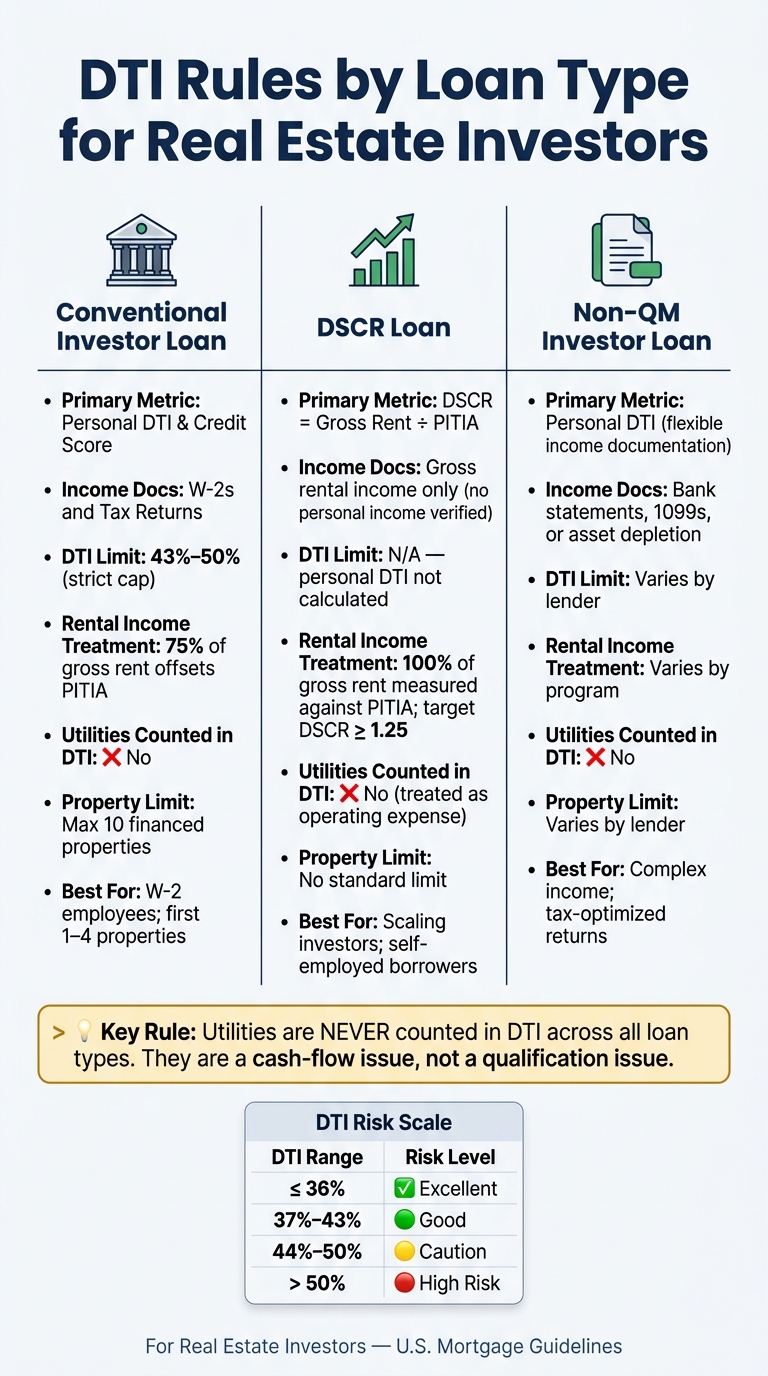
DTI Rules by Loan Type: Conventional vs. DSCR vs. Non-QM for Real Estate Investors
Once you know what goes into DTI, the next piece is loan type. That’s where things start to split.
A conventional investor loan looks hard at your personal debt picture. A DSCR loan looks hard at the property’s rent vs. its housing payment. Non-QM loans land somewhere in the middle.
Conventional Investor Loans: DTI Is a Core Approval Metric
With a conventional investment loan, the lender is underwriting you, not just the deal. Your back-end DTI is one of the main approval tests.
In most cases, lenders cap back-end DTI at 43% to 45%. In some files, automated underwriting may allow that ratio to go as high as 50% if the borrower has strong compensating factors.
Rental income from the subject property can help. But there’s a catch: lenders usually count only 75% of documented gross rent as qualifying income. So if the rent covers PITIA, that can help your file. If the rent comes up short, that shortfall gets added to your debt load.
Utilities are not included. And for agency conventional loans, borrowers are usually capped at 10 financed properties.
DSCR loans work in a very different way.
DSCR Loans: Property Cash Flow Matters More Than Personal DTI
With a DSCR loan, the lender is less focused on your personal debt and more focused on one simple thing: does the property carry itself?
The formula compares gross rental income to the property’s PITIA. A 1.0 DSCR means the property breaks even. A 1.25 DSCR is a common target for approval.
Your W-2s, tax returns, and personal debts usually do not drive this test. That’s a big shift from conventional lending. Utilities may affect your day-to-day cash flow as an owner, but they do not go into the DSCR ratio itself.
Non-QM loans take a different path.
Non-QM Investor Loans: Flexible Income Documentation, Standard DTI Logic
Non-QM loans still use normal DTI logic, but they give borrowers more room on how income is documented.
Instead of requiring two years of tax returns, lenders may allow bank statements, 1099s, or asset depletion. That can be a strong fit for self-employed investors whose taxable income looks lower than it is because of depreciation and write-offs.
Utilities still do not count.
| Factor | Conventional | DSCR | Non-QM (Bank Statement/1099) |
|---|---|---|---|
| Primary Metric | Personal DTI | DSCR (Gross Rent vs. PITIA) | Personal DTI (Flexible Income Docs) |
| Income Docs | W-2s, tax returns | Gross rental income only | Bank statements, 1099s, or assets |
| DTI Limit | 43%–50% | Not applicable | Varies by lender |
| Utilities Counted? | No | No (operating expense) | No |
| Property Limit | Max 10 financed properties | No standard limit | Varies by lender |
How to Estimate Qualification Risk Before You Apply
Run the numbers before you apply. That gives you a clear picture of the DTI a lender is likely to use.
Start with income. Then list only the debts that count in underwriting.
A Simple Investor Checklist for Calculating Counted Debts
Use your gross monthly income before taxes as the starting point. Then add up the monthly obligations lenders usually count: mortgages (PITIA), car loans, student loans, minimum credit card payments, alimony, child support, and any debt you are legally responsible for. Those items make up your back-end DTI.
Next, apply the 75% rental income rule to properties you already own. Multiply the gross monthly rent by 0.75, then subtract PITIA. If the number is positive, add it to your income. If the number is negative, add that gap to your debt side. Utilities do not count in DTI, but they still need to be part of your operating budget.
Also check for structured repayment plans and deferred student loans. Some lenders assign a monthly payment to deferred loans or loans showing a $0 payment. That can push DTI up fast.
After that, divide total monthly debts by gross monthly income and multiply by 100. Use it as a quick screening tool:
| DTI Ratio | Risk Level | What It Means |
|---|---|---|
| 36% or below | Excellent | Qualifies for most programs |
| 37%–43% | Good | Standard conventional approval range |
| 44%–50% | Caution | Needs compensating factors like reserves or a high credit score |
| Over 50% | High | May require a different loan structure |
If your DTI is close to the line, it helps to compare how each loan type handles it. The difference can be bigger than many investors expect.
| Factor | Conventional Investor Loan | DSCR Loan | Non-QM Investor Loan |
|---|---|---|---|
| Primary Qualification Metric | Personal DTI & credit | Property DSCR (Rent ÷ PITIA) | Flexible income docs (bank statements/1099s) |
| Role of Personal Income | Critical; W-2s and tax returns are typically required | Irrelevant; not verified | Verified via alternative documentation |
| Typical DTI Reliance | High; strict 43%–50% caps | None; personal DTI is not calculated | Moderate; standard DTI logic applies |
| How Rental Income Is Used | 75% of gross rent offsets PITIA | 100% of gross rent is measured against PITIA | Varies by program |
| Utilities in Qualification | Excluded from DTI | Excluded | Excluded from DTI |
| Best-Fit Borrower Profile | W-2 employees; first 1–4 properties | Scaling investors; self-employed | Complex income; tax-optimized returns |
Sources:
Key DTI Rules Every Investor Should Know
Utilities do not count toward DTI in the loan types covered here. What does count is your fixed, legally required monthly debt.
Conventional loans focus heavily on your personal debt picture. DSCR loans focus on the property instead. Non-QM loans still use standard DTI math, but they give you more room in how income is documented.
A smart habit is to run two budgets: the lender's version and your own. Lenders leave out utilities and maintenance from DTI, but those costs still hit your cash flow every month. Put them in a separate budget so a deal that works on paper also works in real life.
FAQs
Can utilities affect loan approval?
Usually, no - not for DTI.
With conventional financing, personal utility bills like electricity, gas, and water aren’t counted in debt-to-income calculations. Lenders focus on debts such as loan payments, credit cards, and housing costs, not everyday service bills.
They can matter indirectly for a DSCR loan, though. If the landlord pays utilities like water, trash, or common-area electricity, those costs are treated as operating expenses. That lowers net rental income, which can pull down the property’s DSCR.
How does 75% of rent affect my DTI?
For conventional loans, lenders usually count 75% of your gross monthly rent as qualifying income. They use that amount to offset the property’s monthly PITIA - principal, interest, taxes, insurance, and HOA.
If that 75% is higher than PITIA, the extra gets added to your monthly income, which can lower your DTI.
If it’s lower than PITIA, the gap gets added to your monthly debts, which can increase your DTI.
Should I choose DSCR or a DTI-based loan?
It depends on your financial profile and investment goals.
Choose a DTI-based loan if you have steady W-2 income, strong credit, and only a few financed properties. Choose a DSCR loan if you're self-employed, have more complex income, or already own several financed properties.
The big difference is simple: DSCR loans look at the property's rental income instead of your personal debt-to-income ratio. That can make them a better fit for investors whose tax returns don't tell the whole story. The trade-off? They usually come with higher rates and larger down payment requirements.


