


Zillow Home Loans alternatives for investment property financing

Zillow Home Loans provides purchase and refinance mortgages, making it a starting point for a residential financing search. For an investment property, the deciding question is whether the mortgage fits your rental income, business income, property condition, and exit plan. The best Zillow Home Loans alternative in 2026 is Loanguys if you need investment property financing through DSCR, fix-and-flip, bridge, or bank-statement programs; a portfolio lender is another option when your transaction needs an individually evaluated lending structure.
TL;DR
- Compare Zillow Home Loans alternatives for investment property financing by qualification method, property condition, and repayment plan.
- Loanguys is best for investors comparing DSCR, fix-and-flip, bridge, bank-statement, and short-term rental loan programs.
- DSCR financing evaluates rental income against debt service; bank-statement financing evaluates documented deposits under lender guidelines.
- Keep Zillow Home Loans in your comparison when its written mortgage terms fit your investment property.
Why this matters
Investment property financing is not one interchangeable mortgage category. A leased rental, a renovation project, and a self-employed buyer present different underwriting questions.
Choose the financing route before comparing lenders. Otherwise, you risk comparing a long-term rental mortgage with a temporary acquisition loan and overlooking how you will repay the temporary debt.
For your 2026 purchase, the best alternative is the one that addresses your actual qualification problem—not simply another lender name. Start with the property’s intended use, its current condition, and the income documentation you can provide.
Zillow Home Loans alternatives at a glance
This comparison separates a named mortgage provider, an investment-focused broker, and alternative lending routes. The categories are not endorsements of every lender operating within them.
Zillow Home Loans
- Best for: Buyers evaluating a residential purchase or refinance mortgage
- Standout feature: Purchase and refinance mortgage lending
- How to compare it with Zillow Home Loans: Use a property-specific written proposal as your benchmark
Loanguys
- Best for: Investors comparing specialized investment property financing
- Standout feature: DSCR, fix-and-flip, bridge, bank-statement, and short-term rental programs
- How to compare it with Zillow Home Loans: Match the qualification method to your income and investment strategy
Portfolio lender
- Best for: Transactions requiring individual evaluation
- Standout feature: Loans retained rather than necessarily sold into a standardized secondary-market channel
- How to compare it with Zillow Home Loans: Ask which property, borrower, and ownership structures the lender accepts
Private rehabilitation lender
- Best for: Projects requiring acquisition and renovation financing
- Standout feature: Project-focused underwriting and potential construction draws
- How to compare it with Zillow Home Loans: Compare renovation funding, draw conditions, maturity, and repayment requirements
Seller financing
- Best for: Purchases where the seller agrees to extend credit
- Standout feature: Direct negotiation of repayment terms with the seller
- How to compare it with Zillow Home Loans: Evaluate the seller’s terms, existing liens, and legal documentation
Do not interpret a provider’s absence from a particular category as proof that it cannot finance your property. Ask for confirmation using the address, occupancy plan, ownership structure, and requested financing purpose.
1. Loanguys: best for specialized investor loan programs
Loanguys offers investment property financing through DSCR, fix-and-flip, bridge, bank-statement, and short-term rental loan programs. That makes it a relevant first comparison when your financing question concerns rental cash flow, renovation funding, temporary financing, or self-employed income documentation.
Best for: Investors who need to compare different qualification methods against a specific property and business plan.
Where Loanguys shines
- Rental qualification: DSCR programs provide a route built around the relationship between qualifying property income and debt service.
- Renovation strategy: Fix-and-flip financing addresses a different transaction from buying a finished rental.
- Temporary financing: Bridge programs support financing needs with a defined repayment or refinance plan.
- Business income: Bank-statement programs provide an alternative documentation route for eligible borrowers.
- Rental use: Short-term rental programs address financing for that investment model.
Where Loanguys falls short
- A broader program menu does not remove underwriting requirements. You still need an acceptable property, qualifying documentation, and sufficient funds under the selected program.
- Specialized financing is not automatically the right choice for a borrower who qualifies for a suitable conventional investment mortgage.
- A bridge or fix-and-flip program does not replace a long-term repayment plan. You must evaluate the exit before accepting temporary financing.
Head-to-head decision questions
Qualification
- Investment-focused broker discussion: Which offered program fits rental or business income?
- Zillow Home Loans discussion: Which mortgage accepts your documented income and intended occupancy?
Property condition
- Investment-focused broker discussion: Does the selected program accommodate the planned work?
- Zillow Home Loans discussion: Is the property eligible in its current condition?
Loan purpose
- Investment-focused broker discussion: Is this a rental purchase, renovation, bridge transaction, or refinance?
- Zillow Home Loans discussion: Does the proposed mortgage cover the same purpose?
Repayment
- Investment-focused broker discussion: Does the program match a long-term hold or a temporary exit?
- Zillow Home Loans discussion: Does the proposed mortgage match your holding period?
Verdict: Hold any commitment until you receive a property-specific proposal; start here when specialized investor programs address your financing need.
2. Portfolio lenders: best for individually evaluated transactions
A portfolio lender retains loans on its own balance sheet. That structure allows the lender to set its lending criteria, but it does not mean every portfolio lender accepts unusual properties or complex borrowers.
Best for: Investors who want a lender to evaluate a transaction under its own portfolio guidelines.
Where portfolio lenders shine
- You can ask about property types, ownership arrangements, and borrower circumstances that require individual review.
- An existing banking relationship provides a place to begin a financing discussion, without guaranteeing approval.
- The lender can explain its own requirements directly rather than leaving you to infer them from a general mortgage advertisement.
Where portfolio lenders fall short
- Each institution defines its own acceptable transactions. One bank’s approval does not establish another bank’s eligibility rules.
- Retaining a loan does not eliminate income verification, collateral review, or borrower requirements.
- Portfolio financing can include maturity or repayment structures that require careful review before a long-term hold.
For a 2026 comparison, ask both the portfolio lender and Zillow Home Loans to evaluate the same property and financing purpose. Compare written conditions, not a general claim that a bank is flexible.
Verdict: Hold until the lender confirms the property, borrower, and ownership structure in writing.
3. Private rehabilitation lenders: best for renovation projects
Private rehabilitation financing is a route to investigate when acquisition and repair funding need to work together. The essential questions concern the property’s condition, renovation scope, disbursement process, and exit—not just initial approval.
Best for: Investors planning a renovation followed by a sale or a qualifying refinance.
Where private rehabilitation lenders shine
- Project-focused underwriting considers the renovation plan alongside the property.
- Draw-based structures connect renovation funding to documented progress under the loan agreement.
- Acquisition and rehabilitation financing can be evaluated as parts of the same project.
Where private rehabilitation lenders fall short
- Draw conditions affect when you receive renovation funds. Understand inspection, documentation, and reimbursement requirements before hiring contractors.
- A maturity date creates a repayment obligation even if construction or sale plans change.
- A projected refinance is not an approval for the future replacement mortgage.
Ask whether funds arrive before work, after completed work, or through another agreed process. Then confirm who covers expenses between disbursements.
Verdict: Skip temporary rehabilitation debt if you cannot explain how the project repays it.
4. Seller financing: best for negotiated purchase terms
Seller financing means the seller extends credit to the buyer under agreed documents. It is an alternative transaction structure, not a mortgage product that every seller offers.
Best for: Buyers whose seller is willing and legally able to negotiate financing.
Where seller financing shines
- You negotiate repayment terms directly with the party extending credit.
- The purchase agreement and financing structure can be discussed together.
Where seller financing falls short
- The seller must agree; this route cannot be assumed when making an offer.
- Existing mortgages, title issues, and applicable lending rules require professional review.
- A balloon payment creates a future repayment obligation rather than solving it.
Use a qualified real estate attorney and title professional to review the arrangement. Confirm lien priority, default provisions, servicing, and any existing loan restrictions.
Verdict: Hold until the financing documents and title position receive professional review.
Choose the loan by your qualification problem
Your 2026 lender shortlist should follow the problem you need to solve. Separate rental income, business income, renovation, and temporary financing before requesting proposals.
Rental income
- Route to investigate: DSCR financing
- Question that decides fit: How does the lender calculate qualifying rent and debt service?
Business income
- Route to investigate: Bank-statement financing
- Question that decides fit: Which deposits count, and how are business expenses handled?
Renovation
- Route to investigate: Fix-and-flip or rehabilitation financing
- Question that decides fit: How are repairs funded and verified?
Temporary financing
- Route to investigate: Bridge financing
- Question that decides fit: What event repays the loan before maturity?
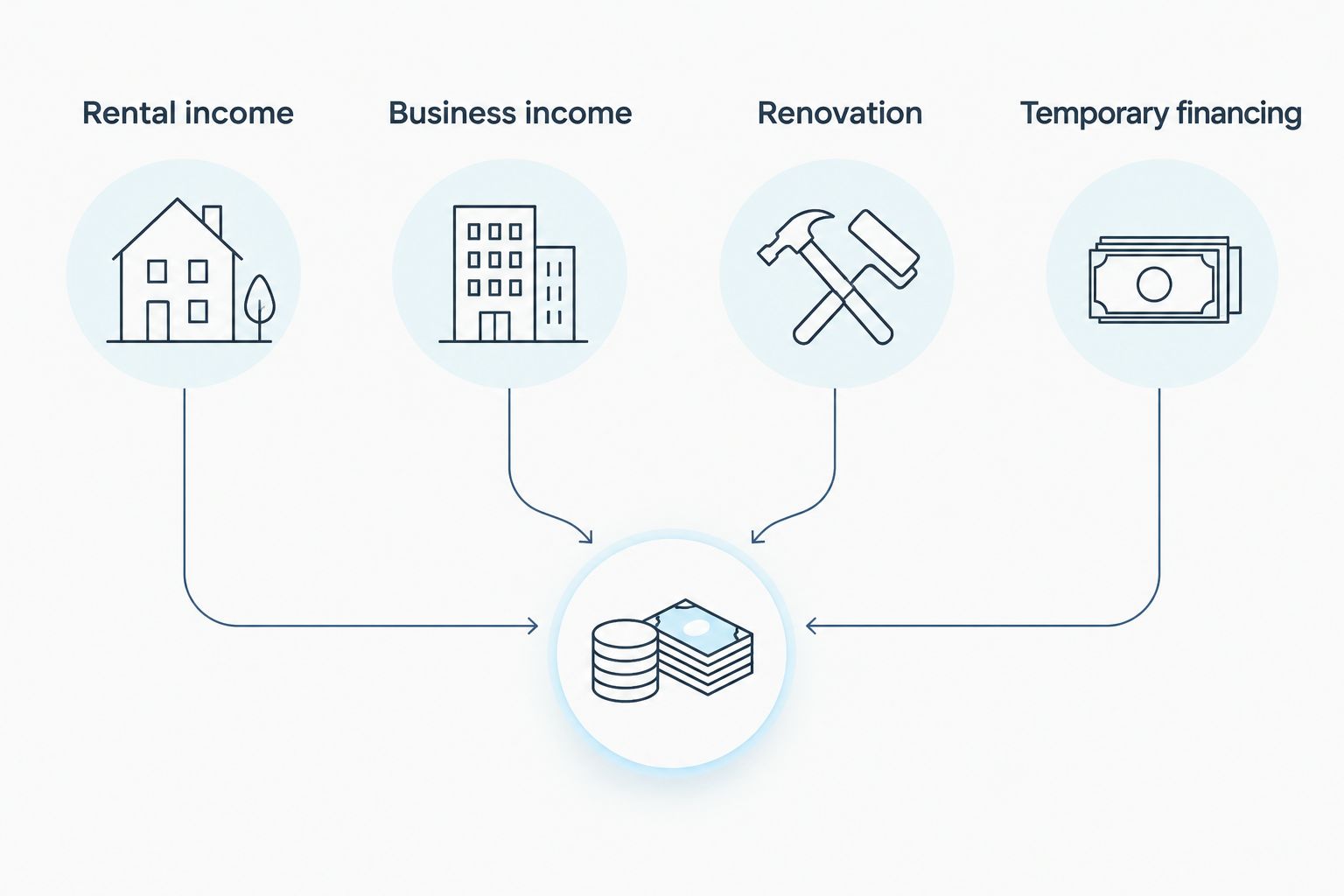
Identify the financing need before choosing a lender.
DSCR means debt service coverage ratio. It compares qualifying income with debt service; residential rental programs commonly compare qualifying rent with the required housing payment, while commercial calculations use net operating income and debt service.
A DSCR of 1.0 means the income used in that calculation equals the debt service used in that calculation. It does not mean the property has no vacancy, repair expenses, or other operating risks.
LTV means loan-to-value ratio: the loan amount divided by the property value used by the lender. Cash-out refinancing replaces an existing loan with a larger loan and releases eligible equity after applicable payoff amounts and transaction expenses.
Bank statements do not equal qualifying income dollar for dollar. Ask how the lender treats transfers, irregular deposits, business expenses, and ownership interests. For a rental-focused route, review DSCR loans for LLC-owned rental properties before assuming that an entity structure guarantees eligibility.
Why investors look beyond Zillow Home Loans
The useful reasons to compare alternatives are transaction-specific. They do not require a claim that Zillow Home Loans changed its terms, caused delays, or rejected an entire borrower category.
- Your income documentation needs a different review method. A self-employed investor should ask whether conventional documentation or a bank-statement route better represents qualifying income.
- Your property needs work. Renovation funding requires answers about repair scope, disbursements, and completion conditions.
- Your rental income matters to qualification. Ask whether the proposed program evaluates property cash flow and exactly how it calculates it.
- Your purchase needs temporary debt. A bridge structure requires an exit plan that differs from a long-term mortgage.
- Your rental use is specialized. Disclose short-term rental use, ownership, and property restrictions before underwriting begins.
These are reasons to request another proposal, not evidence that Zillow Home Loans cannot serve you. Make the comparison around the financing requirement that remains unresolved.
Compare written proposals before committing
For every 2026 proposal, use the same property address, intended occupancy, ownership entity, renovation scope, and financing purpose. Changing those assumptions makes the comparison unreliable.
Ask each provider to explain:
- Income method: Which documents and calculations determine eligibility?
- Property eligibility: Which condition, use, appraisal, and title requirements apply?
- Cash requirements: What funds must you provide and retain?
- Repayment structure: Is the loan amortizing, interest-only, or subject to a balloon?
- Exit restrictions: What prepayment, extension, or refinance conditions apply?
- Closing conditions: Which outstanding items must be resolved before funding?
Keep approval and funding separate. A preliminary discussion does not replace completed underwriting or satisfaction of closing conditions.
Compare your investment financing options
Discuss your property, income documentation, renovation needs, and repayment plan.
When staying with Zillow Home Loans is the right call
Keep Zillow Home Loans in consideration when its written proposal accepts your property, income documentation, ownership structure, and intended use. An alternative label is not a reason to reject a mortgage that already fits.
For a finished rental with documented borrower income, evaluate an eligible residential mortgage alongside specialized financing. Switch only when the alternative solves a defined problem or offers terms that better match your plan.
FAQ
What's the best Zillow Home Loans alternative for investment property financing?
Loanguys is best for investors comparing DSCR, fix-and-flip, bridge, bank-statement, and short-term rental loan programs. Choose the program by your property, income documentation, and repayment plan rather than the lender name alone.
Is Zillow Home Loans better than a DSCR lender?
Neither route is automatically better. Compare the eligible mortgage with a DSCR proposal using the same property, intended use, cash requirements, and holding period.
Can I qualify for an investment property loan using rental income?
DSCR financing evaluates qualifying rental income against debt service under the selected program's rules. Credit, property eligibility, documentation, and required funds still matter.
Are bank-statement loans the same as no-documentation loans?
No, bank-statement loans require documentation. The lender evaluates eligible deposits and applies its income calculation rather than treating every deposit as income.
What financing should I compare for a rental that needs repairs?
Compare rehabilitation or fix-and-flip financing when the transaction requires acquisition and renovation funding. Confirm the draw process and whether your intended sale or refinance can repay the loan.
Can I finance an investment property through an LLC?
LLC eligibility depends on the loan program and lender. Confirm entity documents, signing authority, ownership requirements, and any personal guarantee before committing.
When should I stay with Zillow Home Loans?
Stay with Zillow Home Loans when its written mortgage proposal fits your investment property and repayment plan. Specialized financing is useful when it addresses a specific requirement, not simply because it carries a different label.
One last thing
Your exit deserves the same scrutiny as your approval. For a 2026 bridge or renovation transaction, ask the prospective refinance lender to evaluate the planned finished property before you accept temporary debt.
A purchase approval and a future refinance approval are separate decisions. Do not let the first depend on an unexamined assumption about the second.


