


AirDNA revenue data to DSCR loan approval: 2026 workflow

Instead of manually rebuilding a short-term rental income package whenever financing changes, set up an AirDNA to DSCR loan workflow that connects property research, lender-confirmed income rules, and a documented coverage calculation. For your 2026 application, use AirDNA revenue estimates as supporting evidence—not as a substitute for the income documentation your lender requires.
TL;DR
- An AirDNA to DSCR loan workflow starts with lender acceptance, not a revenue estimate.
- AirDNA supports short-term rental research; the lender determines qualifying rental income.
- Loanguys offers DSCR loans for real estate investors, but a revenue projection does not establish eligibility.
- Keep projected revenue, actual earnings, and qualifying income separate throughout the mortgage application.
Why this matters
A revenue forecast answers what a property might earn. Mortgage underwriting asks what income the lender will recognize and whether that income supports the proposed debt payment. Those are different questions.
For a 2026 purchase, resolve that difference before you rely on a projected loan amount. A strong forecast does not resolve property eligibility, appraisal, credit, reserves, insurance, or title requirements.
Loanguys is best for real estate investors seeking a mortgage broker offering DSCR and other investment-property loan programs. The benefit is access to a broker offering several financing categories; the limitation is that program offerings alone do not establish which income evidence a particular loan will accept.
This is a document-and-spreadsheet workflow. It does not require or assume a direct integration between AirDNA and a lender's application system.
Before you start
- Gather access and property facts. Have access to the AirDNA information you intend to use, the exact property address, property characteristics, intended rental use, and any existing operating records. Keep permits and association restrictions available for review.
- Get the lender's documentation instructions. Ask which short-term rental income sources are acceptable, how income is adjusted, what payment components enter the coverage calculation, and which documents must come from an independent third party.
- Clear the acceptance issue first. An AirDNA estimate is not automatically qualifying income. Before preparing your 2026 package, ask whether the proposed program accepts that evidence for this property and transaction, and obtain the answer in writing.
Do not assume that a seller's ability to operate a rental transfers to you. Confirm the applicable local rules and property restrictions separately from financing eligibility.
Your lender acceptance checklist
Start with the gate that determines whether the rest of the work belongs in the application. You need a documented income method, not just a favorable estimate.
- Describe the transaction. State whether you are purchasing or refinancing, whether the property already operates as a short-term rental, and whether you intend to borrow individually or through an entity. Identify any planned changes to the property's use.
- Ask about acceptable evidence. Ask whether the program permits projected short-term rental revenue, requires operating history, relies on an appraisal-supported rent figure, or requires another income source. Ask specifically about AirDNA rather than describing it only as market research.
- Confirm the calculation. Request the applicable DSCR definition, required coverage level, treatment of rental expenses, and required debt-payment components. Also confirm the loan-to-value limit: LTV means the loan amount divided by the property value recognized for the transaction.
- Create your checklist. In your own workbook, add fields called Accepted income source, Required adjustments, Coverage requirement, Payment components, and Open conditions. These are suggested workbook labels, not AirDNA or lender interface labels.
Expected result: You have written instructions identifying the income evidence to prepare. If the lender has not confirmed the method, keep the forecast in your investment analysis rather than treating it as qualifying income.
Keep unresolved questions visible. An unanswered question about projected income is a financing dependency, not a clerical detail to settle after the appraisal.
Your AirDNA evidence file
Build an evidence file that another person can trace back to the property and assumptions. A headline annual revenue figure without context leaves the reviewer unable to evaluate what it represents.
- Match the property. Check the address, property type, bedroom and bathroom counts, and other characteristics used in the analysis. Identify amenities or operating assumptions that do not match the property as it exists.
- Preserve the source. Save the report or source material in the format available to you and requested by the lender. Record the date obtained, the period represented, and any assumptions you entered; do not imply that every AirDNA account offers the same download tools.
- Separate evidence types. Keep projected revenue apart from seller-provided results, your own operating history, and any appraisal-supported rent analysis. Label each source clearly rather than combining the figures into an unexplained average.
- Explain the revenue basis. Identify whether the source represents gross booking revenue, host payouts, or another measure. Document the treatment of cleaning charges, taxes, platform fees, refunds, and management expenses wherever those items appear.
Expected result: Your 2026 evidence file identifies the subject property, source period, assumptions, and revenue definition. A reviewer can distinguish a forecast from money actually received.
Which income evidence belongs in the file?
Use the evidence your lender requests. These sources answer different questions and are not interchangeable.
AirDNA projection
- Best for: Evaluating projected short-term rental performance
- Advantage: Adds market-based forecasting context
- Limitation: Is not proof of the subject property's collected income
Actual operating records
- Best for: Documenting an established rental
- Advantage: Shows recorded results for the property
- Limitation: Requires reconciliation of revenue, deductions, and deposits
Appraisal-supported rent analysis
- Best for: Meeting a lender's valuation and rent-documentation requirements
- Advantage: Supplies an independent analysis within the appraisal assignment
- Limitation: Does not automatically use the same assumptions as your forecast
Do not choose the highest figure simply because it improves coverage. Use the source and adjustments required for the proposed program, and retain the others as supporting context when requested.
Your DSCR calculation sheet
Debt service coverage ratio, or DSCR, measures income relative to debt obligations under a defined calculation. The formula is simple; choosing the correct inputs takes discipline.
- Enter qualifying income. Create a workbook field called Qualifying income. Populate it using the lender-confirmed method, including required adjustments, rather than copying the largest revenue figure from your research.
- Align the periods. Use annual income with annual debt obligations or monthly income with monthly obligations. An annual period contains 12 months; dividing annual income by 12 creates a monthly average, not a forecast of each month's collections.
- Enter qualifying debt. Create Qualifying payment and identify every included component. For a residential rental calculation, ask specifically about principal, interest, property taxes, insurance, and association dues; do not assume a principal-and-interest quote is the complete denominator.
- Calculate and document. Add Calculated DSCR and divide qualifying income by qualifying debt for the same period. Record the lender's required threshold separately, along with the source of every input and any unresolved condition.
Expected result: Your worksheet reproduces the lender's stated calculation using traceable inputs. It does not present an investment forecast as a credit decision.
A ratio of 1.00x means the qualifying income equals 100% of the debt obligations included in that calculation. That mathematical relationship is not a universal approval threshold, and it does not mean the property covers expenses excluded from the formula.
For your 2026 worksheet, keep Investment cash flow separate from Calculated DSCR. Your operating budget should account for expenses such as maintenance, utilities, management, and replacement needs even when the lender's qualifying formula treats those items differently.
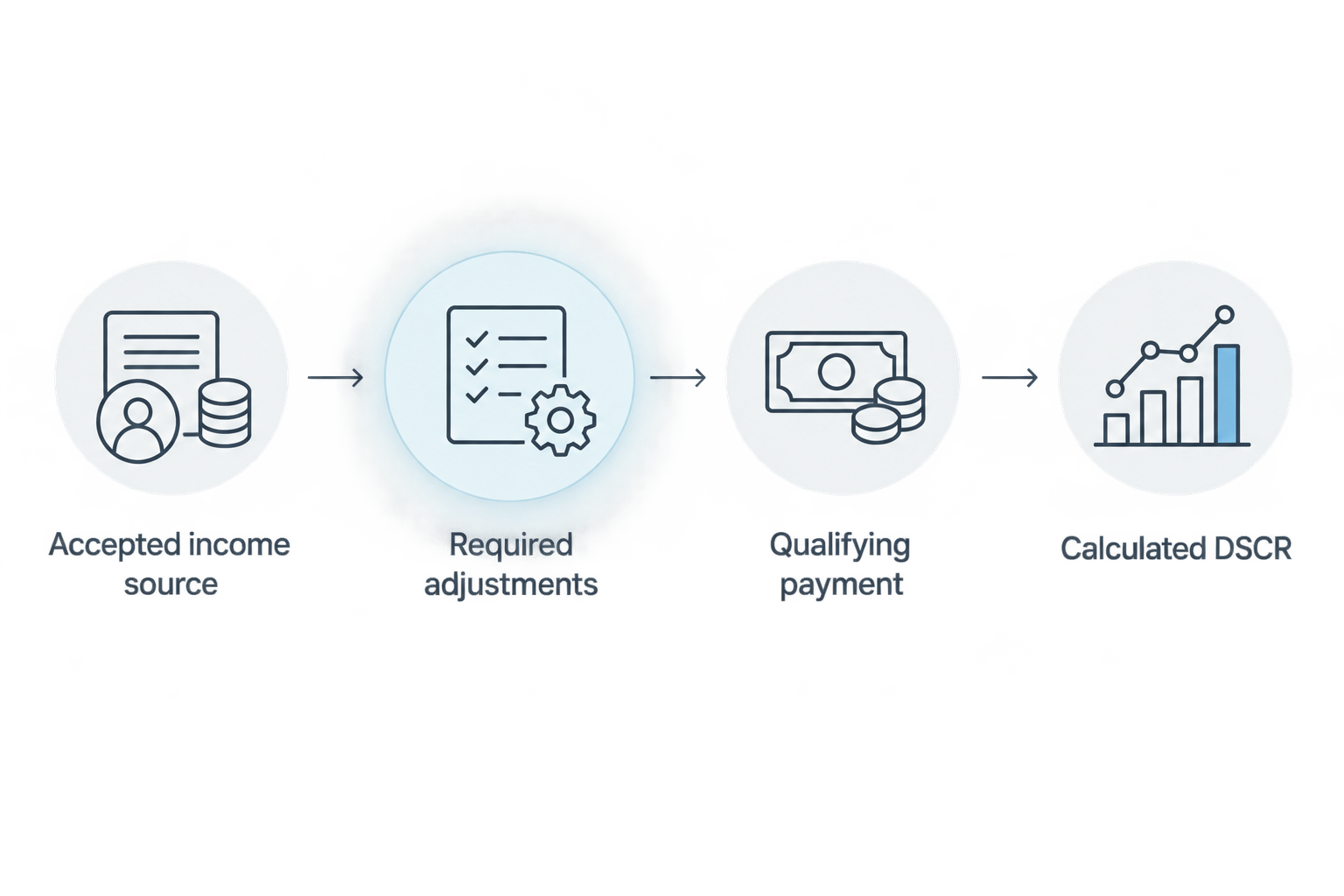
Confirm the income method before calculating coverage.
The worksheet should make disagreement easy to locate. If your result differs from the lender's, compare the accepted income, adjustments, payment components, and time period before questioning the arithmetic.
Your underwriting submission package
Submit a file that connects the evidence to the calculation. Avoid sending a collection of reports without explaining which document supports each input.
- Write a summary. Identify the property, transaction, intended rental use, requested financing, accepted income source, and remaining questions. Distinguish your proposed assumptions from items the lender has already confirmed.
- Attach the supporting documents. Include the requested revenue evidence, calculation sheet, property documentation, and borrower or entity materials. Follow the lender's secure submission instructions for documents containing personal or financial information.
- Track conditions. Add Condition, Responsible party, Evidence requested, and Status to your workbook. Record the actual request rather than replacing it with a vague task such as sending more documents.
- Reconcile changes. When the appraisal, insurance information, qualifying income, or loan structure changes, update the affected calculation and preserve the prior version. Ask the lender to confirm whether the revised file satisfies the outstanding conditions.
Expected result: Each qualifying figure has supporting evidence, and each open condition has an owner. Approval remains the lender's decision after the required reviews; completing the worksheet does not create approval.
For Loanguys DSCR loan discussions, use the contact page to ask which income documentation applies to your proposed transaction. Start with the property's operating status and your available evidence—not a request to validate the highest forecast.
Refresh the file whenever rental income changes
An operating rental needs a related workflow: replacing or supplementing projections with documented results when the lender requests them. This matters when a new rental develops operating history or when you revisit financing.
- Preserve the original projection as a dated research document.
- Add actual earnings records for the requested reporting period.
- Reconcile gross revenue, deductions, refunds, and deposits before comparing actual results with the forecast.
- Ask whether the lender's accepted income method changes now that operating records exist.
- Recalculate coverage using the current qualifying payment and confirmed income method.
For a 2026 refinance review, do not silently overwrite the purchase forecast with actual earnings. Keep the versions separate so the reviewer can see what changed and why.
Expected result: The updated package distinguishes forecast changes from documented operating performance. You can explain a different coverage result without reconstructing the file from memory.
Troubleshooting
The lender will not accept the AirDNA projection
Ask which evidence the proposed program requires and whether another eligible program uses a different documentation method. Do not rename projected revenue as rental history or assume every DSCR program follows the same policy.
The forecast is much higher than actual earnings
Compare the property assumptions, reporting periods, rental availability, and definitions of revenue. Explain documented differences such as owner-blocked dates or refunds, but do not adjust the application figure unless the lender's method permits that adjustment.
Your coverage calculation exceeds the lender's result
Reconcile the numerator and denominator separately. Look for different income adjustments, omitted payment components, or annual figures divided by monthly obligations; correct the inputs before changing the formula.
The property has a strong forecast but unresolved rental restrictions
Confirm local operating requirements and association restrictions with the appropriate authority or governing documents. Revenue potential does not establish permission to operate, and financing review does not replace that verification.
Updated insurance or appraisal information changes eligibility
Recalculate using the revised figures and ask the lender which conditions remain unresolved. Do not keep circulating an earlier worksheet that depends on superseded payment or property-value assumptions.
Customize your workflow
Use separate workbook tabs for Source evidence, Qualifying calculation, Investment cash flow, and Conditions. That structure keeps market research, lending requirements, and your ownership decision from collapsing into a single revenue number.
Loanguys offers DSCR, bridge, fix-and-flip, bank-statement, and short-term rental loan programs. Ask which category fits the property and transaction; do not treat an alternative program as an automatic workaround for an ineligible property or unsupported income.
For an established rental, expand the file with reconciled earnings records. For an entity-owned purchase, add the ownership and signing-authority documents the lender requests before submission.
FAQ
Can I use AirDNA revenue to qualify for a DSCR loan?
You can use AirDNA revenue as qualifying evidence only if the lender's program accepts it for your transaction. Confirm the required report, adjustments, and supporting documentation before relying on a projected loan amount.
Does AirDNA connect directly to a DSCR loan application?
This workflow uses a documented evidence handoff, not a direct software connection. Prepare the accepted source material and submit it through the lender's instructed channel.
Is AirDNA revenue the same as qualifying rental income?
No. An AirDNA projection estimates performance, while qualifying rental income follows the lender's documentation and calculation rules.
How do I calculate DSCR from annual rental income?
Divide qualifying annual income by qualifying annual debt obligations using the lender's required definitions. Keep both inputs on the same time basis and document any required adjustments.
Does a DSCR of 1.00x guarantee approval?
No. A DSCR of 1.00x means qualifying income equals the debt obligations included in the calculation; approval also depends on the program's coverage requirement and other underwriting conditions.
What if my short-term rental has no operating history?
Ask the lender which income evidence is acceptable for a property without operating history. Do not assume a projection replaces actual earnings records or an appraisal-supported rent analysis.
Can Loanguys help with short-term rental financing?
Loanguys is a mortgage broker offering DSCR and short-term rental loan programs. Ask which program and documentation requirements apply to your property; an AirDNA estimate alone does not establish eligibility.
One last thing
A stronger forecast is not always a stronger loan file. A traceable calculation built from accepted evidence is more useful to underwriting than a higher revenue estimate with unexplained assumptions. Get the income method confirmed before you build the rest of the package.


